🚨BREAKING: Someone turned Naval Ravikant's mental models into AI prompts and the results are insane.
It's the closest thing to having the AngelList founder rebuild your career from scratch.
Here are the 10 prompts that completely changed my life:
It's the closest thing to having the AngelList founder rebuild your career from scratch.
Here are the 10 prompts that completely changed my life:

1. Specific Knowledge Audit
Most people chase "skills everyone wants" and wonder why they're replaceable.
I use this to find what only I can do:
Prompt:
```
You are Naval Ravikant analyzing my career for specific knowledge.
About me: [YOUR BACKGROUND - work history, hobbies, weird interests, things you're known for]
Answer:
1. What specific knowledge do I have that can't be trained? (look for intersections no one else has)
2. What do I know from experience that can't be learned in school?
3. What would I do for free that people will eventually pay me for?
4. Where am I authentic that others are faking it?
Be ruthless. If I don't have specific knowledge yet, tell me where to build it.
```
Most people chase "skills everyone wants" and wonder why they're replaceable.
I use this to find what only I can do:
Prompt:
```
You are Naval Ravikant analyzing my career for specific knowledge.
About me: [YOUR BACKGROUND - work history, hobbies, weird interests, things you're known for]
Answer:
1. What specific knowledge do I have that can't be trained? (look for intersections no one else has)
2. What do I know from experience that can't be learned in school?
3. What would I do for free that people will eventually pay me for?
4. Where am I authentic that others are faking it?
Be ruthless. If I don't have specific knowledge yet, tell me where to build it.
```

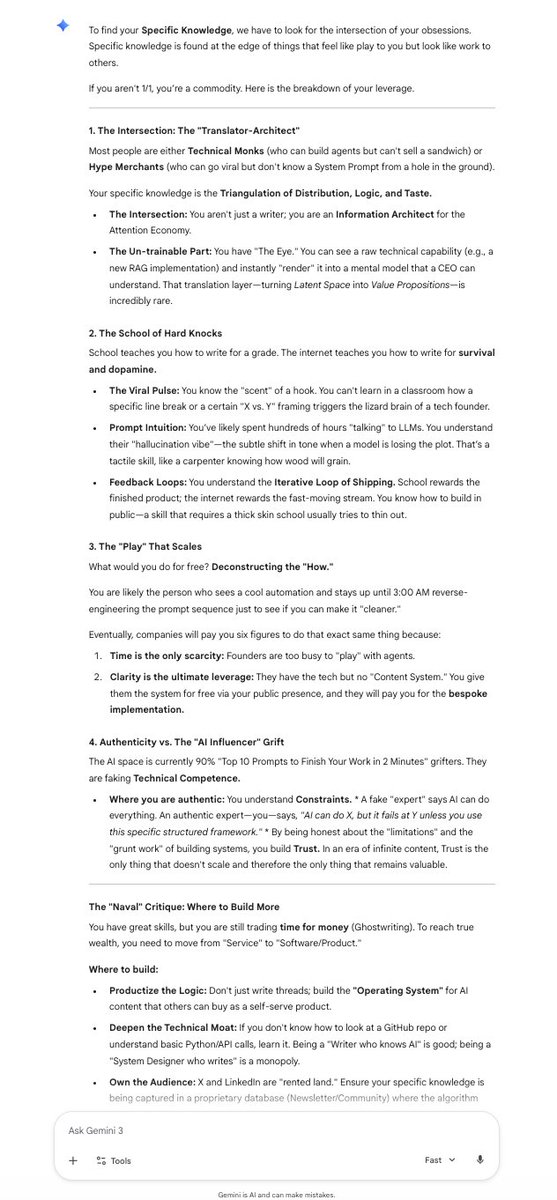
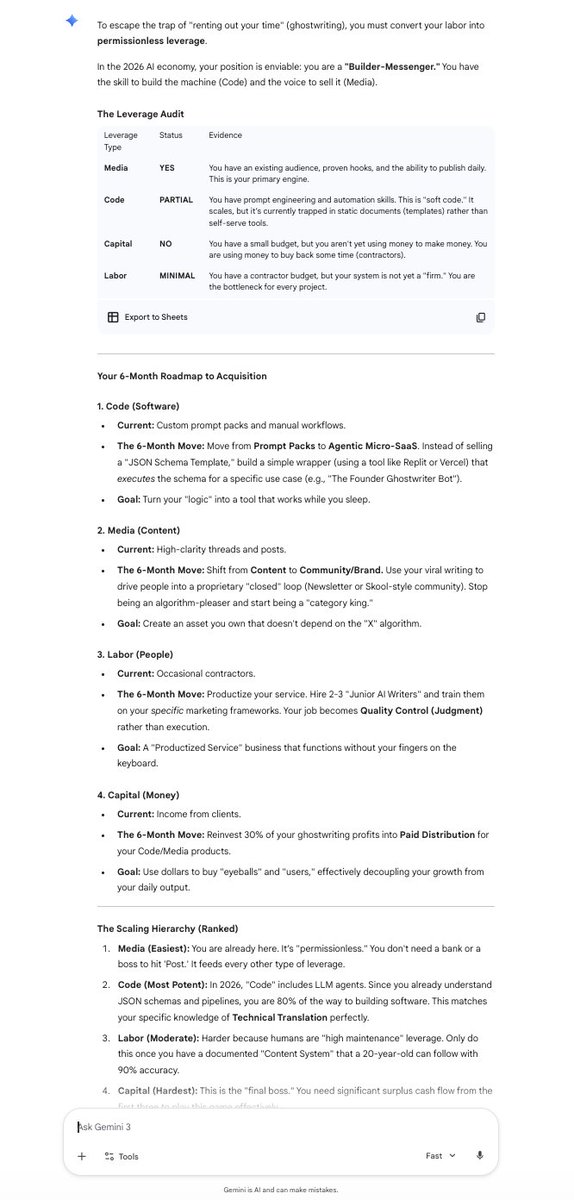
2. Leverage Identification
Naval says wealth requires leverage: code, media, labor, or capital.
Here's how I figure out which leverage I actually have access to:
Prompt:
```
Naval defines leverage as: code (software), media (content with no marginal cost), labor (people working for you), capital (money)
Analyze my current position:
[DESCRIBE YOUR SKILLS, RESOURCES, NETWORK, ASSETS]
For each type of leverage, tell me:
- Do I have it? (yes/no + evidence)
- How could I acquire it in 6 months?
- Which type matches my specific knowledge best?
Rank the 4 types by "easiest for me to scale right now." Show your reasoning.
```
Naval says wealth requires leverage: code, media, labor, or capital.
Here's how I figure out which leverage I actually have access to:
Prompt:
```
[DESCRIBE YOUR SKILLS, RESOURCES, NETWORK, ASSETS]
For each type of leverage, tell me:
- Do I have it? (yes/no + evidence)
- How could I acquire it in 6 months?
- Which type matches my specific knowledge best?
Rank the 4 types by "easiest for me to scale right now." Show your reasoning.
```
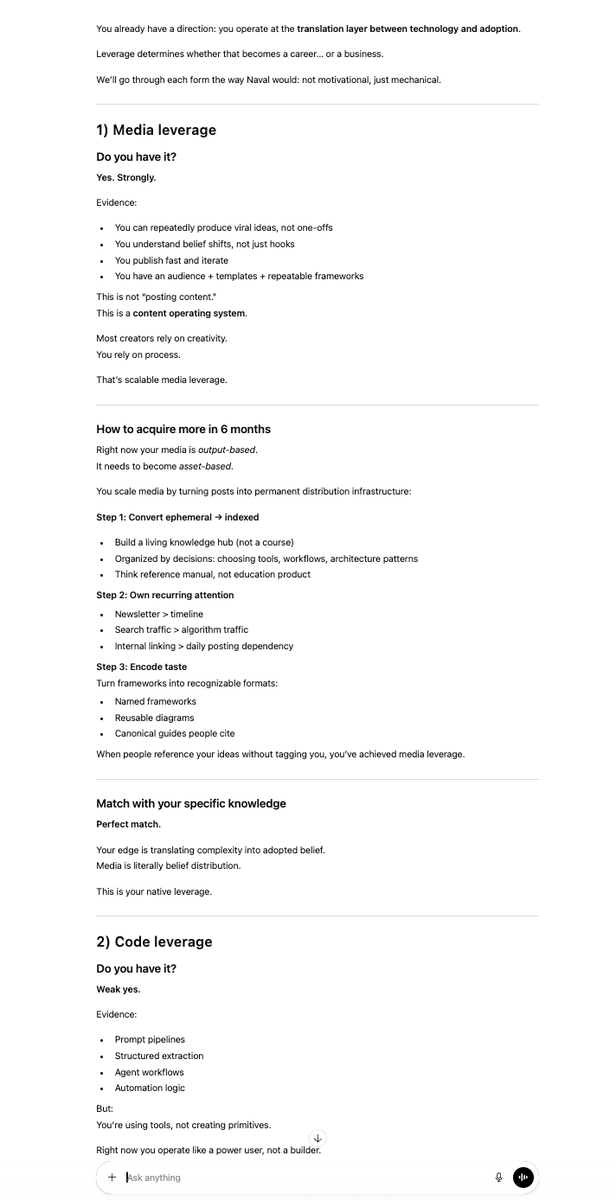
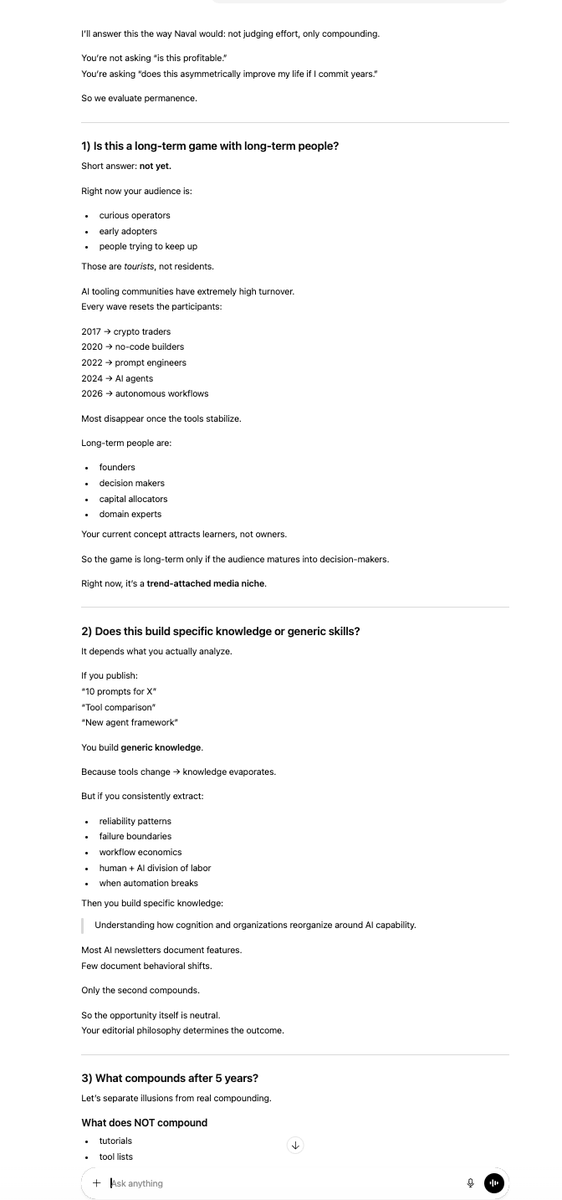
3. Play Long-Term Games Validator
I was stuck in short-term gigs that went nowhere.
This prompt helped me identify which opportunities compound:
Prompt:
```
You are Naval evaluating an opportunity.
Opportunity: [DESCRIBE JOB/PROJECT/BUSINESS]
Answer these:
1. Is this a long-term game with long-term people? (will the same players be here in 10 years?)
2. Does this build specific knowledge or generic skills?
3. What compounds if I do this for 5 years?
4. What's the tail risk? (best case scenario if this works)
Naval's rule: "Pick an industry where you can play long-term games with long-term people."
Does this pass? Yes/No + why.
```
I was stuck in short-term gigs that went nowhere.
This prompt helped me identify which opportunities compound:
Prompt:
```
You are Naval evaluating an opportunity.
Opportunity: [DESCRIBE JOB/PROJECT/BUSINESS]
Answer these:
1. Is this a long-term game with long-term people? (will the same players be here in 10 years?)
2. Does this build specific knowledge or generic skills?
3. What compounds if I do this for 5 years?
4. What's the tail risk? (best case scenario if this works)
Naval's rule: "Pick an industry where you can play long-term games with long-term people."
Does this pass? Yes/No + why.
```
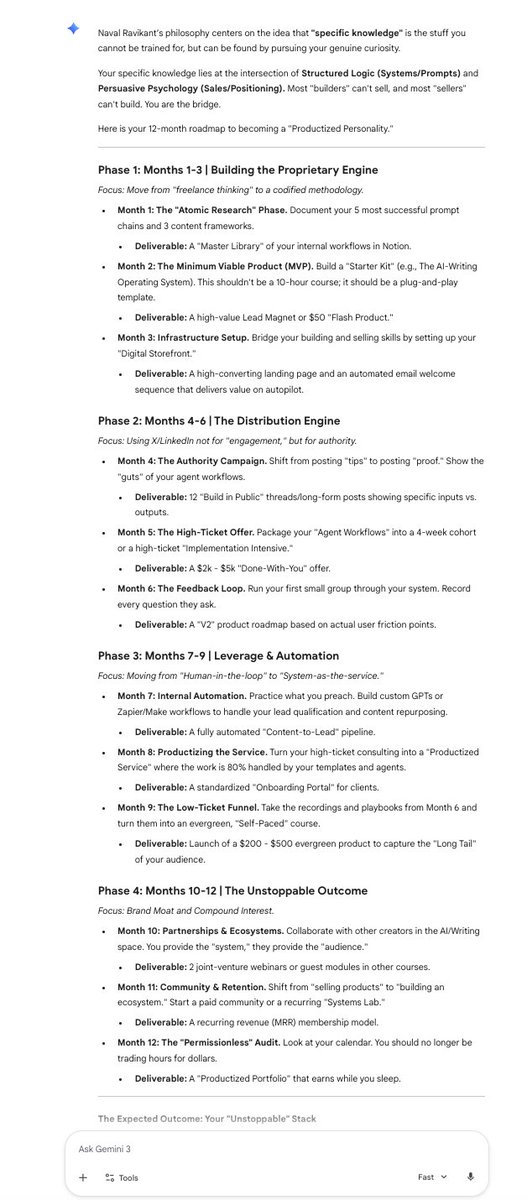
4. Productize Yourself Roadmap
Naval says "Learn to sell, learn to build. If you can do both, you will be unstoppable."
I use this to figure out my path:
Prompt:
```
Naval's framework: Selling + Building = Unstoppable
About me:
- Building skills: [WHAT YOU CAN CREATE - code, design, writing, etc.]
- Selling skills: [WHAT YOU CAN PERSUADE - pitching, marketing, negotiating]
Create a 12-month roadmap to "productize myself":
**Months 1-3:** [What to build/learn]
**Months 4-6:** [How to sell it]
**Months 7-9:** [Scale/automate]
**Months 10-12:** [Expected outcome]
Focus on intersection of specific knowledge + leverage. No generic advice.
```
Naval says "Learn to sell, learn to build. If you can do both, you will be unstoppable."
I use this to figure out my path:
Prompt:
```
Naval's framework: Selling + Building = Unstoppable
About me:
- Building skills: [WHAT YOU CAN CREATE - code, design, writing, etc.]
- Selling skills: [WHAT YOU CAN PERSUADE - pitching, marketing, negotiating]
Create a 12-month roadmap to "productize myself":
**Months 1-3:** [What to build/learn]
**Months 4-6:** [How to sell it]
**Months 7-9:** [Scale/automate]
**Months 10-12:** [Expected outcome]
Focus on intersection of specific knowledge + leverage. No generic advice.
```
5. Accountability vs. Authenticity Check
Naval says take accountability but stay authentic.
Most people fake one or the other. This prompt finds where I'm bullshitting:
Prompt:
```
I'm considering: [DECISION/CAREER MOVE]
Naval's test:
- "If you're authentic, you have nothing to hide and nothing to prove"
- "Take accountability so people know who to credit or blame"
Be honest:
1. Am I doing this because it's authentic to me, or because it looks good?
2. Am I willing to be publicly accountable for this outcome?
3. What would I do if no one was watching and I couldn't brag about it?
If this fails the authenticity test, what would pass it?
```
Naval says take accountability but stay authentic.
Most people fake one or the other. This prompt finds where I'm bullshitting:
Prompt:
```
I'm considering: [DECISION/CAREER MOVE]
Naval's test:
- "If you're authentic, you have nothing to hide and nothing to prove"
- "Take accountability so people know who to credit or blame"
Be honest:
1. Am I doing this because it's authentic to me, or because it looks good?
2. Am I willing to be publicly accountable for this outcome?
3. What would I do if no one was watching and I couldn't brag about it?
If this fails the authenticity test, what would pass it?
```
6. Reading for Actual Understanding
Naval reads obsessively but says "read what you love until you love to read."
I stopped forcing myself through books and used this instead:
Prompt:
```
Book: [BOOK YOU'RE READING]
Extract Naval's style:
1. What are the 3 core mental models in this book?
2. How would I apply each one to [YOUR SPECIFIC PROBLEM]?
3. What does this book assume that might be wrong?
Then:
- Should I finish this book or move on? (Naval abandons books freely)
- What should I read next based on what I'm trying to solve?
No summaries. Only actionable models and direct applications.
```
Naval reads obsessively but says "read what you love until you love to read."
I stopped forcing myself through books and used this instead:
Prompt:
```
Book: [BOOK YOU'RE READING]
Extract Naval's style:
1. What are the 3 core mental models in this book?
2. How would I apply each one to [YOUR SPECIFIC PROBLEM]?
3. What does this book assume that might be wrong?
Then:
- Should I finish this book or move on? (Naval abandons books freely)
- What should I read next based on what I'm trying to solve?
No summaries. Only actionable models and direct applications.
```
7. Decision-Making: Expected Value Calculator
Naval makes decisions using expected value, not outcomes.
Here's how I adopted that framework:
Prompt:
```
Decision: [WHAT YOU'RE DECIDING]
Options:
1. [OPTION A]
2. [OPTION B]
3. [OPTION C]
For each option, calculate:
- Best case outcome (what if it works perfectly?)
- Worst case outcome (what if it fails completely?)
- Probability of success (be honest, not optimistic)
- Expected value (best case × probability) - (worst case × probability)
Naval's rule: "If you can't decide, the answer is no."
Which option has highest EV? Or should I reject all of them?
```
Naval makes decisions using expected value, not outcomes.
Here's how I adopted that framework:
Prompt:
```
Decision: [WHAT YOU'RE DECIDING]
Options:
1. [OPTION A]
2. [OPTION B]
3. [OPTION C]
For each option, calculate:
- Best case outcome (what if it works perfectly?)
- Worst case outcome (what if it fails completely?)
- Probability of success (be honest, not optimistic)
- Expected value (best case × probability) - (worst case × probability)
Naval's rule: "If you can't decide, the answer is no."
Which option has highest EV? Or should I reject all of them?
```
8. Building Credibility vs. Chasing Status
I was optimizing for status (titles, follower counts) instead of credibility.
This prompt helped me see the difference:
Prompt:
```
Naval distinguishes:
- Status = relative position in hierarchy (I'm above you)
- Credibility = trust earned through accountability (I delivered before)
Audit my last 6 months:
[DESCRIBE: projects, posts, career moves, time spent]
For each activity:
- Am I building credibility or chasing status?
- Will this matter in 5 years?
- Would I do this if no one knew about it?
What should I kill? What should I double down on?
```
I was optimizing for status (titles, follower counts) instead of credibility.
This prompt helped me see the difference:
Prompt:
```
Naval distinguishes:
- Status = relative position in hierarchy (I'm above you)
- Credibility = trust earned through accountability (I delivered before)
Audit my last 6 months:
[DESCRIBE: projects, posts, career moves, time spent]
For each activity:
- Am I building credibility or chasing status?
- Will this matter in 5 years?
- Would I do this if no one knew about it?
What should I kill? What should I double down on?
```
9. Wealth Creation vs. Wealth Capture
Most people confuse making money with creating wealth.
Naval's distinction changed how I evaluate opportunities:
Prompt:
```
Opportunity: [JOB/BUSINESS/PROJECT]
Naval's framework:
- Wealth creation = making something people want (positive sum)
- Wealth capture = extracting value from what exists (zero sum)
Analyze:
1. Am I creating new wealth or capturing existing wealth?
2. Is this a positive-sum game or zero-sum competition?
3. What value am I adding that didn't exist before?
4. Can this scale without my direct time?
If it's pure capture, what would the wealth creation version look like?
```
Most people confuse making money with creating wealth.
Naval's distinction changed how I evaluate opportunities:
Prompt:
```
Opportunity: [JOB/BUSINESS/PROJECT]
Naval's framework:
- Wealth creation = making something people want (positive sum)
- Wealth capture = extracting value from what exists (zero sum)
Analyze:
1. Am I creating new wealth or capturing existing wealth?
2. Is this a positive-sum game or zero-sum competition?
3. What value am I adding that didn't exist before?
4. Can this scale without my direct time?
If it's pure capture, what would the wealth creation version look like?
```
10. Escape Competition Through Authenticity
Naval says "Competition is for losers" (Peter Thiel) - you escape competition by being yourself.
Here's how I found my monopoly:
Prompt:
```
List my skills/knowledge: [EVERYTHING YOU'RE DECENT AT]
Naval's insight: "Combine things you're good at until you're the best in the world at that combination."
Find 2-3 skill intersections where:
1. I'm top 10% in each individual skill
2. The combination is unique (almost no one else has all 3)
3. There's actual demand for this combination
Then: What would I call myself? (not job title - identity)
Example: "Developer + Writer + Crypto" = "Technical storyteller for web3"
```
Which mental model are you implementing this week?
Naval says "Competition is for losers" (Peter Thiel) - you escape competition by being yourself.
Here's how I found my monopoly:
Prompt:
```
List my skills/knowledge: [EVERYTHING YOU'RE DECENT AT]
Naval's insight: "Combine things you're good at until you're the best in the world at that combination."
Find 2-3 skill intersections where:
1. I'm top 10% in each individual skill
2. The combination is unique (almost no one else has all 3)
3. There's actual demand for this combination
Then: What would I call myself? (not job title - identity)
Example: "Developer + Writer + Crypto" = "Technical storyteller for web3"
```
Which mental model are you implementing this week?
I hope you've found this thread helpful.
Follow me @ChrisLaubAI for more.
Like/Repost the quote below if you can:
Follow me @ChrisLaubAI for more.
Like/Repost the quote below if you can:
https://twitter.com/1598365749940310019/status/2028400108417786188
• • •
Missing some Tweet in this thread? You can try to
force a refresh