Alex Priou Profile picture
Mar 5 9 tweets 2 min read Read on X
A.I. and The Humanities—An Experiment

I plan to spend the Fall studying Machiavelli's Discourses on Livy, and for that I will use Claude liberally.

The goal: to see how much it can accelerate the process of close reading.

Call it "Artificial Thoughts on Machiavelli."

🧵
I'm going to use it in a few ways.

1) Collect sources

Machiavelli draws on a number of different texts as he proceeds.

As I go chapter-by-chapter, I will have Claude comb the web for sources people have identified, and compile them into a single document for my review
2) Analyze discrepancies

Machiavelli infamously departs from the sources he draws on, often with intended meaning.

So, I will have Claude add to the compilation of sources a preliminary list of discrepancies, again for my review.
3) Transcribe my dictated thoughts

After a review of the text and Claude's material, and anything else I am reading, I will dictate my thoughts on the chapter for Claude, or another A.I., to transcribe.

I will edit for accuracy, then give it Claude for review.
4) Refinement of the Strauss-bot

I will ask Claude for feedback, and correct Claude/my work as needed. I will ask it to apply these results going forward.
That last step will be the real test. Can it learn how to read, to really read? Or will it fall into typical ruts of thinking?

Can it actually notice things, can it develop an eye, or at least more of an eye than we Humanities professors give it credit for?
I want to take this new tool seriously—it has already been very helpful with mundane tasks.

I want to give it the benefit of the doubt, so I am going to read a very difficult text with it, and see what it can do.
It certainly helps with the grunt work of collecting primary sources.

It has helped, too, with finding passages for me in primary sources, when my memory needed jogging.

It clearly speeds things up. Not without a cost, I'm aware, but it's not a total loss—it's a trade-off.
I'm already aware of the benefits of the old school way. But how can one assess trade-off, without assessing the benefits of the new school way?

I'll report back when I have some conclusions I'm confident in.

• • •

Missing some Tweet in this thread? You can try to force a refresh

 

Keep Current with Alex Priou

Alex Priou Profile picture

Stay in touch and get notified when new unrolls are available from this author!

Read all threads

This Thread may be Removed Anytime!

PDF

Twitter may remove this content at anytime! Save it as PDF for later use!

Try unrolling a thread yourself!

how to unroll video
  1. Follow @ThreadReaderApp to mention us!

  2. From a Twitter thread mention us with a keyword "unroll"
@threadreaderapp unroll

Practice here first or read more on our help page!

More from @alexpriou

Sep 9, 2024
What are we reading @uaustinorg?

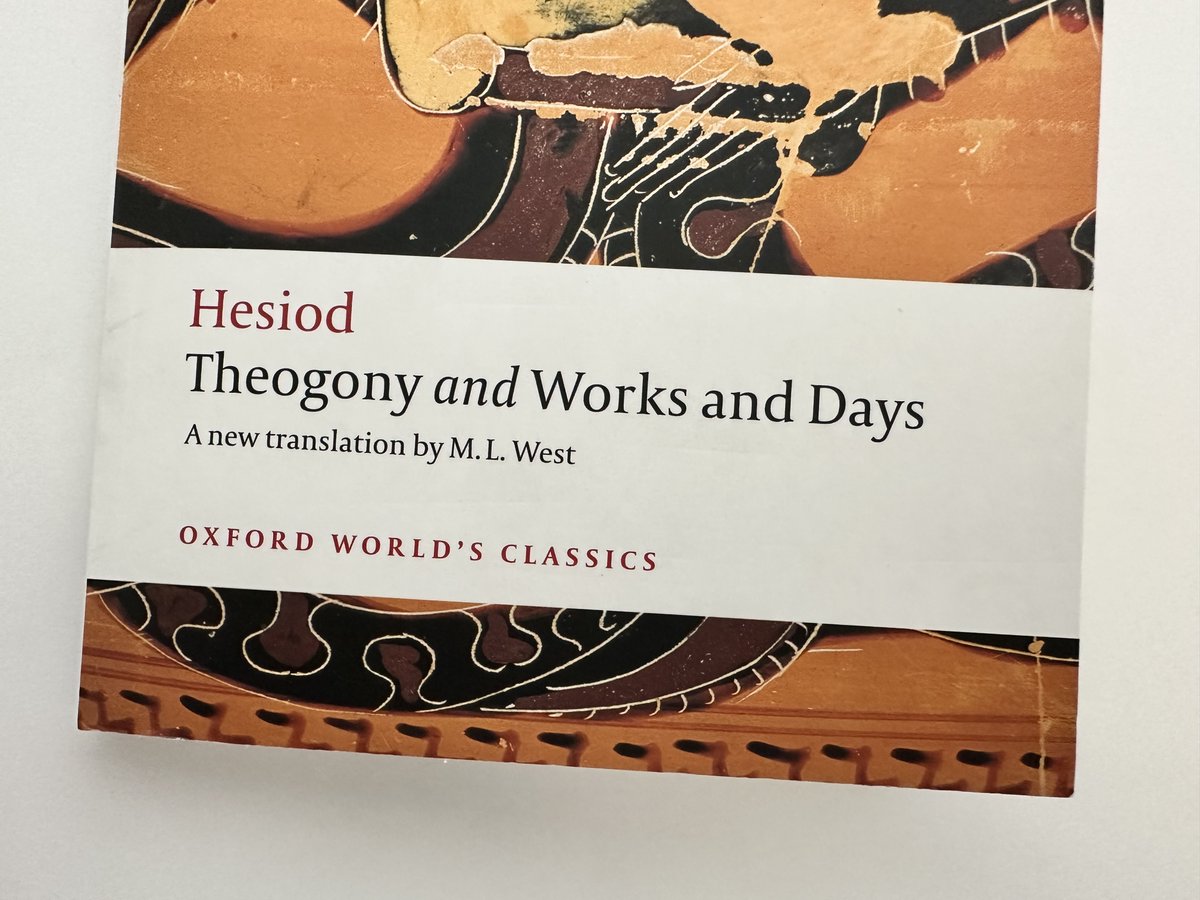
"Chaos and Civilization" starts with two origins stories: Hesiod’s Theogony and the Book of Genesis.

Both describe beginnings, but they begin in very different ways.

So the question I posed the class was: Which beginning is better?

🧵Image
Genesis begins at the very beginning—it tells its story directly from the start, and that seems sensible enough.

Hesiod, however, begins from the here and now, from himself, and works to establish himself as an authority. That also seems sensible.
Hesiod therefore tells us his name. Genesis, however, begins without an author. (We are told it is Moses, but Moses eventually dies.)

But in what does the authority of Genesis lie, if not the author? The authority of tradition, of being passed down since time immemorable?
Read 8 tweets
Aug 2, 2023
The flaw in this critique of Sparta is that it judges Sparta by contemporary standards, essentially by the standards of liberal democracy, our regime.

Is that really the purpose of academic inquiry? Is that why we engage in historical studies and the study of other peoples?

🧵
This form of critique looks academic, in that it is based on a careful accumulation of evidence from primary sources and from archaeological evidence.

But at bottom it tells us what we should praise or blame according to our inherited opinions.
This gets us absolutely nowhere. Spartans could simply flip it on us, saying its silly to think a Helot and Sparta are each deserving of the same.

If one cares to live in a good political community, one must seek a common standard, agreed upon by all parties involved.
Read 18 tweets
Apr 14, 2023
Some thoughts on Strauss's "The Socratic Question," a lecture delivered at Claremont College, 2/15/68.

A massive question with Strauss is whether he succeeded in overcoming historicism, and if not, how aware he was of it.

This lecture is essential reading on this question.

🧵 Image
Strauss's most extensive, published critique of historicism is in chapter one of Natural Right and History.

The chapter is deeply dialectical, and ends in aporia and with an exhortation to a non-historicist understanding both of historicism and of non-historicist philosophy. Image
Presumably, Strauss saw the rest of the book as providing such an understanding. Yet it is obviously incomplete, not least on the question of Machiavelli, the study of whom is essential for confronting the modern roots of historicism directly.
Read 13 tweets
Apr 13, 2023
Lately, I've been thinking a lot about this section of Nietzsche's "Thus Spoke Zarathustra."

It's a fantastic critique of the corrosive effect of the state, in its opposition to society, religion, culture etc.

It reads prophetically. Image
The most revealing moment, I think, is when he refers to the state as a monster, a cold monster. It seems clear that Nietzsche has Hobbes' Leviathan in mind. Image
Zarathustra then refers to the members or devotees of the state as the superfluous, whom he criticizes for vulgarizing great works, their newspapers, and their concern with wealth—Hobbes again.

One reader was not pleased with the elitism! Image
Read 4 tweets
Feb 6, 2023
Some confusion in a conversation yesterday about whether human nature is malleable for Machiavelli.

On the one hand, the desires seem constant—fear and greed. Yet the higher longings are deemed imaginary and thus admit of great malleability than before.

So, malleable or not?
It's helpful, I think, to notice that often nature is used in a two-fold sense in modern thinkers.

First, it refers to the pure simples that cannot be changed.

Second, it refers to the complex arrangements of those simples.
This two-fold sense is very clear in Bacon, New Organon II.1.

Human power can superinduce on material bodies *new* natures. Malleable.

Yet it is constrained by the form that determines that nature, also referred to as "causative nature." Unmalleable.
Read 7 tweets
Nov 1, 2022
Clearly he hasn't even read the first line of The City and Man!

Satoor has some bizarre axe to grind with Strauss, which makes him a bad reader and sloppy thinker.

Do your homework, or just leave it be. Otherwise you just out yourself as a lazy hack.
Here's a tip: nothing of Strauss's core thought "depends on the rhetoric of natural right." That's obvious from the first chapter of NRH, where he delineates how the possibility of Socratic philosophy depends on fewer premises than the assertion of natural right.
He had the decency to delete his initial tweet, where he asserted that Strauss's course on Hegel said nothing true. Such hyperbole nevertheless betrays the vitriol that motivates him.
Read 4 tweets

Did Thread Reader help you today?

Support us! We are indie developers!


This site is made by just two indie developers on a laptop doing marketing, support and development! Read more about the story.

Become a Premium Member ($3/month or $30/year) and get exclusive features!

Become Premium

Don't want to be a Premium member but still want to support us?

Make a small donation by buying us coffee ($5) or help with server cost ($10)

Donate via Paypal

Or Donate anonymously using crypto!

Ethereum

0xfe58350B80634f60Fa6Dc149a72b4DFbc17D341E copy

Bitcoin

3ATGMxNzCUFzxpMCHL5sWSt4DVtS8UqXpi copy

Thank you for your support!

Follow Us!

:(