Alex Priou Profile picture
Roubos Sabbatical Scholar @BensonCenter & Professor of Political Philosophy @uaustinorg | Specialist in the most weighty matters and the one thing needful
Mar 5 9 tweets 2 min read
A.I. and The Humanities—An Experiment

I plan to spend the Fall studying Machiavelli's Discourses on Livy, and for that I will use Claude liberally.

The goal: to see how much it can accelerate the process of close reading.

Call it "Artificial Thoughts on Machiavelli."

🧵 I'm going to use it in a few ways.

1) Collect sources

Machiavelli draws on a number of different texts as he proceeds.

As I go chapter-by-chapter, I will have Claude comb the web for sources people have identified, and compile them into a single document for my review
Sep 9, 2024 8 tweets 2 min read
What are we reading @uaustinorg?

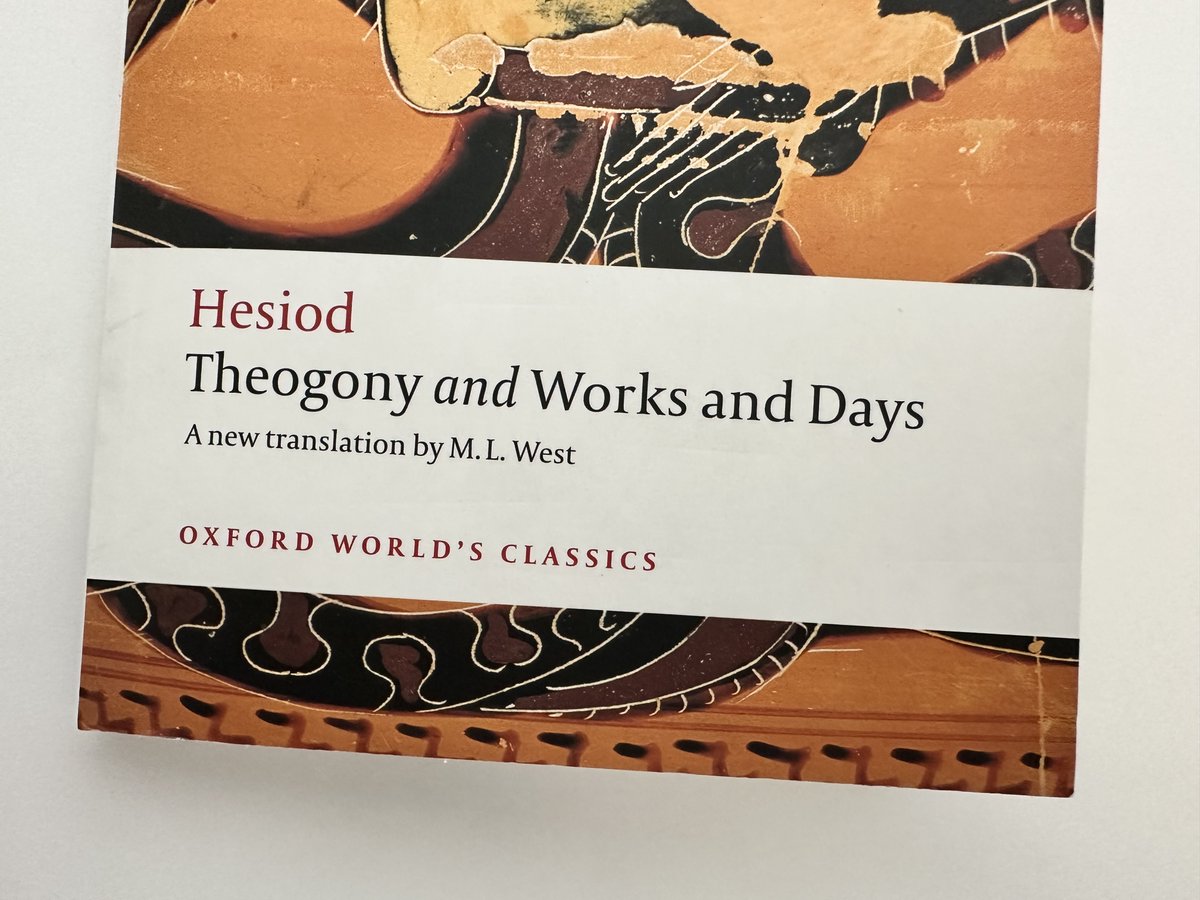
"Chaos and Civilization" starts with two origins stories: Hesiod’s Theogony and the Book of Genesis.

Both describe beginnings, but they begin in very different ways.

So the question I posed the class was: Which beginning is better?

🧵Image Genesis begins at the very beginning—it tells its story directly from the start, and that seems sensible enough.

Hesiod, however, begins from the here and now, from himself, and works to establish himself as an authority. That also seems sensible.
Aug 2, 2023 18 tweets 4 min read
The flaw in this critique of Sparta is that it judges Sparta by contemporary standards, essentially by the standards of liberal democracy, our regime.

Is that really the purpose of academic inquiry? Is that why we engage in historical studies and the study of other peoples?

🧵 This form of critique looks academic, in that it is based on a careful accumulation of evidence from primary sources and from archaeological evidence.

But at bottom it tells us what we should praise or blame according to our inherited opinions.
Apr 14, 2023 13 tweets 4 min read
Some thoughts on Strauss's "The Socratic Question," a lecture delivered at Claremont College, 2/15/68.

A massive question with Strauss is whether he succeeded in overcoming historicism, and if not, how aware he was of it.

This lecture is essential reading on this question.

🧵 Image Strauss's most extensive, published critique of historicism is in chapter one of Natural Right and History.

The chapter is deeply dialectical, and ends in aporia and with an exhortation to a non-historicist understanding both of historicism and of non-historicist philosophy. Image
Apr 13, 2023 4 tweets 2 min read
Lately, I've been thinking a lot about this section of Nietzsche's "Thus Spoke Zarathustra."

It's a fantastic critique of the corrosive effect of the state, in its opposition to society, religion, culture etc.

It reads prophetically. Image The most revealing moment, I think, is when he refers to the state as a monster, a cold monster. It seems clear that Nietzsche has Hobbes' Leviathan in mind. Image
Feb 6, 2023 7 tweets 2 min read
Some confusion in a conversation yesterday about whether human nature is malleable for Machiavelli.

On the one hand, the desires seem constant—fear and greed. Yet the higher longings are deemed imaginary and thus admit of great malleability than before.

So, malleable or not? It's helpful, I think, to notice that often nature is used in a two-fold sense in modern thinkers.

First, it refers to the pure simples that cannot be changed.

Second, it refers to the complex arrangements of those simples.
Nov 1, 2022 4 tweets 1 min read
Clearly he hasn't even read the first line of The City and Man!

Satoor has some bizarre axe to grind with Strauss, which makes him a bad reader and sloppy thinker.

Do your homework, or just leave it be. Otherwise you just out yourself as a lazy hack. Here's a tip: nothing of Strauss's core thought "depends on the rhetoric of natural right." That's obvious from the first chapter of NRH, where he delineates how the possibility of Socratic philosophy depends on fewer premises than the assertion of natural right.
May 29, 2022 8 tweets 2 min read
Done grading for my summer course!

Here’s what’s first on my summer reading. Very excited to return to this now that I’m getting a better sense of Strauss’s early work. Here's what I'll be thinking about while reading.

First, Spinoza assimilated the Jewish tradition to Western liberalism. But the integration he effected would soon undergo rejection as Strauss wrote "Philosophy and Law."
Apr 10, 2022 6 tweets 1 min read
“Reading old books is today indispensable as an antidote to the ruling dogma that the very notion of a final and true account of the whole is absurd.”

– Leo Strauss “I do not know of any historian who grasped fully a fundamental presupposition of a great thinker which the great thinker himself did not fully grasp.”