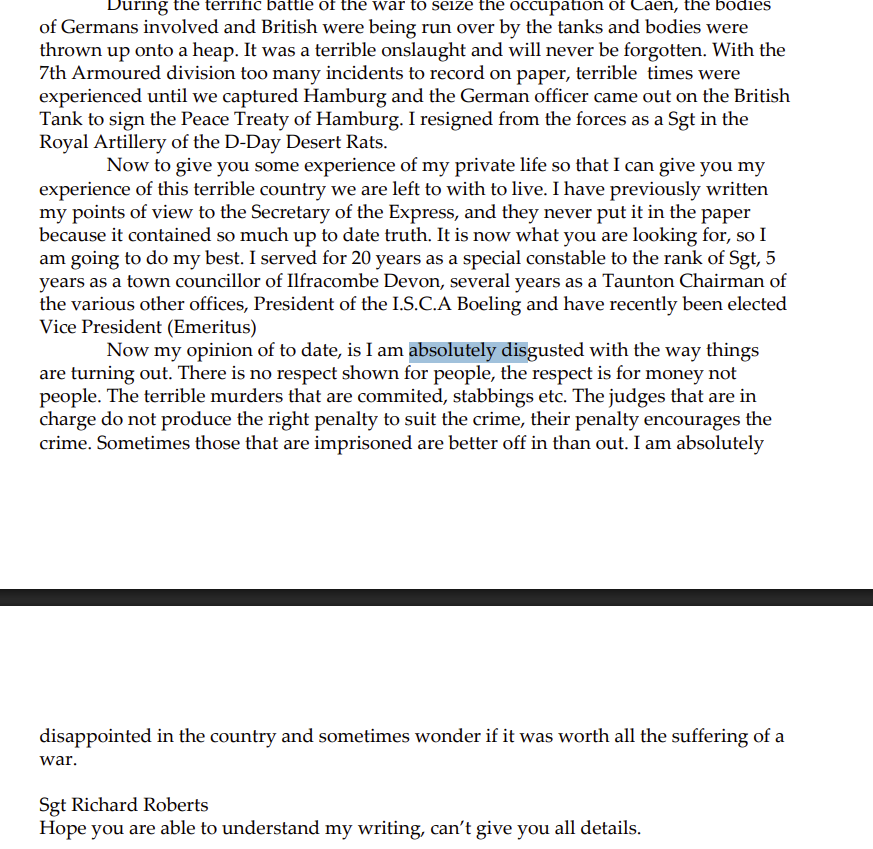
In 2015, Twitter was "the free speech wing of the free speech party" according to CEO Jack Dorsey, even avoiding collaboration with the NSA (unlike Google, Facebook). By 2019 it was one of the most censored, monitored, and controlled social media networks in the world. 
YouTube was the biggest and most monetizable platform, Reddit the most important discussion forum, Amazon needed for authors and websites, and Google Search the only way to surface niche info sources. Twitter mattered as the social network of the intelligentsia.
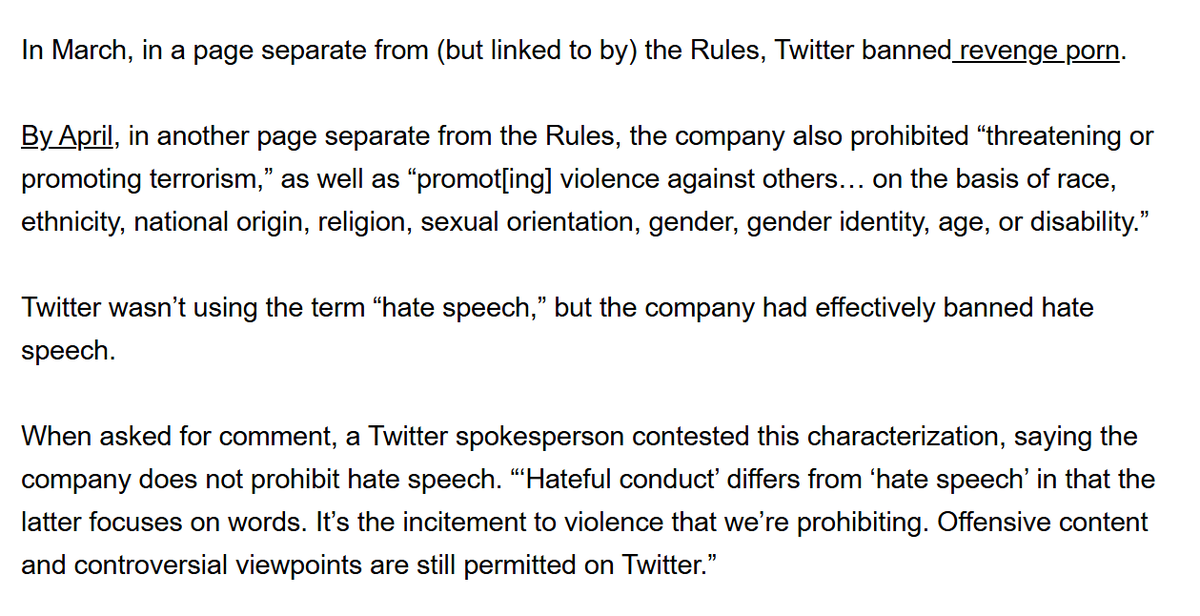
In 2015, Twitter under Twitter general counsel Vijaya Gadde began reinterpreting their existing rules much more broadly and banned hate speech, to "keep Twitter safe." Chuck Johnson was banned for tweeting that would "take out" (attack digitally, not murder) a BLM activist.
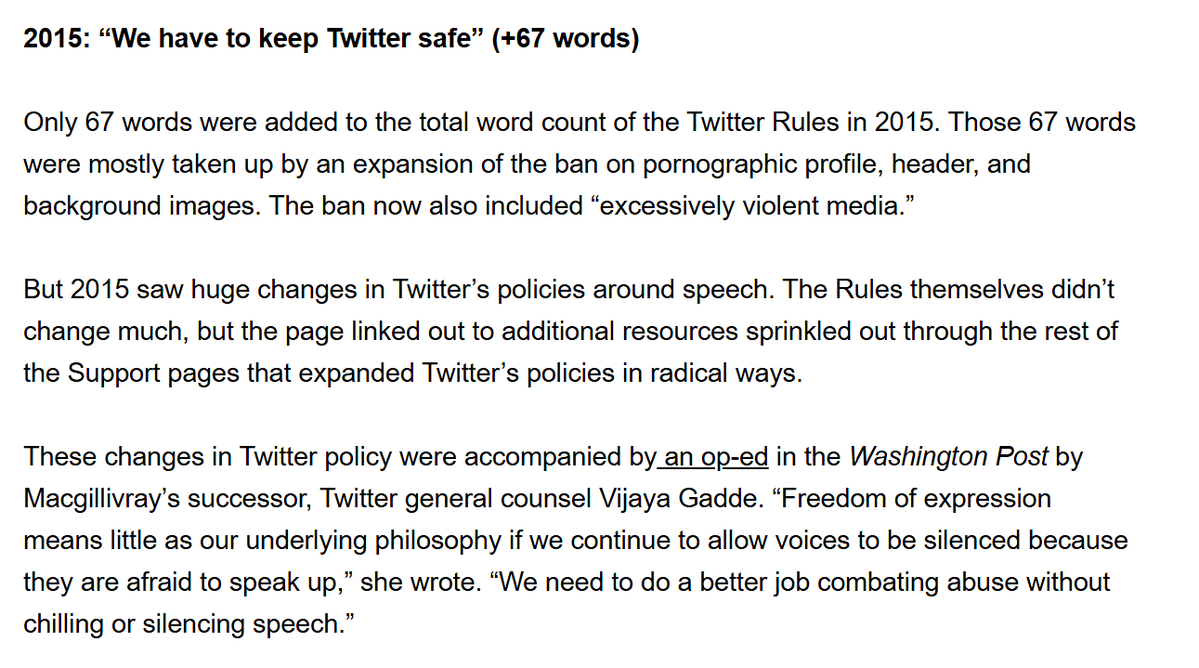
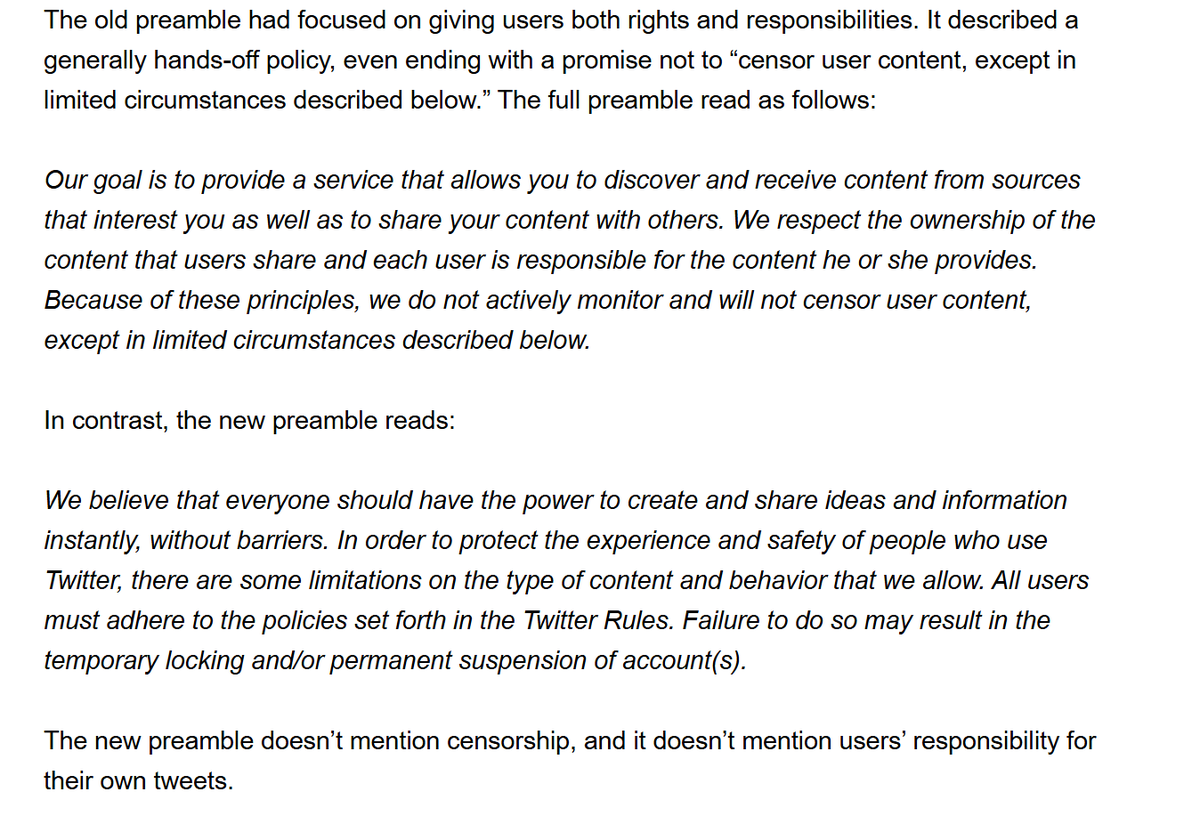
Twitter's informal stance had already started changing, but the big formal changes to the rules began in 2016, when it no longer promised not to censor user content that didn't break the rules ("limited circumstances described below").
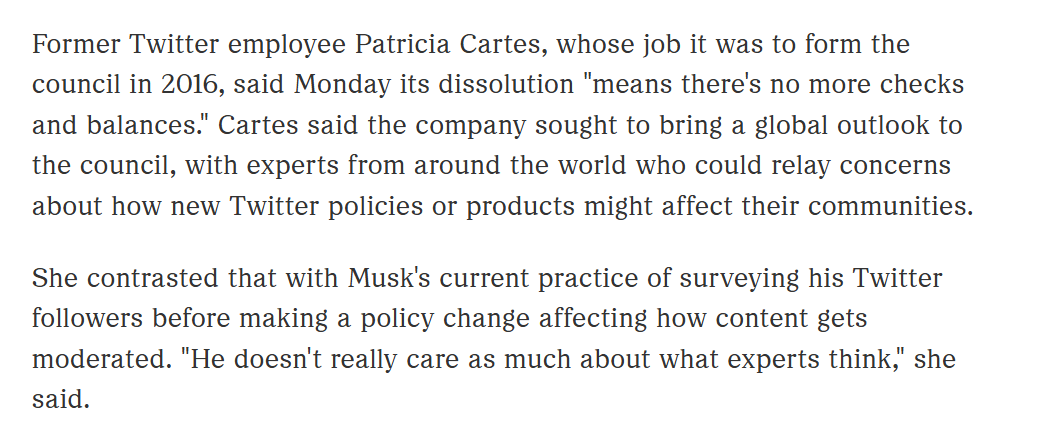
In February 2016, Twitter established its (in)famous "Trust and Safety" council, a body which networked censorship/moderation/activist expertise around the world to inform Twitter policy.
In 2017, Twitter formally moved against "hate symbols" and "unwanted sexual advances." The blue check aristocracy began to take form too, with Rose McGowan's followers impelling this change (on her behalf) after she was temporarily locked for posting someone's private number.


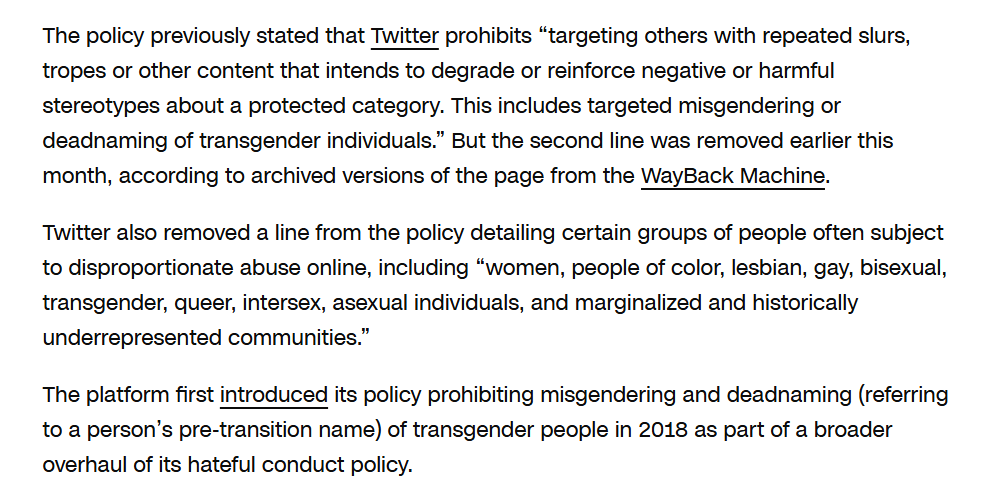
In 2018, Twitter banned "misgendering" transsexuals, and laid out which groups got special protection ("women, people of color, lesbian, gay, bisexual, transgender, queer, intersex, asexual individuals, and marginalized and historically underrepresented communities").
Twitter also began shadowbanning prominent Republican politicians in 2018, though they later claimed this was a bug and backtracked when Republicans attacked them for it.

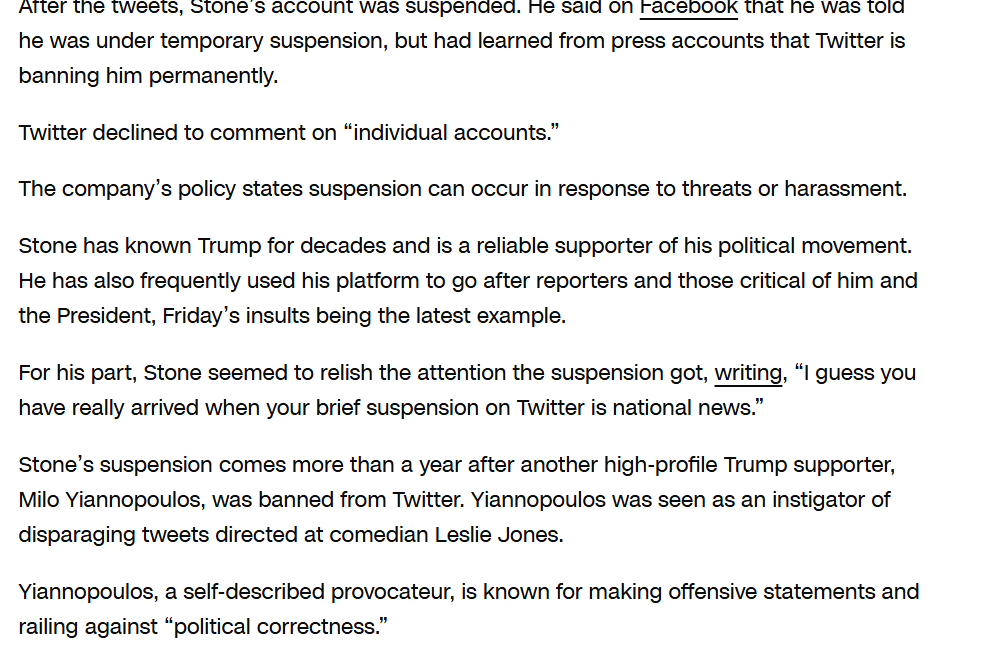
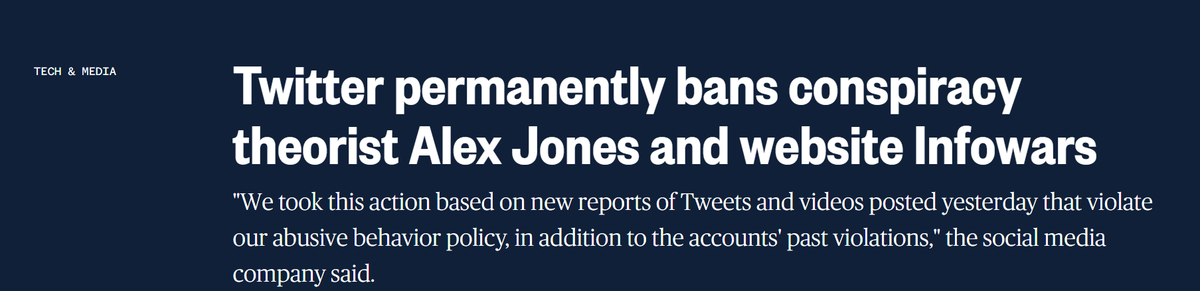
High profile bans included Milo Yiannopoulos (338,000 followers, July 2016), major Trump advisor Roger Stone (October 2017), Gavin McInnes and the Proud Boys (August 2018), Alex Jones (coordinated with other platforms, Sept 2018), Laura Loomer (265,000 followers, Nov 2018).
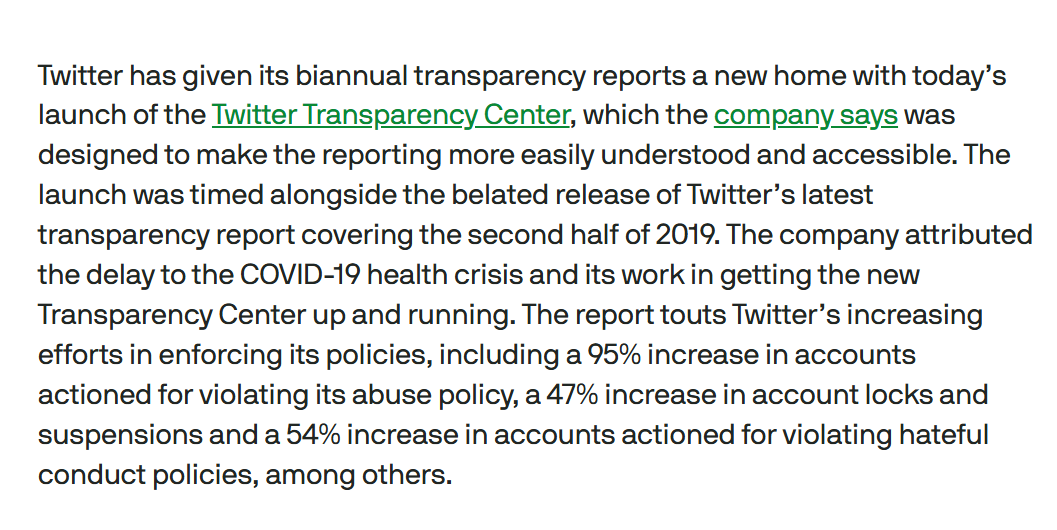
In the first half of 2018, Twitter actioned 250,806 accounts for hateful conduct. This increased by 54% by the second half of 2019.

Some revelations from the Twitter files:
1) The FBI had a dedicated task force of 80 agents and a one-way communication channel called teleporter to flag posts, even joke posts from tiny accounts
1) The FBI had a dedicated task force of 80 agents and a one-way communication channel called teleporter to flag posts, even joke posts from tiny accounts

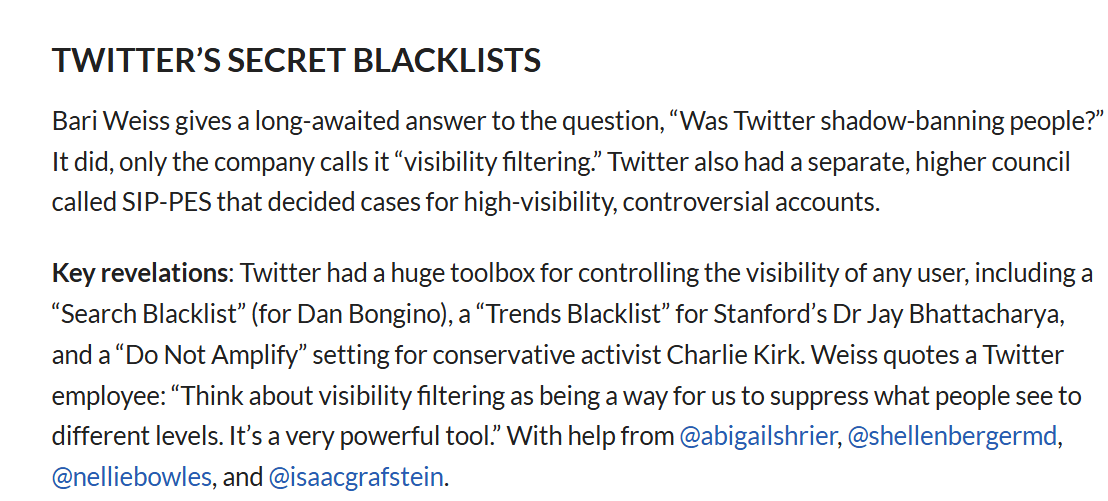
2) All of the conspiracies about shadowbans were totally vindicated; Twitter had separate lists for Trends blacklists, Search blacklists, and "Do Not Amplify" (which included Charlie Kirk), with multiple levels of visibility filtering and internal bodies to administer them
I have deliberately avoided getting into the 2020-2022 intensification of censorship/narrative control (eg putting notes on Trump's posts and banning him, Hunter Biden's laptop, everything related to COVID, lab leak, and the lockdowns).
Here are the sources used in this thread:
stoppingsocialism.com/2023/01/the-tw…,
techcrunch.com/2020/08/19/twi…,
committees.parliament.uk/writtenevidenc…,
nbcnews.com/tech/tech-news…,
cbsnews.com/news/proud-boy…,
cnn.com/2017/10/29/pol…,
vice.com/en/article/twi…,
web.archive.org/web/2025010812…,
cnn.com/2023/04/19/tec…,
medianama.com/2017/10/223-tw…,
npr.org/2022/12/12/114…,
vice.com/en/article/the…,
dailydeclaration.org.au/2023/01/09/hel…
stoppingsocialism.com/2023/01/the-tw…,
techcrunch.com/2020/08/19/twi…,
committees.parliament.uk/writtenevidenc…,
nbcnews.com/tech/tech-news…,
cbsnews.com/news/proud-boy…,
cnn.com/2017/10/29/pol…,
vice.com/en/article/twi…,
web.archive.org/web/2025010812…,
cnn.com/2023/04/19/tec…,
medianama.com/2017/10/223-tw…,
npr.org/2022/12/12/114…,
vice.com/en/article/the…,
dailydeclaration.org.au/2023/01/09/hel…
• • •
Missing some Tweet in this thread? You can try to
force a refresh