Regarding the reported destruction of a U.S. AN/TPY-2 missile-defense radar in Jordan, and the possible damage to a component of another U.S. AN/TPY-2 radar in the UAE, a few points to clarify what happened, the significance and implications.
First, modern air and missile defense should be understood as a network of sensors, communications, and engagement systems. These networks combine ground-based, airborne, and satellite-based sensors (primarily radars), command-and-control systems, as well as ground-based and
airborne interceptors such as surface-to-air missile batteries, anti-aircraft guns, jet fighters, and increasingly high-energy laser systems. Each element contributes different capabilities, and the overall performance of the system depends on how effectively these elements are
integrated. This is why they are referred to as integrated air and missile defense systems (IAMD). For this reason, air and missile defense relies on layered defenses, with different sensors and interceptors operating at different ranges and altitudes in order to provide full
coverage of the airspace. When the network functions properly, it can provide very advanced defensive capabilities, as the weaknesses of some components are compensated by the strengths of others. When key nodes are absent or degraded, however,the effectiveness of the system can
decline significantly because important vulnerabilities emerge. Second, radars play a central role within air and missile defense systems. Radars provide long-range, day-and-night, and largely all-weather detection, identification, and tracking capabilities. These functions are
essential because, in order to attempt an interception, air and missile defense systems must first detect, identify, and track a target. Without reliable detection, identification, and tracking, engagement becomes extremely difficult. This is why radar systems are frequently
targeted in the early phases of air campaigns. Disabling radars reduces the defender’s ability to observe incoming threats at extended distances, which in turn limits the time available to assess the situation, determine the nature of the target, and coordinate a response with
the appropriate engagement system. Third, the AN/TPY-2 radar is an unusual and technologically sophisticated system. It operates in the X-band frequency range (approximately 8–12 GHz). Radars operating in this band are typically used for fire-control tasks because the high
frequency provides very fine resolution, which is important for precise discrimination, identification, and tracking. This allows the radar to distinguish between different objects associated with a ballistic missile trajectory, such as warheads, debris, or decoys, to positively
identify an incoming threat, and to provide accurate tracking information to interceptor systems.
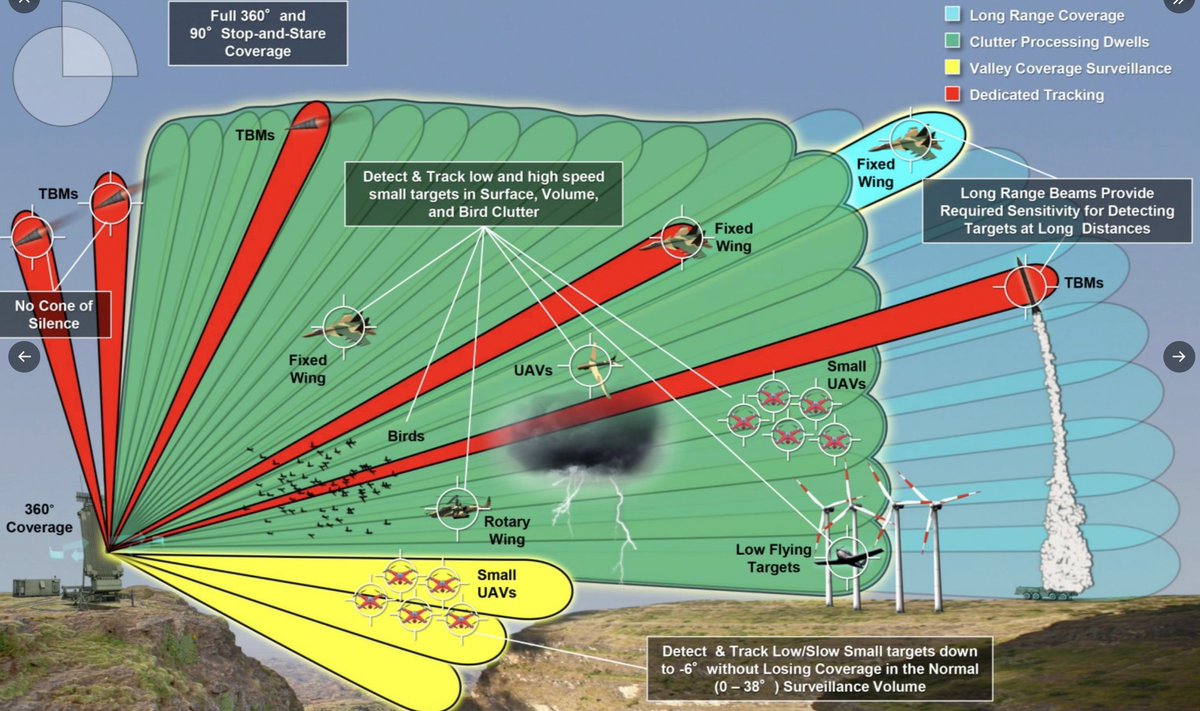
What makes the AN/TPY-2 distinctive is that, despite operating in X-band, it can also perform long-range surveillance functions. This capability derives from the radar’s large phased-array antenna, its substantial transmitted power, and the use of advanced beamforming techniques
These features allow the radar to detect, identify, and track ballistic missile targets at very long distances while maintaining the high resolution normally associated with fire-control radars. In practical terms, the system combines characteristics that are often associated
with different radar types. The picture above provides an illustration of the capabilities of an AN/TPY-2 system. This vignette illustrates the capabilities: 
How was it possible for Iran to strike such an advanced system? A deployed AN/TPY-2 system includes the large phased-array antenna unit together with supporting components such as the electronics unit, cooling equipment, and power generation systems. Although the system is
transportable and can be redeployed when necessary, it remains a large installation that is slow to move and extremely difficult to conceal. An emitting radar antenna is also relatively easy to locate electronically,as radar emissions can be detected and geolocated by adversary
sensors – tantamount to a flashlight in the middle of the night. While we do not yet have definitive information about what happened, it is plausible that the radar lacked effective point defenses capable of intercepting the incoming strike, and that Iran identified
trajectories or attack profiles that reduced the probability of interception. By destroying the antenna unit, the radar is effectively disabled even if some supporting components remain intact. If confirmed, this represents a clear operational success for Iran and a defensive
failure for the host state responsible for protecting the site. Finally, these systems are expensive because of the engineering involved. Modern radars rely on advanced semiconductor technologies, including gallium-nitride (GaN) components, which enable high power output and
improved efficiency in transmit-receive modules. These systems also incorporate sophisticated electronic warfare engineering designed to make the radar more resilient to adversary countermeasures, including features such as low-probability-of-intercept emissions and reduced side
lobes. As a result, they are technically demanding and costly to manufacture. Production capacity is limited and delivery timelines are long. The loss of such a radar therefore attracts attention because replacing it is neither simple nor immediate.
• • •
Missing some Tweet in this thread? You can try to
force a refresh