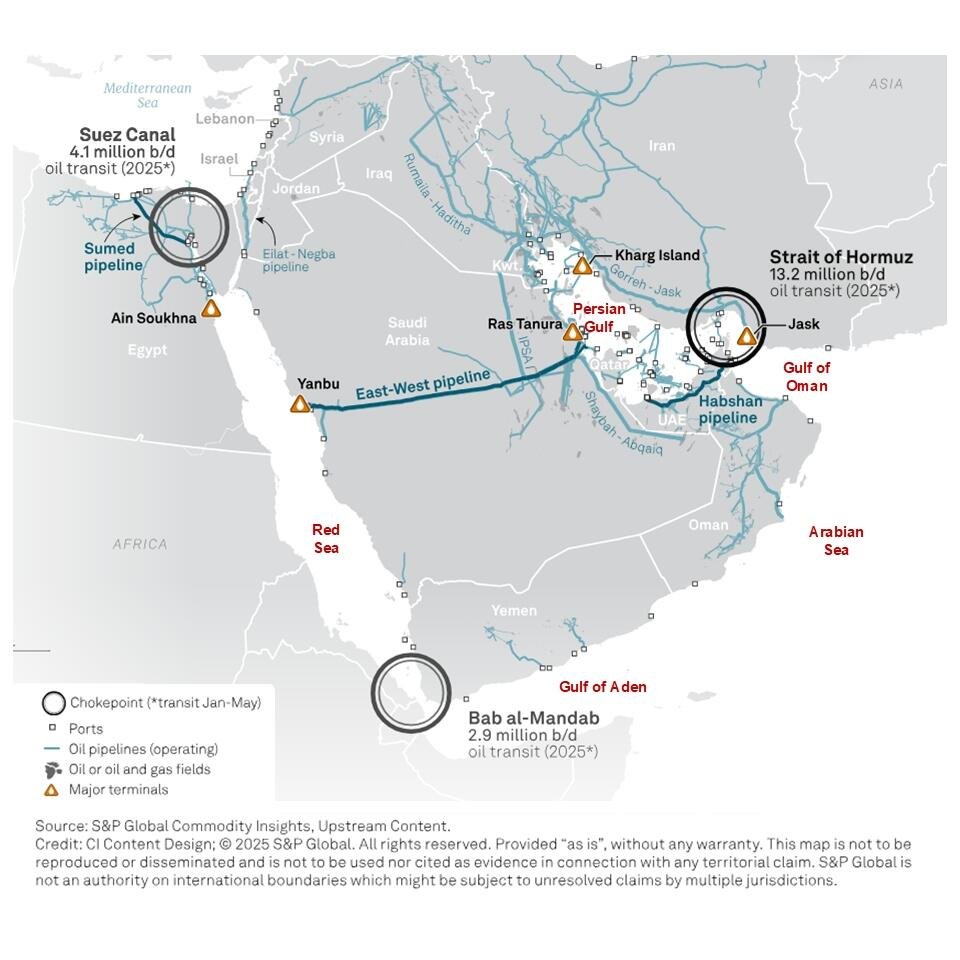
The east‑to‑west pipeline is known as the Petroline (East–West Crude Oil Pipeline). It runs from Abqaiq, near the Ras Tanura oil terminal on the Persian Gulf, to the Red Sea export terminals at Yanbu and Al Muajjiz (left image).
Before the war, this pipeline carried roughly 1 million b/d east‑to‑west. Saudi officials now say they are only a few days away from ramping throughput to capacity of about 7 million b/d (repost). Tankers are lining up in the Red Sea to lift these redirected cargos.
The right image is a real-time Marine Traffic map of Yanbu, the end of the pipeline. The 18 red dots are anchored tankers, the red arrows are moving tankers (green is containerships). A Suezmax tanker, the largest that fit through the Suez Canal to the north, is 1MM barrels. So, ~18mm of capacity is waiting.
This will not "fix" the Strait of Hormuz problem, but getting another 6MM b/d out will definitely help (the pipeline was 1mm b/d, about to be 7mm b/d).
@mercoglianos @johnkonrad
Before the war, this pipeline carried roughly 1 million b/d east‑to‑west. Saudi officials now say they are only a few days away from ramping throughput to capacity of about 7 million b/d (repost). Tankers are lining up in the Red Sea to lift these redirected cargos.
The right image is a real-time Marine Traffic map of Yanbu, the end of the pipeline. The 18 red dots are anchored tankers, the red arrows are moving tankers (green is containerships). A Suezmax tanker, the largest that fit through the Suez Canal to the north, is 1MM barrels. So, ~18mm of capacity is waiting.
This will not "fix" the Strait of Hormuz problem, but getting another 6MM b/d out will definitely help (the pipeline was 1mm b/d, about to be 7mm b/d).
@mercoglianos @johnkonrad

Good color from @0xCarlos_
This pipeline was built in the 1980s as a hedge against the Iran-Iraq War. It was designed for exactly this scenario — but it hasn't operated anywhere near 7M bpd in decades.
The pumping stations along 1,200 km need to work flawlessly at 7x throughput. These aren't parallel redundant systems — one pump station failure and throughput drops to zero until repaired.
Running aging infrastructure at nameplate capacity under emergency conditions is a roll of the dice.
This pipeline was built in the 1980s as a hedge against the Iran-Iraq War. It was designed for exactly this scenario — but it hasn't operated anywhere near 7M bpd in decades.
The pumping stations along 1,200 km need to work flawlessly at 7x throughput. These aren't parallel redundant systems — one pump station failure and throughput drops to zero until repaired.
Running aging infrastructure at nameplate capacity under emergency conditions is a roll of the dice.
• • •
Missing some Tweet in this thread? You can try to
force a refresh