1/ Vladimir Putin is said to be concerned about a possible coup by the Russian military following the arrest of former First Deputy Defence Minister Ruslan Tsalikov. Mobile Internet in the centre of Moscow has been turned off for the past week, with no official explanation. ⬇️ 

2/ Tsalikov's arrest last week was the culmination of a long-running corruption investigation (see thread below). Investigators have reportedly found that the former minister and his family had amassed property worth over 4 billion rubles.
https://x.com/ChrisO_wiki/status/1673605328452108288
3/ Tsalikov is a close friend and ally of former Defence Minister Sergei Shoigu, who was sacked in 2024 after numerous allegations of corruption and mishandling of the war in Ukraine. Shoigu has a long history as a close ally of Putin, but has since fallen out of favour.
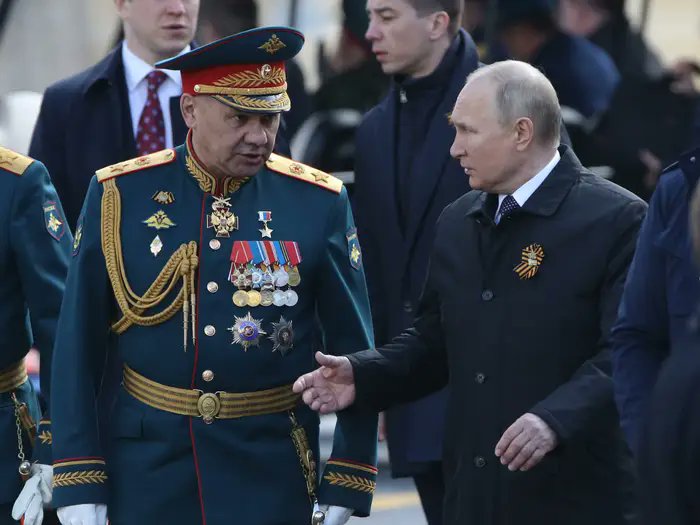
4/ Since 5 March 2026, a mysterious shutdown of Internet access in central Moscow has plagued the city's inhabitants. Only certain whitelisted websites are accessible, and restrictions have also affected Wi-Fi in the metro.
5/ Russian mobile network operators insist that they're not the cause of the problem. VimpelCom says it's "due to external restrictions", while T2 says the restrictions are "not on the operator's side". This seems to make it clear that they have been imposed by the government.
6/ There has been no explanation from the Russian government of why the restrictions – which it has not acknowledged – are in place, nor why they have lasted so long. Restrictions have occasionally been imposed during Ukrainian drone attacks, but there have been none recently.
7/ However, the Russian outlet VChK-OGPU says that according to a source they are linked to Tsalikov's arrest: "The restrictions on mobile phone service and internet access in central Moscow and some districts of Moscow suspiciously coincided with the start of investigative…
8/ …actions against Shoigu himself and those closest to him. The attempt to imprison former Defense Minister Tsalikov, a close friend and associate, in Lefortovo was accompanied by some kind of mad scramble at the top. And it ended with Tsalikov never being sent to Lefortovo.
9/ "It was limited to charges and house arrest. The only person next in line after Tsalikov could be Shoigu himself. And he retains considerable influence, both in the highest echelons of power and in the security services and the Ministry of Defence.
10/ "By a 'strange coincidence,' the Lubyanka, the Presidential Administration, the Security Council, Moscow-City, and several Defense Ministry and FSB departments, as well as the locations of Alpha and Vympel security forces…
11/ …and the operational staff of the FSB's Constitutional Order Service, and the residences of security service representatives, were affected by the poor cellular, internet, and VPN service.
12/ "It's impossible to completely cut off cellular service in Moscow, as the entire infrastructure of housing and communal services and other operational services in the capital rely on cellular data.
13/ "Therefore, such restrictions could only be caused by very serious reasons, given that no serious UAV attacks on Moscow were observed during these days."
14/ VChK-OGPU also reports that Putin has not visited any military command posts so far this year, in marked contrast to his frequent visits last year. A source sees another link to a possible security threat:
15/ "This isn't just a conspiracy theory; the Kremlin is genuinely afraid of certain events, and they're not related to Ukraine, but to internal processes in Russia.
16/ "I don't know if they're afraid of a coup, a conspiracy, or something similar, but they're definitely afraid of something serious."
17/ Another source links the lack of visits to Putin getting increasingly tired of the war: "No progress on the front lines, exhausting negotiations, and Putin's own cooling toward the topic of war." /end
• • •
Missing some Tweet in this thread? You can try to
force a refresh