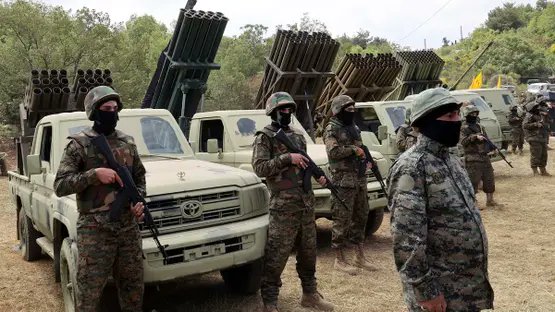
Hezbollah's large-scale rocket salvo on Northern Israel pushed a strategic crossroads to the forefront. Short thread on Hezbollah's capabilities and Israel's changing security conception. 🧵👇
Hezbollah still possesses over 23,000 missiles/rockets/mortars of all kinds. Many thousands can reach Israeli towns along the border with Lebanon, and several thousand can penetrate all the way to the Lower Galilee and Haifa. And that's keeping in mind the fact that most Hezbollah rocket launches are now occuring north of the Litani River, largely east and south of Nabatieh.
The fact they were even able to launch 100 rockets is a failure on Israel's part, as their goal is to preemptively suppress the launchers before that's possible. Of course keep in mind that 80% of Israel's intelligence and air force wherewithal is concentrated on Iran. This also means Israeli infantry lacks the same degree of close air support that it enjoyed during the 2024 invasion.
Since the November 2024 ceasefire, Hezbollah's been able to reconstitute much of its drone arsenal (Unit 127) and this time around a much larger proportion of the total Hezbollah attacks are conducted via UAVs, of which they have over 1,000.
Hezbollah's ATGMs are still potent and can be fired from ridges between Nabatieh and the Litani River border towns in the Galilee Panhandle. Over the past week Hezbollah has used 4 Almas ATGM variants, with the Almas-3/4 having a range of up to 16km!
Israeli infantry, tanks, armored vehicles, and bulldozers can't even cross the Lebanese border being targeted. And given the current Israeli approach being extremely casualty-averse, the mere threat of getting struck is enough to drag out the fighting for an extended period of time out of caution.
Hezbollah still fields a significant ground force. There are over 20,000 core-fighters in addition to over 20,000 reservists. Since the resumption of hostilities, Hezbollah has deployed the elite Radwan Force to the border with Israel. During the ceasefire they'd been located north of the Litani and in Baalbek.
But now they've been given instructions to defend each town within 10km of the border to a teeth. These 3,000 Radwan operatives will be supported by the Aziz and Nasser geographic divisions.
Regardless of tactical successes, Israel's policy of overwhelming bombardments of Hezbollah's support bases in Shia-majority regions, coupled with limited ground incursions with an emphasis on casualty avoidance clearly has its limits.
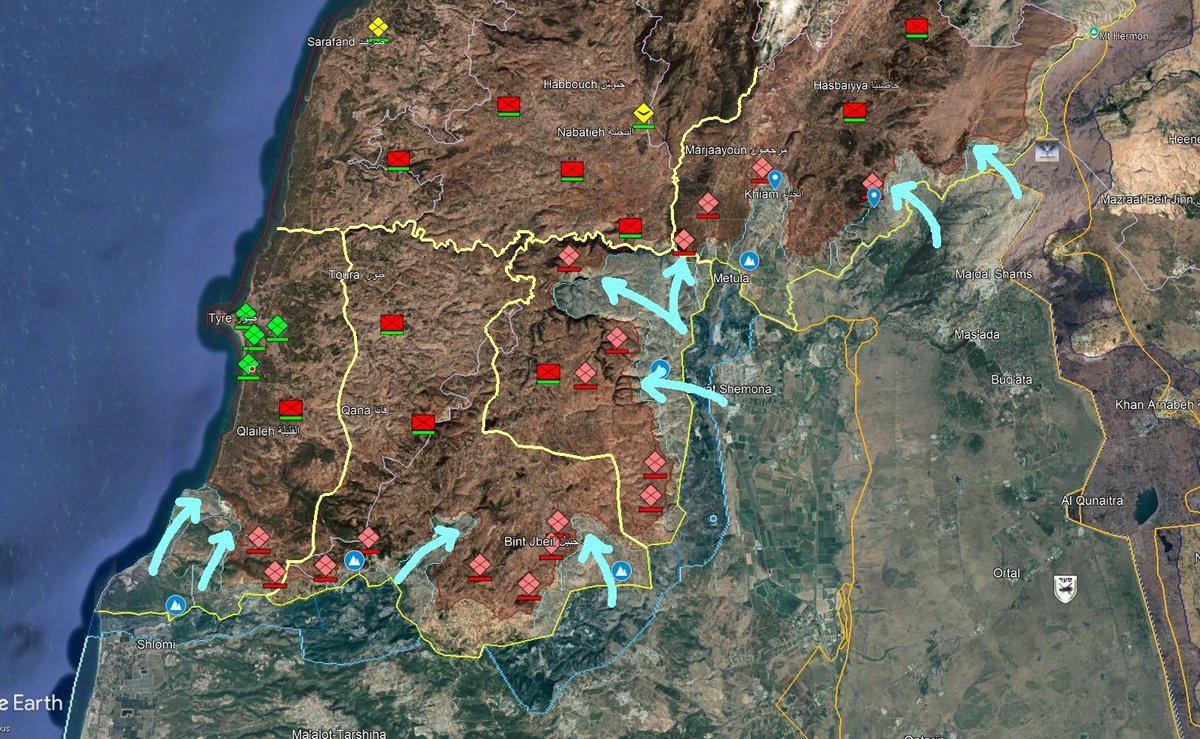
Now Israel is considering a much more forceful entry into Southern Lebanon. Israel is in the process of fully deploying the 36th, 91st, 146th, 162nd, and 210th Divisions to the Lebanon border. Today the Golani Brigade was deployed to the eastern sector of the border.
So one proposed solution is significantly escalating ground manuevers. The other proposal is to extoll such as high cost on Lebanon as a whole such that internal pressure forces the LAF to take the disarmament process more seriously, even if it means directly clashing with a political party that is literally in the governing coalition.
Also consider a wildcard scenario where Syria tries establishing a buffer zone in the Bekaa-Hermel region, or Israel convincing America to strike Hezbollah's underground missile storage facilities in northeastern Lebanon.
But the bottom line is that a ceasefire now would simply kick the can down the road. Even with limited Iranian support and compromised supply lines, Hezbollah's ability to rebuild post-2024 proves that they'd be able to do the exact same thing once again.
• • •
Missing some Tweet in this thread? You can try to
force a refresh

THREAD🧵I haven't seen this mentioned enough, but Israel's refinements to the David's Sling's interceptors prevented a catastrophic situation in which Iranian ballistic missile launches would've rapidly depleted Israel's emergency stocks of Arrow-2/3 missiles and US THAAD/SM-3s.
In July 2025 Israel signed a large-scale contract with Israel Aerospace Industries to significantly accelerate Arrow serial production with some components supplied by Stark Aerospace in Mississippi. In December 2025, Israel and IAI signed a $3.1 billion Arrow contract with Germany, which built upon a previous $3.5 billion Arrow-3 purchase.
This expansion helped IAI and Tomer further upscale their production line. Due to acute shortages during Epic Fury, Israel supposedly quadrupled Arrow production rates in March in conjunction with increased American shipments of subsystems and canisters.
On April 6th, another multi-billion shekel agreement was approved by the Ministerial Committee for Procurement between the Israeli MOD & IAI to ramp up output. Even with all the efforts over the 11 months and 2 months in particular, the baseline rates were so low that an increase in several orders of magnitude isn't enough to absorb sustained Iranian ballistic missile fire without eating into emergency reserves.
This is why recent improvements to the Stunner interceptors are so critical. Stunners cost 3-4 times less than Arrow-3s, and their production time is shorter as it has a simple two-stage design with a multi-pulse motor.
David's Sling was initially supposed to deal with tactical ballistic missiles, long-range rockets, and cruise missiles with a range between 40-300km. After the 12-Day War, Israel conducted live-fire tests to expand the system's operational range. By February 2026 modifications were made to the interceptor's kinematics, maneuverability, multi-threat handling, discrimination, and high/low-altitude performance.
🧵🚨MEGA THREAD & ANALYSIS: Tonight Netanyahu will face one of the most significant strategic dilemmas of his entire tenure. He ordered the pinprick attacks on the southern suburbs of Beirut this afternoon for two reasons:
1) To re-establish deterence vis-a-vis Hezbollah. After all, in the American-brockered "ceasefire" between the Israeli and Lebanese governments it was stipulated that in return for not striking Dahiya, Hezbollah would refrain from attacks on Northern Israel. Since then Hezbollah has resumed rocket/drone attacks on the Galilee Panhandle and other Israeli towns running along the border.
Netanyahu was already opposed to the concept of a ceasefire with Hezbollah in any manifestation as the IDF is still carrying out its offensive plans on the ground in Southern Lebanon, which includes an effort to depopulate and occupy the surroundings of Nabatieh.
IDF also intends to expand its buffer zone south of the Litani River to include nearly all of the territory encompassing Hezbollah's "Eastern Sector", including notable towns such as Tebnine and Majdal Selm. Netanyahu and the IDF high command are conscious of the substantial threat currently posed by Hezbollah's nascent FPV drone program, and know that any ceasefire would give them the wiggle room to further develop it over coming months/years in anticipation of another clash with Israel.
For this reason Israel is wary of a complete ceasefire in Lebanon under the present field conditions, wherein they feel like they haven't established a sufficient territorial buffer zone yet. So for the past few weeks Lebanon has been in a sort of purgatory state, wherein Israel continues gradual advances with infantry while conducting airstrikes on Shia-majority communities in Tyre, Sidon, and Nabatieh.
Netanyahu feels he's waging the war with one hand tied behind his back because he was restricted from striking Dahiya and other cities on the Lebanese rear with notable volume. Meanwhile almost every day another Israeli soldier is killed by FPV drones.
With this reality in mind, it become strategically and politically impossible for Bibi to ignore Dahiya, which is of course home to many high-value Hezbollah targets, but is also always in the crosshairs of Israel's conscience because they want to create an equation where even the slightest inconvenience experienced in Northern Israel is reciprocated with destruction in Beirut.
So the Israeli strikes today were purposefully "precise" (relative to previous attacks) and didn't generate a mass casualty event, because Israel was trying to ease US/Lebanon/Hezbollah/Iran back into the pre-war equation where strikes on Beirut were a normal component of combat operations. Had Iran not responsed tonight, it's evident that the scope and intensity of attacks would exponentially broaden.
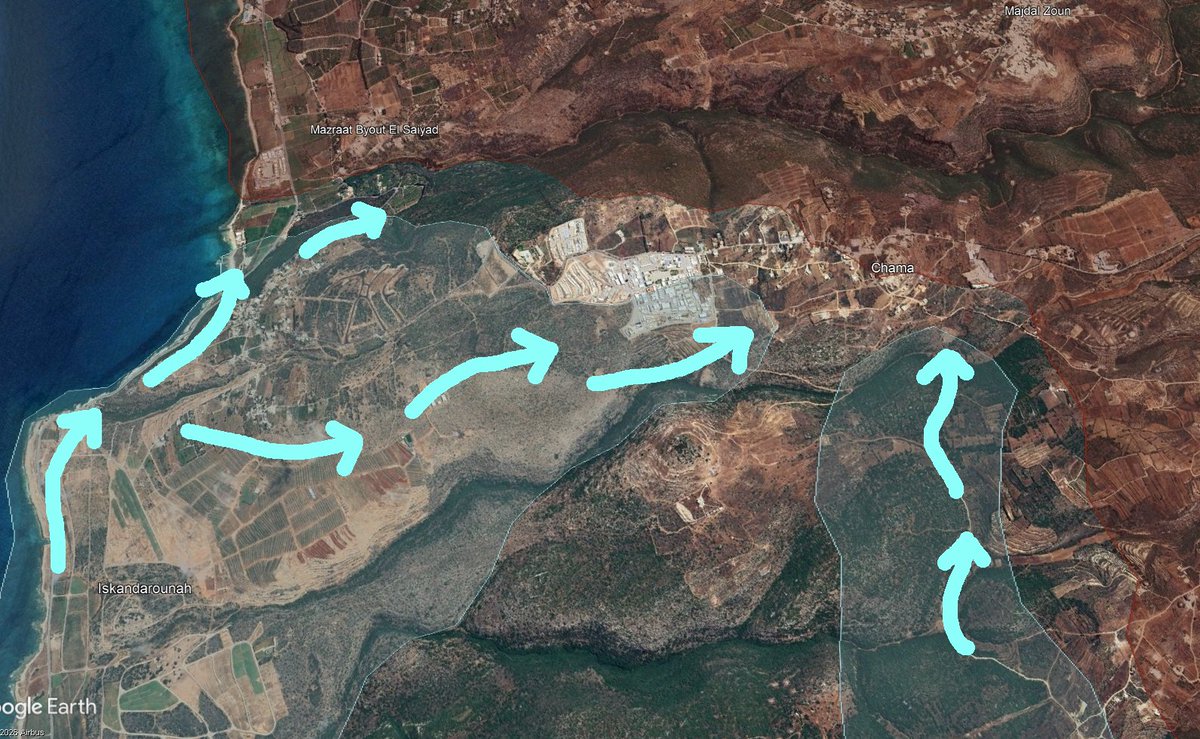
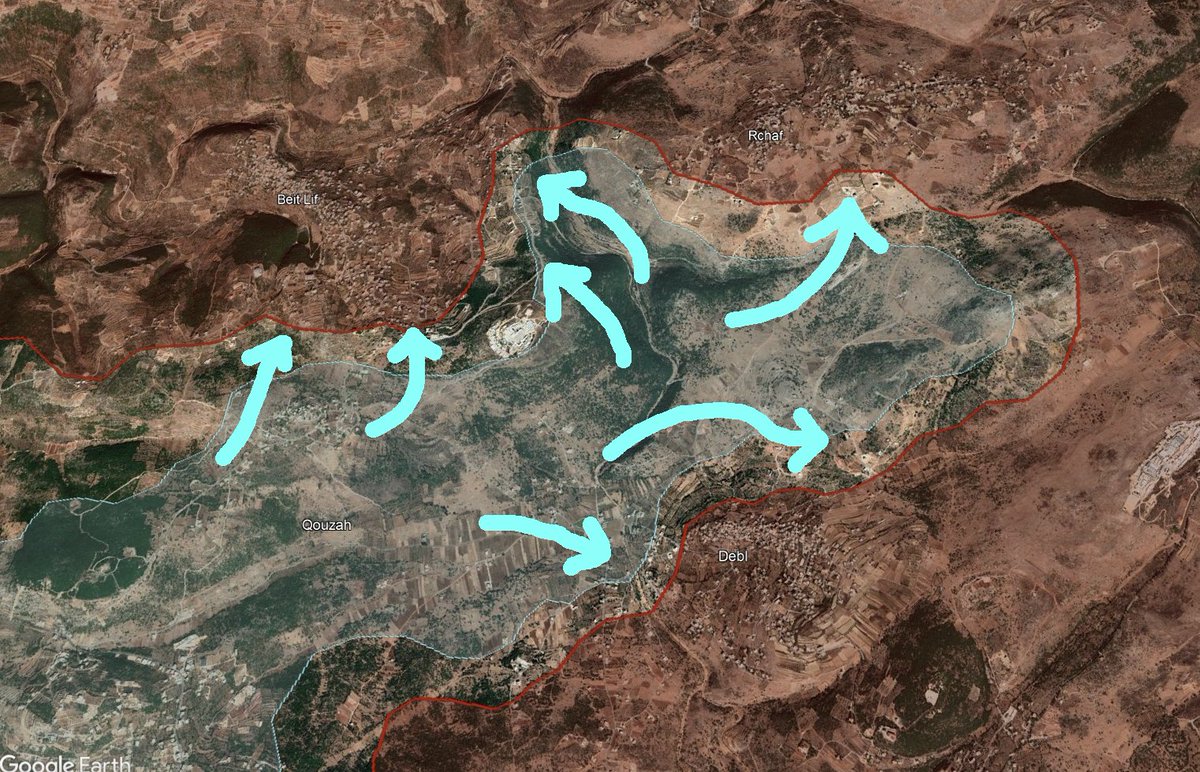
🧵Lebanon Update: Significant advances have been reported along four axes over the past 2 days.
> The 226th Reserve Paratroopers Brigade of the 146th Division deepened its advances along the Tyre coastal road, securing the entirety of al-Bayada. At the very least, the Black Vulture Anti-Tank Company of the 35th Paratroopers Brigade has been operating in conjuction with the 226th Brigade during the battles for Naqoura & al-Bayada. It is possible that reservists from the 202nd Battalion of the 35th Brigade have also been assigned to the 226th.
> In conjunction with these coastal advances, other elements of the 146th Division advanced past Aalma ash-Shaab and pushed through forestry, creaks, local roads, and the hamlet of Jejim, eventually arriving at the southern and eastern outskirts of Shamaa. Shamaa's flanks are now compromised due to this two pronged attack. Hezbollah (Aziz & Radwan) cells are simultaneously defending against advances from al-Bayada to the west and Jejim to the south.
> This leaves roughly ~10km^2 of open territory between the two Israeli attack vectors in limbo. Organized Hezbollah resistance in this area has dissipated, but there may be isolated fighters who were unable to withdraw. The hamlet of Hamoul and the nearby campsites haven't been cleared yet.
> Elements of the 401st Armored Brigade have deepened their infiltrations in the Beit Lif axis. Hezbollah is already firing ATGMs and mortars at Israeli forces pushing from newly established bases in al-Qouzah to southern Beit Lif. IDF has also established a corridor along Debel's western/northern outskirts that allows them to access large swathes of open fields, forested areas, and streams.
> IDF has galvanized on these forward positions north of Debel in several ways. First of all they pushed past Ain el-Aayoun and are already clashing with Hezbollah cells in eastern Beit Lif. They're also approaching the southernmost houses in Rchaf, northwest of Birket al-Hajar.
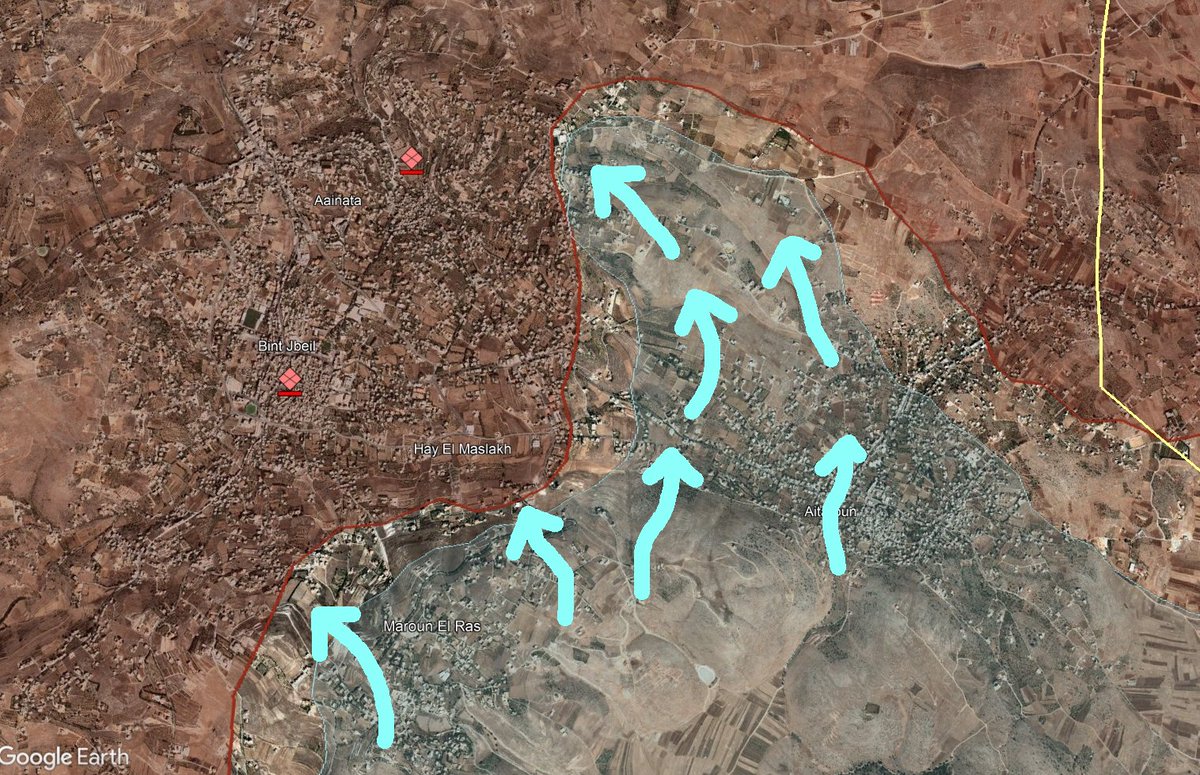
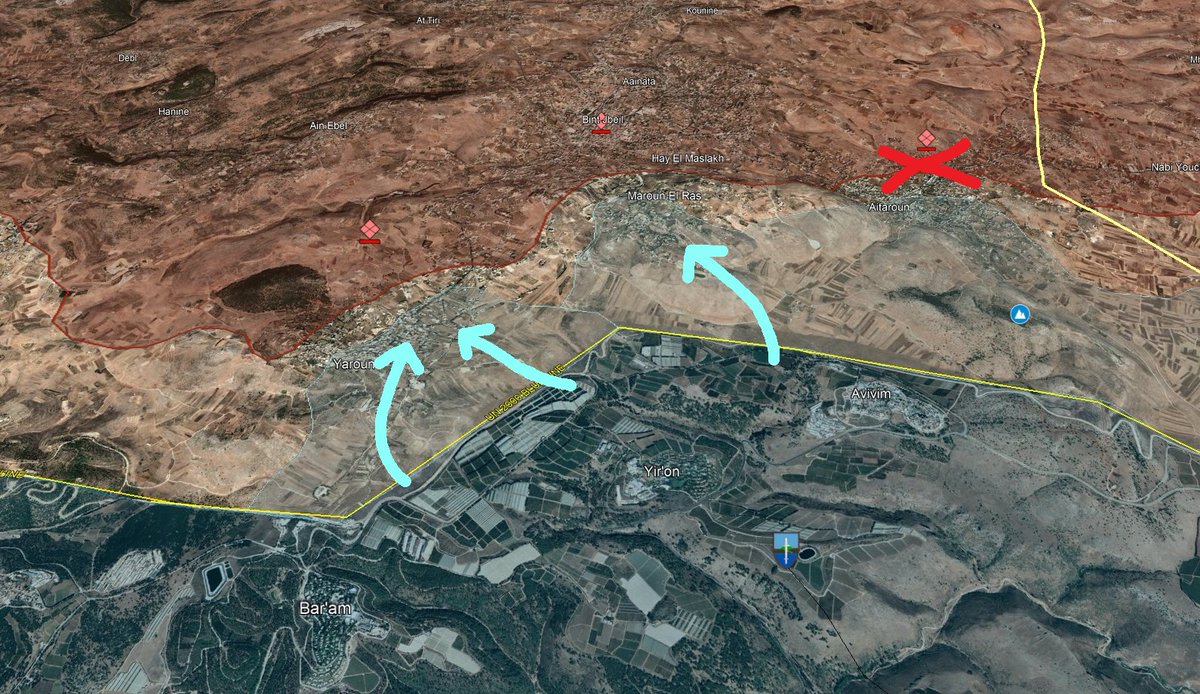
> IDF's pincer manuever on Bint Jbeil is well underway. From the west IDF is only 4km away, but first has to clear vanguard forces in Hanine and At-Tiri. However, the eastern flank is far closer to Bint Jbeil. Elements of the 91st Territorial Division largely cleared Aitaroun in part due to head on-advances from through the dense Khallaq neighborhood. But the more momentous attack vector originated from Jabal Kuhayl, just northeast of Maroun el-Ras.
> Maroun el-Ras is already under full IDF control and is being used as a springboard to attack Hay el-Maslakh. The 91st is also pushing northwards along the ridges east of Maroun el-Ras, cutting off the Marjayoun-Bint Jbeil road and occupying the rural areas east of Aainata.
> Hezbollah confirmed this advance, saying that Israeli forces pushed from Tallet Ghidmassé (a notable height that is similar in elevation to much of Bint Jbeil) into the eastern outskirts of Aainata, including the Martyrs Stadium. Hezbollah claims they ambushed the Israeli infantry with IEDs, ATGMs, small arms, and hit 2 Merkavas with FPV drones.
Lebanon Update: Many advances, troops deployments, and new footage to go through: 👇
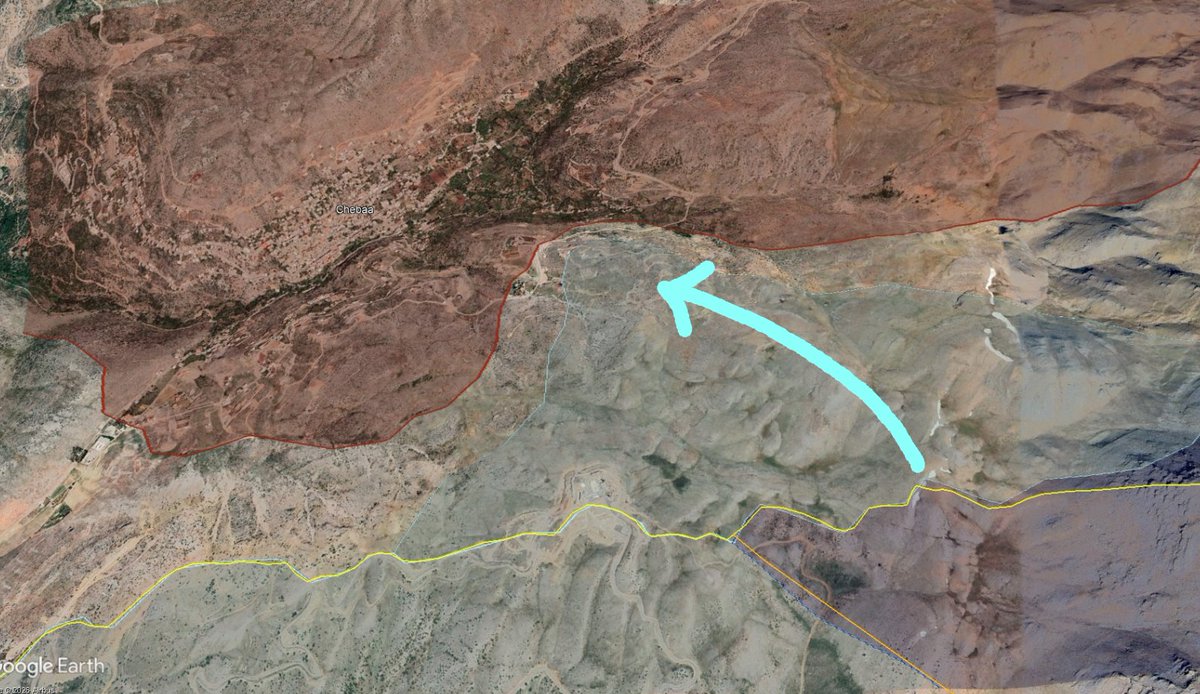
> The 810th Mountain Brigade advanced 1.7km past the Lebanese border and started combing operations along the eastern outskirts of Chebaa. Geolocated footage shows the 810th Brigade demolishing a house on the eastern ridge overlooking the town. (x.com/MarioLeb79/sta…)
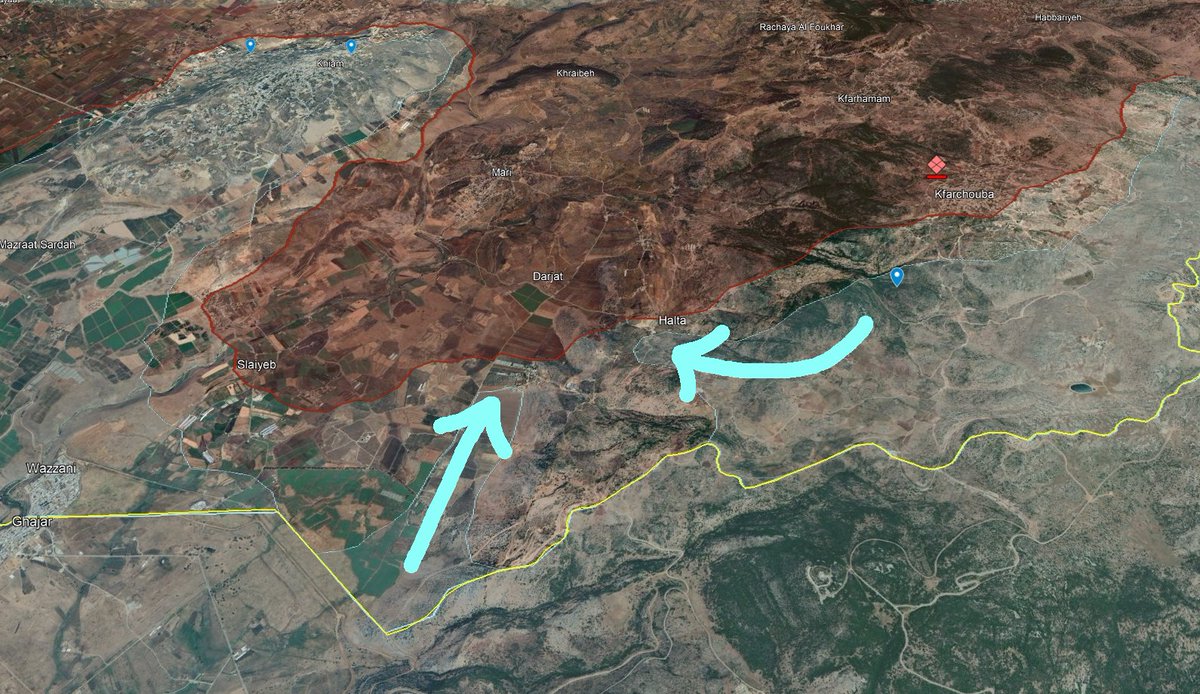
> In recent days the 810th Brigade also expanded its presence southwest of Kfarchouba all the way to the forested height in the Shanouh area, overlooking Halta.
> Local media and administrative sources reported an IDF raid into Halta in early March 24th. Israeli soldiers entered several houses and kidnapped one person. On March 23rd the IDF also entered houses and farmland in the Khansa Valley, south of Darjat.
> The Israeli troop deployments across the easternmost section of the Lebanese border is relatively thin but they've gradually expanded their buffer zone, locating tunnels and demolishing isolated structures. Hezbollah has barely mentioned this theater in their daily statements. This is because:
1) This front is disconnected from more substantial IDF advances into populated areas south of the Litani River
2) Sunnis make up the vast majority fo Kfarshouba and Chebaa. This isn't to say Hezbollah doesn't have local cells and infrastructure in these regions, but it's far less defined. IDF has other interests in these towns though do to their hostility to Jamaa Islamiya.
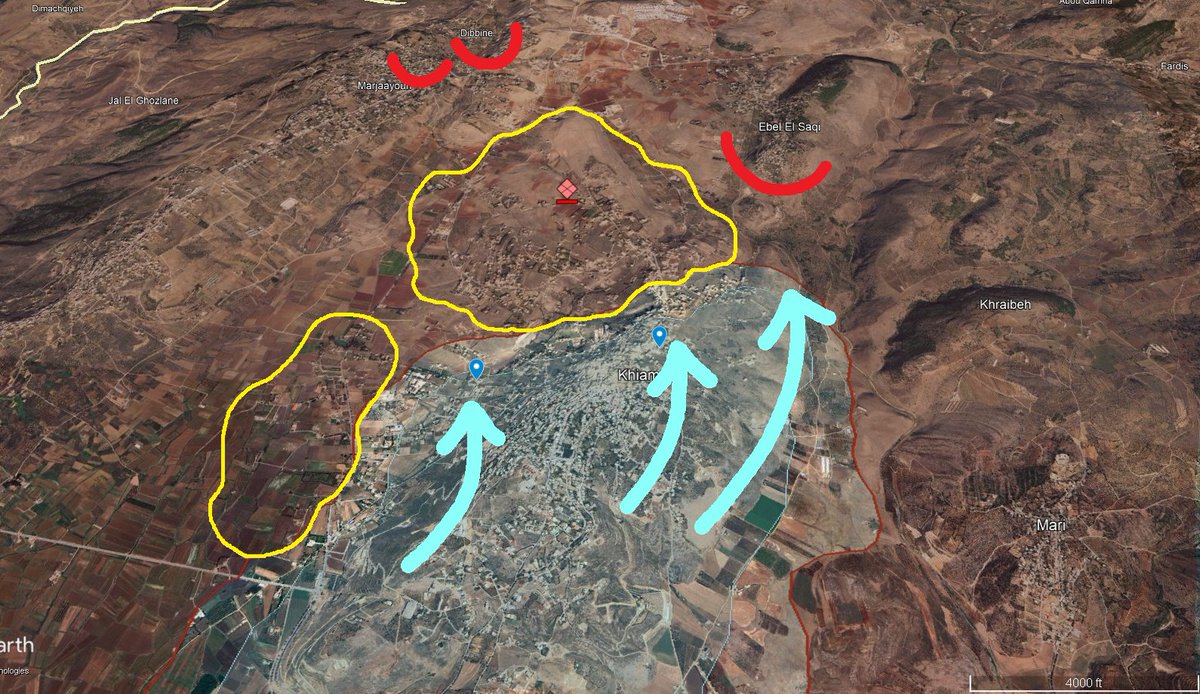
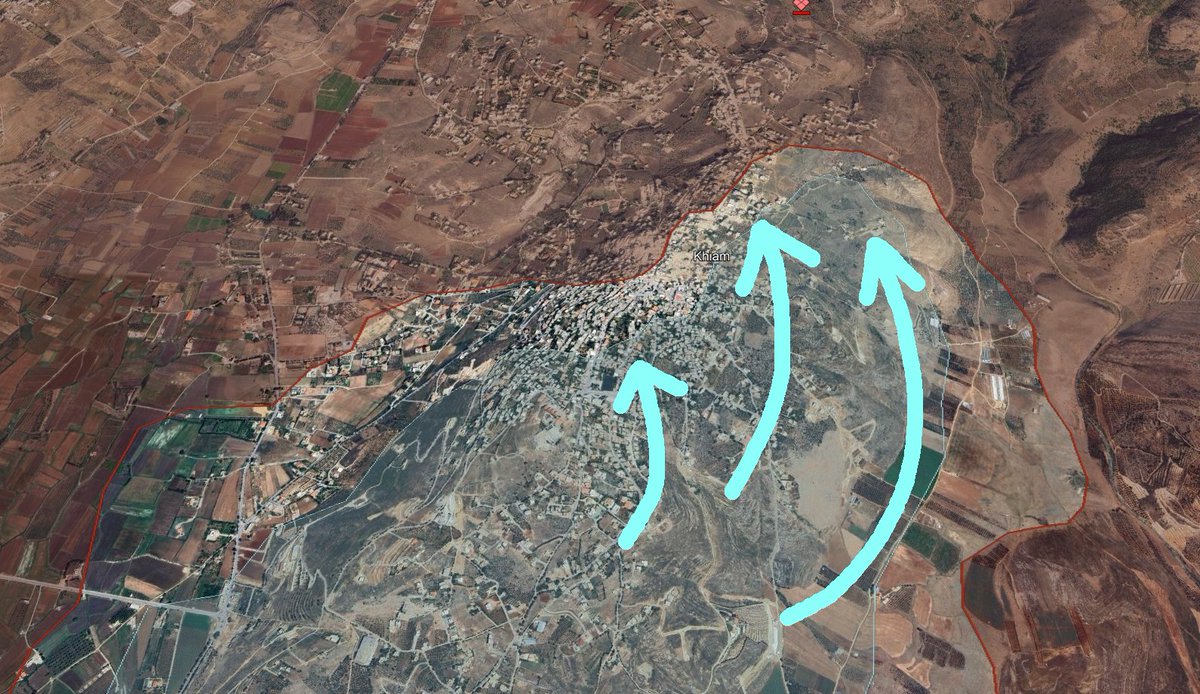
> IDF has seized the vast majority of al-Khiam. In recent days the 84th Givati Brigade (operating under the 91st Territorial Division) cleared the dense central neighborhood of the final Radwan cells. During combing operations Givati apprehended 2 Hezbollah fighters planning to launch anti-tank weapons.
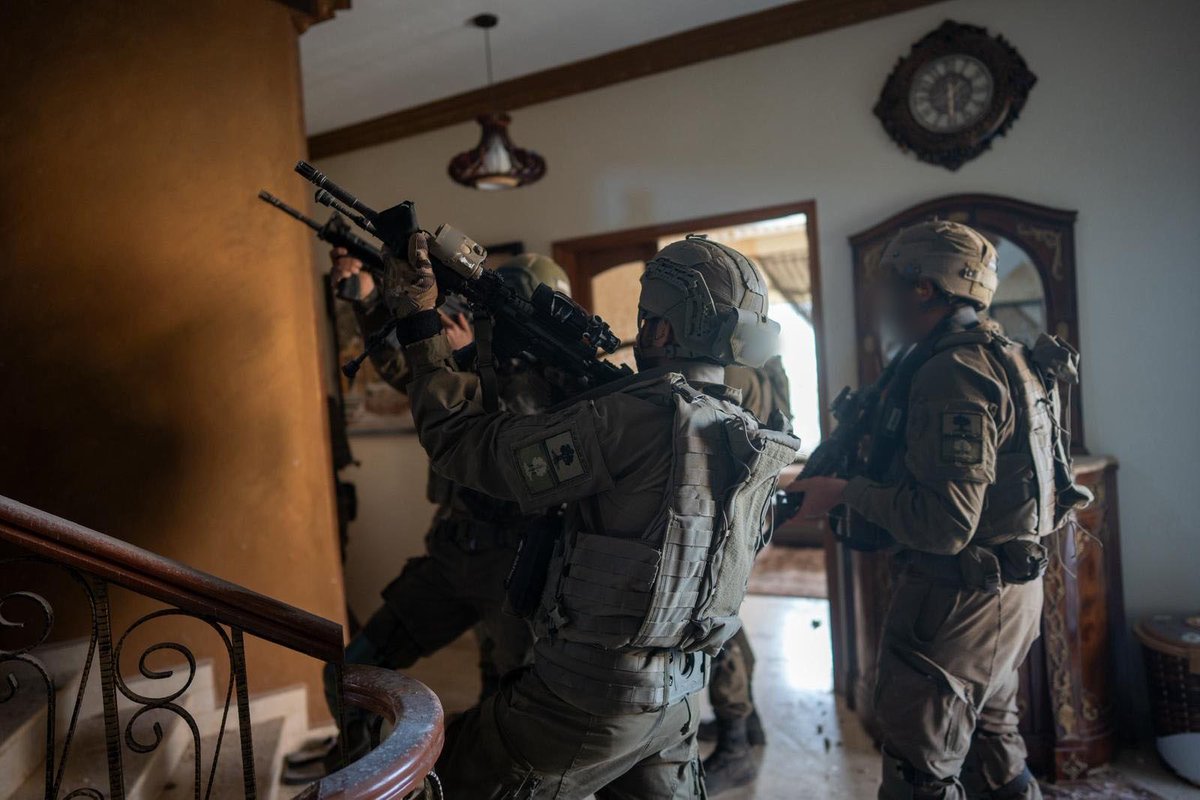
> IDF is already demolishing structures (including a minaret and highly-elevated houses) in central and eastern al-Khiam. Geolocated footage shows soldiers from Givati's 846th Patrol Battalion operating in the town's center with a tank convoy.
(x.com/Me1Ray/status/…)
> Hezbollah vestiges continue hiding and conducting hit-and-run attacks from the chalets in the western and northwestern outskirts of Khiam. These forces are trying to drag out the fighting so Givati can't push deeper towards Ebel al-Saqi, Dibbine, and northern Marjayoun. Israeli airstrikes also killed the commander of the Khiam sector, Muhammad Ali Asaf.
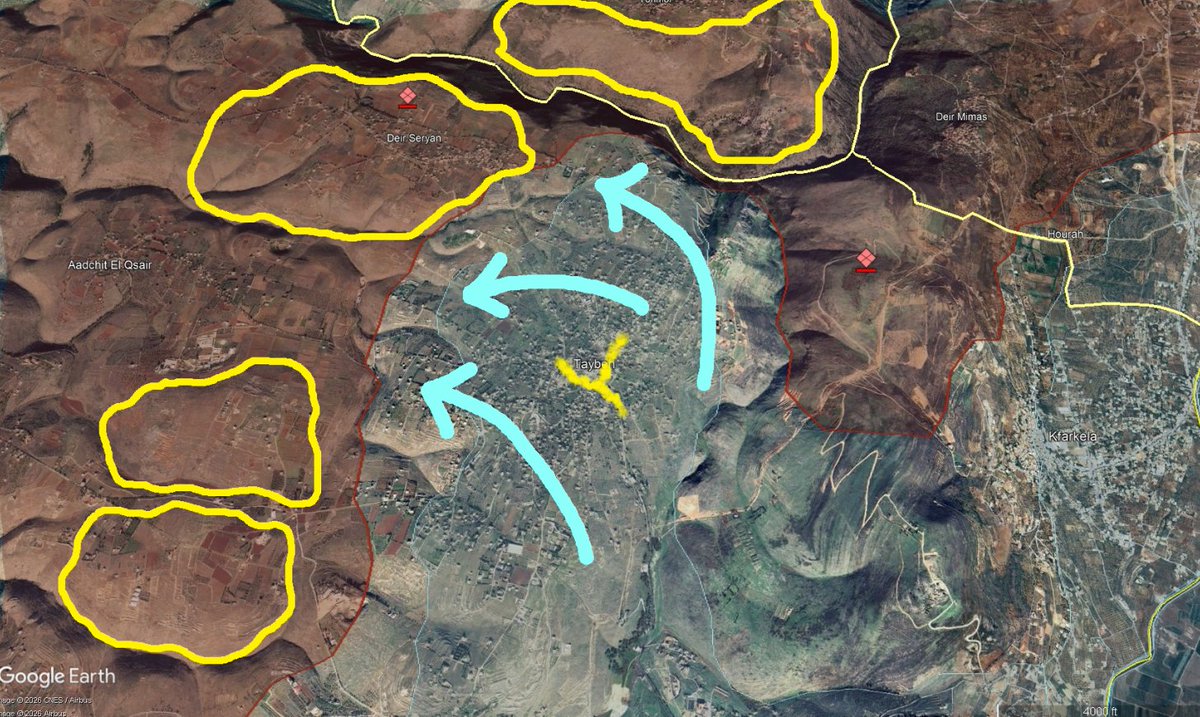
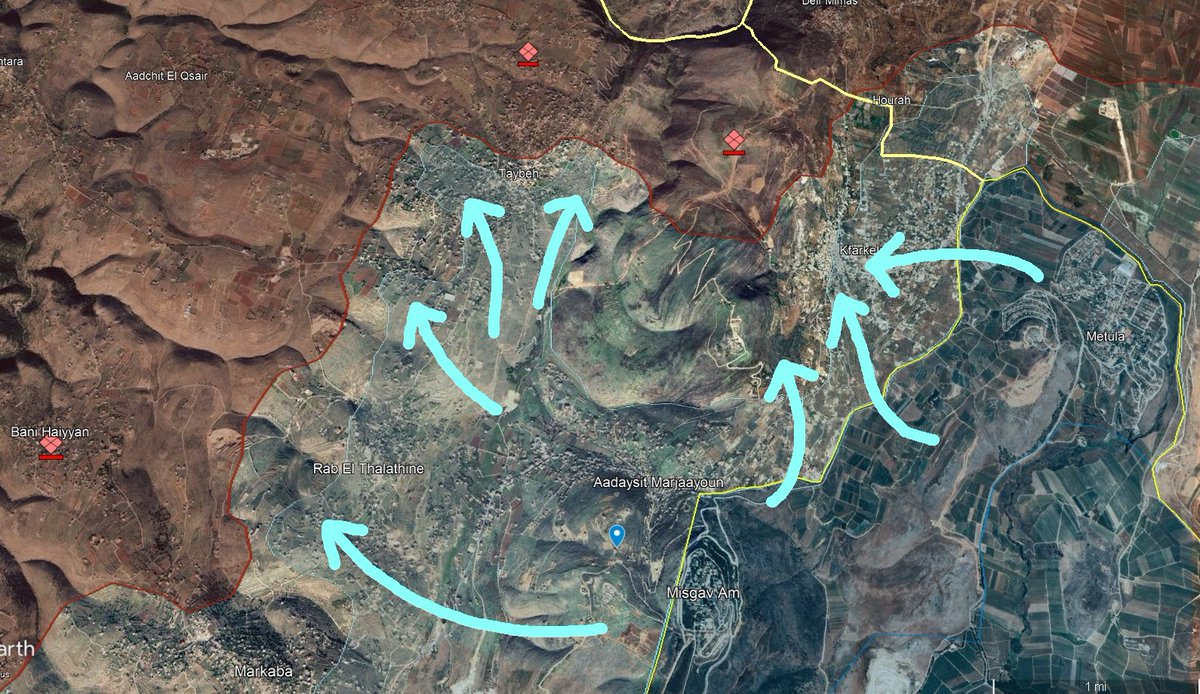
> The Golani Infantry and 188th Armored Brigades have largely taken over Taybeh. Large-scale demolitions of houses are already occurring in the town center. (x.com/Me1Ray/status/…)
> During the clashes in Taybeh last week, Golani uncovered tunnels and high-elevated staging points with ATGMs, sniper rifles, Kalashnikovs, submachine guns, and grenades. Demolitions using pre-positioned explosive charges are a telltale sign that the IDF feels the surrounding regions have been sufficiently cleared of hostile cells. This is reaffirmed by Hezbollah's statement today that they targeted a D9 bulldozer in Baydar al-Faqani (northern Taybeh).
> Hezbollah fighters from the Radwan Force and Nasser Division have withdrawn to heights west of Taybeh in Deir Seryan and Qantara. They still control forward ATGM positions on the ridge north of the Litani River.
Lebanon Update: Notable changes across most axes over the past few days have now been confirmed
> 810th Mountain Brigade occupied sections of the Daf esh-Sheikh mountain peak on the Lebanese side of the border. From there they advanced towards the eastern outskirts of Chebaa and started demolishing chalets.
> The Lebanese Army advanced from its border positions around en-Nouqar (south of Chebaa). They regrouped around the town's entrance, the local pharmacy, and the municipal building.
> IDF continues pushing deeper into al-Khiam through the eastern part of the town and local roads on the far-eastern perimeter. The IDF is pushing into Khiam's northernmost neighborhood, Jlahiye, in an effort to sever the connection between the Radwan cells serving as a vanguard force and Ebel el-Saqi on the rear.
> An IDF compilation of air/drone strikes proved that the 869th Field Intelligence Battalion is involved in surveying Khiam. The 869th Battalion is subordinate to the 91st Territorial Division. This indicates that the 91st Division is still involved in some operations in Khiam, while the headquarters and most of the manpower has been moved to the Bint Jbeil region.
> The same IDF footage geolocated by @Me1Ray shows a tank firing at a Hezbollah cell hiding in a house in center of al-Khiam. This portion of the town very dense and contains winding alleyways and highly-elevated ATGM positions.
> Given the use of tanks it's possible elements of the 7th Armored Brigade of the 36th Division are involved in the advance. The only other option is that the 401st Armored Brigade of the 162nd Division is split between al-Khiam and Ayta ash-Shab.
> Hezbollah also acknowledges the Israeli presence in al-Khiam. They claim to have repelled an Israeli advance past the detention center.
> 36th Armored Brigade is clearing southern Kfar Kela. The advances originate from staging points in Metula and Odaisseh. There's still a small pocket of Hezbollah resistance in the far western part of the town, in the Qaitoule neighborhood.
> Forward Radwan cells are dragging out the fighting there in order to deny the IDF unabated access to Al-Awaida Hill, which would connect Taybeh to Kfar Kela. It would also open the gateways to the southern bank of the Litani River.
> IDF has taken over the majority of Taybeh via local routes originating from Odaisseh. IDF took over the Jabal Amel Project in southern Taybeh, and from there they're pushing the Al-Rihani area and the town's western outskirts. The town center is contested. Hezbollah claims they targeted Israeli forces in Taybeh 4 times today.
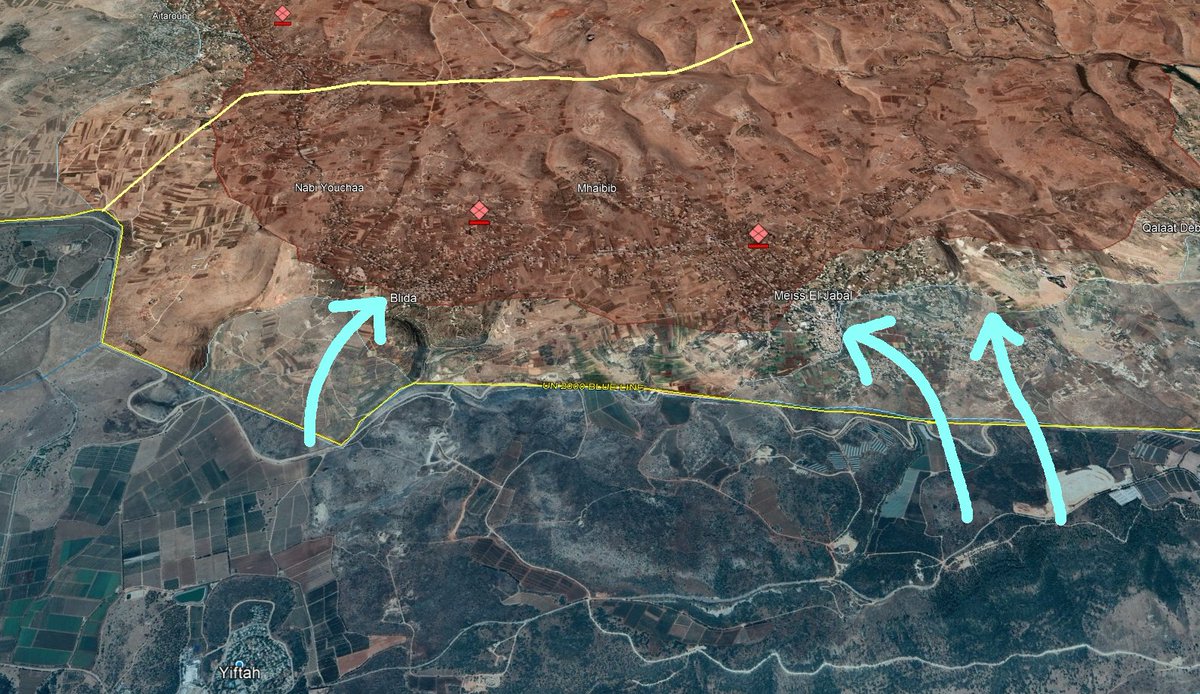
> IDF pushed deeper into the Jdeideh neighborhood in northern Meiss al-Jabal. They advanced along the Marjayoon-Bint Jbeil road & the Krum Almurah park. The current focus is on infiltrating or squeezing Hezbollah out of the dense town center. There was also a minor incursion toward Blida's outskirts from the Yiftach post to the east.
> No new IDF progress past the Al-Khanouq neighborhood in southern Aitaroun. The 91st Division has advance from the hills to the east into Maroun el-Ras itself.
> The cutoff point between Maroun el-Ras and Hay el-Maslakh is rather arbitrary, but it seems like the IDF's operational objective is to advance along the slight less dense southeastern outskirts of Bint Jbeil so they can launch a two-pronged attack on the stronghold from both Maroun el-Ras and Aitaroun.
> Israeli armored vehicles crossed the Lebanese border around Ein el-Khirba and advanced from south to north along Yaroun's main road, bypassing most of the houses located east of the road.
Really important thread🧵👇
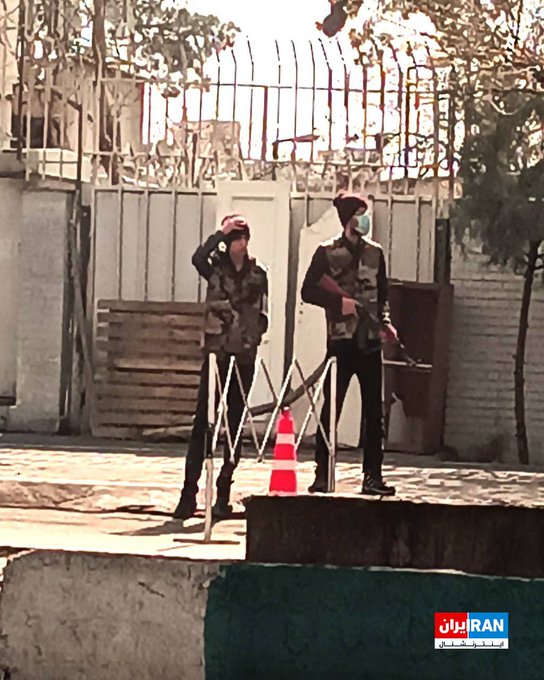
Israel appears to be setting conditions for a revolt in Tehran. UAVs have struck targets since day one, but tonight they reached a new zenith. There is a particular emphasis on monitoring and striking checkpoints set up in Tehran, Karaj, and Varamin.
The roadblocks, checkpoints, and newly formed military deployment points were set up by the following Iranian security organs:
- Basij 1. Imam Ali Battalions (meant to counter street protests) 2. University Basij Cadets
- FARAJA 1. Iranian Prevention Police 2. Iranian Public Security Police 3. Iranian Police Special Units 4. Greater Tehran Police Command 5. Traffic Police
IRGC 1. IRGC Intelligence Organization 2. IRGC Ground Forces
(Credit to @INTELonIRAN for compiling these images)
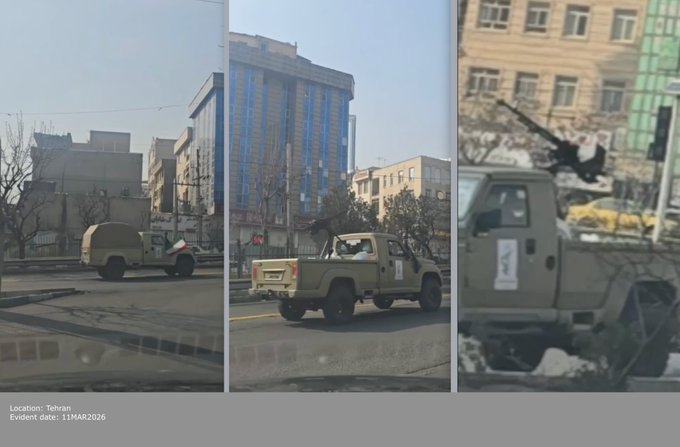
These security forces set up checkpoints along highways and neighborhood entrances. FARAJA, IRGC, and Basij deployed technical vehicles mounted with machine guns at key sites in the city center. Hermes-450/900 & Herons tracked these movements and targeted at least dozens of security posts.
The number cited by Fars News during the evening was 29, and it certainly increased since then. Fars also reported that these drone strikes killed at least 10 IRGC/Basij personnel. Again, Israel likely used Herons and Hermes to launch precision-guided attacks. Harop loitering UAVs are another option.