What you see here is called "lying"
It's what happens when someone's anti-competitive protections are under attack
CON laws are insane. Basically:
If you want to open a new medical practice somewhere, you have to get your potential competitors to sign off, saying you're needed
It's what happens when someone's anti-competitive protections are under attack
CON laws are insane. Basically:
If you want to open a new medical practice somewhere, you have to get your potential competitors to sign off, saying you're needed
https://twitter.com/WVHospitals/status/2032101811058880759

If you want to add beds to a hospital, build facilities, purchase diagnostic scanners, but you live somewhere with CON laws, then you have to prove you're not creating competition for other medical facilities in the area, which is often the whole state.
No. Competition. Allowed.
No. Competition. Allowed.

The idea behind these laws is that people will spend excessively on healthcare, so to combat that, we'll have people report if there's more spending needed before approving it.
'A bed built is a bed filled' is the old adage.
But no one considered the obvious bad incentives.
'A bed built is a bed filled' is the old adage.
But no one considered the obvious bad incentives.

Who does the state ask to determine if an area has a 'need'? Local doctors, practices, and health departments, and sometimes the CON committee just makes up a judgment.
They ask your competitors if they need competition, and if they say no, then you cannot operate in their area.
They ask your competitors if they need competition, and if they say no, then you cannot operate in their area.
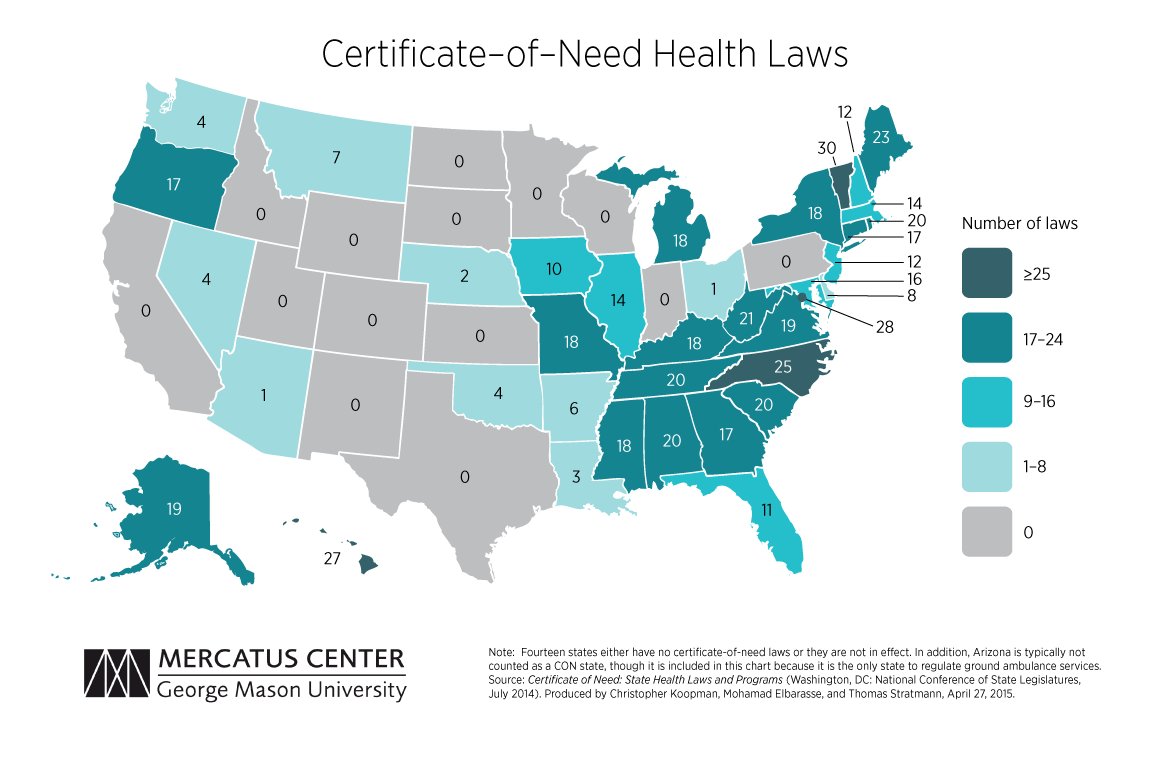
Places with CON laws have fewer hospital beds, fewer rural hospitals, greater drive times to get medical care, and higher cost medical care.
These laws have led to countless headlines like this, where a town tries to build a hospital and another hospital goes 'nah, fuck you':
These laws have led to countless headlines like this, where a town tries to build a hospital and another hospital goes 'nah, fuck you':

Cui bono?
In case it wasn't obvious, it's the people who get to say 'no' when the state asks if an area has medical need.
For example, hospital CEOs got a ~$91k/yr pay bump due to CON laws. In 2026, that's about ~$135k/yr from blocking competition and hurting the populace.
In case it wasn't obvious, it's the people who get to say 'no' when the state asks if an area has medical need.
For example, hospital CEOs got a ~$91k/yr pay bump due to CON laws. In 2026, that's about ~$135k/yr from blocking competition and hurting the populace.

IMO? Ban these laws nationally. They are anti-competitive and they hurt Americans while driving up medical costs and empowering unions to do more evil.
Sources:
mercatus.org/research/data-…
mercatus.org/research/worki…
nytimes.com/2018/09/05/us/…
pubmed.ncbi.nlm.nih.gov/21812351/
Sources:
mercatus.org/research/data-…
mercatus.org/research/worki…
nytimes.com/2018/09/05/us/…
pubmed.ncbi.nlm.nih.gov/21812351/
• • •
Missing some Tweet in this thread? You can try to
force a refresh