
CAUTION
/////////////
We have traded the language of "spirit possession" for the language of "disorder" and "biochemical imbalance." The terms are scientifically grounded, but they are wrongly used to perform the same externalization we once attributed to demons.
/////////////
We have traded the language of "spirit possession" for the language of "disorder" and "biochemical imbalance." The terms are scientifically grounded, but they are wrongly used to perform the same externalization we once attributed to demons.
From our neuropsychiatric and psychotherapeutic framework, here is how we "secularize" the demon:
1. The "Disease" becomes an Alien Agent
When we speak of addiction as a "brain disease" or depression as a "chemical imbalance," we provide necessary medical context.
1. The "Disease" becomes an Alien Agent
When we speak of addiction as a "brain disease" or depression as a "chemical imbalance," we provide necessary medical context.
However, patients often use this as a modern form of Splitting through the narrative: "It’s not me, it’s my Depression." "It’s not my choice, it’s my Addiction talking." As a result, this creates a distance between the individual's identity and their behavior.
That might reduces paralyzing shame (a positive), but it can inadvertently create a "secular demon", an invisible, external force that "attacks" the person, leaving them as a passive victim of their own biology.
2. The Pathologizing of the Shadow
In a therapeutic sense, we treat "Anxiety" or "Trauma" as monsters to be "defeated" or "managed." By turning these internal states into nouns (The Anxiety, The Trauma), we turn them into entities.
In a therapeutic sense, we treat "Anxiety" or "Trauma" as monsters to be "defeated" or "managed." By turning these internal states into nouns (The Anxiety, The Trauma), we turn them into entities.
The neuropsychiatric reality tells us that anxiety isn't an entity; it is the Autonomic Nervous System performing a high-arousal survival function. When we externalize these states, we incur the risk to stop listening to what they are trying to communicate about our environment
or our history. We treat them as "bugs in the code" rather than "signals from the system." To overcome that, we need to start a journey on the path of integration from projection to sovereignty
If the "Demon/Disease" narrative trades vulnerability for terror,
If the "Demon/Disease" narrative trades vulnerability for terror,
the "Integration" narrative trades terror for sovereignty. Integration is the process of reclaiming the "monstrous" parts of our biology and recognizing them as functions of the Self.
We do it first with linguistic shifts from nouns to verbs, by changing how we
We do it first with linguistic shifts from nouns to verbs, by changing how we
speak. Instead of: "My Anxiety is acting up" (External Agent) we say "I am feeling anxious" or "My nervous system is currently in a state of high arousal" (Internal Function). The benefit of changing the way we speak is found in the fact that
we acknowledges that the feeling is a part of your current biological reality, not an intruder. You cannot negotiate with a "demon," but you can regulate a "feeling."
Morevover, we can somatically internalize ad befriend the "Monster". In psychotherapy, particularly in
Morevover, we can somatically internalize ad befriend the "Monster". In psychotherapy, particularly in
Internal Family Systems (IFS) or Somatic Experiencing, we stop trying to "exorcise" the symptom. We rather ask the "demon" (the addiction, the rage, the fear) what it is trying to protect. Usually, these "monsters" are primitive survival mechanisms.
The "demon" of addiction might be a desperate attempt to numb unbearable pain; the "demon" of rage might be a boundary-protector that was over-activated in childhood. When you recognize the "demon" as a misguided protector, the need to "fight" it diminishes.
You begin to integrate its energy back into your conscious control.
Integration requires the ego to accept that it is not "all good." The neuropsychiatric goal is to strengthen the Prefrontal Cortex (PFC) so it can witness the impulses of the Limbic System without being hijacked
Integration requires the ego to accept that it is not "all good." The neuropsychiatric goal is to strengthen the Prefrontal Cortex (PFC) so it can witness the impulses of the Limbic System without being hijacked
by them or disowning them. The result is that you move from saying "A demon made me do it" to "A part of my biology felt threatened and reacted with aggression; I am responsible for that reaction and will work to regulate it."
On this path, it is necessary to accept
On this path, it is necessary to accept
vulnerability and randomness, which is the final stage of the integration, and the most difficult. The final stage is to accept that we are biological organisms in an indifferent universe and that this is perfectly ok.
At that point we finally are able to move away from the "Meaningful Terror" (The Universe is out to get me/God is mad) toward Radical Acceptance. At that point we finally become sovereign and we can say in total calmness,
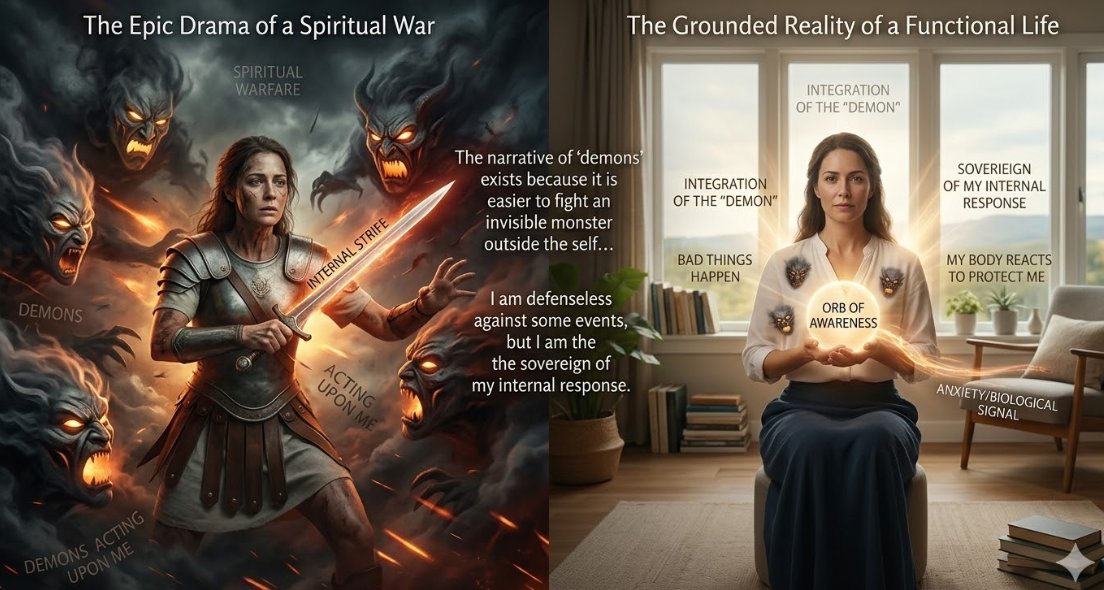
"Bad things happen, and my body reacts to protect me. I am defenseless against some events, but I am the sovereign of my internal response."
That's the integration of the "demon". You lose the epic drama of a spiritual war, but you gain the grounded reality of a functional life.
That's the integration of the "demon". You lose the epic drama of a spiritual war, but you gain the grounded reality of a functional life.
@threadreaderapp unroll
• • •
Missing some Tweet in this thread? You can try to
force a refresh




