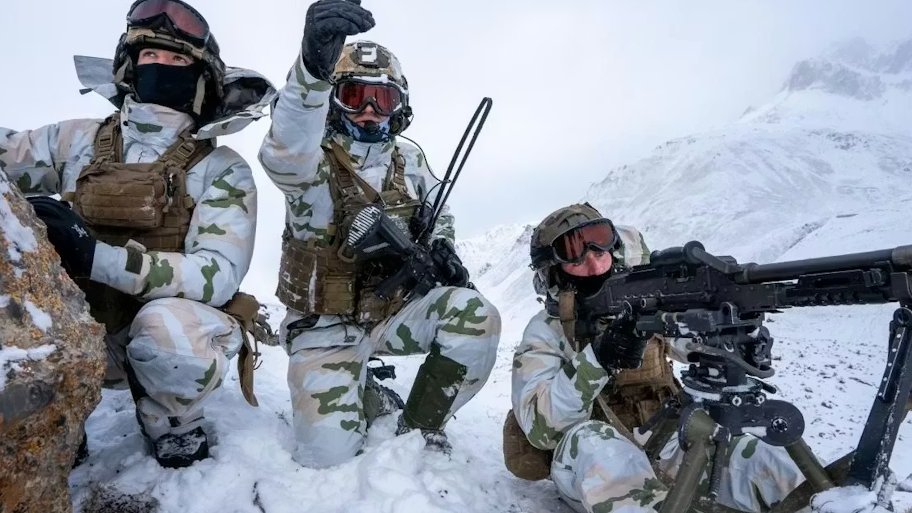
1/ Denmark was reportedly preparing for full-scale war with the US over Greenland in January, with military support from France, Germany, and Nordic nations. Elite troops and F-35 jets with live ammunition were sent, and runways were to be blown up to prevent an invasion. ⬇️
2/ The Danish public broadcaster DR reports that officials in Denmark, France and Germany say that Donald Trump's threats to seize Greenland were taken so seriously that wide-ranging preparations were made to forcibly resist a US invasion of the Danish island.
3/ The Danish and French governments worked together to create a northern European coalition to defend Greenland from the United States. Under the cover of a pre-planned defence exercise, Greenland's defences were bolstered to raise the costs of any US invasion attempt.
4/ This included sending blood to treat wounded soldiers; sending elite Danish troops and French alpine troops to Greenland; preparing Greenland's runways for demolition to prevent a Hostomel-style seizure; and sending armed F-35 jets to patrol the skies.
5/ The trigger for this, according to DR, was the American attack on Venezuela on 3 January 2026 in which President Nicolas Maduro was abducted and taken to the US.

6/ According to a source, "When Trump keeps saying he wants to take over Greenland, and then what happened in Venezuela, we had to take all scenarios seriously."
7/ The US attack on Venezuela also convinced the governments that "the official US is not functioning as usual", which had to be taken into account in their threat assessments.
8/ "Trump doesn't have the same level of people around him as before who would talk him out of it. It's super dangerous," says the source.
9/ As well as alpine troops, France also sent a warship and refueling aircraft, pledged hundreds more soldiers, and expressed willingness to send anything else the Danes needed. Sweden, Norway, and the UK also sent military support to Greenland.
10/ As a source puts it, the French said: "Would you like more soldiers? You could have them. Would you like more naval support? You could have that. Would you like more air support? You could have that too."
11/ Sources that "the goal of having soldiers on land in Greenland – with as many different flags on their shoulders as possible – was ... so that the Americans would be forced to take a major hostile action if Donald Trump actually wanted to occupy Greenland militarily."
12/ Denmark chose to capitulate to the Nazi invasion of April 1940, but has vowed not to repeat that experience. Danish soldiers are under standing orders to resist with force any foreign incursions on the territory of the Kingdom of Denmark, which includes Greenland.
13/ The deployments made it clear that any attempt to seize Greenland would have consequences of the utmost seriousness, including shattering NATO, destroying the relationship between Europe and the US, and causing significant loss of life to US forces.
14/ Although this persuaded Trump to back down and Greenland has since faded from the headlines, the Danish government assesses that the US still poses a continuing threat to the island, according to a high-ranking source quoted by DR.
15/ "This is not over. Trump is here for three more years. And no matter what happens, the distrust and challenge to the [Danish] Commonwealth will persist as long as he has set out to go down in history by expanding the territory of the United States." /end
1/ Has Iran managed to reinvent the Sound Dues – the tolls that Denmark imposed for over 400 years on ships entering the Baltic Sea? Recent ship movements suggest that rather than completely blocking the Strait of Hormuz, Iran is monetising it instead. ⬇️
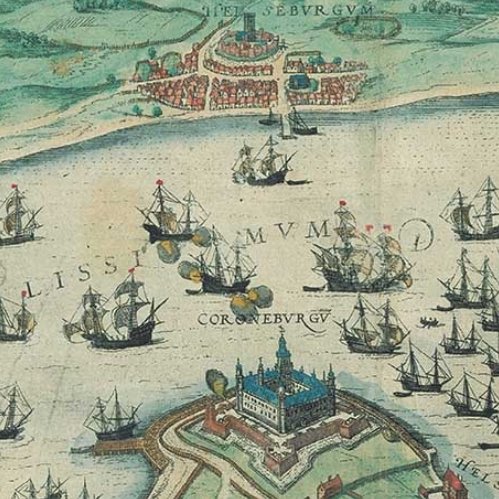
2/ Between 1429 and 1857, Denmark levied a toll on ships passing through the Øresund, the body of water separating Denmark from Sweden. At the time, Denmark controlled both sides of the strait with the castles at Helsingør (Hamlet's Elsinore) and Helsingborg.
3/ The tolls were enforced by the cannon batteries in both castles, which could open fire on a ship trying to pass without authorisation and sink it. They were calculated on the basis of a ship passage fees plus 1–2%, sometimes up to 5%, of the declared cargo value.
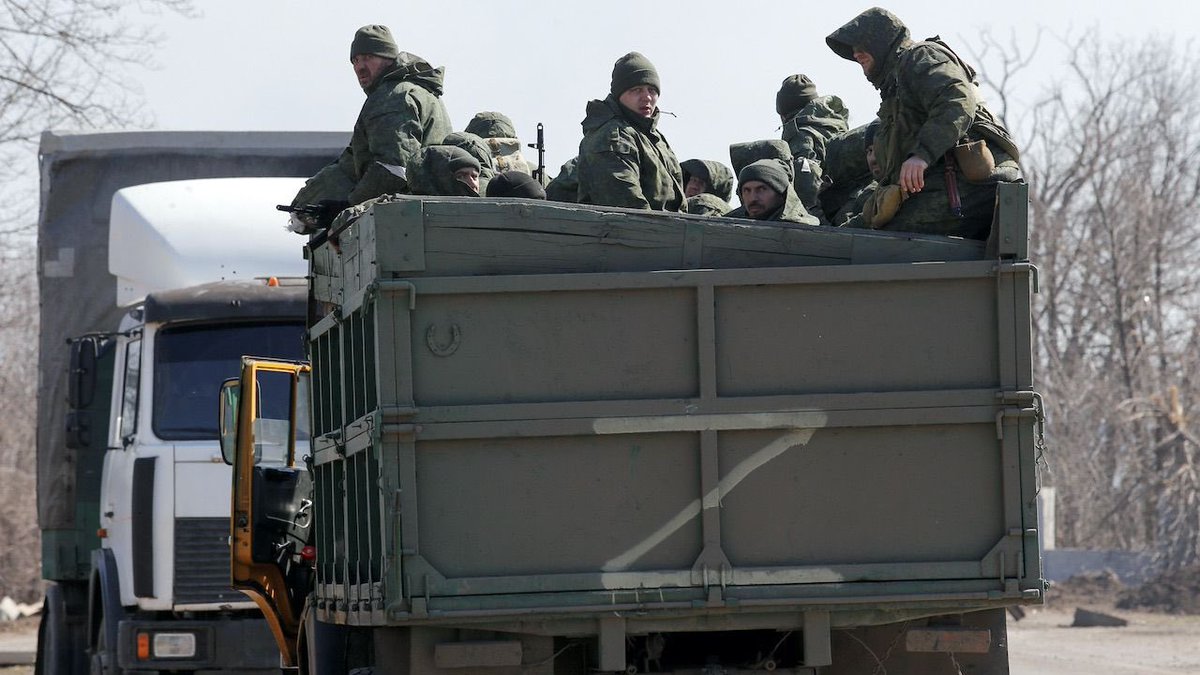
1/ Russian soldiers are now divided into two 'castes', says a front-line soldier: "short-livers", who die almost immediately after being sent to the front in Ukraine, often as a punishment, and "long-livers", the privileged ones in the officer cadre and rear areas. ⬇️
2/ A Russian soldier in Ukraine writes to the 'Ramsay' Telegram channel:
"Everyone today understands the brutal nature of today's war, where two "castes" of participants have effectively emerged—as in [Ivan] Efremov's novel "The Hour of the Bull"—the "KZhI" and the "DZhI."
3/ [Note – This refers to a 1968 science-fiction novel in which a dystopian society is rigidly divided into two castes: 'short-livers' (the working underclass doomed to hard labour and ritual death around age 25–27), and 'long-livers' (the intellectual elite who live long, privileged lives) – compare the Morlocks and Eloi in H.G. Wells' 'The Time Machine'.]
1/ Russia faces increasing difficulties in its war in Ukraine, comments a Russian warblogger, including a build-up of Ukrainian offensive capabilities, a military system that weeds out "energetic, proactive people", and the likely loss of Trump's assistance after the midterms. ⬇️
2/ 'Voenkor Kotenok' writes that a new sense of realism is setting in among the 'turbo-patriots' who promote the Russian government's talking points on TV:
"Our TV show 'stars' are accustomed to convincing viewers that the enemy in Ukraine is almost defeated."
3/ "But by the beginning of the fifth year of the Special Military Operation, such enthusiastic utterances as "We'll just raise an eyebrow!" or "We'll crush you in three days" are no longer heard on the idiot box. The talkers haven't dried up, but they've reformed themselves.
1/ It's very hard to win a war with a strategy that is built on bullshit. This was one of the key lessons of World War II, thanks to the approach taken by Adolf Hitler, who launched the war in Europe. Here are some of the lessons from Hitler's Great European Bullshit War. ⬇️
2/ Harry Frankfurt's famous essay "On Bullshit" draws a crucial distinction that is useful to consider here. A liar knows the truth and deliberately inverts it. A bullshitter is entirely indifferent to truth – what matters is the effect produced and the audience managed.
3/ It mustn't be forgotten that Hitler's rise to power was based on bullshit. His Dolchstoßlegende — the stab-in-the-back myth, blaming Germany's WWI defeat on Jews and socialists rather than military failure – was entirely invented, an early example of the Big Lie technique.
1/ Pro-government Russians shouldn't be excessively disappointed by the Putin regime's repressive behaviour in recent months, says drone manufacturer Alexey Chadayev. He argues that that's how it's always been in Russia and nobody should expect any different. ⬇️
2/ Chadayev is the Director General of Russia's Ushkuynik Research and Production Centre (NPC Ushkuynik). He comments on recent complaints by previously pro-government commentators about the blocking of Telegram and the Internet shutdowns in Moscow and St Petersburg:
3/ "On the topic of 'disillusioned patriots' (I'm not talking about weathervane lawyers, in case it's unclear, but about the threat of 'loss of motivation' among government supporters, a topic that has been much discussed by various commentators in recent days).
1/ While the world's eyes are elsewhere, the long-running water crisis in Donetsk is continuing. An account from Russian warblogger Dmitry Steshin highlights how residents of what had been one of Ukraine's most developed cities are living now. ⬇️
2/ Since 2022, much of the occupied Donetsk and Luhansk regions have been experiencing a severe water shortage. Cities have faced water rationing, while outlying towns and villages have often had no water at all.
3/ The root cause of this is a combination of war damage to the canal that provided pre-war Donetsk with water, the source of which is in Ukrainian-held territory near Kramatorsk, and decrepit infrastructure which has gone unmaintained due to corruption.