Christophe Dorigné-Thomson Profile picture
Mar 19 32 tweets 5 min read Read on X
Breaking the Colonial Frame at the United Nations: A Thread

1/ A report now formally lodged within the UN system @UN, submitted to the UN Secretary General António Guterres @antonioguterres by the Chinese non-profit International Probono Legal Services Association (IPLSA) based in Hong Kong, China, with Liberation Scotland and several partners, reframes Scotland not as a “region” of the UK, but as a case of decolonisation. Scotland is an English colony.

IPLSA has Special Consultative Status at the United Nations Economic and Social Council (ECOSOC). The significance of its support for Scotland is tremendous, notably geopolitically. Former colonised people recognise other colonised people.

This is legal positioning not commentary.🧵
2/ This document has crossed a decisive threshold:

-Circulated at the UN Human Rights Council (61st session)
-Received by the UN Secretary-General
-Entered into official UN procedures

The whole world can read it online on the official United Nations website.

Scotland has been inserted into the architecture of international law.
3/ For decades, one narrative dominated:

“Scotland freely chose and continues to choose the Union”. It's a colonial lie created by the English colonial state.

This report fractures that narrative at its core. Scotland did not enter into a "voluntary union" and is a "decency" i.e. an English colony.
4/ It replaces political storytelling with legal analysis; a colonial fiction with the truth.

Scotland is examined not through British i.e. English constitutional language, but through the framework used globally to assess colonial situations.
5/ Within that decolonisation and international law framework, the conclusion is stark:

Scotland aligns with recognised patterns of territorial subordination under a dominant, colonial state.
6/ This is the strategic breakthrough.

Once a situation is read through international law rather than domestic mythology, the entire terrain shifts.
7/ The report dismantles the central pillar of the UK’s position i.e. the position of the English coloniser :

the idea that devolution equals self-government.
8/ Instead, devolution is revealed as a managed system of delegated authority.

Power is distributed, but never transferred.
Control remains structurally centralised. Scotland remains annexed and plundered by the English colonial state.
9/ In plain terms:

Scotland administers (certain domains given the highly colonial existence of "reserved matters"). The English state decides.

That is not sovereignty but colonial supervision.
10/ This reflects a wider global pattern.

Across multiple territories, limited autonomy has been used to stabilise domination, not to dismantle it. What is particularly shocking with the case of Scotland is that the English colonial state has managed to mostly hide its annexation and territorial alienation of Scotland until now. But Liberation Scotland, Scotland's liberation movement, with Professor Robert Black King's Counsel, Scotland's leading law authority, has proven annexation. This must be judged on the international stage.
11/ The report identifies this clearly:

internal arrangements operate within boundaries defined by the dominant power.

Freedom is simulated. Authority is retained. Scotland is enslaved by the English colonial state.
12/ From this follows a crucial legal conclusion:

internal self-determination, under such conditions, cannot resolve the situation. Scotland is a sovereign state illegally occupied by another state, the English colonial state.
13/ The only coherent pathway, grounded in UN doctrine, is:

external self-determination.

The recognised route of decolonisation in international law. This is the road for Scotland to be free and sovereign again.
14/ This is not rhetoric.

It is anchored in:
-UN Charter Article 1(2)
-UN General Assembly Resolution 1514
-UN General Assembly Resolution 1541

These are the foundations of modern decolonisation.

The English colonial state should have reported Scotland as a non-self governing territory i.e. a colony in 1946/48 under the UN Charter. Instead the English coloniser has created a fiction of a "voluntary union".
15/ The implication is decisive:

Scotland’s status cannot be settled within the constitutional order that defines and limits it. Westminster is illegitimate in Scotland and unlawfully intervening in Scotland. Scotland is a matter of international law.
16/ Another key dimension:

Scotland is not only colonially governed, it is strategically instrumentalised (and plundered as we know, Scotland being the most resource-rich nation in Europe).
17/ The presence of nuclear weapons at Faslane illustrates this clearly.

Decisions of existential consequence are imposed, while risks are borne locally. Nuclear presence in Scotland should only be a sovereign Scottish decision. (Not even mentioning nuclear pollution and contamination in Scotland).
18/ This is a familiar structure in colonial configurations:

The colonial centre concentrates power. The colonised, annexed territory absorbs exposure.
19/ The report then advances a concrete institutional pathway:

consideration of Scotland as a Non-Self-Governing Territory i.e. a colony listed as such by the United Nations.
20/ Such recognition would trigger:

- Formal acknowledgment within the UN system
-Legal responsibilities under Article 73
-International monitoring of the decolonisation process
-Global interest

This is procedural leverage at the highest level.
21/ For decades, this classification has been avoided.

Now it is reintroduced, formally, within UN space. Once again, Scotland should have been classified as a colony by the UN in the 1950s. The English colonial state created a fiction and a lie instead about a "voluntary union".
22/ The most profound shift is this:

Scotland is no longer confined to a domestic, English constitutional question.

It is repositioned as an issue of international concern.
23/ Once internationalised:

-External actors can engage
-UN bodies can intervene
-Legal scrutiny replaces narrative control
-The international community can see the truth

The monopoly of interpretation is broken.
24/ The cumulative effect is severe for the established narrative:

-“Voluntary union” is destabilised. It's an English colonial construction
-Devolution is reinterpreted. It's simply part of England's colonialism in Scotland
-Internal self-determination is insufficient and rigged

A different legal reality emerges.
25/ That reality is structured, comparative, and grounded in law. International law.

Not slogans. Not sentiment.

But doctrine. (By the way, the Treaty of Union is international law since it was signed between sovereign states. But England never implemented the Treaty used to colonise Scotland.)
26/ This document therefore functions as:

- A legal articulation of Scotland’s colonial condition
- A diplomatic instrument within the UN system
- A bridge toward formal decolonisation mechanisms
-An important milestone for unveiling the truth about Scotland's reality on the global stage
27/ Its entry into UN processes matters enormously.

It creates record and introduces language while compelling response.
28/ For Scotland, this is an opening.

For the English colonial state, this is exposure to external scrutiny.

The world can understand that Scotland is an English colony.
29/ The essential transformation is now underway:

The question shifts from political preference to legal status.
30/ Once framed in law, at the international level, the dynamics change irreversibly. As an English colony, Scotland's liberation cannot be left to the English colonial state, which opposes it.
31/ This is how decolonisation begins:

not with permission,
but with reclassification, mobilisation, knowledge, and international engagement.
32/ End/ As an English colony, Scotland has now entered that process.

The framework is in place and the argument is lodged.
The arena is now global.

Saor Alba 🏴󠁧󠁢󠁳󠁣󠁴󠁿

• • •

Missing some Tweet in this thread? You can try to force a refresh

 

Keep Current with Christophe Dorigné-Thomson

Christophe Dorigné-Thomson Profile picture

Stay in touch and get notified when new unrolls are available from this author!

Read all threads

This Thread may be Removed Anytime!

PDF

Twitter may remove this content at anytime! Save it as PDF for later use!

Try unrolling a thread yourself!

how to unroll video
  1. Follow @ThreadReaderApp to mention us!

  2. From a Twitter thread mention us with a keyword "unroll"
@threadreaderapp unroll

Practice here first or read more on our help page!

More from @thomsonchris

Feb 14
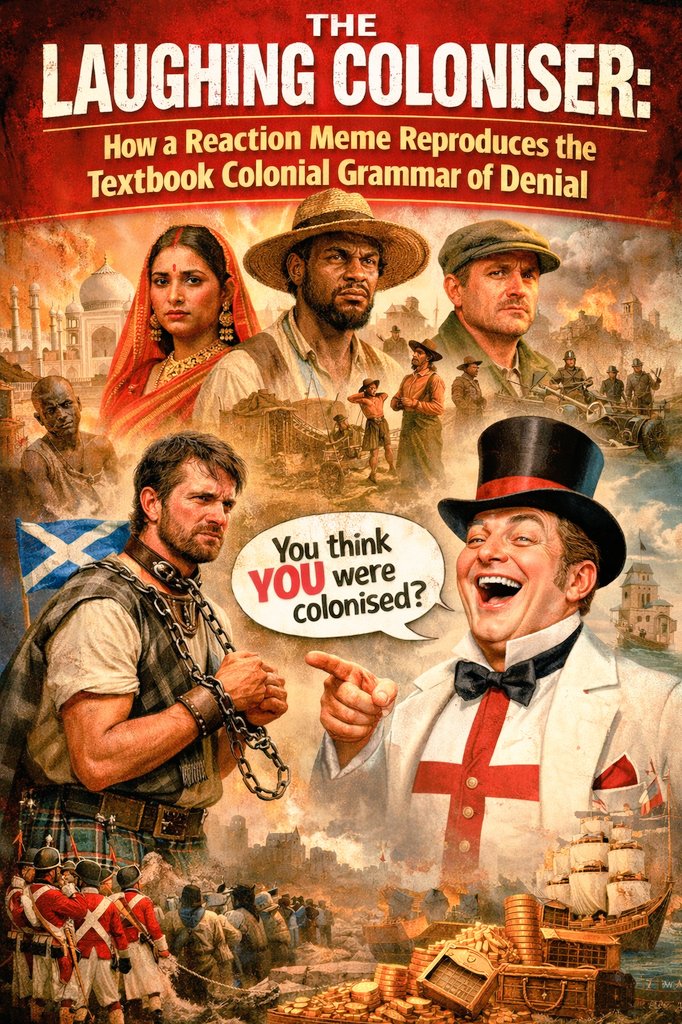
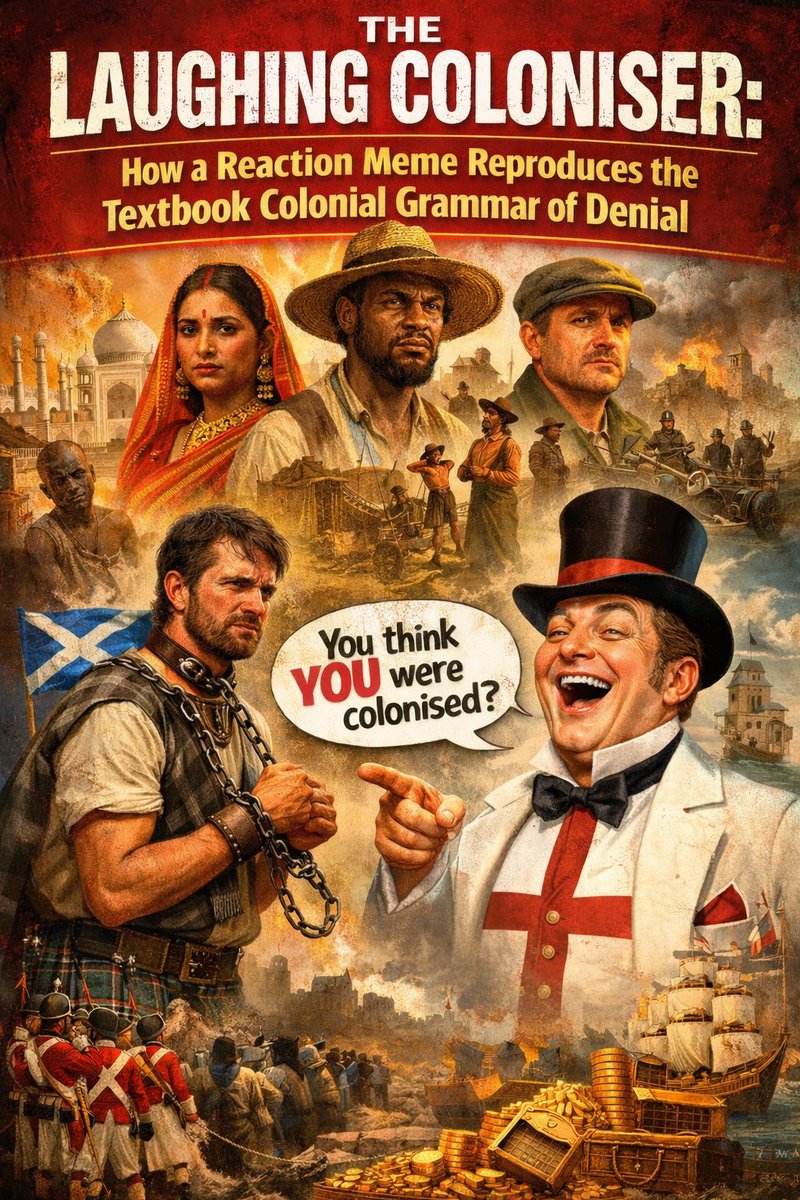
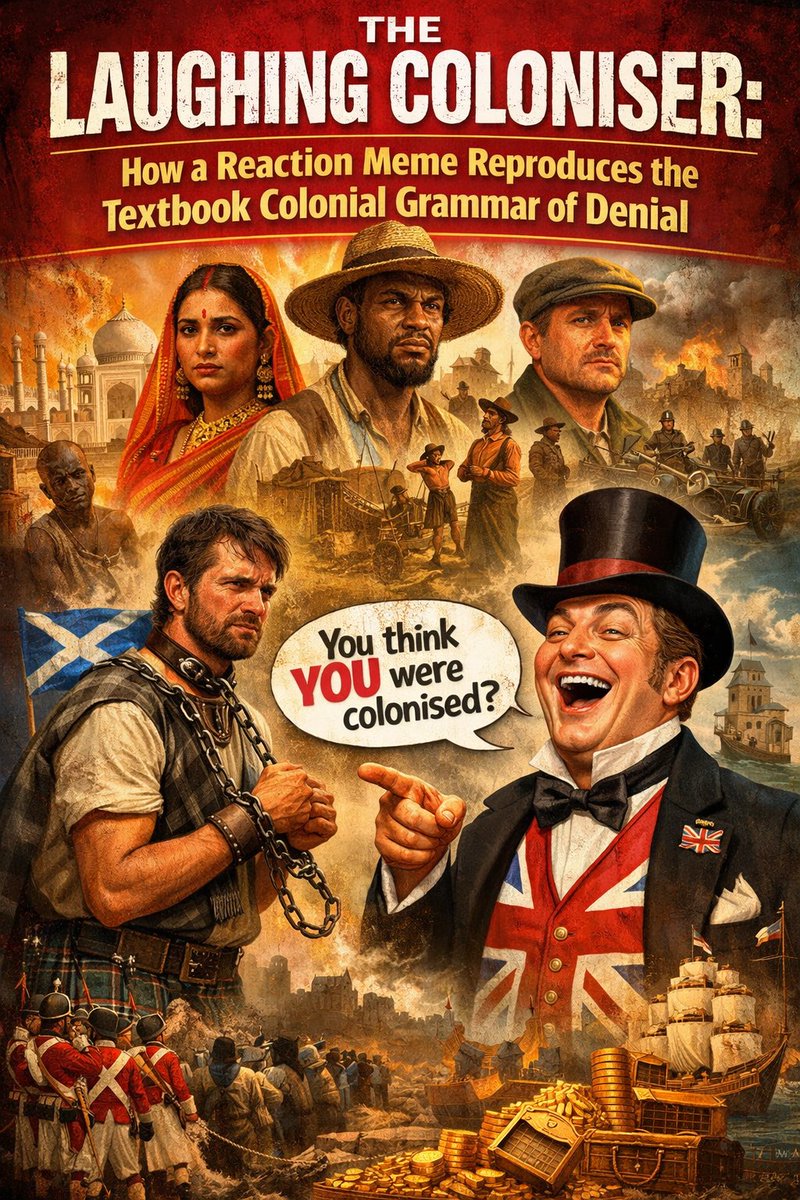
The Laughing Coloniser: How a Reaction Meme Reproduces the Textbook Colonial Grammar of Denial of Scotland’s Colonisation

Below I analyse a colonial meme attacking Scots and Scotland posted in an X post that I am quoting. The post comes from a relatively anonymous and low visibility account styled “medieval memelord” @medievalmlord, which mainly circulates history themed memes. Authorship remains unknown. Provenance remains opaque. No conclusive attribution can be made on the basis of an account profile alone. Yet, the narrative architecture of the meme is highly legible and suspicious. The meme performs a recognisable colonial operation against Scots and Scotland, and that operation does not correspond to the realities of Scotland’s colonisation by the English colonial state, including continued non-sovereignty and colonial annexation in the present.

The meme’s structure is brutally simple. India, Jamaica, and Ireland appear as moral witness figures. A facial expression of exaggerated disbelief supplies the emotional verdict. Scottish claims of colonisation are framed as laughable. No evidence is offered. No constitutional history is engaged. No conceptual definition of colonialism is attempted. The meme does not argue. The meme disciplines.

That move is textbook colonial technique.

Colonial rule has always required more than military coercion and economic extraction. Colonial rule also requires narrative control, because colonisation must become thinkable as normal and resistance must become thinkable as absurd. A reaction meme achieves precisely that function. Laughter becomes a technology of governance. Ridicule becomes a border checkpoint for legitimacy. The viewer is nudged into a reflex: do not examine, do not compare, do not enquire, do not dignify. Accept the inherited common sense that the colonial state’s constitutional story cannot be reopened. The English colonial state has done this everywhere on earth.

The meme’s first manoeuvre is the production of a hierarchy of colonial legitimacy. India represents famine, extraction, and mass domination. Jamaica represents plantation slavery and racial terror. Ireland represents conquest, dispossession, and suppression. These cases carry undeniable historical weight. The meme exploits that weight to impose a moral ranking system: colonialism is real only where atrocity looks like the most spectacular and internationally recognised forms of colonial violence. Every other modality becomes unworthy of the category. Scotland is pushed outside the circle of intelligibility through moral comparison rather than historical method. This is of course a lie since Scotland's colonisation is fully documented and the crimes of the English coloniser in Scotland are immense.

This is not solidarity with colonised peoples but weaponisation of their histories as a policing instrument against another colonised claim. The English colonial state has no shame.

Colonial regimes have repeatedly used moral ranking to fracture coalitions. Divide and rule has never belonged solely to administrative practice. Divide and rule also belongs to epistemology. A hierarchy of suffering forces subordinated groups into competition for recognition, then frames mutual recognition as theft. The effect is predictable. Solidarity becomes harder while comparative analysis becomes taboo. The coloniser enjoys a quieter field.Image
The Laughing Coloniser: How a Reaction Meme Reproduces the Textbook Colonial Grammar of Denial of Scotland’s Colonisation

2/ The meme’s second manoeuvre is definitional sabotage. Colonialism is silently reduced to one narrow image: overseas plantation slavery and distant racial domination. This reduction is a classic colonial tactic because colonialism has never been a single form. Moreover, it must immediately be added that Scots suffer, until today, for extreme racism and Scotophobia from the English coloniser. Colonialism functions through multiple modalities that share a common structure: asymmetry of authority and constrained self-determination. Plantation colonies represent one modality. Settler colonialism represents another. Annexation through treaty under duress represents another. Fiscal absorption, administrative centralisation, cultural marginalisation, demographic engineering, elite replacement, and language suppression represent further modalities. A colonial state adapts form to terrain while preserving structure. Scotland has been exposed to all including ethnic cleansing and genocide; and represents the matrix, the core model of English colonial rule applied around the world.

The meme depends on a single image of colonialism precisely to try and deny Scotland’s case since the world has been lied to by the English colonial state about its terrible colonialism in Scotland. The meme avoids any serious definition or conceptualisation which would force attention towards sovereignty, constitutional authority, fiscal command, institutional supremacy, and the long durée of structural subordination. That terrain is dangerous for colonial narrative stability. So the meme evacuates definition and replaces definition with derision.

The meme’s third manoeuvre is the collaborator trap. The meme implies that any Scots who were co-opted within the English colonial state’s global project invalidate Scotland’s colonised status. This is one of the oldest colonial manoeuvres in existence. Colonial governance routinely recruits intermediaries from subordinated territories. Local elites gain access to power, wealth, networks, and prestige through the colonial apparatus. The colonial centre then uses that elite incorporation as propaganda: see, consent exists, partnership & co-ownership exists. An English colonial lie. That logic appears across colonial history with numbing regularity.

A serious analysis separates individual participation from collective sovereignty. Colonial collaboration is compatible with colonised status. Colonialism is by definition a collaborative project with certain native elites. Otherwise it fails. In many cases, colonial collaboration is evidence of colonisation’s success in reorganising incentives, status hierarchies, and channels of advancement. When a colonised territory loses sovereign control over core decisions, individual advancement within the dominant apparatus does not restore national autonomy. The collaborator trope is designed to collapse that distinction, because the distinction is fatal to colonial storytelling. Scotland remains an English colony, annexed and plundered until now.

A comparative and chronological perspective further exposes the collaborator fallacy embedded in the meme. Scottish involvement in the English Caribbean before 1707 was limited in scale and structurally constrained. English Navigation Acts restricted Scottish access to colonial markets. Prior to the colonial Union i.e. annexation, very few Scots participated in colonialism, compared to Irish for example; many of them professionals especially doctors rather than major plantation magnates. The dramatic expansion of Scottish participation occurred only after incorporation into the Anglo-British state granted access to imperial trade networks. Scots were already a colonised people.Image
The Laughing Coloniser: How a Reaction Meme Reproduces the Textbook Colonial Grammar of Denial of Scotland’s Colonisation

3/ By contrast, Irish presence in English colonial territories predates 1707 by decades when almost no Scots were involved. Irish were far more present. Following the Cromwellian conquest, thousands of Irish were forcibly transported to Caribbean colonies such as Barbados and Montserrat, the latter developing a strong Irish demographic character in the 17th century. Even more revealing is the case of British India. By 1945 the colonial state had mobilised approximately 2.5 million Indian soldiers, widely recognised as the largest volunteer army of the Second World War. Indian troops were deployed across Africa and Southeast Asia, including Indonesia in 1945 during British attempts to reassert colonial control. More than 1.5 million Indians were transported through the indenture system across the colonial world. In Burma, Indian migrants were frequently perceived locally as intermediaries of colonial administration. These examples illustrate a structural constant of colonial governance: subordinated populations are routinely incorporated at scale into the expansion of colonial power. Co-optation does not equal sovereignty. Participation does not negate subordination.

The meme’s fourth manoeuvre is ridicule as symbolic violence. Ridicule converts a constitutional question into a social stigma. The viewer is not invited to examine evidence. The viewer is invited to adopt a posture. This is a form of narrative policing that operates beneath formal argument. Social shame performs the work that censorship would otherwise need to perform. In a colonial context, such shame is not incidental. Shame is governance by other means. A population begins to self censor. A claim begins to appear unserious. A debate begins to feel socially costly. The English colonial state is used to this type of manoeuvres against colonised people like Scots.

The meme’s fifth manoeuvre is epistemic erasure through homogenisation. The meme smuggles a taken for granted category, “Britain,” as a neutral container. The category is treated as morally indivisible and politically innocent. But in reality “British” functions as a colonial veil for an English centred sovereign, colonial power. Under that lens, a constitutional story of equality becomes a technique of misrecognition. Misrecognition is a core colonial method. The colonised are encouraged to name the coloniser’s state as their own, then accused of incoherence when they describe colonial domination. Language becomes a weapon. Naming becomes capture.

A colonial state benefits enormously when the colonised must speak in the coloniser’s grammar. That grammar carries built in limits. Certain questions become unsayable. Certain structures become natural. The meme draws power from that grammar; relying on the common sense that Scotland must be described through the very category that sustains Scotland’s subordination. Such reliance is precisely why the meme looks colonial. Colonialism reproduces itself through everyday categories that make colonial subjugation appear ordinary.

The meme’s sixth manoeuvre is moral laundering. India, Jamaica, and Ireland are placed in the frame not to honour their suffering but to launder the colonial state’s legitimacy. The meme implies that acknowledging Scotland would dilute recognition of “real” colonialism, and thereby casts the colonial state as the guardian of anti-colonial morality. That inversion is a hallmark of colonial ideology. Colonial power frequently represents itself as the administrator of civilisation, the protector of order, the curator of legitimacy. The meme extends that logic into the moral domain. The colonial state, through the meme’s logic, becomes the arbiter of who counts as colonised.

That role belongs to the coloniser’s epistemic sovereignty. The coloniser claims authority over the classification of reality.Image
Read 4 tweets
Oct 11, 2025
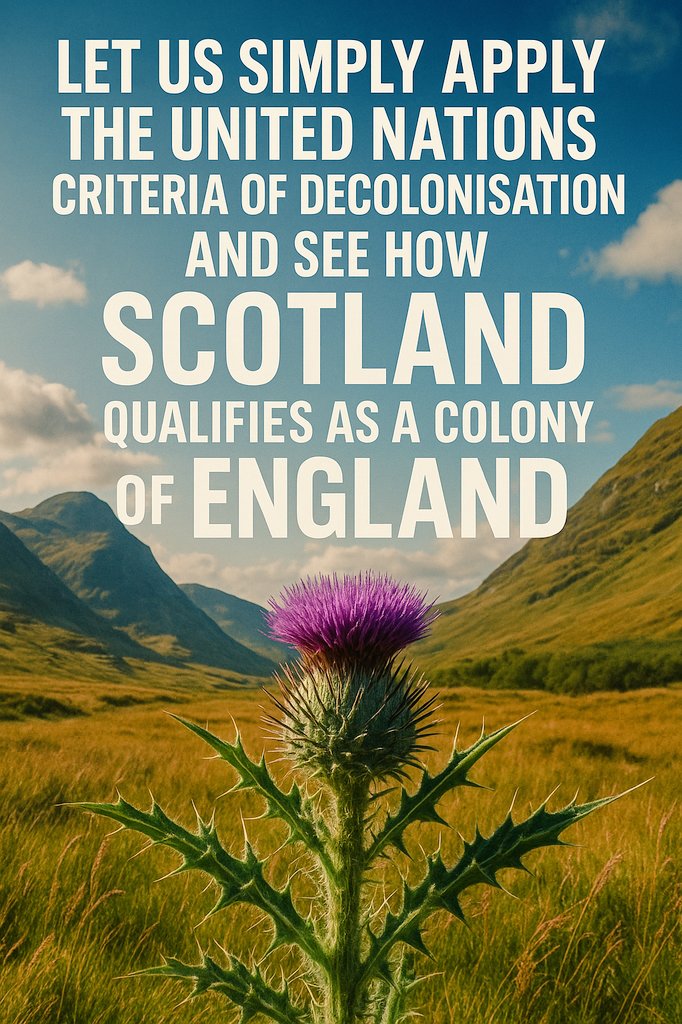
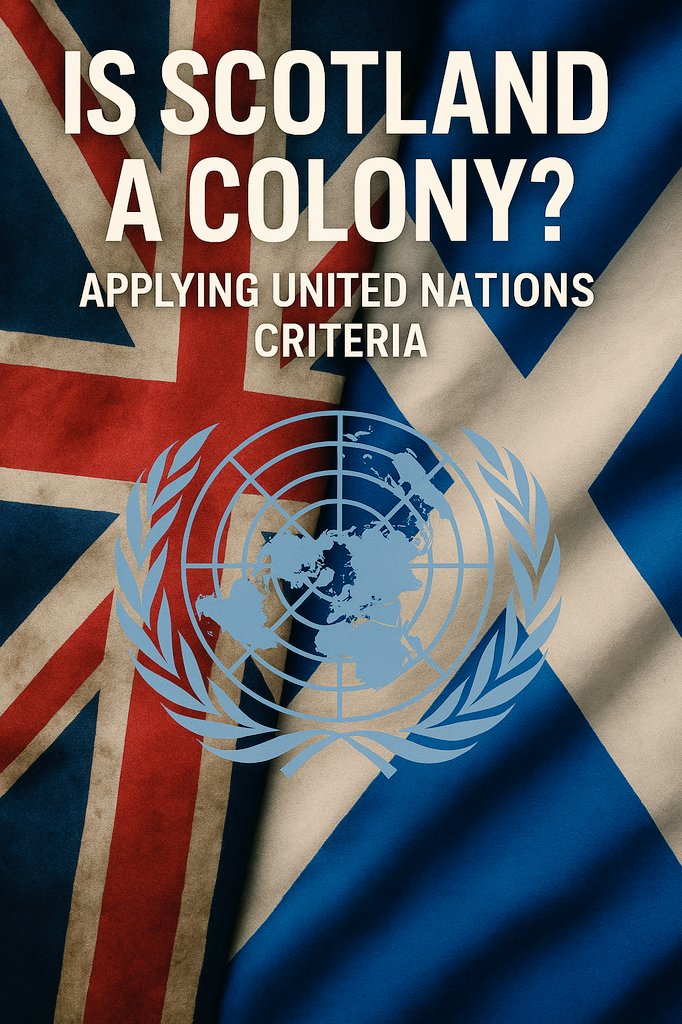
Let Us Simply Apply the United Nations Criteria of Decolonisation & See How Scotland Qualifies as a Colony of England

I sense that for certain people there remains a genuine hesitation whenever the idea of Scotland as a colony is mentioned. This confusion is neither accidental nor unique. It's normal & belongs to the very psychology & strategy of colonialism itself. Throughout history, colonised nations have often struggled to recognise their own subjugation, precisely because the coloniser’s greatest success lies in shaping perception; in transforming colonial domination into partnership, & dependence into loyalty. Pride, denial, honour, dignity, & the inherited myths of equality all serve this purpose. In Scotland’s case, the English coloniser ensured that the truth of colonisation was buried under centuries of constitutional language, legal manipulation, propaganda, symbolism & tokenism, cultural assimilation through Anglophone settler colonialism. The result is a nation that has been systematically taught to believe it was never colonised at all, even as the structures & realities of colonisation define its past & present.

When political narratives & domestic constitutional myths obscure reality, international law can help restore clarity. The question of whether Scotland is a colony is not a matter of rhetoric, propaganda, loyalty, or constitutional interpretation; but a matter of legal classification under the framework that governs all decolonisation processes at the UN. The time for hypothetical debate has passed. The international process has already begun.

In 2025, Liberation Scotland, the recognised Scottish liberation movement, began presenting Scotland’s case within the UN system. In March 2025, the UN Secretary General & the C-24 Committee (UN Special Committee on Decolonization) received an advanced notice (petition) from Liberation Scotland on behalf of its now around 20,000 members. In June & October 2025, Liberation Scotland representatives have spoken before the C24 & the Fourth Committee of the General Assembly (C4), intervening on behalf of the peoples of Kanaky (New Caledonia) & Maʻohi Nui (French Polynesia), two Non-Self-Governing Territories (NSGT) officially recognised by the UN, part of the current UN list of 17 NSGTs. These interventions demonstrated Scotland’s understanding of, & active participation in, the same international legal framework that guides all decolonisation processes.

On 18 September 2025, during the 60th session of the UN Human Rights Council, Liberation Scotland organised an international conference at the UN Headquarters in Geneva on Scotland’s Right to Self-Determination under International Law, an event fully promoted & acknowledged by the UN. The conference brought together jurists, scholars, diplomats, NGO leaders, representatives of decolonisation movements worldwide to discuss the legal pathways for Scotland’s restoration of sovereignty. With these actions, Scotland’s decolonisation process entered the sphere of formal international engagement.

The Legal Foundations

Three legal instruments form the cornerstone of the UN doctrine on decolonisation:

1. Article 73 of the United Nations Charter (1945), which defines the responsibility of administering powers (i.e. colonisers) for territories whose peoples have not yet attained a full measure of self-government (i.e. remain colonised).

2. General Assembly Resolution 1514 (XV) of 14 December 1960, the Declaration on the Granting of Independence to Colonial Countries and Peoples.

3. General Assembly Resolution 1541 (XV) of 15 December 1960, which codifies the principles for determining whether a territory is non-self-governing (i.e. colonised by a coloniser).

These instruments provide the legal matrix through which the international community recognises colonial relationships & supervises their resolution. This is how we can assess legally if a nation like Scotland is colonised by England.Image
Let Us Simply Apply the United Nations Criteria of Decolonisation & See How Scotland Qualifies as a Colony of England

2/ The Criteria of Colonial Status

Resolution 1541 sets three objective criteria:

1. The territory is geographically separate & ethnically or culturally distinct from the administering state.

2. The territory does not possess a full measure of self-government.

3. The relationship arose through domination, subjugation, or lack of genuine consent.

Applied to Scotland, these criteria yield an unambiguous conclusion.

1st Condition: Distinct Geography & Identity

Existing long before England, free for centuries with the oldest flag in Europe (the Saltire), Scotland is geographically distinct & historically developed as an independent kingdom with its own monarchy, parliament, church, & legal system. The Treaty & Acts of Union of 1706-1707 abolished Scotland’s sovereign government while leaving England’s intact. The Union did not merge two equal states into a new creation. It extended England’s jurisdiction northward. The continued existence of Scots law within this structure does not contradict the colonial character of the relationship. Many colonies retained local legal systems under external sovereignty.

Under Article 73 & Principle I of Resolution 1541, Scotland’s geographical & cultural distinctness is beyond dispute. I would add that Scotland is famous and distinguishable globally. Everyone knows Scotland as a nation. A Scottish song, Auld Lang Syne, is the world's most universal & played song, uniting the planet. The first condition is fulfilled.

2nd Condition: Absence of a Full Measure of Self-Government

The second condition concerns whether a people exercises control over its constitutional & international status. Scotland does not. The Supreme Court of the United Kingdom (i.e. colonial England) ruled in November 2022 that the Scottish Parliament lacks authority to hold an independence referendum without the consent of Westminster. Sovereignty remains concentrated in London. Devolution is a delegation of administrative powers that can be withdrawn at any time by the UK i.e. English Parliament.

In UN practice, genuine self-government requires constitutional autonomy & control over external affairs. Scotland’s institutions possess neither. Its parliament cannot determine its constitutional future. Its government cannot represent the nation internationally. As I have demonstrated this fully, I would add that Scottish people & Scotland are officially called English & England by the colonial English Foreign Office in foreign languages around the world in countries representing over 3 billion people. The supposedly British embassy in Jakarta for example is called the English embassy (Inggris) officially in Indonesian, a country of 300 million people (same in Japan, Thailand, China, Tanzania, Kenya, Vietnam, etc.). The second condition is fulfilled.

3rd Condition: Lack of Equal Consent & the Historical Act of Absorption

The third criterion examines whether the present relationship originated in free & equal consent. The record of 1707 demonstrates coercion, military threat, bribery, treason & annexation. English trade restrictions, threats, corruption, financial inducements ensured the passage of the Treaty & Acts of Union. Scotland’s parliament & government were dissolved. England’s institutions continued without alteration.

Professor Robert Black KC, emeritus professor of Scots law, the most important living reference in Scots law, has shown that none of Scotland’s treaties survived the Union, while all of England’s did. England’s alliances with Portugal, Spain, Denmark, the Ottoman Empire remained binding. Scotland’s treaties with France, Denmark-Norway, the Dutch Republic, & others were cancelled. England’s legal personality remained unbroken. Scotland’s was erased. This pattern corresponds precisely to the definition of annexation in international law. Scotland is a colony of England.Image
Let Us Simply Apply the United Nations Criteria of Decolonisation & See How Scotland Qualifies as a Colony of England

3/ Resolution 1514 defines colonisation as “the subjection of peoples to alien domination & exploitation”. The absorption of Scotland by England in 1707 fits that definition in every respect. The third condition is fulfilled.

The Legal Character of the Relationship

When the three conditions are considered together, the legal classification is clear. Scotland meets every element of a Non-Self-Governing Territory under Article 73 of the Charter, Resolutions 1514 & 1541. It is geographically distinct, lacks a full measure of self-government, was absorbed without equal consent. (We have not even mentioned genocide, ethnic cleansing, enslavement & deportation, asset stripping, cultural oppression & suppression, & all the other colonial crimes of England against Scotland & the Scottish people.)

Under the UN framework, this constitutes a colonial relationship. The United Kingdom, continuing the legal personality of colonial England, functions as the administering power (the coloniser). Scotland’s people are therefore entitled to exercise their right to self-determination under UN supervision.

Colonial status is not diminished by time. The UN continues to monitor cases whose origins date back centuries. Time cannot erase legal reality. Scotland is an ancient state that never died, made a dependency by the English coloniser illegally occupying its territory.

The Process Already Under Way

Scotland’s decolonisation process is now active within the UN, as demonstrated by Liberation Scotland's interventions in formal sessions of both the C4 & the C24, notably giving voice to the decolonisation demands of Kanaky (New Caledonia) & Māohi Nui (French Polynesia), two territories formally listed as Non-Self-Governing. These interventions have connected Scotland’s struggle to the wider legal tradition of decolonisation & reaffirmed solidarity among colonised nations across the Global South.

The movement’s participation represents the reopening of a process that was deliberately blocked in the mid-twentieth century. In 1954, as the UN intensified its global review of colonial territories under Article 73(e) of the UN Charter, questions arose over why the UK’s official reports listed dozens of colonies but omitted Scotland. To prevent international scrutiny, the government in London, representing the UK i.e. colonial England, declared that the “United Kingdom” was a single sovereign state composed of four equal nations & therefore had no (internal) colonies. At the same time, it established the Royal Commission on Scottish Affairs (1952–1954), chaired by Lord Catto, to reinforce that narrative. Lying to the UN, the Commission’s report claimed that Scotland was already self-governing within the so-called Union & possessed no separate international identity. This assertion, presented to the world as evidence of equality, was accepted by the UN at face value, excluding Scotland from the early decolonisation process. In substance, this was a strategy by the UK i.e. England to conceal Scotland’s dependent status & to prevent any external recognition of its colonial condition. England deceived the UN & the international community.

Liberation Scotland's September 2025 conference at the United Nations Headquarters in Geneva entitled Scotland’s Right to Self-Determination under International Law confirmed the procedural legitimacy of the decolonization initiative. If Scotland was clearly not an English colony, the UN would have blocked the event.

Liberation Scotland's actions mark a historic turning point. The question of Scotland’s status is no longer confined to domestic debate. It has entered the institutional mechanisms of international law. The concealment that began in 1954 has ended. The process of decolonisation is now visible to the international community.
Read 4 tweets
Jun 17, 2025
The Coloniser’s Secret Police: How MI5 and MI6 Sustain English Colonial Rule Over Scotland in Violation of the UN Charter and the Right to Decolonisation

1. Introduction: Scotland as a Colony under Covert Occupation

Scotland is a colony of England, held not by consent but by force, deception and surveillance. Scotland is governed from a foreign capital, denied international representation, prevented from managing its own resources and compelled to subsidise the prosperity of its coloniser. This reality is obscured not only through constitutional misdirection but through a hidden apparatus of control. At the centre of this system stand MI5 and MI6 (i.e. for MI6 the FCDO), the intelligence services of the English colonial state, acting as secret enforcers of colonial domination.

These agencies do not serve the Scottish people. They serve the English state’s overriding imperative: to maintain control over the last significant colony within its grasp. Just as they once targeted anti-colonial leaders in India, Kenya and Ireland, they now monitor, disrupt and undermine Scotland’s peaceful struggle for independence. Their tools are psychological warfare, elite manipulation, surveillance and global narrative control. Their purpose is to keep the Scottish people "doun-hauden", held down, silenced and neutralised.

@UN
@UN_HRC
@EU_Commission
@Europarl_EN
@eu_eeas
@coe
@EURightsAgency
@francediplo
@FranceintheUK
@franceintheus
@cgfEdimbourg
@Elysee
@GermanyDiplo
@bundeskanzler
@NorwayMFA
@dfatirl
@PresidentIRL
@antonioguterres
2. From Empire to Colony: Intelligence as a Colonial Instrument

MI5 and MI6 were created as instruments of empire. MI5’s domestic surveillance operations were first used against Irish republicans, Indian nationalists and trade unionists deemed to threaten the stability of imperial rule. MI6 was tasked with gathering intelligence abroad to maintain Britain’s global dominance. These agencies were designed not to protect democracy, but to crush liberation.

The strategies used in Kenya, India and Ireland were brutal and effective. MI5 maintained detailed networks of informants within nationalist organisations. MI6 coordinated with colonial officials to undermine leaders, discredit movements and prevent international recognition. The colonial state’s intelligence apparatus ensured that all resistance would be contained, fragmented or eliminated.

These same institutions and strategies are now used against Scotland. The empire did not end. It was reconfigured. Scotland was not granted self-determination but absorbed into a colonial structure that masquerades as union and operates through the same logic of dominance and extraction. MI5 and MI6, rather than being decommissioned, have been turned inward. Their function is to manage Scotland not as an equal, but as a colony that must be controlled.

@UN
@UN_HRC
@EU_Commission
@Europarl_EN
@eu_eeas
@coe
@EURightsAgency
@francediplo
@FranceintheUK
@franceintheus
@cgfEdimbourg
@Elysee
@GermanyDiplo
@bundeskanzler
@NorwayMFA
@dfatirl
@PresidentIRL
@antonioguterres
3. MI5 in Scotland: Surveillance, Subversion and Psychological Containment

MI5 has conducted extensive operations within Scotland to monitor, disrupt and discredit the independence movement. The agency classifies Scottish nationalism as a threat to constitutional stability. In practice, this means treating the peaceful assertion of sovereignty as a form of internal insurrection. A classic colonial framework.

The tactics used mirror those employed against earlier colonial populations.

In Ireland, British/English intelligence placed informants within the Irish Republican Brotherhood and Sinn Féin, manipulated internal divisions, and coordinated smear campaigns. In India, British agents monitored nationalist meetings, disrupted printing presses and detained organisers without trial. In Kenya, the colonial government used MI5-linked files to detain thousands of suspected Mau Mau supporters.

In Scotland, similar methods have been adapted to 21st century conditions.

Pro-independence campaigners have reported unexplained digital intrusions, intercepted communications and untraceable leaks. Grassroots groups such as Radical Independence, All Under One Banner and IndyLive have faced cyber attacks, shadow bans and suspicious internal sabotage. Prominent figures have been targeted through smear campaigns that appear coordinated and timed to coincide with key political events.

Academic institutions have been quietly pressured to avoid work that frames Scotland as a colonised nation. Universities that promote research on Scottish sovereignty have had grants questioned or withdrawn, visiting speakers blocked and media access curtailed. The aim is not to debate, but to discredit and destabilise.

MI5 also works through elite grooming. Individuals within the civil service, the media and senior political circles are cultivated as compliant stewards of colonial continuity. These individuals speak the language of devolution, sometimes independence, while enforcing the policies of centralised control. Their function is to simulate autonomy while maintaining subordination. This is how colonial management operates in a modern European context.

@UN
@UN_HRC
@EU_Commission
@Europarl_EN
@eu_eeas
@coe
@EURightsAgency
@francediplo
@FranceintheUK
@franceintheus
@cgfEdimbourg
@Elysee
@GermanyDiplo
@bundeskanzler
@NorwayMFA
@dfatirl
@PresidentIRL
@antonioguterres
Read 7 tweets
Jun 8, 2025
The SNP and Scotland’s Decolonisation: A National Party Must Now Support the International Struggle

1. From Domestic Dead Ends to the Global Stage

Scotland’s national struggle has now irreversibly entered the international arena. The formal launch of its decolonisation process through United Nations mechanisms, led by Liberation Scotland with its over 18,000 members and legally represented by Justice pour Tous Internationale (JPTi), aims to secure Scotland’s recognition as a Non-Self-Governing Territory (NSGT) by the UN Special Committee on Decolonisation (C-24). This is not an abstract gesture. It is a lawful, historically grounded act of self-determination grounded in the UN Charter and General Assembly Resolutions 1514 (XV) and 1541 (XV), the same legal instruments that dismantled the world’s last empires. The Scottish National Party, if it remains serious about delivering independence, must support this process without hesitation. It must understand this not as a desperate last resort, but as the only lawful and strategically sound path remaining; and an act of justice.
@UN
@UN_HRC
@eu_eeas
@coe
@EURightsAgency
@francediplo
@FranceintheUK
@franceintheus
@cgfEdimbourg
@Elysee
@GermanyDiplo
@bundeskanzler
@NorwayMFA
@dfatirl
@PresidentIRL
2. The Dunfermline Conference: A Legal and Political Turning Point

The case for Scotland’s inclusion on the NSGT list was significantly advanced at the international conference titled “Next Steps for Scottish Sovereignty,” held from 16 to 18 May 2025 at the Carnegie Conference Centre in Dunfermline. Organised by the Scottish Sovereignty Research Group, the event convened over three hundred participants, including international legal experts, former diplomats, UN observers, and leaders of Scotland’s liberation movement. A pivotal session titled “Decolonisation and Self-Determination,” hosted by Salvo, the educational wing of Liberation Scotland, featured compelling legal testimony from Professor Robert Black KC FRSE, Professor Alf Baird, Ambassador Craig Murray, and other constitutional experts.

Professor Black’s conclusion was unequivocal. He stated that no conscientious and impartial lawyer reviewing the events surrounding the 1707 arrangements could reasonably conclude that Scotland and England created a new, united sovereign state. Rather, Scotland was annexed into a pre-existing English state, which continued to exist under a symbolic and misleading name. Following this landmark event, Justice pour Tous Internationale, acting in its legal capacity as counsel for Liberation Scotland before the United Nations, submitted a formal communication to the C-24. It affirmed that Scotland meets all internationally recognised criteria for classification as a Non-Self-Governing Territory.
@UN
@UN_HRC
@eu_eeas
@coe
@EURightsAgency
@francediplo
@FranceintheUK
@franceintheus
@cgfEdimbourg
@Elysee
@Germanydiplom
@bundeskanzler
@NorwayMFA
@dfatirl
@PresidentIRL
3. Scotland’s Legal Case for Decolonisation

Under Resolution 1541 (XV), a territory is considered non-self-governing if it is geographically distinct, possesses a cultural and historical identity of its own, and lacks full self-government in key areas. Scotland meets every one of these requirements. It is geographically and historically distinct from England. It has its own legal system, education system, church, and national consciousness. Furthermore, it is denied sovereign control over foreign affairs, defence, broadcasting, monetary policy, and the administration of justice.

The submission by Justice pour Tous Internationale also confirms that the United Kingdom acts as an administering Power. It withholds from the Scottish people the exercise of their inalienable right to self-determination in violation of international law. Crucially, under established United Nations precedent, a territory may be added to the NSGT list without the consent of the colonising state. The 2013 case of French Polynesia, which was inscribed despite French opposition, confirms that only one UN Member State is required to sponsor such a resolution. Scotland’s path forward does not require Westminster’s approval, only principled international engagement.

@UN
@UN_HRC
@eu_eeas
@coe
@EURightsAgency
@francediplo
@FranceintheUK
@franceintheus
@cgfEdimbourg
@Elysee
@GermanyDiplo
@bundeskanzler
@NorwayMFA
@dfatirl
@PresidentIRL
Read 7 tweets
Jun 3, 2025
Scotland: England's Original Colonial Laboratory. Why Scotland Must Be Liberated to Break the English Colonial Model Which Has Oppressed So Many Nations Globally

Introduction: The Empire’s First Experiment

Before England ruled continents, it conquered a neighbour. Before it extracted gold from Ghana or tea from Assam, it extracted obedience, land, and silence from Scotland. The story of the British Empire is usually told as an outward march, Europe projecting power onto the world. But this narrative is a lie of omission. The empire began not in the tropics, but in the cold winds of the North. Scotland was not a junior partner in imperial glory, it was the proving ground for imperial control. It was here that England first refined the tools of domination: institutional co-optation, cultural erasure, forced migration, manufactured consent, ethnic cleansing, genocide, asset stripping, and ideological control.

What followed in Ireland, India, Africa, and the Caribbean was not invention, it was export. Every technique later employed by British administrators in Bengal, Kenya, or Jamaica had a Scottish prototype. Forced removals in Kenya echo the Highland Clearances. The divide and rule of Hindus and Muslims was prefigured in the fracturing of Highland clans. The burning of cultural heritage and linguistic suppression across Africa had a precursor in the destruction of Gaelic culture. Scotland was the first model, the first laboratory, the first internal colony of what would become the largest colonial empire in human history. And yet, uniquely among England’s conquests, Scotland has been denied even the dignity of being recognised as such. Cloaked in the rhetoric of union and equality, the subjugation of Scotland has been disguised as partnership. But history, when stripped of myth, tells a different tale. Scotland is a colony of England, its original colonial laboratory.

@UN
@UN_HRC
@eu_eeas
@coe
@EURightsAgency
@francediplo
@FranceintheUK
@franceintheus
@cgfEdimbourg
@Elysee
@GermanyDiplo
@bundeskanzler
@NorwayMFA
@dfatirl
@PresidentIRL
I. The Empire Begins at Home
In the sweeping history of empire, England's colonial exploits abroad have been endlessly scrutinised, condemned, and at times romanticised. Less interrogated, however, is the domestic crucible in which that empire was first forged. While Ireland is often cited as England's first colony, a deeper and more revealing truth lies further north: Scotland was the original laboratory of English colonialism. Not a partner in constitutional union, but its first victim. Not an ally in conquest, but the proving ground for conquest itself. The mechanisms of imperial domination, territorial subjugation, cultural erasure, elite co-optation, economic extraction, ideological control, forced migration, ethnic cleansing, genocide, and enslavement were all first honed on Scotland before being deployed globally. England's empire did not begin at Calcutta or Cape Coast, it began at Holyrood.

The 1707 Acts of Union are frequently portrayed as a voluntary, even enlightened, political merger. Such mythmaking, however, collapses under historical scrutiny. The Darien Scheme, often cited as a trigger for the Union, was not a failed attempt at colonisation but an effort to establish a trading post in Panama, made necessary because England had systematically blocked Scotland's access to global trade routes. Far from being a reckless colonial gamble, it was a desperate bid for economic survival by a nation under siege.

What followed was not negotiation but coercion. The Scottish Parliament was subjected to intense pressure and elite bribery. The English government threatened economic strangulation and even military invasion if the Union was not accepted. The Scottish population was overwhelmingly opposed to the Union, as evidenced by widespread protests, petitions, and civic unrest. But their voices were ignored. The decision was made not by the people, but by a compromised elite under duress. England dictated the terms, not as an equal partner but as a metropolitan power imposing integration on a weaker neighbour. The Union was not a covenant, it was a conquest ratified in law.
@UN
@UN_HRC
@eu_eeas
@coe
@EURightsAgency
@francediplo
@FranceintheUK
@franceintheus
@cgfEdimbourg
@Elysee
@GermanyDiplo
@bundeskanzler
@NorwayMFA
@dfatirl
@PresidentIRL
II. Highland Guinea Pigs and the Birth of Domestic Imperialism

Scotland, and particularly the Highlands, became the first terrain upon which England would experiment with the tools of internal colonisation. Following the 1745 Jacobite rising, the British state launched a comprehensive campaign of repression and re-engineering. The goal was not merely to extinguish rebellion, but to dismantle the very idea of a culturally distinct, politically assertive Scottish nationhood. The Highlands were transformed into a zone of surveillance and pacification. Traditional clan structures were dismantled. Tartan, Gaelic, and Catholicism were outlawed. Disarmament was enforced, not only militarily but culturally. These were not isolated punitive measures, they were the birth of England’s modern colonial technique: the civilising mission via suppression.

The infamous Highland Clearances, far from being a mere socio-economic transition to agrarian capitalism, were acts of state-enabled demographic violence. They involved forced migration, ethnic cleansing, and the calculated destruction of social cohesion. Landowners, many of them newly enriched by English patronage, expelled entire populations to make way for sheep and rents. The human cost was staggering. Families were forcibly evicted, communities dissolved, languages lost, and lives extinguished through poverty and exile. These techniques of displacement and extraction would later be replicated on grander scales across the British Empire: from the dispossession of Aboriginal Australians to the forced removals under apartheid South Africa. But it is here, in the glens of Sutherland and the isles of the Hebrides, that the blueprint was drawn.
@UN
@UN_HRC
@eu_eeas
@coe
@EURightsAgency
@francediplo
@FranceintheUK
@franceintheus
@cgfEdimbourg
@Elysee
@GermanyDiplo
@bundeskanzler
@NorwayMFA
@dfatirl
@PresidentIRL
Read 9 tweets
May 30, 2025
Unmasking the Manipulation of Scotland’s 2014 Referendum. The @UN through its decolonisation mechanisms will prevent such manipulation.
The 2014 Scottish independence referendum has often been hailed by the English establishment as a triumph of democratic expression, a peaceful, decisive moment where the people of Scotland “chose” to remain in the 'United Kingdom'. Yet, this narrative collapses under even modest scrutiny. Behind the ceremonial surface of ballot boxes and televised debates lay a calculated system of structural manipulation: a media environment rigged by state broadcasters, an electoral franchise designed to dilute the Scottish voice, and a campaign of fear orchestrated at the highest levels of government and finance. What occurred was not an equal contest between competing futures, but a managed defeat, engineered to preserve Westminster’s colonial grip on Scotland under the guise of democratic legitimacy. Let's reopen the record to expose how the British state, through psychological warfare, economic coercion, and covert interference, ensured the survival of its shrinking Union by strangling the very principles it claimed to uphold.
1. The Rigged Playing Field: A Contest Between State & Citizen
In the aftermath of the 2014 Scottish independence referendum, significant concerns emerged regarding the integrity of the campaign environment through insidious forms of manipulation: psychological pressure, institutional interference, and information warfare. The informational and political ecosystem in which the referendum unfolded was heavily skewed in favour of the 'Union'. What took place was not a fair democratic contest between two constitutional visions, but rather a struggle between a grassroots national movement and the full coercive, financial, and communicative power of a centralised English state determined to preserve its territorial authority, its Scottish colony.
2. Media as a Weapon: The Robertson Study and BBC Bias
One of the most disturbing aspects of the referendum was the role played by mainstream media, particularly the BBC. Professor John Robertson of the University of the West of Scotland conducted a rigorous study titled Fairness in the First Year?, which examined over 620 hours of BBC Scotland’s Reporting Scotland and STV News broadcasts from September 2012 to September 2013. His findings were damning: the coverage displayed systemic bias in favour of the ‘No’ campaign. Robertson noted that broadcasts frequently opened and closed with anti-independence messaging, framing the debate through a Unionist lens. Economic doom, diplomatic exile, and financial chaos were presented as inevitable consequences of a ‘Yes’ vote, while the Union was depicted as a haven of stability. This media narrative was not simply slanted; it was structurally embedded.

The BBC, naturally, rejected the findings. Its Scottish director, Ken MacQuarrie, dismissed the study as flawed. Yet, Robertson’s conclusions resonated with many Scots, thousands of whom marched on BBC headquarters in protest. The effect of the coverage was not just to inform, but to condition, a classic example of state-sponsored framing designed to shift the psychological baseline of the electorate. @UN @UN_HRC
Read 9 tweets

Did Thread Reader help you today?

Support us! We are indie developers!


This site is made by just two indie developers on a laptop doing marketing, support and development! Read more about the story.

Become a Premium Member ($3/month or $30/year) and get exclusive features!

Become Premium

Don't want to be a Premium member but still want to support us?

Make a small donation by buying us coffee ($5) or help with server cost ($10)

Donate via Paypal

Or Donate anonymously using crypto!

Ethereum

0xfe58350B80634f60Fa6Dc149a72b4DFbc17D341E copy

Bitcoin

3ATGMxNzCUFzxpMCHL5sWSt4DVtS8UqXpi copy

Thank you for your support!

Follow Us!

:(