Christophe Dorigné-Thomson Profile picture
Doctor in politics. Scottish-French. Book: Indonesia's Engagement with Africa, Palgrave Macmillan. Ballater, Aberdeenshire, Scotland. Saor Alba gu bràth.
Feb 14 4 tweets 8 min read
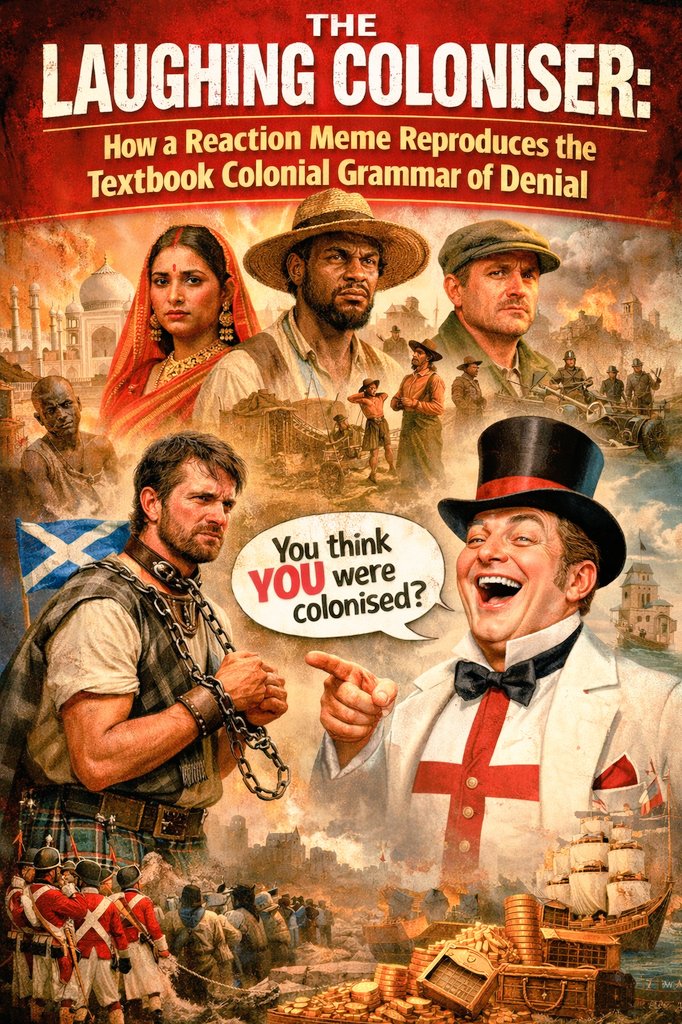
The Laughing Coloniser: How a Reaction Meme Reproduces the Textbook Colonial Grammar of Denial of Scotland’s Colonisation
Below I analyse a colonial meme attacking Scots and Scotland posted in an X post that I am quoting. The post comes from a relatively anonymous and low visibility account styled “medieval memelord” @medievalmlord, which mainly circulates history themed memes. Authorship remains unknown. Provenance remains opaque. No conclusive attribution can be made on the basis of an account profile alone. Yet, the narrative architecture of the meme is highly legible and suspicious. The meme performs a recognisable colonial operation against Scots and Scotland, and that operation does not correspond to the realities of Scotland’s colonisation by the English colonial state, including continued non-sovereignty and colonial annexation in the present.

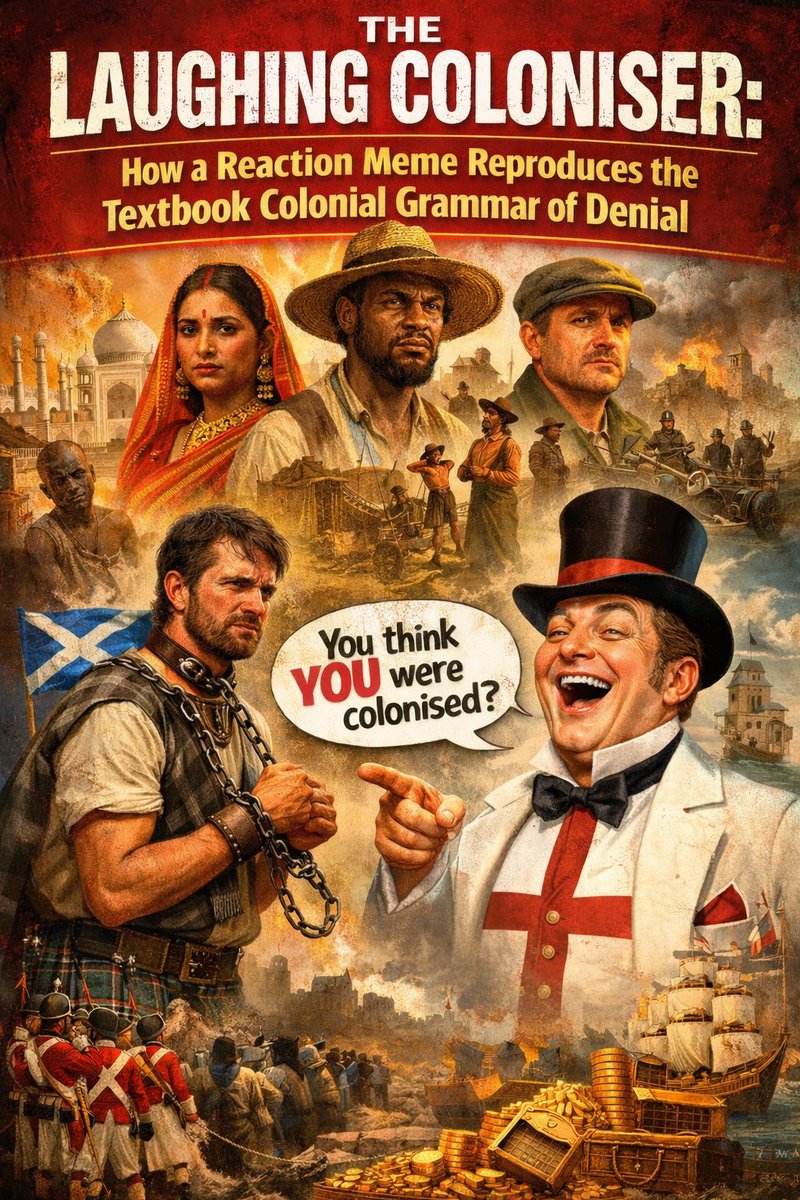
The meme’s structure is brutally simple. India, Jamaica, and Ireland appear as moral witness figures. A facial expression of exaggerated disbelief supplies the emotional verdict. Scottish claims of colonisation are framed as laughable. No evidence is offered. No constitutional history is engaged. No conceptual definition of colonialism is attempted. The meme does not argue. The meme disciplines.

That move is textbook colonial technique.

Colonial rule has always required more than military coercion and economic extraction. Colonial rule also requires narrative control, because colonisation must become thinkable as normal and resistance must become thinkable as absurd. A reaction meme achieves precisely that function. Laughter becomes a technology of governance. Ridicule becomes a border checkpoint for legitimacy. The viewer is nudged into a reflex: do not examine, do not compare, do not enquire, do not dignify. Accept the inherited common sense that the colonial state’s constitutional story cannot be reopened. The English colonial state has done this everywhere on earth.

The meme’s first manoeuvre is the production of a hierarchy of colonial legitimacy. India represents famine, extraction, and mass domination. Jamaica represents plantation slavery and racial terror. Ireland represents conquest, dispossession, and suppression. These cases carry undeniable historical weight. The meme exploits that weight to impose a moral ranking system: colonialism is real only where atrocity looks like the most spectacular and internationally recognised forms of colonial violence. Every other modality becomes unworthy of the category. Scotland is pushed outside the circle of intelligibility through moral comparison rather than historical method. This is of course a lie since Scotland's colonisation is fully documented and the crimes of the English coloniser in Scotland are immense.

This is not solidarity with colonised peoples but weaponisation of their histories as a policing instrument against another colonised claim. The English colonial state has no shame.

Colonial regimes have repeatedly used moral ranking to fracture coalitions. Divide and rule has never belonged solely to administrative practice. Divide and rule also belongs to epistemology. A hierarchy of suffering forces subordinated groups into competition for recognition, then frames mutual recognition as theft. The effect is predictable. Solidarity becomes harder while comparative analysis becomes taboo. The coloniser enjoys a quieter field.Image The Laughing Coloniser: How a Reaction Meme Reproduces the Textbook Colonial Grammar of Denial of Scotland’s Colonisation

2/ The meme’s second manoeuvre is definitional sabotage. Colonialism is silently reduced to one narrow image: overseas plantation slavery and distant racial domination. This reduction is a classic colonial tactic because colonialism has never been a single form. Moreover, it must immediately be added that Scots suffer, until today, for extreme racism and Scotophobia from the English coloniser. Colonialism functions through multiple modalities that share a common structure: asymmetry of authority and constrained self-determination. Plantation colonies represent one modality. Settler colonialism represents another. Annexation through treaty under duress represents another. Fiscal absorption, administrative centralisation, cultural marginalisation, demographic engineering, elite replacement, and language suppression represent further modalities. A colonial state adapts form to terrain while preserving structure. Scotland has been exposed to all including ethnic cleansing and genocide; and represents the matrix, the core model of English colonial rule applied around the world.

The meme depends on a single image of colonialism precisely to try and deny Scotland’s case since the world has been lied to by the English colonial state about its terrible colonialism in Scotland. The meme avoids any serious definition or conceptualisation which would force attention towards sovereignty, constitutional authority, fiscal command, institutional supremacy, and the long durée of structural subordination. That terrain is dangerous for colonial narrative stability. So the meme evacuates definition and replaces definition with derision.

The meme’s third manoeuvre is the collaborator trap. The meme implies that any Scots who were co-opted within the English colonial state’s global project invalidate Scotland’s colonised status. This is one of the oldest colonial manoeuvres in existence. Colonial governance routinely recruits intermediaries from subordinated territories. Local elites gain access to power, wealth, networks, and prestige through the colonial apparatus. The colonial centre then uses that elite incorporation as propaganda: see, consent exists, partnership & co-ownership exists. An English colonial lie. That logic appears across colonial history with numbing regularity.

A serious analysis separates individual participation from collective sovereignty. Colonial collaboration is compatible with colonised status. Colonialism is by definition a collaborative project with certain native elites. Otherwise it fails. In many cases, colonial collaboration is evidence of colonisation’s success in reorganising incentives, status hierarchies, and channels of advancement. When a colonised territory loses sovereign control over core decisions, individual advancement within the dominant apparatus does not restore national autonomy. The collaborator trope is designed to collapse that distinction, because the distinction is fatal to colonial storytelling. Scotland remains an English colony, annexed and plundered until now.

A comparative and chronological perspective further exposes the collaborator fallacy embedded in the meme. Scottish involvement in the English Caribbean before 1707 was limited in scale and structurally constrained. English Navigation Acts restricted Scottish access to colonial markets. Prior to the colonial Union i.e. annexation, very few Scots participated in colonialism, compared to Irish for example; many of them professionals especially doctors rather than major plantation magnates. The dramatic expansion of Scottish participation occurred only after incorporation into the Anglo-British state granted access to imperial trade networks. Scots were already a colonised people.Image
Oct 11, 2025 4 tweets 9 min read
Let Us Simply Apply the United Nations Criteria of Decolonisation & See How Scotland Qualifies as a Colony of England
I sense that for certain people there remains a genuine hesitation whenever the idea of Scotland as a colony is mentioned. This confusion is neither accidental nor unique. It's normal & belongs to the very psychology & strategy of colonialism itself. Throughout history, colonised nations have often struggled to recognise their own subjugation, precisely because the coloniser’s greatest success lies in shaping perception; in transforming colonial domination into partnership, & dependence into loyalty. Pride, denial, honour, dignity, & the inherited myths of equality all serve this purpose. In Scotland’s case, the English coloniser ensured that the truth of colonisation was buried under centuries of constitutional language, legal manipulation, propaganda, symbolism & tokenism, cultural assimilation through Anglophone settler colonialism. The result is a nation that has been systematically taught to believe it was never colonised at all, even as the structures & realities of colonisation define its past & present.

When political narratives & domestic constitutional myths obscure reality, international law can help restore clarity. The question of whether Scotland is a colony is not a matter of rhetoric, propaganda, loyalty, or constitutional interpretation; but a matter of legal classification under the framework that governs all decolonisation processes at the UN. The time for hypothetical debate has passed. The international process has already begun.

In 2025, Liberation Scotland, the recognised Scottish liberation movement, began presenting Scotland’s case within the UN system. In March 2025, the UN Secretary General & the C-24 Committee (UN Special Committee on Decolonization) received an advanced notice (petition) from Liberation Scotland on behalf of its now around 20,000 members. In June & October 2025, Liberation Scotland representatives have spoken before the C24 & the Fourth Committee of the General Assembly (C4), intervening on behalf of the peoples of Kanaky (New Caledonia) & Maʻohi Nui (French Polynesia), two Non-Self-Governing Territories (NSGT) officially recognised by the UN, part of the current UN list of 17 NSGTs. These interventions demonstrated Scotland’s understanding of, & active participation in, the same international legal framework that guides all decolonisation processes.

On 18 September 2025, during the 60th session of the UN Human Rights Council, Liberation Scotland organised an international conference at the UN Headquarters in Geneva on Scotland’s Right to Self-Determination under International Law, an event fully promoted & acknowledged by the UN. The conference brought together jurists, scholars, diplomats, NGO leaders, representatives of decolonisation movements worldwide to discuss the legal pathways for Scotland’s restoration of sovereignty. With these actions, Scotland’s decolonisation process entered the sphere of formal international engagement.

The Legal Foundations

Three legal instruments form the cornerstone of the UN doctrine on decolonisation:

1. Article 73 of the United Nations Charter (1945), which defines the responsibility of administering powers (i.e. colonisers) for territories whose peoples have not yet attained a full measure of self-government (i.e. remain colonised).

2. General Assembly Resolution 1514 (XV) of 14 December 1960, the Declaration on the Granting of Independence to Colonial Countries and Peoples.

3. General Assembly Resolution 1541 (XV) of 15 December 1960, which codifies the principles for determining whether a territory is non-self-governing (i.e. colonised by a coloniser).

These instruments provide the legal matrix through which the international community recognises colonial relationships & supervises their resolution. This is how we can assess legally if a nation like Scotland is colonised by England.Image Let Us Simply Apply the United Nations Criteria of Decolonisation & See How Scotland Qualifies as a Colony of England

2/ The Criteria of Colonial Status

Resolution 1541 sets three objective criteria:

1. The territory is geographically separate & ethnically or culturally distinct from the administering state.

2. The territory does not possess a full measure of self-government.

3. The relationship arose through domination, subjugation, or lack of genuine consent.

Applied to Scotland, these criteria yield an unambiguous conclusion.

1st Condition: Distinct Geography & Identity

Existing long before England, free for centuries with the oldest flag in Europe (the Saltire), Scotland is geographically distinct & historically developed as an independent kingdom with its own monarchy, parliament, church, & legal system. The Treaty & Acts of Union of 1706-1707 abolished Scotland’s sovereign government while leaving England’s intact. The Union did not merge two equal states into a new creation. It extended England’s jurisdiction northward. The continued existence of Scots law within this structure does not contradict the colonial character of the relationship. Many colonies retained local legal systems under external sovereignty.

Under Article 73 & Principle I of Resolution 1541, Scotland’s geographical & cultural distinctness is beyond dispute. I would add that Scotland is famous and distinguishable globally. Everyone knows Scotland as a nation. A Scottish song, Auld Lang Syne, is the world's most universal & played song, uniting the planet. The first condition is fulfilled.

2nd Condition: Absence of a Full Measure of Self-Government

The second condition concerns whether a people exercises control over its constitutional & international status. Scotland does not. The Supreme Court of the United Kingdom (i.e. colonial England) ruled in November 2022 that the Scottish Parliament lacks authority to hold an independence referendum without the consent of Westminster. Sovereignty remains concentrated in London. Devolution is a delegation of administrative powers that can be withdrawn at any time by the UK i.e. English Parliament.

In UN practice, genuine self-government requires constitutional autonomy & control over external affairs. Scotland’s institutions possess neither. Its parliament cannot determine its constitutional future. Its government cannot represent the nation internationally. As I have demonstrated this fully, I would add that Scottish people & Scotland are officially called English & England by the colonial English Foreign Office in foreign languages around the world in countries representing over 3 billion people. The supposedly British embassy in Jakarta for example is called the English embassy (Inggris) officially in Indonesian, a country of 300 million people (same in Japan, Thailand, China, Tanzania, Kenya, Vietnam, etc.). The second condition is fulfilled.

3rd Condition: Lack of Equal Consent & the Historical Act of Absorption

The third criterion examines whether the present relationship originated in free & equal consent. The record of 1707 demonstrates coercion, military threat, bribery, treason & annexation. English trade restrictions, threats, corruption, financial inducements ensured the passage of the Treaty & Acts of Union. Scotland’s parliament & government were dissolved. England’s institutions continued without alteration.

Professor Robert Black KC, emeritus professor of Scots law, the most important living reference in Scots law, has shown that none of Scotland’s treaties survived the Union, while all of England’s did. England’s alliances with Portugal, Spain, Denmark, the Ottoman Empire remained binding. Scotland’s treaties with France, Denmark-Norway, the Dutch Republic, & others were cancelled. England’s legal personality remained unbroken. Scotland’s was erased. This pattern corresponds precisely to the definition of annexation in international law. Scotland is a colony of England.Image
Jun 17, 2025 7 tweets 6 min read
The Coloniser’s Secret Police: How MI5 and MI6 Sustain English Colonial Rule Over Scotland in Violation of the UN Charter and the Right to Decolonisation

1. Introduction: Scotland as a Colony under Covert Occupation

Scotland is a colony of England, held not by consent but by force, deception and surveillance. Scotland is governed from a foreign capital, denied international representation, prevented from managing its own resources and compelled to subsidise the prosperity of its coloniser. This reality is obscured not only through constitutional misdirection but through a hidden apparatus of control. At the centre of this system stand MI5 and MI6 (i.e. for MI6 the FCDO), the intelligence services of the English colonial state, acting as secret enforcers of colonial domination.

These agencies do not serve the Scottish people. They serve the English state’s overriding imperative: to maintain control over the last significant colony within its grasp. Just as they once targeted anti-colonial leaders in India, Kenya and Ireland, they now monitor, disrupt and undermine Scotland’s peaceful struggle for independence. Their tools are psychological warfare, elite manipulation, surveillance and global narrative control. Their purpose is to keep the Scottish people "doun-hauden", held down, silenced and neutralised.

@UN
@UN_HRC
@EU_Commission
@Europarl_EN
@eu_eeas
@coe
@EURightsAgency
@francediplo
@FranceintheUK
@franceintheus
@cgfEdimbourg
@Elysee
@GermanyDiplo
@bundeskanzler
@NorwayMFA
@dfatirl
@PresidentIRL
@antonioguterres 2. From Empire to Colony: Intelligence as a Colonial Instrument

MI5 and MI6 were created as instruments of empire. MI5’s domestic surveillance operations were first used against Irish republicans, Indian nationalists and trade unionists deemed to threaten the stability of imperial rule. MI6 was tasked with gathering intelligence abroad to maintain Britain’s global dominance. These agencies were designed not to protect democracy, but to crush liberation.

The strategies used in Kenya, India and Ireland were brutal and effective. MI5 maintained detailed networks of informants within nationalist organisations. MI6 coordinated with colonial officials to undermine leaders, discredit movements and prevent international recognition. The colonial state’s intelligence apparatus ensured that all resistance would be contained, fragmented or eliminated.

These same institutions and strategies are now used against Scotland. The empire did not end. It was reconfigured. Scotland was not granted self-determination but absorbed into a colonial structure that masquerades as union and operates through the same logic of dominance and extraction. MI5 and MI6, rather than being decommissioned, have been turned inward. Their function is to manage Scotland not as an equal, but as a colony that must be controlled.

@UN
@UN_HRC
@EU_Commission
@Europarl_EN
@eu_eeas
@coe
@EURightsAgency
@francediplo
@FranceintheUK
@franceintheus
@cgfEdimbourg
@Elysee
@GermanyDiplo
@bundeskanzler
@NorwayMFA
@dfatirl
@PresidentIRL
@antonioguterres
Jun 8, 2025 7 tweets 6 min read
The SNP and Scotland’s Decolonisation: A National Party Must Now Support the International Struggle

1. From Domestic Dead Ends to the Global Stage

Scotland’s national struggle has now irreversibly entered the international arena. The formal launch of its decolonisation process through United Nations mechanisms, led by Liberation Scotland with its over 18,000 members and legally represented by Justice pour Tous Internationale (JPTi), aims to secure Scotland’s recognition as a Non-Self-Governing Territory (NSGT) by the UN Special Committee on Decolonisation (C-24). This is not an abstract gesture. It is a lawful, historically grounded act of self-determination grounded in the UN Charter and General Assembly Resolutions 1514 (XV) and 1541 (XV), the same legal instruments that dismantled the world’s last empires. The Scottish National Party, if it remains serious about delivering independence, must support this process without hesitation. It must understand this not as a desperate last resort, but as the only lawful and strategically sound path remaining; and an act of justice.
@UN
@UN_HRC
@eu_eeas
@coe
@EURightsAgency
@francediplo
@FranceintheUK
@franceintheus
@cgfEdimbourg
@Elysee
@GermanyDiplo
@bundeskanzler
@NorwayMFA
@dfatirl
@PresidentIRL 2. The Dunfermline Conference: A Legal and Political Turning Point

The case for Scotland’s inclusion on the NSGT list was significantly advanced at the international conference titled “Next Steps for Scottish Sovereignty,” held from 16 to 18 May 2025 at the Carnegie Conference Centre in Dunfermline. Organised by the Scottish Sovereignty Research Group, the event convened over three hundred participants, including international legal experts, former diplomats, UN observers, and leaders of Scotland’s liberation movement. A pivotal session titled “Decolonisation and Self-Determination,” hosted by Salvo, the educational wing of Liberation Scotland, featured compelling legal testimony from Professor Robert Black KC FRSE, Professor Alf Baird, Ambassador Craig Murray, and other constitutional experts.

Professor Black’s conclusion was unequivocal. He stated that no conscientious and impartial lawyer reviewing the events surrounding the 1707 arrangements could reasonably conclude that Scotland and England created a new, united sovereign state. Rather, Scotland was annexed into a pre-existing English state, which continued to exist under a symbolic and misleading name. Following this landmark event, Justice pour Tous Internationale, acting in its legal capacity as counsel for Liberation Scotland before the United Nations, submitted a formal communication to the C-24. It affirmed that Scotland meets all internationally recognised criteria for classification as a Non-Self-Governing Territory.
@UN
@UN_HRC
@eu_eeas
@coe
@EURightsAgency
@francediplo
@FranceintheUK
@franceintheus
@cgfEdimbourg
@Elysee
@Germanydiplom
@bundeskanzler
@NorwayMFA
@dfatirl
@PresidentIRL
Jun 3, 2025 9 tweets 10 min read
Scotland: England's Original Colonial Laboratory. Why Scotland Must Be Liberated to Break the English Colonial Model Which Has Oppressed So Many Nations Globally

Introduction: The Empire’s First Experiment

Before England ruled continents, it conquered a neighbour. Before it extracted gold from Ghana or tea from Assam, it extracted obedience, land, and silence from Scotland. The story of the British Empire is usually told as an outward march, Europe projecting power onto the world. But this narrative is a lie of omission. The empire began not in the tropics, but in the cold winds of the North. Scotland was not a junior partner in imperial glory, it was the proving ground for imperial control. It was here that England first refined the tools of domination: institutional co-optation, cultural erasure, forced migration, manufactured consent, ethnic cleansing, genocide, asset stripping, and ideological control.

What followed in Ireland, India, Africa, and the Caribbean was not invention, it was export. Every technique later employed by British administrators in Bengal, Kenya, or Jamaica had a Scottish prototype. Forced removals in Kenya echo the Highland Clearances. The divide and rule of Hindus and Muslims was prefigured in the fracturing of Highland clans. The burning of cultural heritage and linguistic suppression across Africa had a precursor in the destruction of Gaelic culture. Scotland was the first model, the first laboratory, the first internal colony of what would become the largest colonial empire in human history. And yet, uniquely among England’s conquests, Scotland has been denied even the dignity of being recognised as such. Cloaked in the rhetoric of union and equality, the subjugation of Scotland has been disguised as partnership. But history, when stripped of myth, tells a different tale. Scotland is a colony of England, its original colonial laboratory.

@UN
@UN_HRC
@eu_eeas
@coe
@EURightsAgency
@francediplo
@FranceintheUK
@franceintheus
@cgfEdimbourg
@Elysee
@GermanyDiplo
@bundeskanzler
@NorwayMFA
@dfatirl
@PresidentIRL I. The Empire Begins at Home
In the sweeping history of empire, England's colonial exploits abroad have been endlessly scrutinised, condemned, and at times romanticised. Less interrogated, however, is the domestic crucible in which that empire was first forged. While Ireland is often cited as England's first colony, a deeper and more revealing truth lies further north: Scotland was the original laboratory of English colonialism. Not a partner in constitutional union, but its first victim. Not an ally in conquest, but the proving ground for conquest itself. The mechanisms of imperial domination, territorial subjugation, cultural erasure, elite co-optation, economic extraction, ideological control, forced migration, ethnic cleansing, genocide, and enslavement were all first honed on Scotland before being deployed globally. England's empire did not begin at Calcutta or Cape Coast, it began at Holyrood.

The 1707 Acts of Union are frequently portrayed as a voluntary, even enlightened, political merger. Such mythmaking, however, collapses under historical scrutiny. The Darien Scheme, often cited as a trigger for the Union, was not a failed attempt at colonisation but an effort to establish a trading post in Panama, made necessary because England had systematically blocked Scotland's access to global trade routes. Far from being a reckless colonial gamble, it was a desperate bid for economic survival by a nation under siege.

What followed was not negotiation but coercion. The Scottish Parliament was subjected to intense pressure and elite bribery. The English government threatened economic strangulation and even military invasion if the Union was not accepted. The Scottish population was overwhelmingly opposed to the Union, as evidenced by widespread protests, petitions, and civic unrest. But their voices were ignored. The decision was made not by the people, but by a compromised elite under duress. England dictated the terms, not as an equal partner but as a metropolitan power imposing integration on a weaker neighbour. The Union was not a covenant, it was a conquest ratified in law.
@UN
@UN_HRC
@eu_eeas
@coe
@EURightsAgency
@francediplo
@FranceintheUK
@franceintheus
@cgfEdimbourg
@Elysee
@GermanyDiplo
@bundeskanzler
@NorwayMFA
@dfatirl
@PresidentIRL
May 30, 2025 9 tweets 5 min read
Unmasking the Manipulation of Scotland’s 2014 Referendum. The @UN through its decolonisation mechanisms will prevent such manipulation.
The 2014 Scottish independence referendum has often been hailed by the English establishment as a triumph of democratic expression, a peaceful, decisive moment where the people of Scotland “chose” to remain in the 'United Kingdom'. Yet, this narrative collapses under even modest scrutiny. Behind the ceremonial surface of ballot boxes and televised debates lay a calculated system of structural manipulation: a media environment rigged by state broadcasters, an electoral franchise designed to dilute the Scottish voice, and a campaign of fear orchestrated at the highest levels of government and finance. What occurred was not an equal contest between competing futures, but a managed defeat, engineered to preserve Westminster’s colonial grip on Scotland under the guise of democratic legitimacy. Let's reopen the record to expose how the British state, through psychological warfare, economic coercion, and covert interference, ensured the survival of its shrinking Union by strangling the very principles it claimed to uphold. 1. The Rigged Playing Field: A Contest Between State & Citizen
In the aftermath of the 2014 Scottish independence referendum, significant concerns emerged regarding the integrity of the campaign environment through insidious forms of manipulation: psychological pressure, institutional interference, and information warfare. The informational and political ecosystem in which the referendum unfolded was heavily skewed in favour of the 'Union'. What took place was not a fair democratic contest between two constitutional visions, but rather a struggle between a grassroots national movement and the full coercive, financial, and communicative power of a centralised English state determined to preserve its territorial authority, its Scottish colony.