As a doctor, this is the one diagnosis that genuinely scares me. Bacterial Meningitis doesn't give you days to "wait and see." It gives you hours. By the time you realize it's not just a flu, it’s often too late.
👉Stop scrolling and memorize these 3 clinical red flags:
1. The Fused Neck: This isn't a "stiff muscle" from sleeping wrong. If you have a fever and literally cannot touch your chin to your chest - that is Nuchal Rigidity. It’s an emergency. Period.
2. The "Glass Test" Rash: If you see tiny purple pin-pricks on the skin, press a clear glass firmly against them. If the spots don't fade/disappear under the glass, your blood is leaking. That’s Septicemia. Run to the ER.
3. Agonizing Photophobia: It’s not just "bright lights are annoying." It’s a physical, painful wince at a smartphone screen or a bedside lamp.
👉How to actually stay safe?
1. Mask up in crowds: It’s a respiratory drop infection. If there’s an outbreak in your school/hostel, a mask is your best friend.
2. Stop sharing everything: Vapes, spoons, water bottles, cigarettes. If their saliva is on it, the bacteria is on it.
3. Hygiene: Wash your hands like your life depends on it.
4. Vaccines: Check your records for MenACWY/MenB when you have a minute. It’s the ultimate insurance policy.
• • •
Missing some Tweet in this thread? You can try to
force a refresh

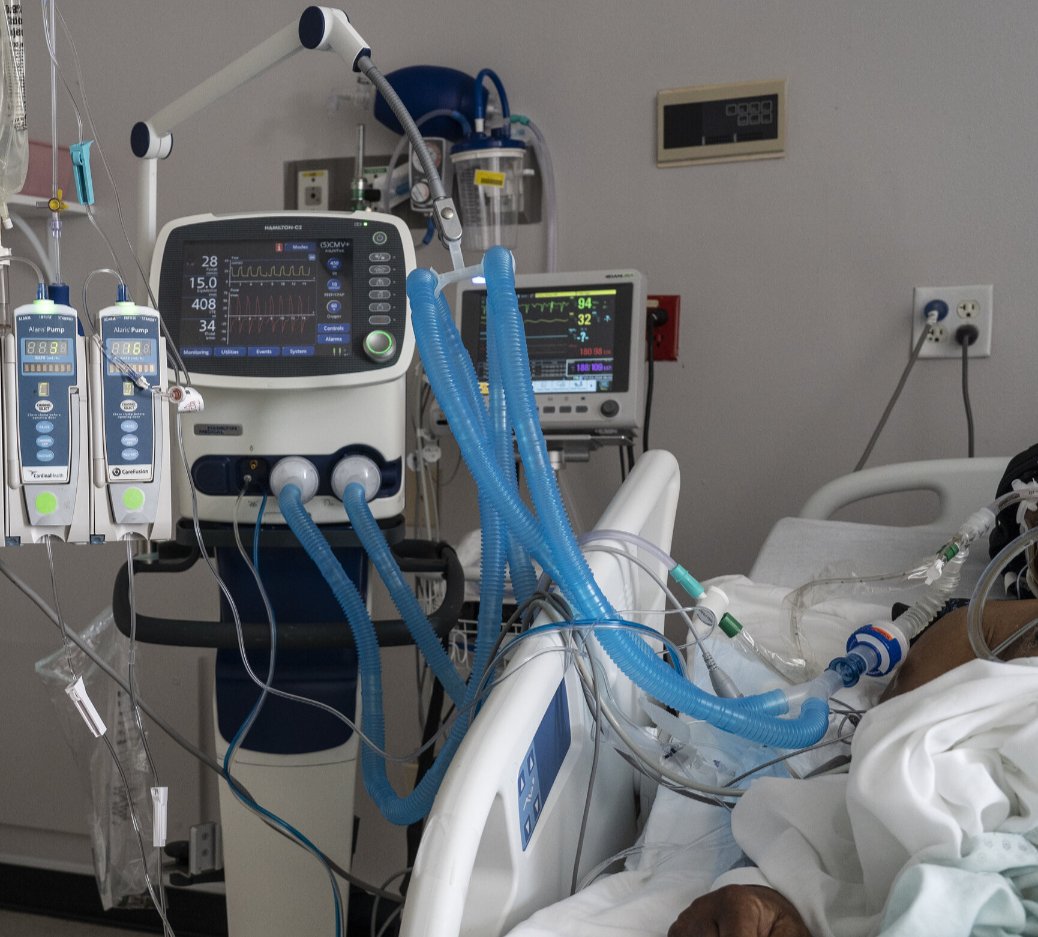
"Ventilator." For many, that word sounds like a final goodbye. Families often fear it more than the illness itself.
But here is the reality: a ventilator is not a death sentence. It is a bridge, a tool we use to buy precious time for the body to heal. Let’s talk about it. 🧵
How does a vent help? Think of it as an external lung.
Used when lungs are physically failing (like infection) or the GCS is low i.e. the brain is unable to protect the airway or trigger the drive to breathe.
The vent handles the mechanics while the body focus on recovery
It’s not just a pump. Modern vents are precise instruments. We calibrate them to match your body’s needs - managing pressure, volume, and oxygen to support you without causing trauma. It’s a delicate, life-sustaining balance.
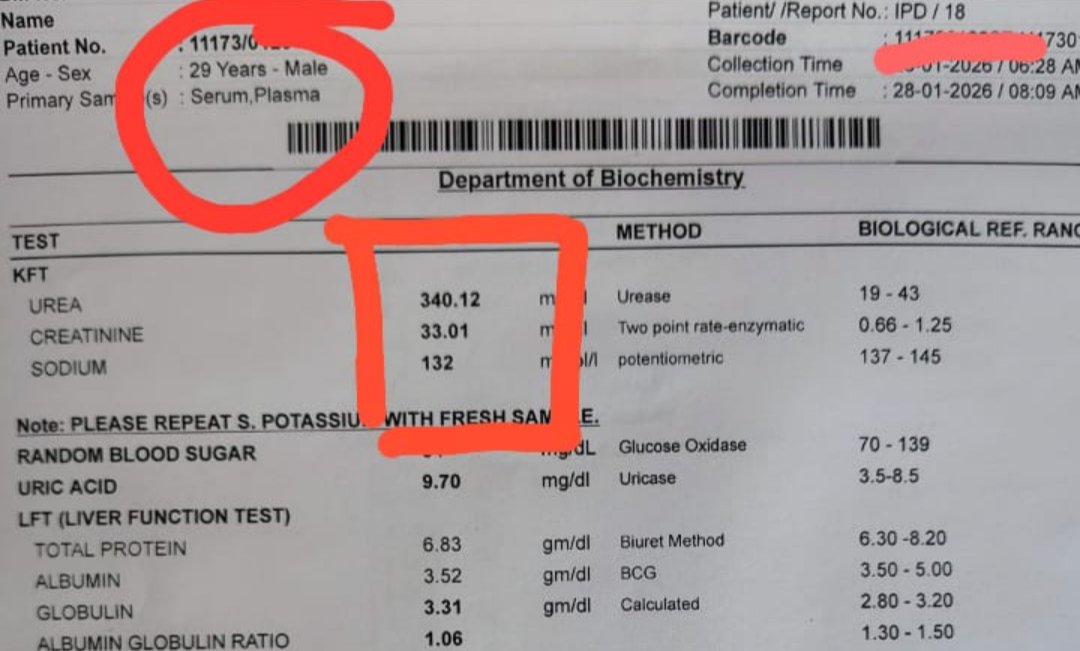
HE IS 29. HIS KIDNEYS HAVE FAILED. AND HE HAD NO IDEA.
I am holding a lab report that shouldn't belong to someone this young. At 29, you are supposed to be at your peak. Instead, this patient is facing a reality that has completely turned his world upside down
The Number: 33.01 mg/dl.
To put this in perspective, a normal Creatinine is around 1.0.
When I saw 33.01, it wasn't just a lab error. It was a siren.
His Urea is 340.12 (Normal is <40).
At these levels, the blood is no longer just "unhealthy"...it is becoming toxic to the brain, the heart, and every vital organ. This is a state of extreme uremia that most people don't survive long enough to walk into a clinic with.
The Silent Trap:
👉He didn’t have "excruciating" pain. He had:
1️⃣Vague fatigue he blamed on his job.
2️⃣Mild swelling he thought was just from sitting too long.
3️⃣A general feeling of being "off" that he ignored for months.
Because he "looked fit" and was under 30, he assumed he was invincible. By the time he reached the ER, the window for simple fixes had slammed shut.
The Reality Check:
❌ Your age is not a shield against chronic disease.
❌ "Feeling fine" is not a substitute for objective data.
❌ A routine blood test takes 10 minutes; a lifetime of dialysis takes 12 hours a week.
The Final Lesson:
Listen to your body. You don't need to live in a state of constant fear or health anxiety. You don't need to overstress about every minor ache. But you must be an active participant in your own health.
If something feels wrong, don't bury it under "busy-ness." Get your basic labs done once a year. Your career, your meetings, and your deadlines can all wait. Your health is the only thing that won't wait for a better time.
Check your labs. Then go live your life.
For everyone asking about the specific cause: we are still in the process of a full clinical work-up to find the "why."
But here is a sobering fact: we are seeing a massive rise in CKD-u (Chronic Kidney Disease of unknown origin).
In many young patients, we don’t find the traditional culprits like Diabetes or long-term Hypertension. Instead, we are looking at a complex mix of:
• Environmental toxins & heavy metals.
• Chronic dehydration/Heat stress.
• Agricultural exposures.
• Genetic predispositions.
Sometimes, the cause isn't one single event, but a silent accumulation over years. This is why screening is non-negotiable....even if you feel 100% healthy.
When I was a medical student, I was taught that Chronic Kidney Disease (CKD) was primarily a disease of the elderly.
My last three years as an Internal Medicine resident have completely shattered that perception.
In this short time alone, we have managed at least 100 young patients with CKD, if not more.
Cases like this 29-year-old with a Creatinine of 33.01 and Urea of 340.12 are no longer the "rare" textbook outliers we once thought they were.
We are witnessing a silent shift in medical demographics. Whether it's environmental factors, undiagnosed conditions, or lifestyle, the "young and healthy" are no longer invincible.
Last week, a 35-year-old male died in my ER because he did everything "wrong" after a snake bite. He followed "movie logic" instead of medical reality.
Here is everything you should know about snake bites and exactly what to do to stay alive. 🧵
The Tourniquet Trap 🚫
His first mistake? Tying a tight rope.
Tourniquets don't "trap" venom. They trap "flesh-eating" toxins in one spot, causing gangrene and amputation. It starves your limb of oxygen.
Never tie it. Treat the limb like a fracture instead.
The "Action Movie" Myth 🔪
He tried to "cut and suck" the venom out.
Don't. Venom is injected deep and spreads instantly.
Cutting causes massive bleeding.
Sucking introduces mouth bacteria.
You waste the "Golden Hour" playing hero.
Meet Alex.
40, fit, and hits the gym daily. He thought he was "bulletproof" until his blood work came back.
His Total Cholesterol was high. He panicked and tried to "hack" it with internet advice. He almost made it worse.
This is the Ultimate Guide to your Lipid Profile. 🧵
1️⃣ The "Total Cholesterol" Trap
Alex’s first mistake? Obsessing over Total Cholesterol.
He saw a "220" and freaked out. But it is just a "bulk" number. It’s like looking at the total number of vehicles on a highway without knowing if they are ambulances or reckless speeders.
The Reality: Total Cholesterol is the sum of everything. It's the least important number on the page.
Let me introduce you to a patient, let's call them "Abhi."
Abhi wanted to "max out" his health. So, every single night at dinner, Abhi swallowed a fistful of supplements: Iron, Calcium, Zinc, Vitamin B12, and Collagen. All in one gulp. 💊
The result? 🧵
He was still anemic, still tired, and his skin/joints weren't improving. Instead he felt exhausted and often had stomach cramps.
Here is why his routine was literally "flushing money down the toilet"👇
The "Transporter" War 🥊
Minerals like Iron, Calcium, and Zinc use the same "gateways" to enter your bloodstream from your gut.
When you take them all at once, Calcium acts like a bully. It crowds the gates, effectively blocking your Iron and Zinc from getting in.