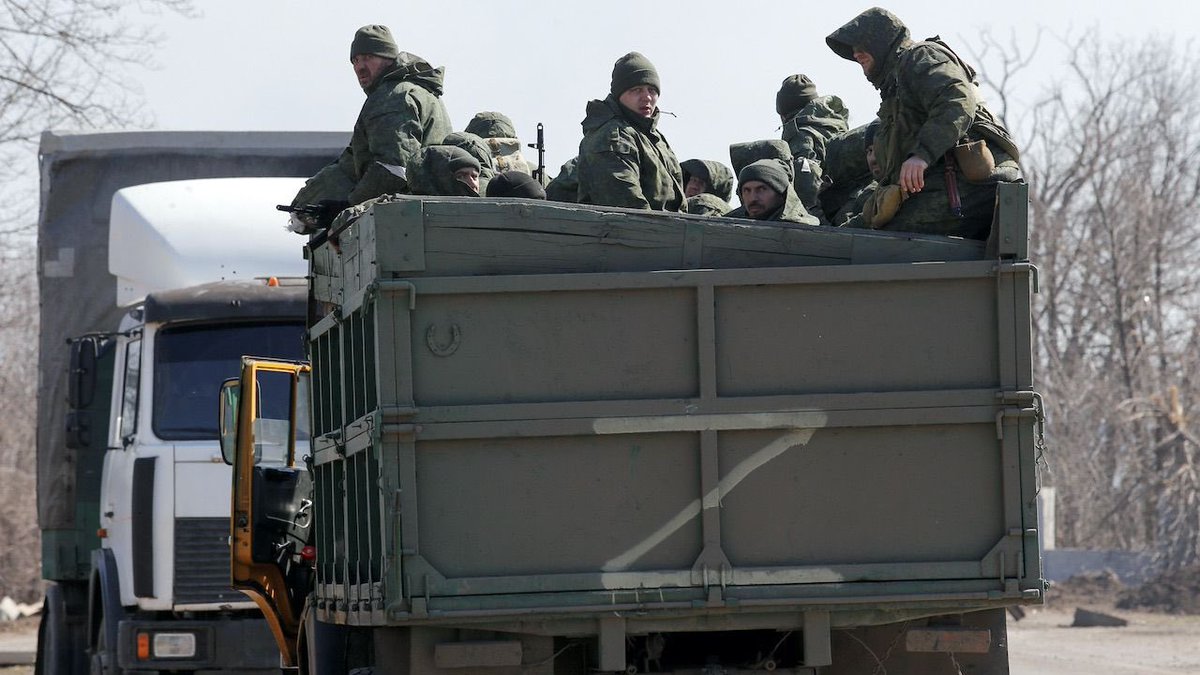
1/ Russian soldiers are now divided into two 'castes', says a front-line soldier: "short-livers", who die almost immediately after being sent to the front in Ukraine, often as a punishment, and "long-livers", the privileged ones in the officer cadre and rear areas. ⬇️ 

2/ A Russian soldier in Ukraine writes to the 'Ramsay' Telegram channel:
"Everyone today understands the brutal nature of today's war, where two "castes" of participants have effectively emerged—as in [Ivan] Efremov's novel "The Hour of the Bull"—the "KZhI" and the "DZhI."
"Everyone today understands the brutal nature of today's war, where two "castes" of participants have effectively emerged—as in [Ivan] Efremov's novel "The Hour of the Bull"—the "KZhI" and the "DZhI."
3/ [Note – This refers to a 1968 science-fiction novel in which a dystopian society is rigidly divided into two castes: 'short-livers' (the working underclass doomed to hard labour and ritual death around age 25–27), and 'long-livers' (the intellectual elite who live long, privileged lives) – compare the Morlocks and Eloi in H.G. Wells' 'The Time Machine'.]
4/ "The former are the "stormers"—fighters in assault units stationed on the front lines—in that very "kill zone," where the enemy hunts us 24/7, using every means at its disposal, trying to "kill as many Russians as possible," as their new strategy puts it.
5/ "Stormers" are those who, despite everything, push forward and earn those very "inch and crumbs" that our high command then so well reports to the political leadership!
6/ "I'm talking about the fact that, in the fifth year of the war, the life of a Russian soldier is still a mere token for the command unit.
7/ "He can be sent to "storm" just a month after signing a contract and, on his very first combat mission, be "200," [killed] like my colleague Nikita Dontsov, a young Moscow volunteer who went missing on 27 January near Kupyansk during one of his first missions.
8/ "You're right that today a soldier's life costs the state at least 20 million rubles [$240,000]. Six for their contract and training, and 14 for the funeral expenses.
9/ "But I'm afraid some commanders don't have the slightest understanding that saved lives represent money that, as you said on air, could be used to purchase much-needed drones of all kinds or military developments for the front.
10/ "This money, in turn, is their personal "raw material" and "resource," used to solve problems often far removed from actual combat.
11/ "Otherwise, how can we explain the increasing number of people being sent to our unit "as punishment"? As if we weren't stormtroopers but penal battalion soldiers?
12/ "In the absence of proper disciplinary practices and enforced laws, the main and only punishment at the front is now exile to assault missions! For literally everything! Caught a soldier with a smartphone? Send him to assault missions? Three days later, he's dead!
14/ "No contact with the unmanned ground vehicle? March yourself to assault missions to lay mines on foot! Result: killed! Lose your reconnaissance drone? Get closer to the enemy yourself? Consider yourself killed!
15/ "Why is it almost always killed? Because people who are completely unprepared for assault operations are immediately transferred to combat units, where personnel are at a premium. And there's no time or opportunity to train them.
16/ "Forward to rotation, 7 km away, through drones, artillery, and mines! Although any stormtrooper will tell you that you can only become a real stormtrooper after weeks of training and an adaptation period, when a person gets used to the kill zone and gets a feel for it.
17/ "And here, such "transfers to stormtroopers" are, in fact, sentences to capital punishment! So it turns out that a citizen, having voluntarily chosen to serve his country, fulfilling his highest duty, finds himself in an environment where he is simply a nobody!
18/ "Expendable! LITERALLY! And if he is dissatisfied with something, or says something about it, then what? That's right – he's sent to the stormtroopers and killed!"
19/ The Russian warblogger 'Zhivoff' agrees, and highlights cases of people he knows personally being killed on the front line within days or a few weeks of arriving there. He comments:
20/ "In some places, I've completely lost track of what's going on here. Why such a negligent attitude toward the lives of soldiers? Besides the loss of healthy men, there are also huge losses to the state due to the loss of breadwinners, insurance, and so on.
21/ "If you don't feel sorry for the people, then shouldn't you feel sorry for the money?! The budget isn't unlimited.
The key demand of sensible people in Russia is for human-centredness —for intellect, reputation, responsible attitude, and life to be valued!
The key demand of sensible people in Russia is for human-centredness —for intellect, reputation, responsible attitude, and life to be valued!
22/ "No women will give birth to anyone anymore. Everything depends on specific, intelligent, passionate people; the loss of one such person can collapse the work of a factory, institute, or regiment.
23/ "There is nothing seditious in my words. I only want what is guaranteed by law: due process, accountability for decision-makers, and a people-centered approach, because in Russia, people and citizens are the source of power, not expendables." /end
• • •
Missing some Tweet in this thread? You can try to
force a refresh


!['Cheburnet [is] Inevitable'](https://pbs.twimg.com/media/HEBhnnbakAAOZfk.jpg)