I need everyone with any modicum of influence in the Democratic Party or prominent progressive organization to drill this into their skull:
“It's a DC myth that the swing voter is a hyper-engaged centrist that writes for the Washington Post. The average swing voter is very much a heterodox moderate — some far-right views, some far-left views.
And they don't really care that much about politics. They don't trust people very much. They think that politicians are in it for themselves. And they generally vote for whoever makes the economy the best and whoever has the least chaos in their opinion.
So that group overlaps a lot with young voters. It overlaps a lot with Hispanic voters. It overlaps a lot in general with the types of low-propensity voters that Donald Trump has gained a lot with.
…[A lot of] these people don't care about politics when a presidential election is not on the ballot. They don't even know a special election is a thing. They barely know a midterm exists.”
“It's a DC myth that the swing voter is a hyper-engaged centrist that writes for the Washington Post. The average swing voter is very much a heterodox moderate — some far-right views, some far-left views.
And they don't really care that much about politics. They don't trust people very much. They think that politicians are in it for themselves. And they generally vote for whoever makes the economy the best and whoever has the least chaos in their opinion.
So that group overlaps a lot with young voters. It overlaps a lot with Hispanic voters. It overlaps a lot in general with the types of low-propensity voters that Donald Trump has gained a lot with.
…[A lot of] these people don't care about politics when a presidential election is not on the ballot. They don't even know a special election is a thing. They barely know a midterm exists.”
https://x.com/admcrlsn/status/2035198995090567471
This has been something I have seen in nearly every poll and focus group of swing and/or low propensity voters I’ve conducted over the course of my career.
This is why lifting up gifted communicators that can break through is so crucial.
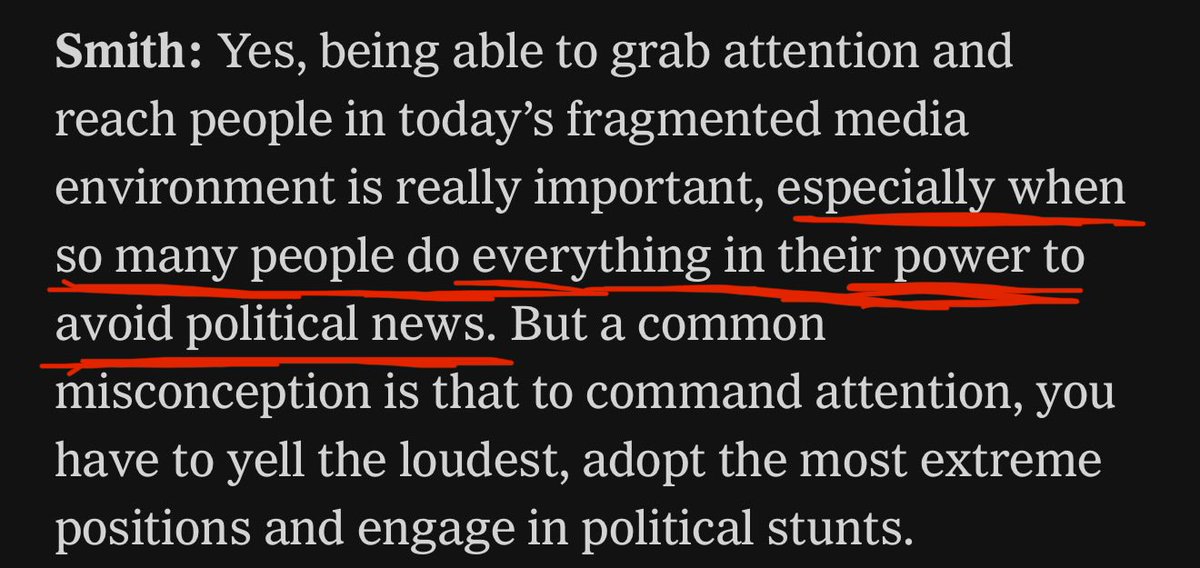
Per @Lis_Smith in NYT Opinion today:
This is why lifting up gifted communicators that can break through is so crucial.
Per @Lis_Smith in NYT Opinion today:
1) Stop nominating and elevating candidates who talk like politicians or lawyers — who are overly careful, equivocate, or dodge hard questions. Who strain to relate to normal or disengaged people.
Nominate and elevate people who speak plainly and with conviction, who are comfortable in their own skin no matter who they talk to — even if they’re not 100% perfect and polished. Ideally people who haven’t worked a white collar job their entire career.
2) Focus on local issues that people care deeply about. That tangibly affect their lives on a regular basis. You don’t have to nationalize everything.
3) Nominate people who know how to communicate effectively in the modern age. Social media, short- and long-form video/podcasts.
Basically a lot of the types of candidates that @fight_agency manages to find, and most of what @Lis_Smith laid out here:
nytimes.com/2026/03/20/opi…
Nominate and elevate people who speak plainly and with conviction, who are comfortable in their own skin no matter who they talk to — even if they’re not 100% perfect and polished. Ideally people who haven’t worked a white collar job their entire career.
2) Focus on local issues that people care deeply about. That tangibly affect their lives on a regular basis. You don’t have to nationalize everything.
3) Nominate people who know how to communicate effectively in the modern age. Social media, short- and long-form video/podcasts.
Basically a lot of the types of candidates that @fight_agency manages to find, and most of what @Lis_Smith laid out here:
nytimes.com/2026/03/20/opi…
• • •
Missing some Tweet in this thread? You can try to
force a refresh