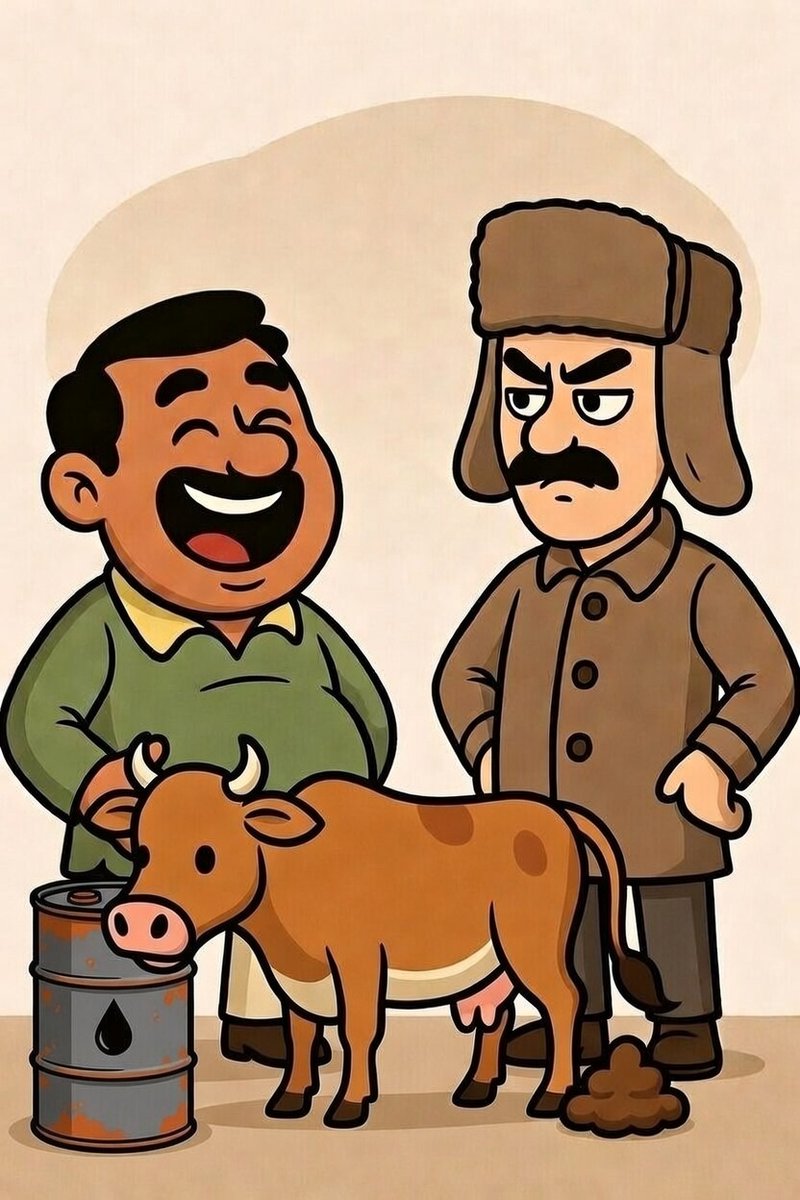
1/ India is ripping off Russia to the tune of hundreds of billions of dollars over oil shipments, according to an angry Russian commentary. India will not pay for Russian oil in anything other than Indian rupees and Indian-made goods, which Russian companies don't want. ⬇️
2/ 'Political Report' writes:
"For several years, Russian officials proudly declared that Europe, by rejecting Russian oil, was only harming itself, while Russia continued to quietly sell its oil to other buyers and enrich itself."
3/ "It was claimed that India was happily buying up barrels at favourable prices. Public figures were aired about the colossal profits the country was supposedly receiving from redirecting supplies to the Asian market. The reality turned out to be far from these rosy reports.
4/ "It turned out that Russia not only failed to receive the promised superprofits but also suffered enormous financial losses.
5/ "According to estimates by independent analysts, the losses from the 'Indian partnership' have long been in the hundreds of billions of dollars, not just tens of billions.
Accurate official data is still lacking, but the scale of the problem can no longer be hidden.
6/ "The main stumbling block is the still unresolved issue of settlements in Indian rupees. Billions of rupees earned from the sale of cheap oil have been frozen in Asian bank accounts for five years now.
7/ "India's strict currency controls prevent these funds from being freely transferred to other jurisdictions or converted into dollars, euros, or other freely convertible currencies.
8/ "They can only be used to buy Indian goods, but Russian companies, in most cases, simply don't need them.
The Indian regulator periodically promises to find a "workable mechanism," but there's still no real solution. Russia has been fed empty promises for five years now.
9/ "While endless approvals and negotiations drag on, the rupee continues to weaken against the dollar. Pending amounts are rapidly losing value, turning virtual profits into real losses.
10/ "The oil was shipped long ago, taxes on it have been paid, and the money earned is simply vanishing from the currency charts.
11/ "The situation looks particularly grim when viewed against the backdrop of initial expectations. The shift to settlements in national currencies was touted as a breakthrough in de-dollarization and a way to circumvent Western sanctions.
12/ "In practice, it turned out to be a trap: the resources were gone, but the money remained inaccessible. Exporters effectively gave India oil in exchange for worthless paper money that cannot be withdrawn or properly spent.
13/ "This case has served as a vivid lesson: changing the settlement currency without ensuring the free movement of capital turns trade into a form of hidden subsidisation of the buyer.
14/ "Russia not only lost revenue but also set a precedent where a partner can hold funds in their own currency for years while it depreciates, and the seller can do nothing about it.
15/ "Essentially, India, like Europe, froze Russian assets, only in this case, Russia prefers to remain silent and accept the Indian bullshit." /end
1/ Russian sources say that Ukraine's Unmanned Systems Forces, under the command of Robert “Madyar” Brovdi, have made "significant strides in UAV production and deployment technology". Russian soldiers are facing "slaughter [like] cattle" as a result. ⬇️
2/ Andrey Medvedev writes:
"We've been reporting since the fall that the Ukrainian Armed Forces and Ukrainian drone manufacturers have made significant strides in UAV production and deployment technology.
3/ "Footage of a single Russian soldier being killed by ten to twenty drones has, unfortunately, been appearing regularly on the Ukrainian segment of Telegram.
1/ Another Russian helicopter has been lost over Ukraine – the second in two days, after yesterday's shootdown of a Ka-52 by an FPV drone (seen here). The Russian warblogger 'Fighterbomber' is angry at the lack of EW protection on helicopters. ⬇️
It's clear that everyone is now preoccupied with urgently installing anti-FPV drone electronic warfare systems on attack helicopters."
3/ "Why attack helicopters, specifically? Because Mi-8 crews are already carrying homemade electronic warfare systems at their own risk, supported by sponsors, volunteers, or even purchased at their own expense.
1/ Has Iran managed to reinvent the Sound Dues – the tolls that Denmark imposed for over 400 years on ships entering the Baltic Sea? Recent ship movements suggest that rather than completely blocking the Strait of Hormuz, Iran is monetising it instead. ⬇️
2/ Between 1429 and 1857, Denmark levied a toll on ships passing through the Øresund, the body of water separating Denmark from Sweden. At the time, Denmark controlled both sides of the strait with the castles at Helsingør (Hamlet's Elsinore) and Helsingborg.
3/ The tolls were enforced by the cannon batteries in both castles, which could open fire on a ship trying to pass without authorisation and sink it. They were calculated on the basis of a ship passage fees plus 1–2%, sometimes up to 5%, of the declared cargo value.
1/ Russian soldiers are now divided into two 'castes', says a front-line soldier: "short-livers", who die almost immediately after being sent to the front in Ukraine, often as a punishment, and "long-livers", the privileged ones in the officer cadre and rear areas. ⬇️
2/ A Russian soldier in Ukraine writes to the 'Ramsay' Telegram channel:
"Everyone today understands the brutal nature of today's war, where two "castes" of participants have effectively emerged—as in [Ivan] Efremov's novel "The Hour of the Bull"—the "KZhI" and the "DZhI."
3/ [Note – This refers to a 1968 science-fiction novel in which a dystopian society is rigidly divided into two castes: 'short-livers' (the working underclass doomed to hard labour and ritual death around age 25–27), and 'long-livers' (the intellectual elite who live long, privileged lives) – compare the Morlocks and Eloi in H.G. Wells' 'The Time Machine'.]
1/ Russia faces increasing difficulties in its war in Ukraine, comments a Russian warblogger, including a build-up of Ukrainian offensive capabilities, a military system that weeds out "energetic, proactive people", and the likely loss of Trump's assistance after the midterms. ⬇️
2/ 'Voenkor Kotenok' writes that a new sense of realism is setting in among the 'turbo-patriots' who promote the Russian government's talking points on TV:
"Our TV show 'stars' are accustomed to convincing viewers that the enemy in Ukraine is almost defeated."
3/ "But by the beginning of the fifth year of the Special Military Operation, such enthusiastic utterances as "We'll just raise an eyebrow!" or "We'll crush you in three days" are no longer heard on the idiot box. The talkers haven't dried up, but they've reformed themselves.
1/ It's very hard to win a war with a strategy that is built on bullshit. This was one of the key lessons of World War II, thanks to the approach taken by Adolf Hitler, who launched the war in Europe. Here are some of the lessons from Hitler's Great European Bullshit War. ⬇️
2/ Harry Frankfurt's famous essay "On Bullshit" draws a crucial distinction that is useful to consider here. A liar knows the truth and deliberately inverts it. A bullshitter is entirely indifferent to truth – what matters is the effect produced and the audience managed.
3/ It mustn't be forgotten that Hitler's rise to power was based on bullshit. His Dolchstoßlegende — the stab-in-the-back myth, blaming Germany's WWI defeat on Jews and socialists rather than military failure – was entirely invented, an early example of the Big Lie technique.