*** Ontario COVID Hospitalization Rates by Age ***
Data is now available for hospital admissions due to COVID by age group going back to Oct 2021. This provides interesting insights into how much children have been impacted with serious infections compared to adults. 🧵1/
Data is now available for hospital admissions due to COVID by age group going back to Oct 2021. This provides interesting insights into how much children have been impacted with serious infections compared to adults. 🧵1/
We have heard from many sources throughout the pandemic that COVID isn't serious in children or they are not impacted as much as adults with some people still claiming this today. 2/
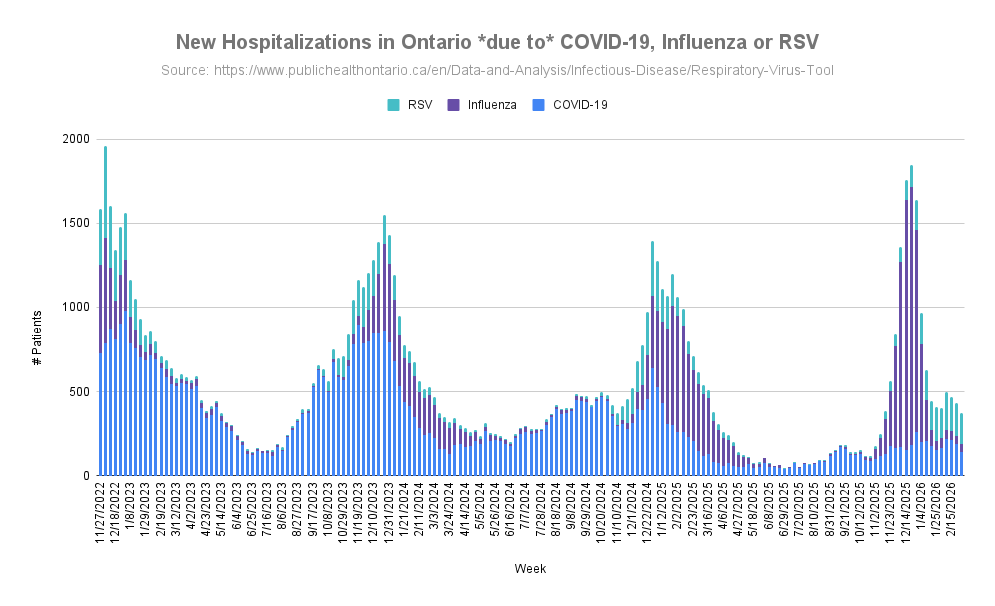
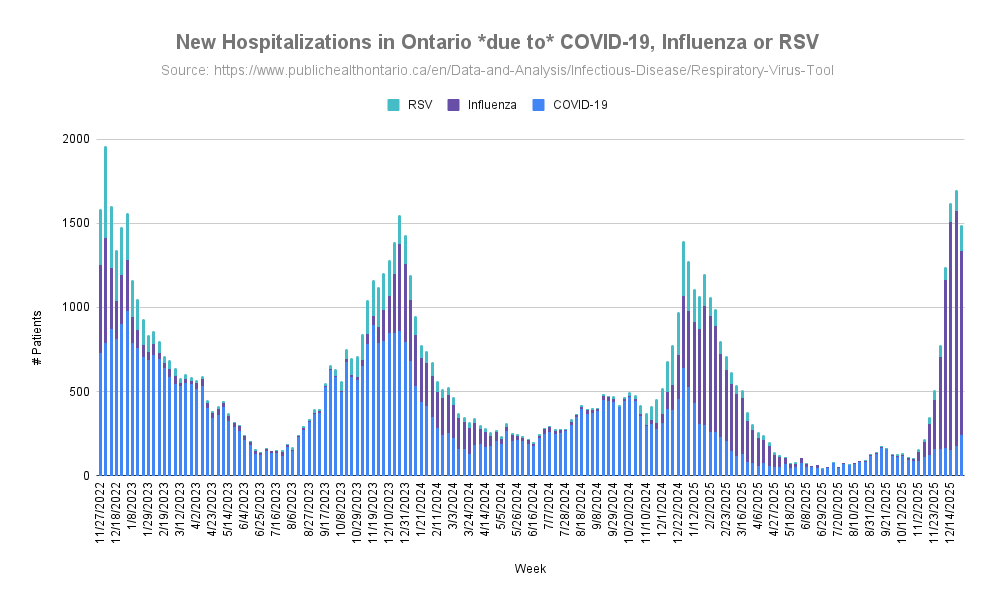
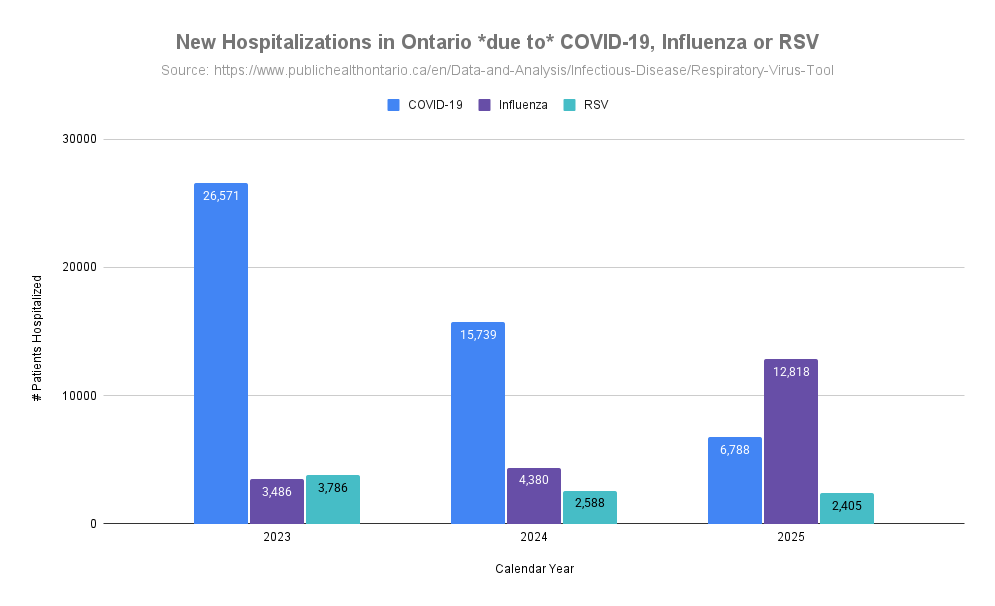
What about today, with lower circulation happening more recently and not the huge waves seen in the past, is anyone even being hospitalized for COVID anymore? The most recent update (week of March 8, 2026) there were 188 people hospitalized in Ontario due to COVID. 3/
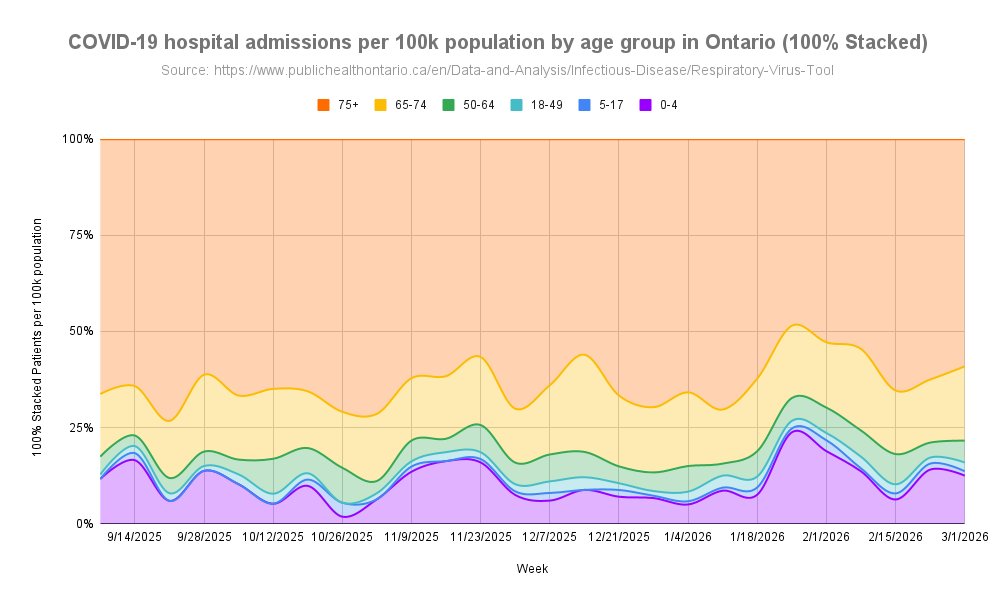
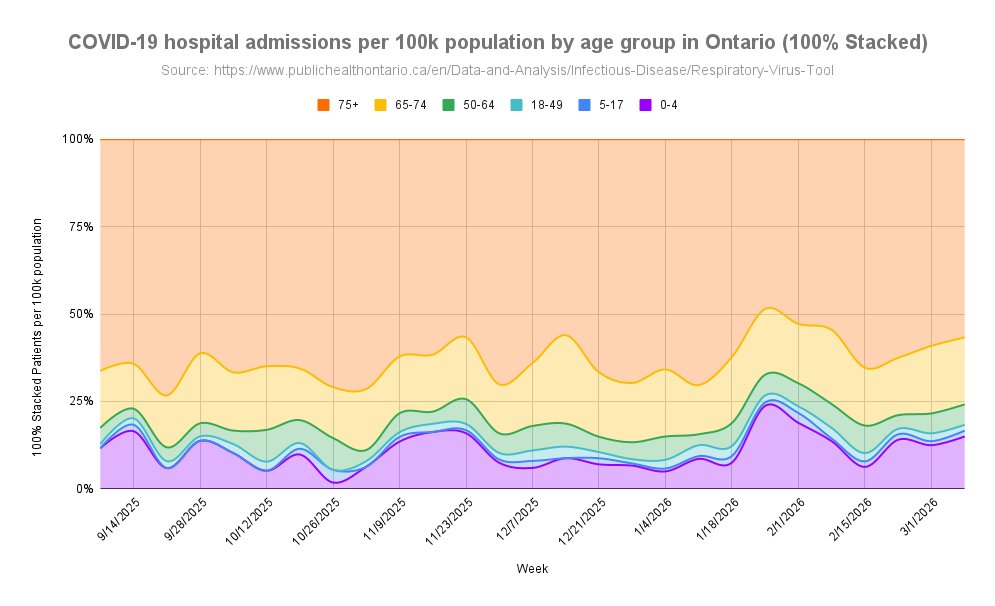
Looking at age groups, those age 75+ had the highest rates of hospitalization due to COVID while second place was age 65-74 and age 0-4 had the third highest rate, all increasing since the last update. 4/
Right now, the youngest age group 0-4 currently have a hospitalization rate due to COVID that are 9x higher than age 5-17, 9x higher than age 18-49, and 2.6x higher than adults 50-64. 5/
You can see from the graph that children age 0-4 actually make up a significant percentage of hospital admissions due to COVID. The rate for age 0-4 is often similar to and sometimes even higher than the 65-74 age group. 6/

This graph shows data from Sept. 2025 to present and since Ontario changed the age categories, it is not directly comparable to earlier historical data. 7/
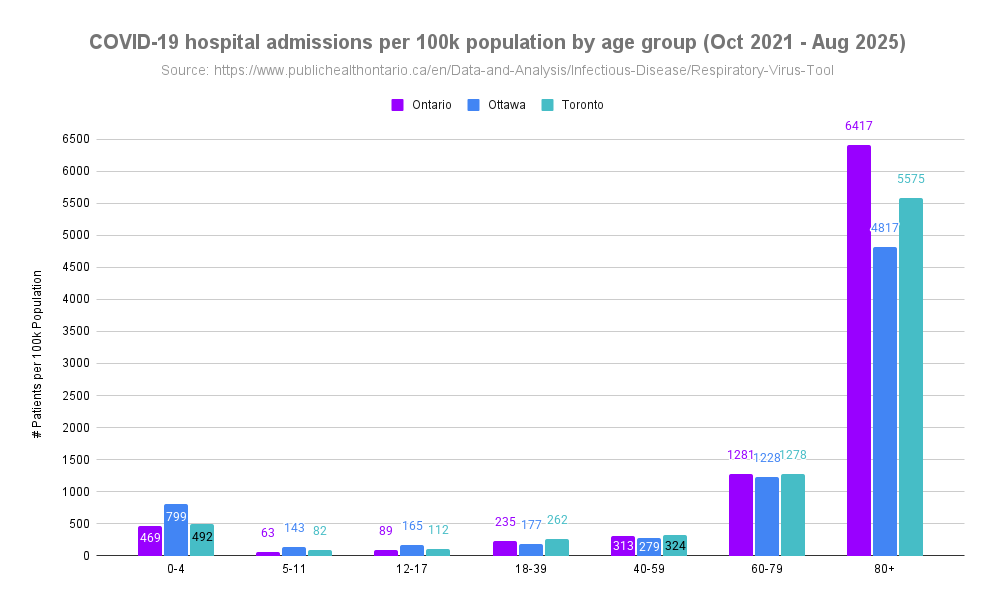
While hospitalization rates have changed throughout the pandemic, what does the picture look like if we examine Oct 2021 to August 2025 all together with the previous age group categories? 8/
This second graph shows COVID hospital admission rates due to COVID for the province of Ontario (population ~14M), Ottawa Public Health (population ~1M) and Toronto Public Health (population ~2.7M). 9/
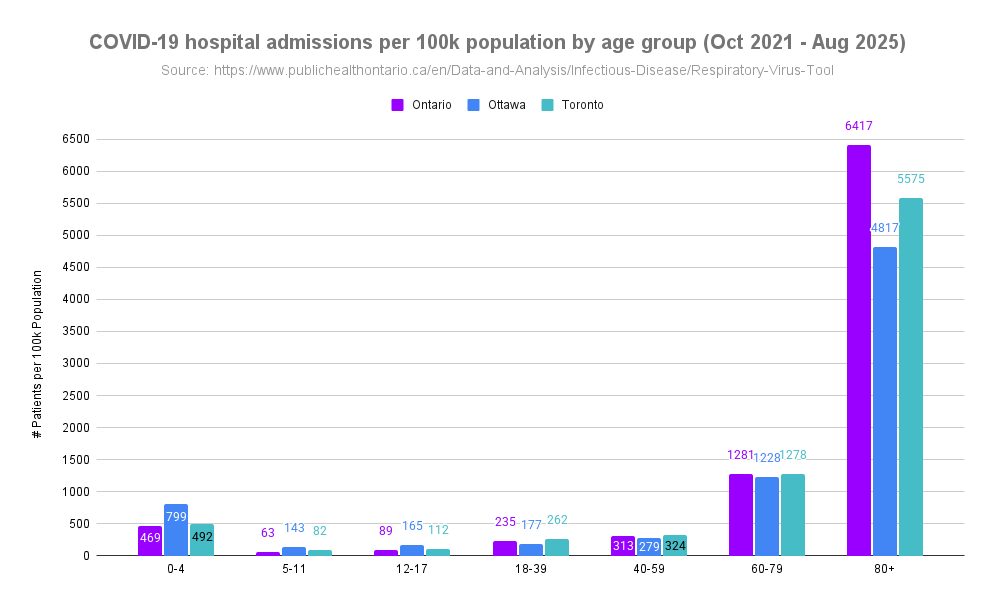
The first thing that jumps out is that locations had significant differences in hospitalization for children and the oldest adult populations. 10/
For whatever reason, Ottawa had almost double the rate of hospitalization for children, while significantly lower rates for ages 18-39 and 80+ compared to Toronto and Ontario as a whole. 11/
The age 0-4 group had the highest rates of hospitalization among children so we will use that as the comparison. 12/
The age 80+ group had by far the highest hospitalization rate for COVID, 13.7x higher in Ontario than age 0-4 with the second highest coming from age 60-79 which was 2.7x higher than age 0-4. 13/
Children age 0-4 had the third highest rate of any age group. In Ontario, children age 0-4 had rates 7.4x higher than age 5-11, 5.2x higher than age 12-17, 2x higher than adults age 18-39 and 1.5x higher than adults 40-59. 14/

In Ottawa there was an even bigger difference compared to adults with children age 0-4 being hospitalized at rates 4.5x higher than age 18-39 and 2.9x higher than age 40-59. Children age 5-17 had similar hospitalization rates to adults 18-39. 15/
Clearly children, especially our youngest, can become seriously ill when infected with COVID requiring hospitalization and these elevated rates continue today with children age 0-4 being the third and sometimes second highest among all age groups. 16/
This isn't even taking into account the long-term damage that COVID infection can cause in children who aren't hospitalized and unborn fetuses which make up a much larger proportion of the population than those that are hospitalized. 17/
You can find my weekly Ontario stats including variants at ( ). 18/covid.gilchrist.ca/Ontario.html
The hospitalization source data used in this post can be found from PHO ( ). 19/publichealthontario.ca/en/Data-and-An…
@threadreaderapp please unroll
• • •
Missing some Tweet in this thread? You can try to
force a refresh