I want to break down Alexis Wilkins’ thread carefully, because the core issue she is pointing at is real: the American information space is under constant pressure from propaganda, coordinated amplification, and foreign influence.
The mistake would be to dismiss that threat just because not every piece is fully mapped, a thread:🧵
The mistake would be to dismiss that threat just because not every piece is fully mapped, a thread:🧵
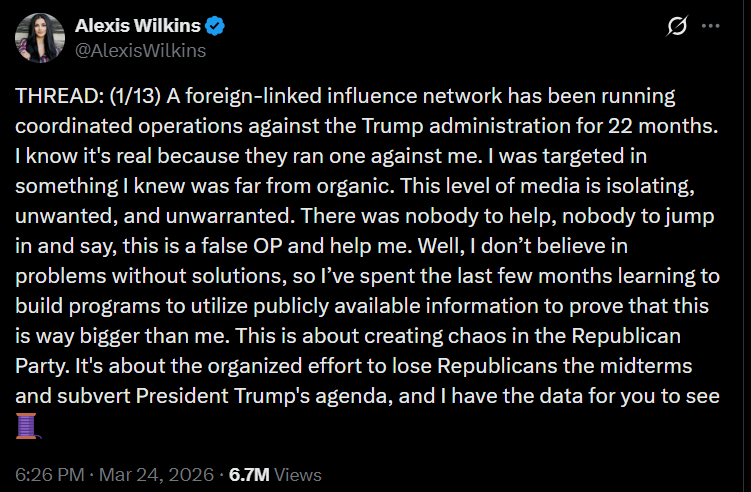
She's not just arguing that people online were mean, dishonest, or reckless.
She's arguing that across multiple political flashpoints, the same amplification patterns, the same recurring accounts, and the same narrative pressure points show up again and again.
That deserves scrutiny, and to disregard it completely is to either ignore reality or acknowledge bias against the possibility of her statements being accurate.
She's arguing that across multiple political flashpoints, the same amplification patterns, the same recurring accounts, and the same narrative pressure points show up again and again.
That deserves scrutiny, and to disregard it completely is to either ignore reality or acknowledge bias against the possibility of her statements being accurate.
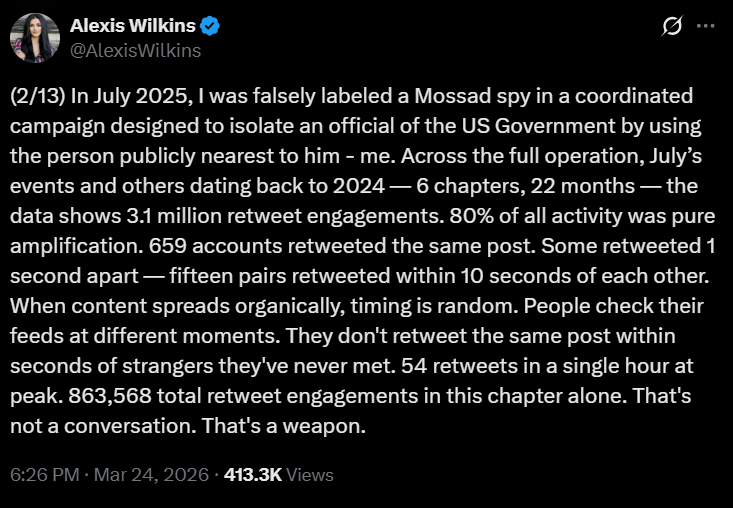
Her thread is strongest where it identifies a broader truth: very little in today's information environment is fully organic.
Narratives don't just spread on their own anymore.
They're pushed, accelerated, rewarded, and amplified by systems and actors that understand exactly how outrage, tribalism, and repetition shape perception.
Narratives don't just spread on their own anymore.
They're pushed, accelerated, rewarded, and amplified by systems and actors that understand exactly how outrage, tribalism, and repetition shape perception.
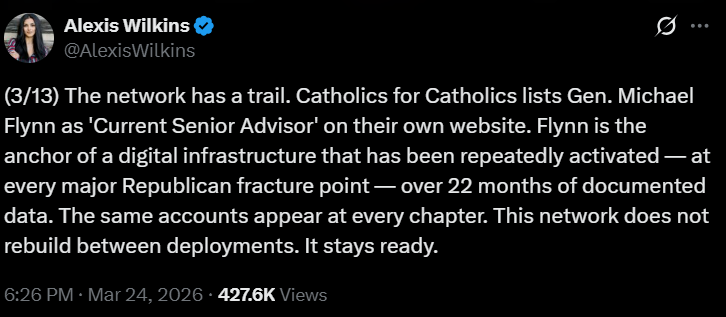
In her first major claim, she points to repeated timing and amplification patterns around key moments of fracture inside the right. Whether every account involved is part of one centrally directed network isn't fully proven in the thread (nor does it need to be, because that is not how our information environment works... nor does it even need to at this point).
The broader point stands: these fractures don't just happen naturally anymore. They're exploited.
The broader point stands: these fractures don't just happen naturally anymore. They're exploited.
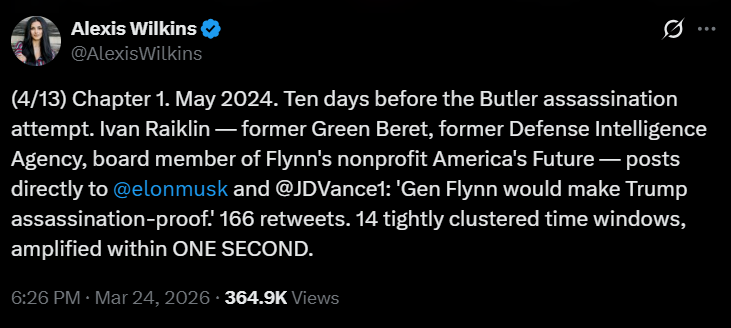
Her second chapter centers on the "Mossad honeypot" narrative directed at her. The key takeaway isn't just the smear itself. It's how quickly a personal accusation can be scaled into a political weapon.
Once a narrative hits the right ecosystem, it stops being gossip and becomes infrastructure. Once a claim is presented repetitiously from multiple points, it is often widely accepted despite veracity.
Once a narrative hits the right ecosystem, it stops being gossip and becomes infrastructure. Once a claim is presented repetitiously from multiple points, it is often widely accepted despite veracity.
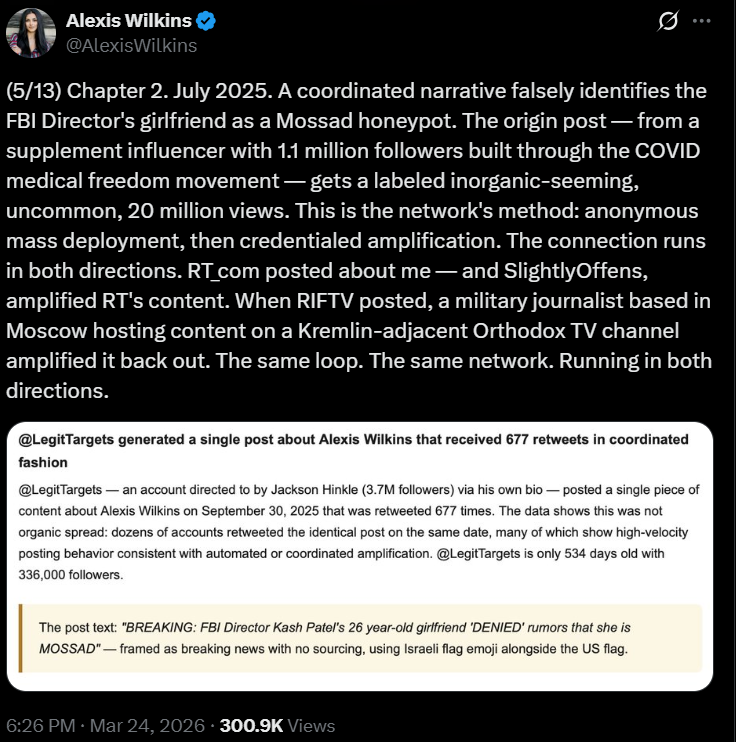
That's where foreign influence matters. Alexis points to RT and other foreign linked amplification as part of the picture. That matters because foreign actors don't need to invent chaos in the United States.
They only need to identify existing divisions and push them harder. That's been their playbook for years.
Russian propaganda has never existed with a purpose of convincing, only with a purpose of creating overwhelming uncertainty due to a flood of contentious narratives.
They only need to identify existing divisions and push them harder. That's been their playbook for years.
Russian propaganda has never existed with a purpose of convincing, only with a purpose of creating overwhelming uncertainty due to a flood of contentious narratives.
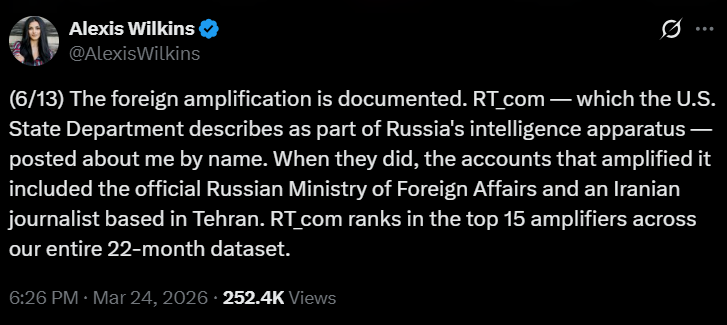
And this is the part too many Americans still fail to understand: foreign influence operations don't always look like fake accounts with broken English and obvious propaganda.
Sometimes they look like domestic narratives being picked up, amplified, echoed back, and injected into the bloodstream at scale.
Sometimes they look like domestic narratives being picked up, amplified, echoed back, and injected into the bloodstream at scale.
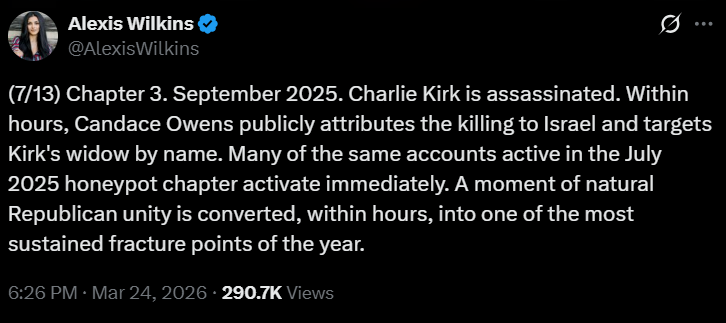
Her Charlie Kirk chapter is important for the same reason. The point isn't simply that people rushed to a divisive conclusion.
The point is that major moments that should produce clarity or unity are now immediately turned into narrative battlefields.
That's how instability is sustained.
The point is that major moments that should produce clarity or unity are now immediately turned into narrative battlefields.
That's how instability is sustained.
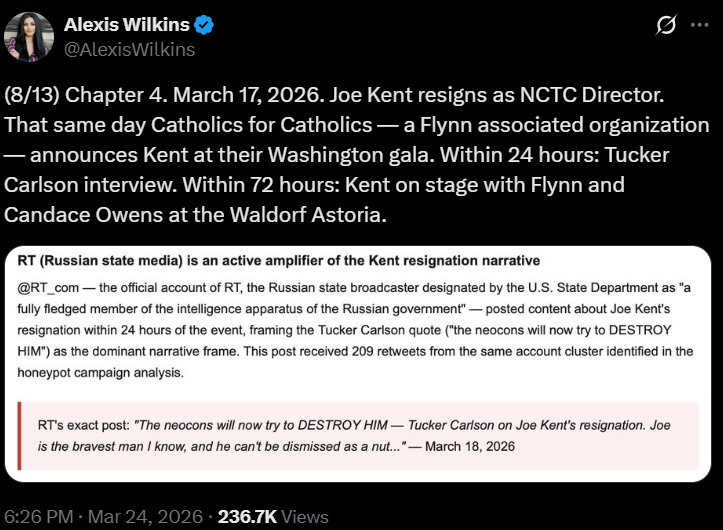
Her Joe Kent chapter pushes that argument further. The thread suggests that when a major national security event occurred, the same influence ecosystem activated quickly around it.
Again, the thread doesn't fully prove one master command structure behind all of it. But it does show a recurring pattern of rapid political weaponization.
Again, the thread doesn't fully prove one master command structure behind all of it. But it does show a recurring pattern of rapid political weaponization.
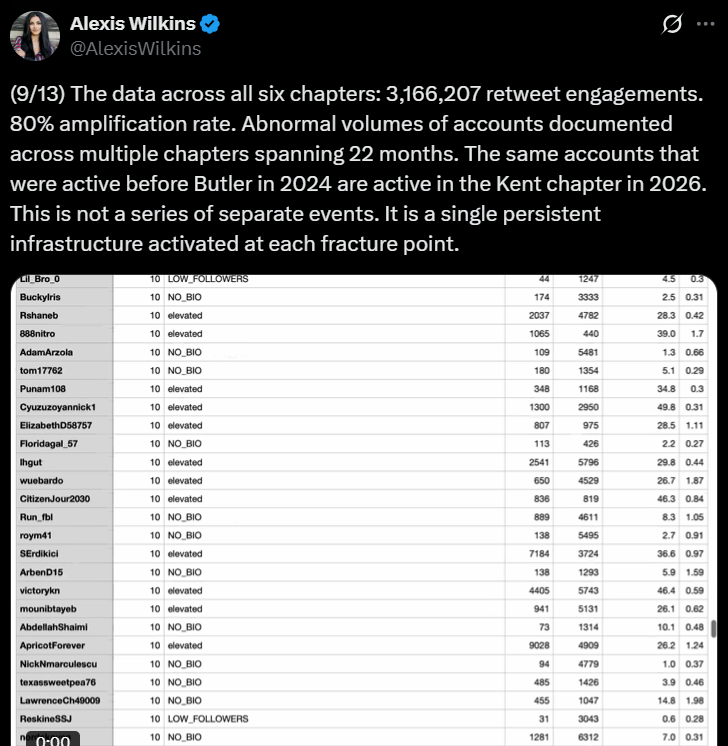
Where I think Alexis is directionally right is this: the real danger isn't just bots, or RT, or a few bad actors.
It's the existence of an information environment where automated accounts, opportunistic foreign actors, influencers, podcasters, and political personalities can all push in the same direction, knowingly or unknowingly.
We are a society faced with information overload and our enemies know it.
It's the existence of an information environment where automated accounts, opportunistic foreign actors, influencers, podcasters, and political personalities can all push in the same direction, knowingly or unknowingly.
We are a society faced with information overload and our enemies know it.
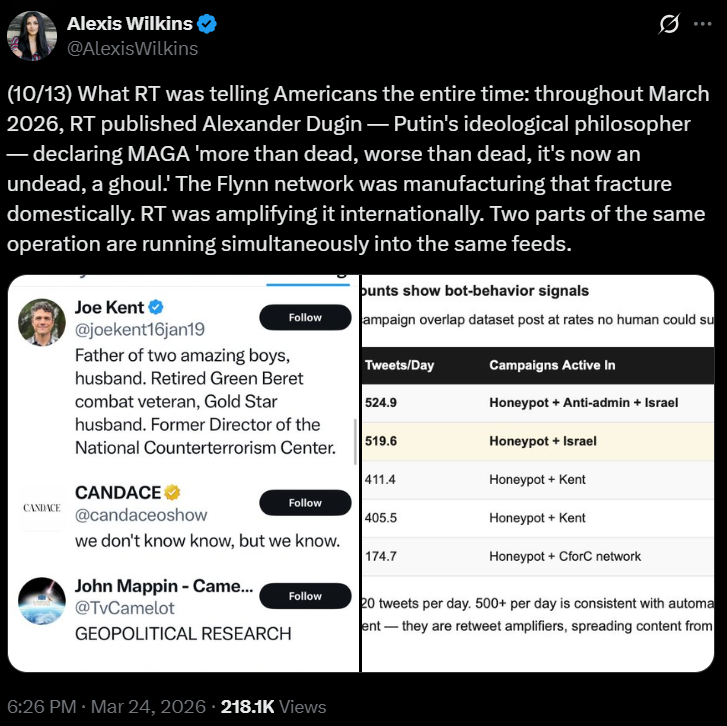
And this last part matters. Not everyone involved in these cycles understands what they're doing. Many people with large platforms, large audiences, and even serious positions of influence are operating inside this environment with almost no understanding of propaganda, perception management, or second and third order effects.
That's a national vulnerability.
That's a national vulnerability.
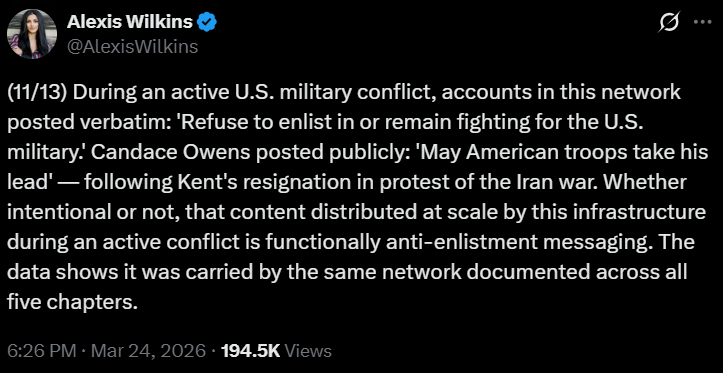
So, the right way to read her thread isn't "she proved every detail of one unified operation beyond doubt."
The right way to read it is: "she identified serious signs that key political fracture points are being amplified inside an information environment already saturated with manipulation, including foreign manipulation."
The right way to read it is: "she identified serious signs that key political fracture points are being amplified inside an information environment already saturated with manipulation, including foreign manipulation."
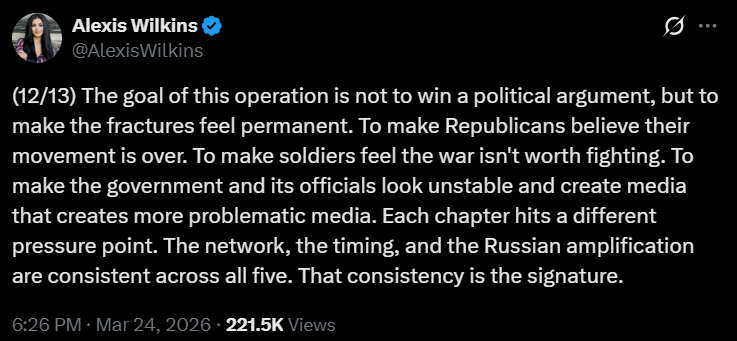
I get the uproar, the virility of it all. This is not a small claim. And it shouldn't be brushed aside as one.
But I really want people to realize that this is the new reality. I have said it many, many times before: the United States of America cannot be attacked kinetically; it cannot be overwhelmed by sheer military force or occupied by any foreign military. It is simply not possible do defeat us in such a manner.
Period.
That means they must find another way to attack us. They must find another way to defeat us.
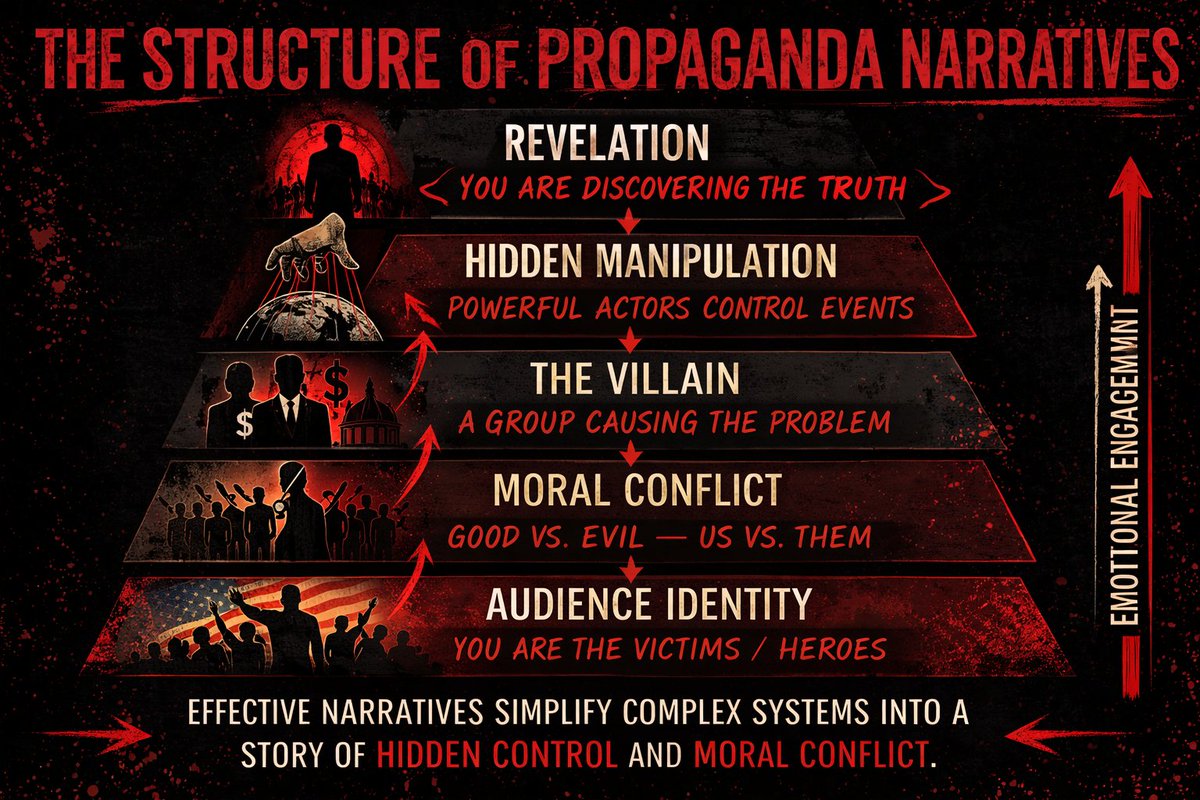
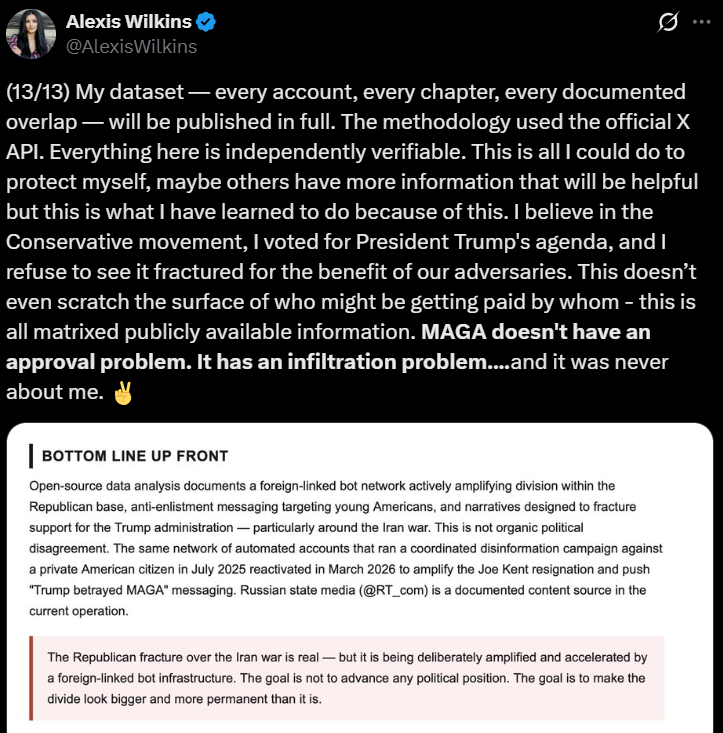
Americans need to start thinking more seriously about how propaganda actually works today: not as one clean conspiracy, but as a contested space where narratives are constantly shaped, accelerated, and weaponized against national cohesion and American prosperity.
But I really want people to realize that this is the new reality. I have said it many, many times before: the United States of America cannot be attacked kinetically; it cannot be overwhelmed by sheer military force or occupied by any foreign military. It is simply not possible do defeat us in such a manner.
Period.
That means they must find another way to attack us. They must find another way to defeat us.
Americans need to start thinking more seriously about how propaganda actually works today: not as one clean conspiracy, but as a contested space where narratives are constantly shaped, accelerated, and weaponized against national cohesion and American prosperity.
• • •
Missing some Tweet in this thread? You can try to
force a refresh