Look at what Iran has been hitting since Feb. 28: radar systems, SATCOM terminals, tankers, and now an AWACS. That's not random.
It's a systematic attack on the infrastructure that makes U.S. air power function. Iran's running an asymmetric counter-air campaign. A 🧵.
2/ Since Feb. 28, Iran has hit radar and SATCOM infrastructure at 7+ U.S. bases across Bahrain, Qatar, Kuwait, Saudi Arabia, and the UAE, targeting the systems used to track incoming missiles and coordinate the entire air defense network. nytimes.com/2026/03/03/wor…
3/ Yesterday, Iran hit Prince Sultan Air Base again, damaging an E-3 Sentry AWACS and multiple KC-135 tankers. Same base was hit March 13, when five KC-135s were damaged on the flight line.
4/ These aren't targets of opportunity. Tankers and AWACS are the logistics and command layer of the entire air war.
5/ The USAF only has 16 E-3s. Nearly 40% deployed to this theater. No replacement in production (E-7 A prototype in ~2028). Boeing delivered the last one in 1992.
The KC-135 fleet is Cold War-era, already under extreme strain, with parts sourced from boneyards.
6/ BL: Iran's going after the radars that detect threats, the tankers that keep jets flying, and the AWACS that direct the battle.
That's a counter-air campaign. Adapted to what Iran can actually do. And the damage is real.
• • •
Missing some Tweet in this thread? You can try to
force a refresh

A few observations on Caine's briefing today. The numbers are striking. The questions they raise are more interesting. A 🧵.
2/80% of Iran's air defenses destroyed, 1,500 targets struck. Impressive. What's in the remaining 20%? MANPADS? Mobile launchers repositioned further east? What parts of Iran remained contested? What altitudes The Pentagon didn't say.
3/ The fact that B-52s were still using JASSMs overland tells you something. JASSM is a standoff weapon. You use it when you don't want to fly into defended airspace. Where is that airspace?
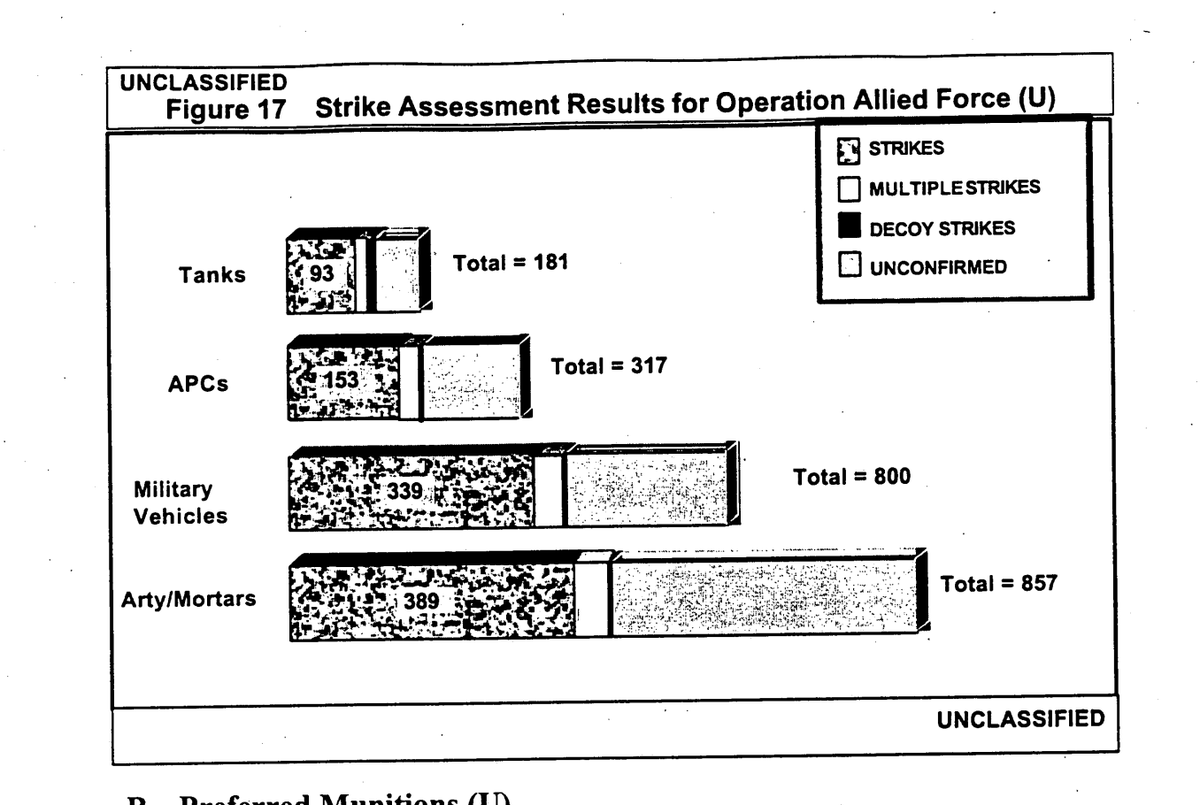
2/ The Pentagon's own 2000 Report to Congress on Kosovo shows 93 tanks confirmed destroyed out of 181 claimed, with "Decoy Strikes" as a labeled category in the official chart. Cohen/Shelton, Fig. 17, p.86. archive.org/details/Report…
3/ A RAND post-war study found Serbs fooled missiles with milk carton decoys, Yugo cars with pipes for gun barrels, and water jugs heated in the sun to fake infrared signatures.
Iranian forces shot down a U.S. F‑15 and damaged an A‑10, and combat search‑and‑rescue helicopters were also hit, resulting in injuries to their crews.
What this tells us about air superiority over Iran? A 🧵.
2/ Air superiority ≠ air supremacy.
Air supremacy = the ability to operate without "effective interference." Translation: The enemy poses no real air threat.
Most Americans are used to thinking this is normal; the U.S. largely had it over battlefields for 30 years.
3/ Air superiority, by contrast, just means you can operate without "prohibitive interference." Threats still exist. The terms are not interchangeable.
Gen. Caine announced Tuesday that after 30 days of strikes, B-52s are now flying overland missions over Iran. Is that a sign it's becoming harder to achieve air superiority against US adversaries? Yes. A 🧵.
2/ Desert Storm in 1991 provides a useful baseline. According to the Air Force History and Museums Program's Decisive Force, B-52s on night 1 made "shallow penetrations" into southern Iraq at less than 400 ft, hitting forward airfields. apps.dtic.mil/sti/pdfs/ADA43…
3/ Now, that wasn't deep Iraq. Still, B-52s were flying overland combat missions from the start.
That matters. Even limited penetrations suggest coalition had already degraded enough of Iraq’s air defenses to allow non-stealth aircraft into contested airspace, within hours.
Iran damaged a U.S. E-3 Sentry AWACS at Prince Sultan Air Base yesterday. The USAF has 16 left, nearly 40% are already in theater, and there's no production line to replace them. This is one of the most strategically consequential losses of the war so far. A 🧵
2/ The E-3 is a flying command center that manages the entire air battle, tracking drones, cruise missiles, and aircraft across a 250-mile radius and directing intercepts in real time.
3/ Boeing delivered the last E-3 in 1992. Replacement E‑7 Wedgetail? Best-case prototype ~2028, first operational aircraft even later. No surge capacity. Every damaged AWACS is out until repaired or replaced. The U.S. is burning a tiny fleet years before its replacement exists.
The Iran war put Gulf air defense stockpiles under pressure they weren't built to absorb alone. A thread on what the numbers show, and why the US role went far beyond supplementing regional defense. A 🧵
2/ I modeled Gulf state's pre-war Patriot, THAAD, and country-specific upper-tier interceptor stocks against confirmed ballistic missile attacks. Not every missile required an intercept; UAE MoD daily reporting showed roughly 7% fell in the sea. Used that rate throughout.
3/ Standard doctrine fires 2-3 interceptors per incoming ballistic missile. At a mid-range rate of 2.5 shots per missile, total Gulf demand was ~2,800 rounds against a combined BM-capable stock of ~2,400. A deficit of roughly 400.