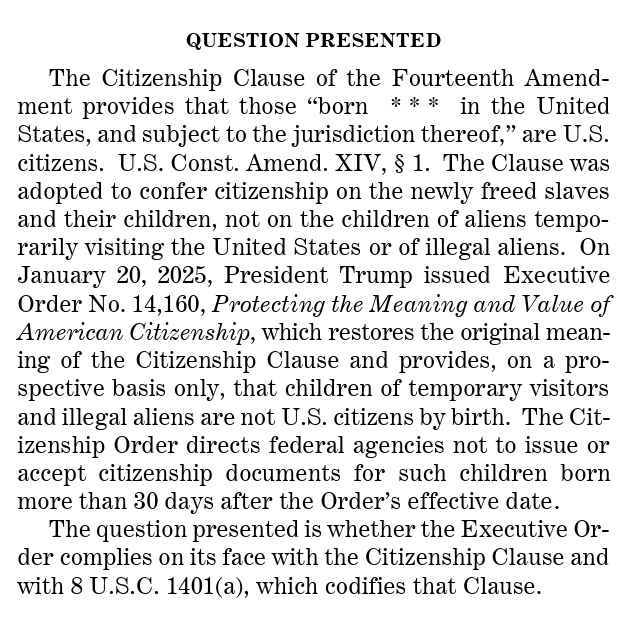
Live-tweeting now while listening in: Oral arguments in the landmark birthright citizenship case, Trump v. Barbara.
There is 1 hour scheduled for the argument, but I expect this argument to go somewhere around 2.5-3 hours, given how thorny and important of an issue this is. 🧵
There is 1 hour scheduled for the argument, but I expect this argument to go somewhere around 2.5-3 hours, given how thorny and important of an issue this is. 🧵
Arguing today are Solicitor General John Sauer, who was my Solicitor General when I was Attorney General of Missouri. He has a very impressive win record at the Supreme Court and is representing the government.
And Cecilia Wang, the National Legal Director for the ACLU.
And Cecilia Wang, the National Legal Director for the ACLU.
President Trump announced he is attending oral arguments today, which will be historic.
A little known fact pointed out by @AAGDhillon, the President has a "designated" seat inside the court room at the Supreme Court.
A little known fact pointed out by @AAGDhillon, the President has a "designated" seat inside the court room at the Supreme Court.
https://x.com/EWess92/status/2039196750976520519?s=20
Video of President Trump headed toward SCOTUS. A historic moment.
https://x.com/WeTheMedia17/status/2039339606404198736?s=20
SG Sauer opens strong: the original public meaning of the 14A does not extend to temporary or illegal aliens.
Justice Thomas’s first question focuses on the history:
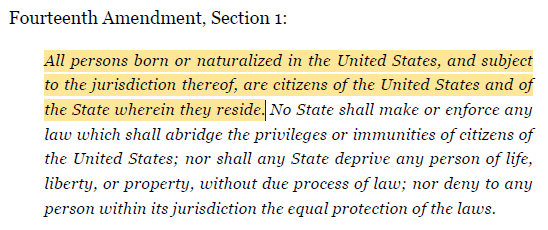
How does the Citizenship Clause correct the Dred Scott decision?
How does the Citizenship Clause correct the Dred Scott decision?
Justice Thomas also asks how SCOTUS should understand the 14A’s reference to state residence
More on that here:
More on that here:
https://x.com/senericschmitt/status/2039333883049640308?s=46
CJ Roberts asks about the historical meaning of “subject to the jurisdiction thereof”
SG Sauer rightly ties it to the Civil Rights Act of 1866, as we discussed at my hearing on birthright citizenship:
SG Sauer rightly ties it to the Civil Rights Act of 1866, as we discussed at my hearing on birthright citizenship:
https://x.com/numbersusa/status/2031453355013214678?s=46
Justice Sotomayor asks about the Wong Kim Ark and Indian tribes
President Trump’s EO aligns with the holding of WKA:
President Trump’s EO aligns with the holding of WKA:
https://x.com/senericschmitt/status/2039333904759329109?s=46
SCOTUS precedent regarding the American Indian tribes also supports President Trump’s position.
https://x.com/senericschmitt/status/2039333902142087679?s=46
Justice Kagan pushes the idea that “jurisdiction” in the Citizenship Clause simply means regulatory jurisdiction.
SG Sauer directs the Court to the statements of the 14A’s Framers and public statements suggesting it means complete political jurisdiction
SG Sauer directs the Court to the statements of the 14A’s Framers and public statements suggesting it means complete political jurisdiction
Justice Gorsuch asks whether the Court should look to the 1868 understanding of domicile or modern understandings.
SG Sauer agrees it should be 1868–when the 14A was ratified.
SG Sauer agrees it should be 1868–when the 14A was ratified.
Justice ACB: How would the govt’s theory of the case cover the children of slaves brought to the US illegally before the Civil War?
(14A was meant to cover children of freed slaves, so her question is whether the govt’s reading aligns with that central purpose)
(14A was meant to cover children of freed slaves, so her question is whether the govt’s reading aligns with that central purpose)
Justice Jackson explores the govt’s domicile argument, asking whether tying 14A’s coverage to domicile would allow Congress to control who becomes a citizen, contrary to the intent of the 14A
CJ Roberts asks about birth tourism.
SG Sauer points out that unlimited birthright citizenship has allowed for China to exploit the 14A
More info on that issue here:
SG Sauer points out that unlimited birthright citizenship has allowed for China to exploit the 14A
More info on that issue here:
https://x.com/govt_acct_inst/status/2031463099014779195?s=46
Justice Thomas asks about the holding of Wong Kim Ark.
SG Sauer reiterates that the holding depended on the fact that the parents in that case were legally domiciled in the US at the time of WKA’s birth.
SG Sauer reiterates that the holding depended on the fact that the parents in that case were legally domiciled in the US at the time of WKA’s birth.
Justice Alito asks about the practical effects of adopting the govt’s understanding of domicile.
SG Sauer points out that nearly every other developed nation does NOT have birthright citizenship, so we know that the effects will not lead to humanitarian issues.
SG Sauer points out that nearly every other developed nation does NOT have birthright citizenship, so we know that the effects will not lead to humanitarian issues.
Justice Sotomayor returns to Wong Kim Ark and other precedents. Is the govt asking SCOTUS to overrule it or other precedents?
SG Sauer: No, we are not asking to overturn Wong Kim Ark, and the other cases did not HOLD that children of illegal aliens are citizens, those were “drive-by” statements not at issue in those cases
SG Sauer: No, we are not asking to overturn Wong Kim Ark, and the other cases did not HOLD that children of illegal aliens are citizens, those were “drive-by” statements not at issue in those cases
Justice Kagan says that unlimited birthright citizenship has been the conventional wisdom, how much evidence do we need to overcome that established understanding?
SG Sauer notes that the historical understanding was not for unlimited birthright citizenship. That understanding didn’t show up until around FDR’s Admin.
SG Sauer notes that the historical understanding was not for unlimited birthright citizenship. That understanding didn’t show up until around FDR’s Admin.
Justice Gorsuch returns to Wong Kim Ark.
SG Sauer reiterates that case only held that there was birthright citizenship for the children of domiciled immigrants.
SG Sauer reiterates that case only held that there was birthright citizenship for the children of domiciled immigrants.
Justice Gorsuch asks about the Immigration and Nationality Act: did that statute incorporate a different meaning than the original meaning of 14A?
SG Sauer: No, they use the same language, so we think the statute incorporated the constitutional meaning from 1868.
SG Sauer: No, they use the same language, so we think the statute incorporated the constitutional meaning from 1868.
Justice Kavanaugh asks about the different language between the 14A and the Civil Rights Act of 1866.
SG Sauer: SCOTUS precedent and the congressional debates at the time make clear that 14A adopted the same meaning, even with slightly different language in order to clear up any ambiguity
SG Sauer: SCOTUS precedent and the congressional debates at the time make clear that 14A adopted the same meaning, even with slightly different language in order to clear up any ambiguity
Justice Kavanaugh returns to Justice Gorsuch’s question about whether the INA creates unlimited birthright citizenship.
SG Sauer: No, the structure of the statute suggests that Congress was incorporating the constitutional meaning, and then extending citizenship to certain additional groups
SG Sauer: No, the structure of the statute suggests that Congress was incorporating the constitutional meaning, and then extending citizenship to certain additional groups
Justice Kavanaugh: Why haven’t you asked us to overrule Wong Kim Ark
SG Sauer: Because we agree with Wong Kim Ark’s rule that domicile is a necessary condition for birthright citizenship
SG Sauer: Because we agree with Wong Kim Ark’s rule that domicile is a necessary condition for birthright citizenship
Justice Barrett: Govt’s theory modifies the common law rule of jus soli (birth on the soil) but it’s not the European rule of citizenship based solely on parentage, so shouldn’t there be more evidence in the congressional debates that they were creating a new standard?
SG Sauer: We think it’s there, they stated they were roaring from British practice and European practice
SG Sauer: We think it’s there, they stated they were roaring from British practice and European practice
Justice Barrett: How do we adjudicate this—we know from other areas of the law that it can be difficult to determine domicile?
SG Sauer: President Trump’s EO and agency guidance provide clear, verifiable approaches to determining who would be a citizen upon birth
SG Sauer: President Trump’s EO and agency guidance provide clear, verifiable approaches to determining who would be a citizen upon birth
Justice Jackson offers examples from congressional debates around 14A that she thinks cut against the govt’s theory of the case
SG Sauer explains why those cited examples actually support the Trump EO
SG Sauer explains why those cited examples actually support the Trump EO
Justice Jackson: Isn’t this about the child, not the parents’ domicile?
SG Sauer: At the time of 14A, well understood that parents status controlled—the exceptions to birthright citizenship that the other side recognizes also depend on parents’ status, so it can’t be only about where child is born
SG Sauer: At the time of 14A, well understood that parents status controlled—the exceptions to birthright citizenship that the other side recognizes also depend on parents’ status, so it can’t be only about where child is born
Justice Jackson: Wong Kim Ark says birthright citizenship is independent of domicile
SG Sauer: That portion of case was not stating the holding, and the holding says domicile is key
SG Sauer: That portion of case was not stating the holding, and the holding says domicile is key
Justice Jackson: How would we determine if a newborn is a citizen?
SG Sauer: This turns on the parents immigration status, which is easily verifiable
SG Sauer: This turns on the parents immigration status, which is easily verifiable
Wow, a masterclass by SG John Sauer. One of the best oral arguments in recent memory.
Now ACLU’s lawyer is up. A tough act to follow.
Now ACLU’s lawyer is up. A tough act to follow.
Cecilia Wang from the ACLU is now up.
Her main argument: Wong Kim Ark controls this case, and it says universal birthright citizenship.
But that’s wrong, as my brief explained:
Her main argument: Wong Kim Ark controls this case, and it says universal birthright citizenship.
But that’s wrong, as my brief explained:
https://x.com/senericschmitt/status/2039333904759329109?s=46
Justice Barrett: What about tribal Indians, are they treated differently under 14A becuz of territory or because of something else?
Wang: Elk isn’t clear
Justice Gorsuch then pushes back—Elk aligns with the SG Sauer’s argument.
Wang: Elk isn’t clear
Justice Gorsuch then pushes back—Elk aligns with the SG Sauer’s argument.
Wang continues to try to evade Elk, but the case strongly supports President Trump’s EO:
https://x.com/senericschmitt/status/2039333902142087679?s=46
Justice Alito raises a really important point:
If an alien—say from China, Russia, or Iran—enters our country illegally and has a child here, that child is automatically a citizen of that foreign nation, and can even be conscripted into that foreign nation’s military and required to fight for that nation.
Isn’t that person “subject to" a foreign nation’s “jurisdiction,” not the US’s—and therefore outside the 14A?
If an alien—say from China, Russia, or Iran—enters our country illegally and has a child here, that child is automatically a citizen of that foreign nation, and can even be conscripted into that foreign nation’s military and required to fight for that nation.
Isn’t that person “subject to" a foreign nation’s “jurisdiction,” not the US’s—and therefore outside the 14A?
Justice Barrett: Does “subject to the jurisdiction” merely incorporate specific historical exceptions to birthright citizenship, or does is it embody a principle that can expand/contract over time?
Wang: It’s a closed set of exceptions that cannot change.
Justices Barrett, Kavanaugh, and Alito all sounded very skeptical of that answer.
Wang: It’s a closed set of exceptions that cannot change.
Justices Barrett, Kavanaugh, and Alito all sounded very skeptical of that answer.
SG Sauer on rebuttal:
The 14A codified the American rule of citizenship in the Civil Rights Act of 1866.
At the time of and immediately after the 14A’s ratification, it was understood to not extend birthright citizenship to temporary aliens—domicile was necessary.
The 14A codified the American rule of citizenship in the Civil Rights Act of 1866.
At the time of and immediately after the 14A’s ratification, it was understood to not extend birthright citizenship to temporary aliens—domicile was necessary.
And that’s a wrap. The case is submitted. Thanks for tuning in.
I expect the court to decide this one at the end of June. Until then, Im going to keep fighting in the Senate on this issue.
I expect the court to decide this one at the end of June. Until then, Im going to keep fighting in the Senate on this issue.
• • •
Missing some Tweet in this thread? You can try to
force a refresh