
1/ Goldman Sachs analysts report that the biggest oil crisis in history is about to hit globally, with profound and highly destructive consequences. A new report asks ""Are We Running Out of Oil?", and concludes that the answer is yes. ⬇️ 

2/ Goldman reports that average daily flows of shipping through the Strait of Hormuz have fallen by 94% from their pre-war levels.
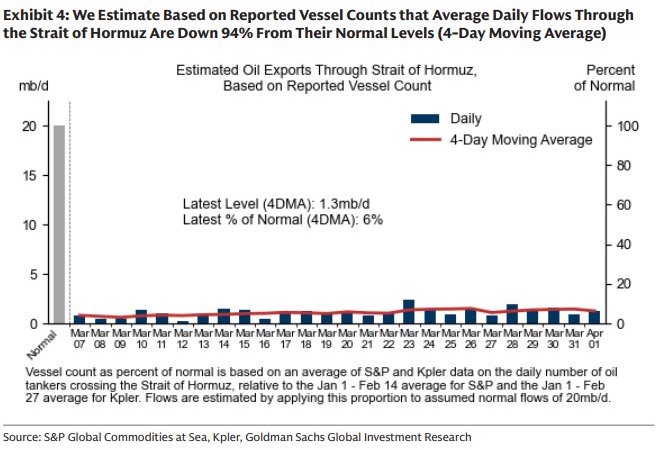
3/ This has led to a 63% collapse in the flow of oil and its refined products from the Middle East. Exports are down from 7.4 million to 2.8 million barrels per day of oil, 39% of which is flowing via a pipeline to Saudi Arabia's Red Sea ports.
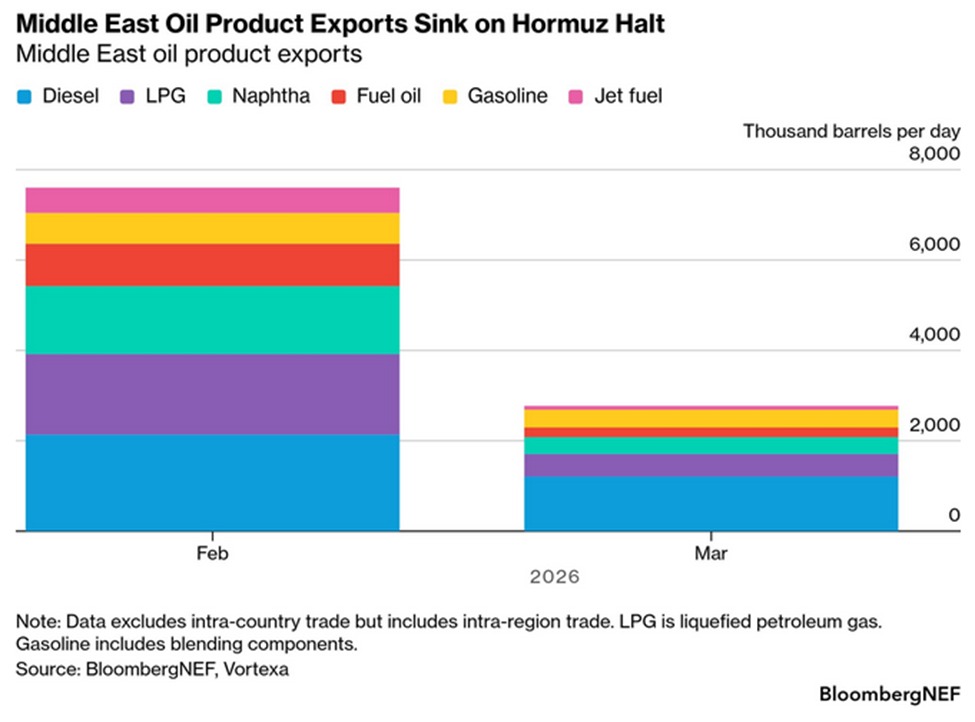
4/ As this Bloomberg graph shows, refined products are even more badly hit. Fuel oil has collapsed by 88%, jet fuel exports have dropped by 85%, naphtha by 73%, LPG by 65%, and diesel by 55%. The last three will have particularly severe effects given the scale of the lost volume.
5/ Asia accounts for a third of global refined products demand but relies on the Persian Gulf for roughly half its supply. Western nations face far more manageable disruptions, with the notable exception of fuel oil for the US and jet fuel for the UK.
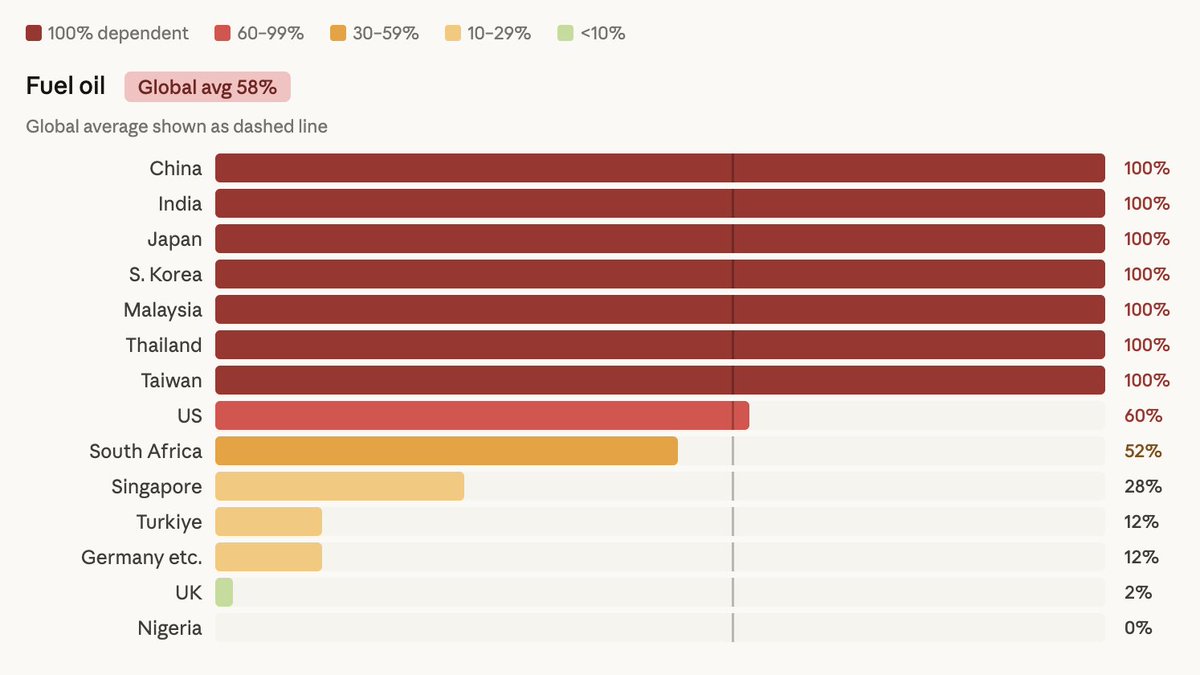
6/ Fuel oil is the most vulnerable product globally – seven Asian nations are fully (100%) dependent, and even the US is 60% exposed. Singapore appears to be uniquely exposed across the board.
7/ Diesel output has taken the largest hit in absolute terms, which has serious downstream implications given its role in global transport and industry. The price of diesel in many regions has already skyrocketed, even before any physical shortages have hit.
8/ LPG disruption is particularly significant for Asian markets (especially Japan, South Korea, India) which rely heavily on Middle East LPG for cooking and petrochemicals. Naphtha losses will squeeze petrochemical feedstock supply across Asia and Europe.
9/ This heat map from Goldman's report shows that many Asian countries face an existential energy shock, with the total loss of Gulf imports of key refined products, especially fuel oil and jet fuel.
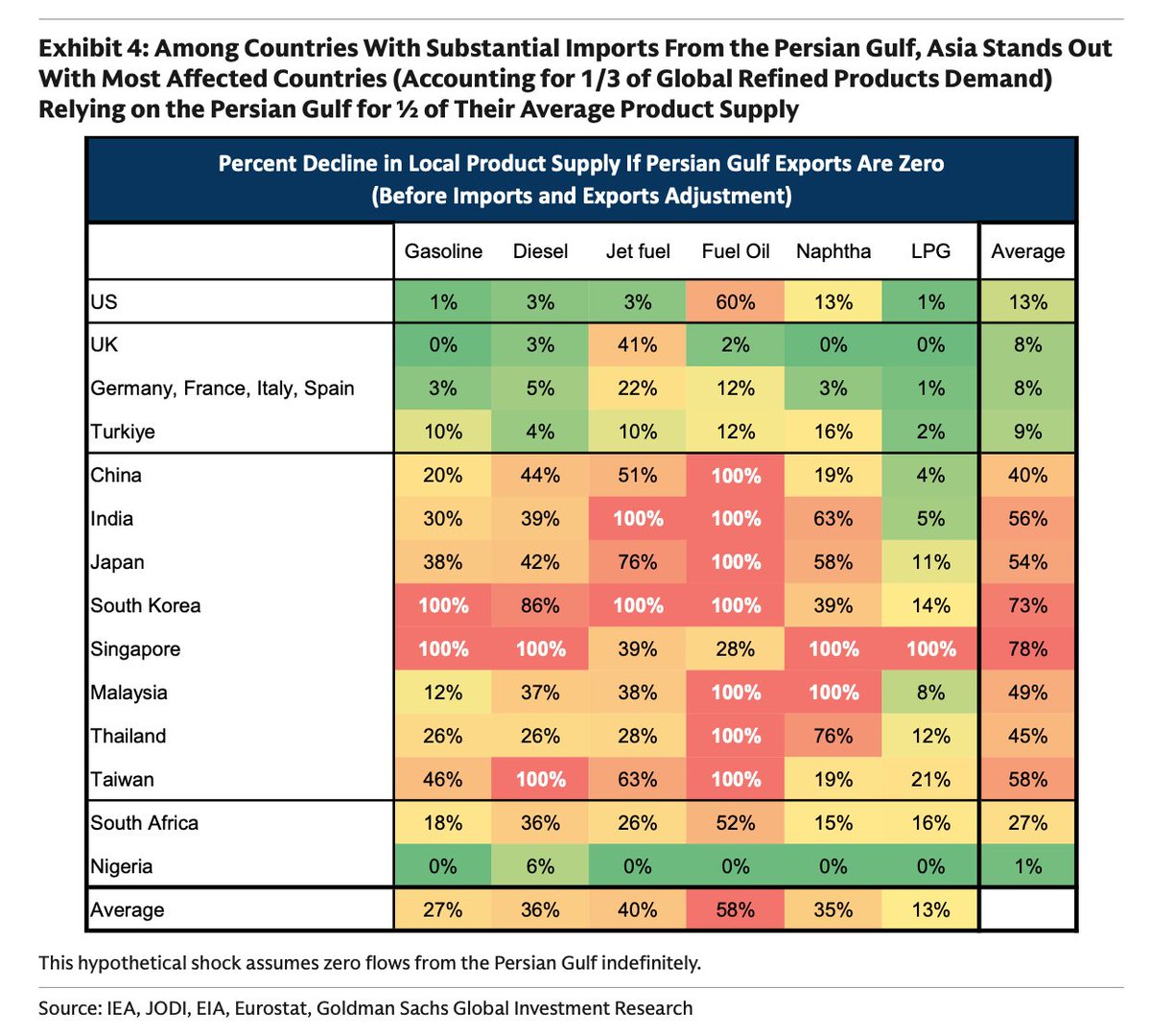
10/ China, India, Japan, South Korea, Malaysia, Thailand, and Taiwan face the loss of 100% of their fuel oil supply. Outside Asia, the US is worst affected, with the loss of around 60% of its supply.
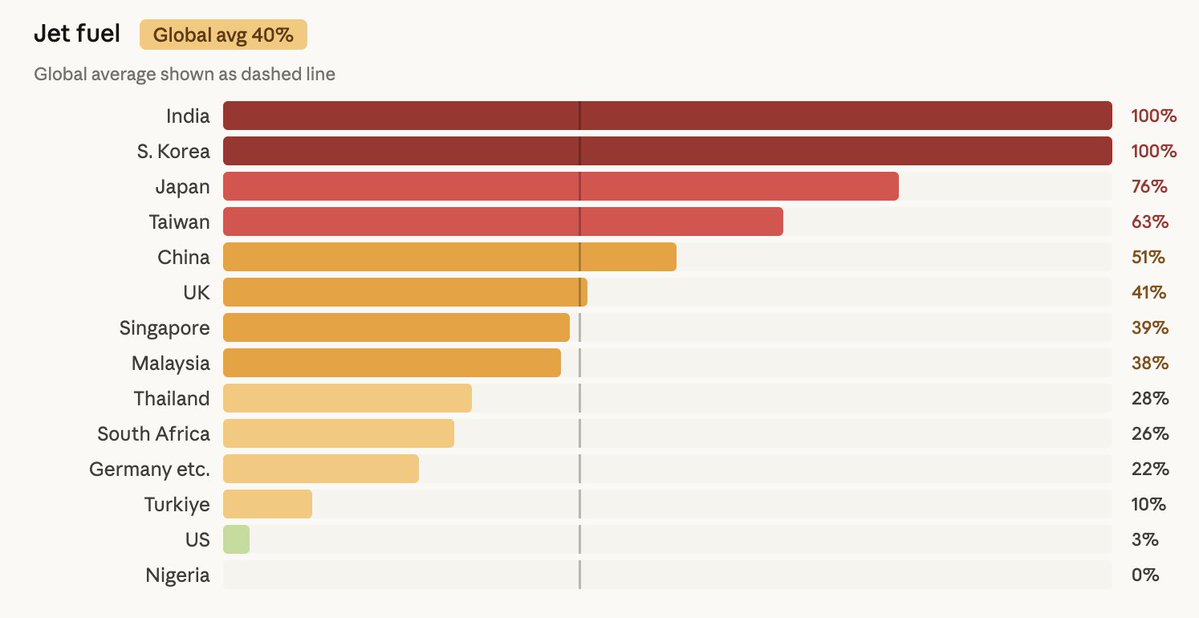
11/ India and South Korea face the loss of 100% of their jet fuel supplies, with Japan, Taiwan and China also badly affected. The UK is worst affected outside the Gulf, with a 41% loss. Jet fuel requires specialised storage and transportation, so reserves are often limited.
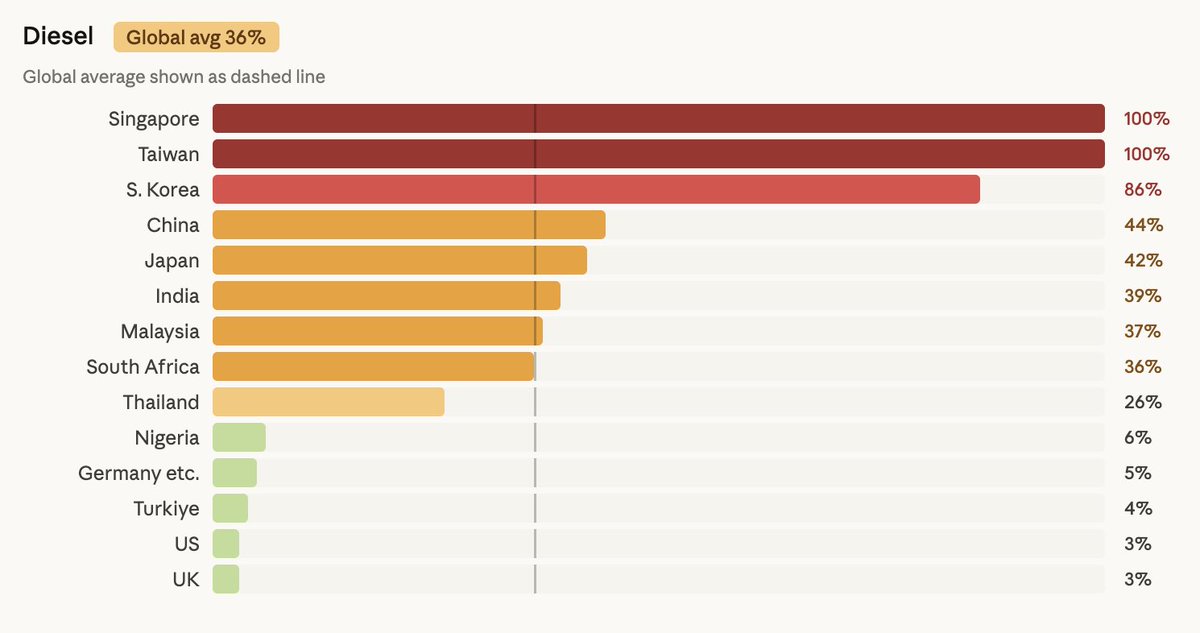
12/ Singapore, Taiwan, and South Korea face the total or near total loss of their entire input of diesel, with other Asian economies also badly affected. Europe and the US are less affected, but will be exposed to soaring prices on world markets. Gasoline shows a similar story.

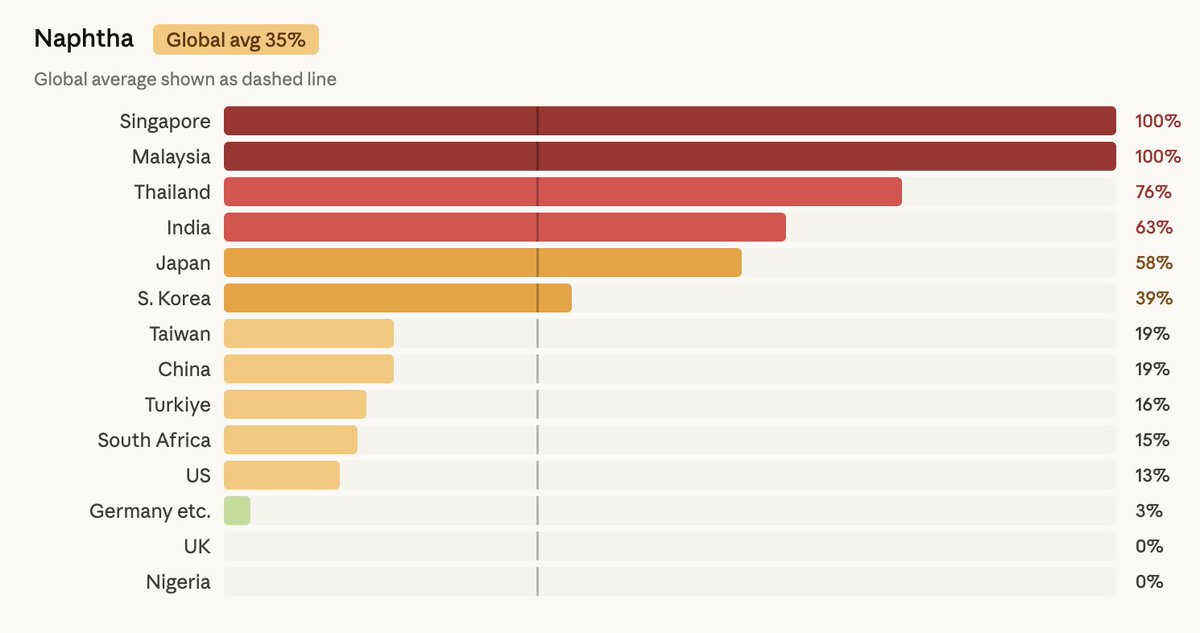
13/ Naphtha is a key feedstock for plastics production. Asian economies are very badly affected, with Singapore, Malaysia, India and Japan particularly hard hit. Plastics manufacturers in India are already shutting down.
14/ Singapore faces the loss of its entire LPG import, with other economies facing a significant but less severe hit. This is a major problem for residential users in particular, as Asian countries commonly rely on it for heating and cooking.

15/ Goldman assesses that the major economies have an average of about 40 days of crude oil in storage (the UK is uniquely exposed here, with only 14 days' worth), and an average of 37 days' worth of stored refined products (India has only 16 days' worth).

16/ These strategic stocks are rapidly being drawn down. In Asia, Japan has the most crude oil in storage (99 days), with India (20 days) and Thailand (17 days) the least. Countries are turning to more costly imports from elsewhere but these are not fully offsetting the losses.
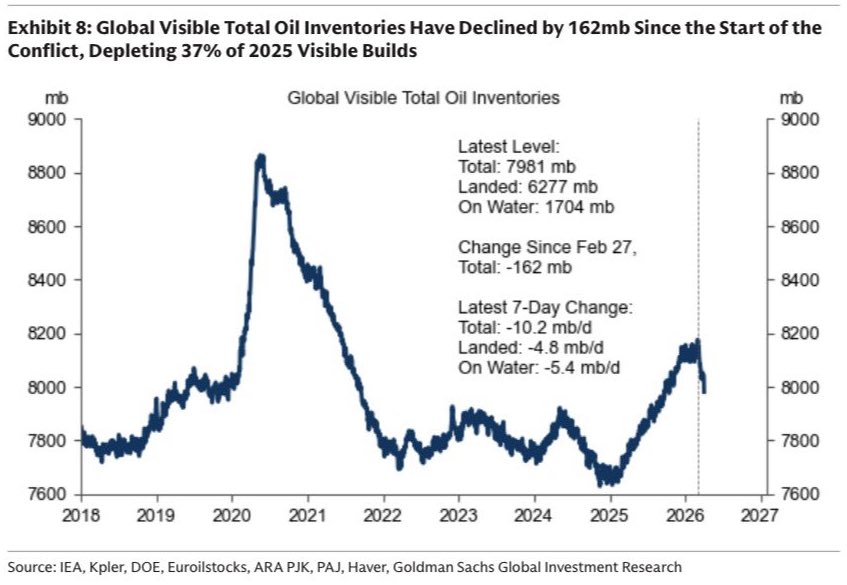
17/ This is causing a structural supply gap to open. The export reduction and rerouting fixes are one-time adjustments. If Persian Gulf flows remain near zero, there is no further offset available and outright supply rationing becomes inevitable.
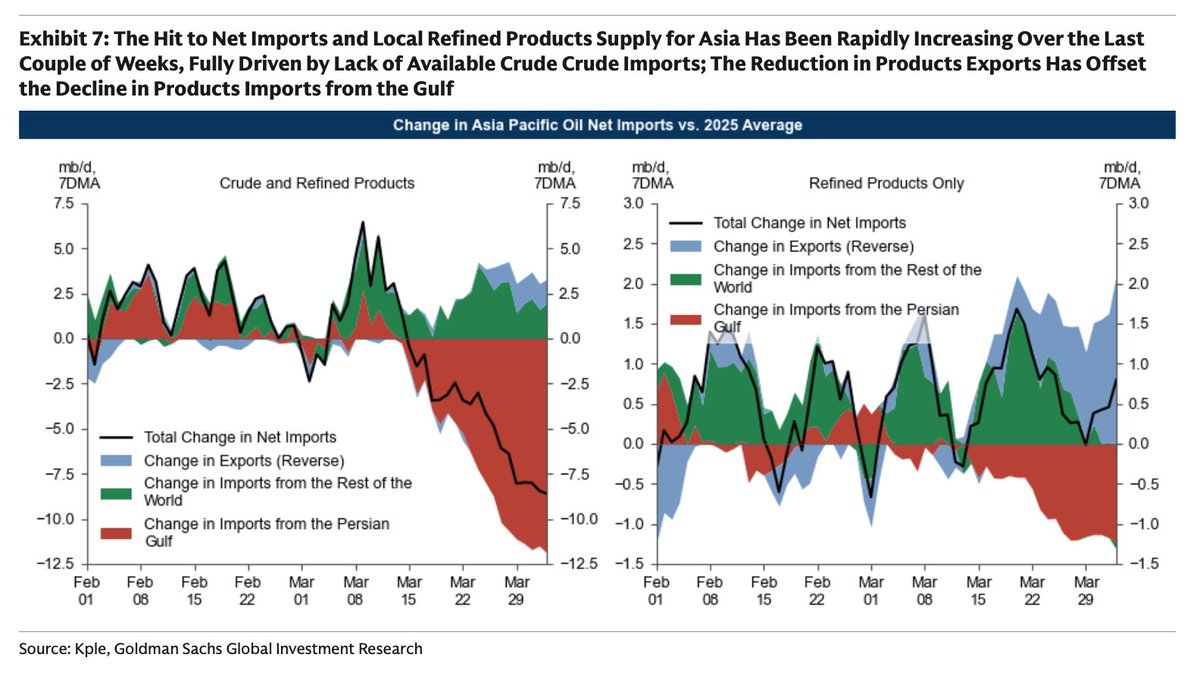
18/ The remaining supply of Persian Gulf oil and refined products is rapidly running out as the last tankers from the region arrive at their destinations. Europe and the US are are facing the impact last due to the lag time in tanker arrivals. Shortages have already hit Asia.
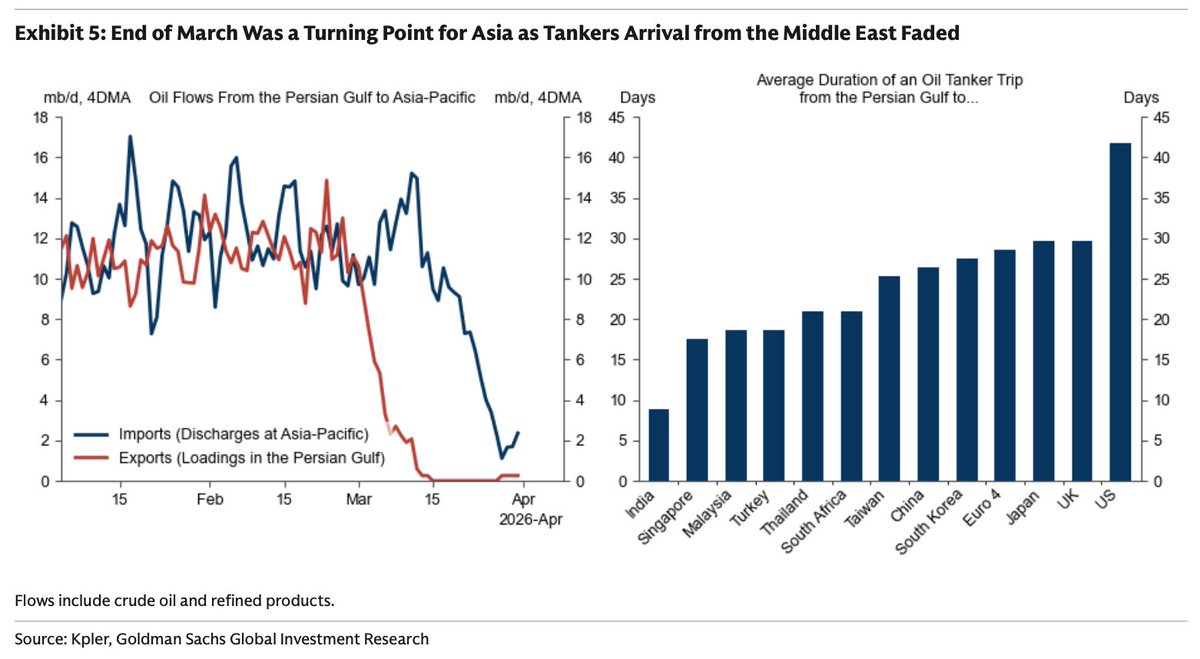
19/ This is highlighted in the map below by JP Morgan, which shows when the last Gulf tankers are due to arrive at various destinations. Europe is next to receive its final shipments, with the last jet fuel tanker due to arrive on 9 April.
https://x.com/ChrisO_wiki/status/2038187681935401098
20/ The consequences are likely to be severe, with physical shortages leading to rationing, demand destruction (flight cancellations, factories closing), and soaring prices as Asian countries pay premiums to divert oil and fuel tankers that would otherwise have gone to the West.

21/ This will also have big effects on everyday costs as a whole, as well as many job losses. In Europe, truck companies are paying an extra €1,200 ($1,382) a month in diesel costs. Up to 100,000 truck driver jobs are at risk in Germany alone – about 15% of the industry.
22/ Because of the scale of the disruption, which includes physical damage to infrastructure in the Gulf states, it's likely to persist for a considerable time. Qatar says that damage to one of its LNG plants – one of the world's largest – will need up to 5 years to repair. /end
Sources:
🔹 "Are We Running Out of Oil?" (April 2026). Yulia Zhestkova Grigsby (lead), Alexandra Paulus, and Daan Struyven at Goldman Sachs & Co. LLC.
🔹 qna.org.qa/en/news/news-d…
🔹 "Are We Running Out of Oil?" (April 2026). Yulia Zhestkova Grigsby (lead), Alexandra Paulus, and Daan Struyven at Goldman Sachs & Co. LLC.
🔹 qna.org.qa/en/news/news-d…
• • •
Missing some Tweet in this thread? You can try to
force a refresh






