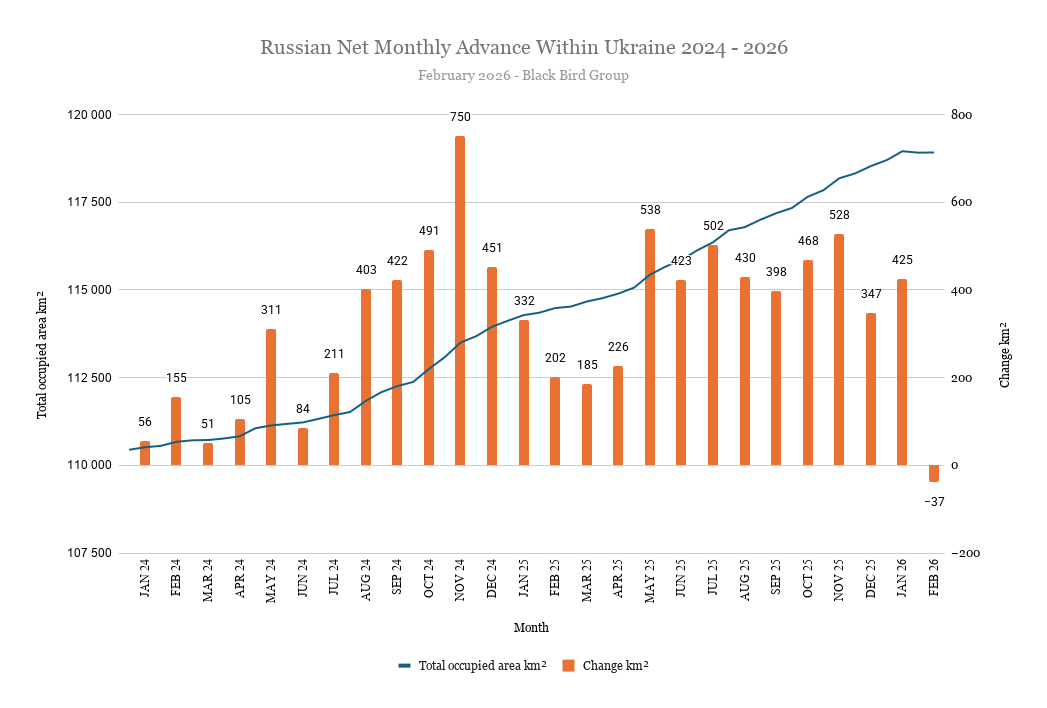
According to our data in March the net gains of the Russian Armed Forces in Ukraine were approximately 25km²
This is slightly more from than it was in February, a net negative, but the Russian offensive momentum has clearly dimimished compared to late 2025.
1/
In total the Russians captured approximately 100km² over the month of March. Mostly around Hulijaipole and in Northern Donetsk.
Despite mechanized attack attempts, the continuing Russian offensive attempts are so far struggling to make significant gains and create momentum.
2/
It should, however, be noted that information about the scope of Ukraine's February offensive north of Hulijaipole and the continued fighting in the area affect this data.
For example, the depth of some of the UA penetrations from February were only confirmed in early March.
3/
This is why, according to our data, the Russian net gains over the first half of the month were in fact negative.
Despite that, in terms of advances 2026 is so far more reminiscent of 2024 than 2025, with Russia clearly struggling to make gains over the winter and spring.
4/
The Russian goals show no large scale change, with a persistent political focus on Donetsk oblast.
Thus, it's almost certain that the Russian forces will continue offensive operations over the coming months wether or not they are able to regain offensive momentum.
5/5
• • •
Missing some Tweet in this thread? You can try to
force a refresh

In February, the Russian monthly net gains in Ukraine turned negative. Over the whole month, the Russians lost 37 km² of territory in Ukraine.
This is the first net loss since November of 2023, and the worst month for Russia in terms of territory since August of 2023. 1/
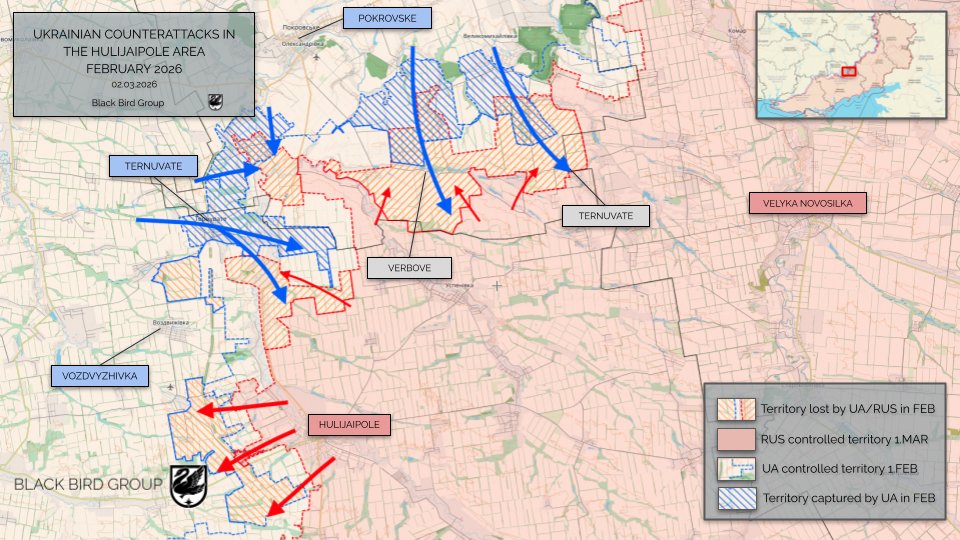
This is mainly due to the Ukrainian counterattacks on the Southern Front, which managed to push the Russians out of 213 km² of territory.
Most of these Ukrainian gains were made around Hulijaipole where Russia lost 192 km².
2/
Ukrainian forces have reached the village of Ternuvate and past the village of Verbove, but it's unclear wether or not they have managed to establish solid control.
Situation remains dynamic. Much of the area Russia has lost is currently remains in the grey zone.
Trump argues that US security requires “total control” of Greenland.
Read charitably, the concern is understandable, but the claim only holds if Greenland is plausibly vulnerable to Russian military operations.
A look at actual capabilities suggests otherwise. 🧵
1/10
From the United States point of view, Greenland matters for missile warning, North Atlantic control, and Arctic access.
However, the real question for Greenlands security is not intent, but whether Russia can operate there militarily.
2/
Starting with sea lift. Russia’s Northern Fleet today can deploy fewer than ~1,000 troops in a single amphibious lift in the High North, In full pre-war strength less than 2000.
In August the Russians occupied 430 sqkm of Ukrainian territory. This is down from the 502 sqkm in July.
However, looking at the numbers alone does not give a full picture of the Russian operations. Over the second half of August the situation became increasingly dynamic.
In the area of the Dnipropetrovsk border, the Ukrainians conducted a tactical counterattack, pushing Russia away from ~50sqkm of territory.
The area in orange was our assessment of Russian control on the 15th of August overlaid on current frontline.
In the Dobropillya direction the RU managed to breach the UA front to the depth of up to 16km and Ukraine was forced to divert forces from other sectors to prevent a breakthrough.
Assessed UA control on the 16th in purple, RU in orange. Current assessment in red/blue.
We have updated the map to reflect the emerging situation in the Kursk salient, where recent Russian offensive have forced the Ukrainians to withdraw from large areas.
The northern part of the salient has been abandoned, with Russians capturing Malaya Lokanaya.
1/
According to Russian sources the Ukrainians had rotated some units out of the salient earlier. It's possible that the Ukrainians were preparing for larger withdrawals.
Recent Russian operations may have started as an pre-emptive attempt to disrupt any Ukrainian withdrawal.
2/
Russian actions throughout the area of operations seem coordinated, further reinforcing the assessment that instead of reacting to a sudden Ukrainian withdrawal, the Russians have the initiative and are forcing the Ukrainians to react to their operations.
3/
Why does our @J_JHelin keep rejecting the "human waves" narrative, instead calling the reported North Korean attacks in Kursk "basic infantry drills"?
Let’s dive into light infantry on the attack and why this distinction matters.
1/
What is light infantry?
At its core, light infantry are troops that:
Operate on foot in combat.
Have little to no support from vehicles.
Move organic support (mortars, MGs) on foot or trucks. Rely primarily on infantry weapons to fight.
Pictured: Finnish Jäger Company
2/
To put it in perspective:
Most WWII infantry would be classified as “light” today. No armored vehicles, minimal mechanization, and reliant on basic infantry tactics.
Modern light infantry is generally built for flexibility, not brute force, at least in the west.
With the news of ceasefire between IDF and Hamas, we're sharing some of our observations. We focus on military situation on the ground in Gaza based on open sources.
This is a short thread about the situation on the ground during the past month. /1
Background in short:
After Oct 7th attack by Hamas, highest casualty terror attack on Israels soil, IDF conscripted a record amount of troops from it's reserve: ~360 000 pax, whom were deployed to directions of Gaza, Blue Line, Golan Heights and West Bank. 2/
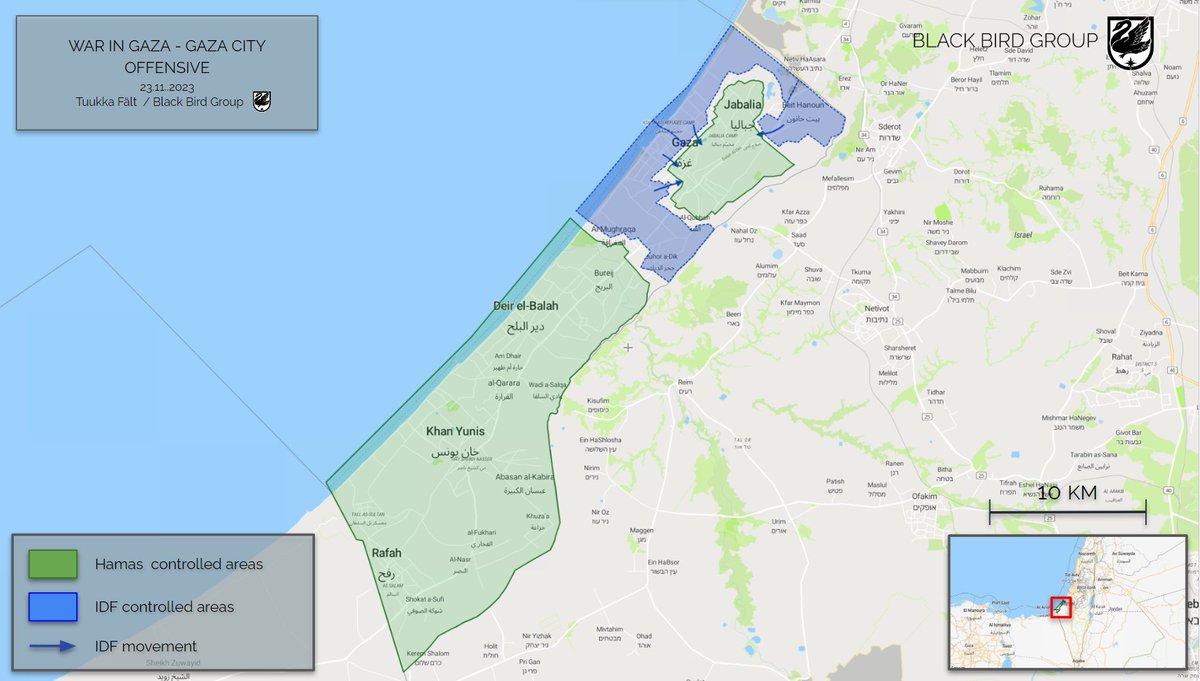
Oct 27th IDF started a ground assault on Northern Gaza. The attack begun from three directions by at least two divisions.
Attacking force consisted of mainly armored- and infantry brigades enforced with fe. land moving capabilities. 3/