Zelenskyy: We proposed to Russia a ceasefire for Easter. But for them all times are the same.
There is nothing sacred to them. If Russia can afford this war and finance it, it will not move toward peace on its own. That is why pressure on the aggressor cannot drop. 1/
Zelenskyy: Our long-range sanctions are working. They are cutting Russian revenues, above all oil revenues.
Only serious financial losses force Russia to think about an exit from the war. Everything Russia earns from shock oil prices, it will pour back into war. 2/
Zelenskyy: If Russia is ready to stop strikes on our energy system, we are ready to respond in kind.
That proposal has already been passed to the Russian side through the Americans. Security guarantees are the key to ending the war, to peace, and to trust in the process. 3/
Zelenskyy: More and more states want to work with Ukraine as a security partner.
For the first time, Ukraine is not just present in the Middle East and the Gulf, but wanted there as a strong partner. New security agreements are coming, and they will make Ukraine stronger. 4X
Thank you for reading this post!
Please also consider donating to support Ukrainian students who study during the war if this cause resonates with you.
Trump spent his first year back in office imposing tariffs on Europe, threatening to withdraw US troops, and flirting with NATO exit. Europe wants to reduce its dependence on Washington.
But the US accounts for over 20% of European exports — Jacob Kirkegaard, Foreign Affairs. 1/
Two-thirds of Europe's cloud market runs on Amazon, Google, and Microsoft. Three quarters of European firms run on US software.
Visa and Mastercard handle roughly two-thirds of card transactions in the euro area. 2/
US LNG imports quadrupled between 2022 and 2025 to replace Russian gas.
The EU has committed to ending all Russian gas imports by 2027. If Iran's strikes on Qatar's LNG facilities cause lasting damage, most of Europe's LNG will need to come from the US. 3/
DW: Ukrainians bring a lot of expertise in UK. They are showing the British how they operate drones.
"Our partners have a certain understanding of drones, but they have not encountered them. They don't fully understand how drones affect the battlefield, how intense it is.” 1/
Ukrainian serviceman: A Ukrainian warrior is an intellectual warrior. He knows why he's going to the front. He knows what he has to do at the front. This is in contrast to the Russian soldier who doesn't know why he's there, who gets sent there by Putin. 2/
DW: Ukraine is a role model for the British. The Irish Guards spent a year training with Ukrainian soldiers.
“What you've seen today is the result of that advice and experience, from small uncrewed aerial systems to drone nets and dropper drones.” 3X
Syrskyi: Russia gets about $700M a day from oil, and that money finances the war.
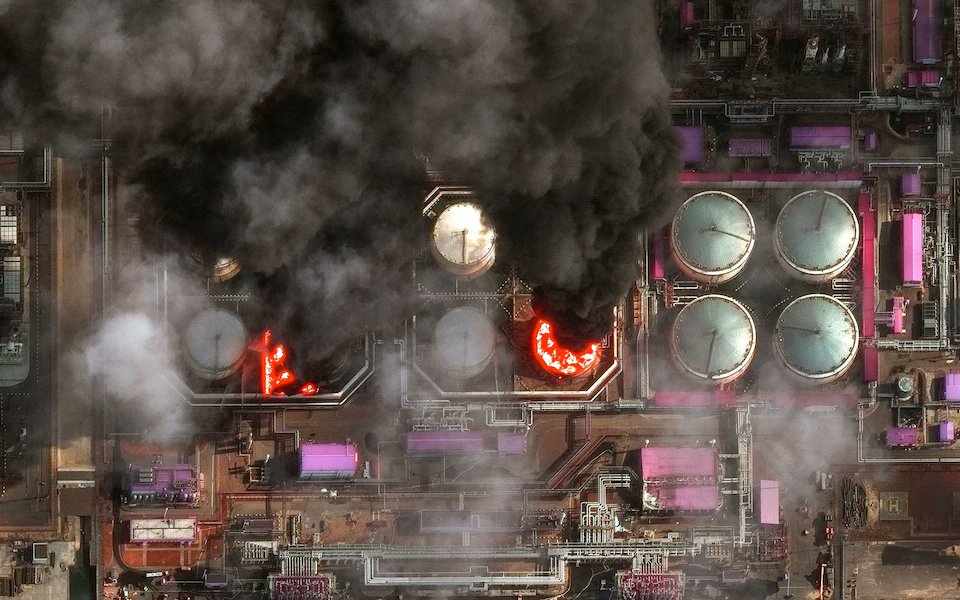
Our strikes on refineries, Ust-Luga, Primorsk, and missile plants are strategic actions. They cut export capacity, hit military production, and reduce the aggressor’s offensive potential. 1/
Syrskyi: There is no instant straight line from a strike on Ust-Luga to a trench in the east.
But the effect builds over time: fuel delays, disrupted deliveries, tanks that do not arrive, missiles that do not fly, and a smaller stockpile for Russia’s war machine. 2/
Syrskyi: Russia planned to make 404 Shaheds a day in 2025 and wanted 1,000 a day in 2026. Those plans are unrealistic.
The strikes also squeeze budgets, delay payments, and fuel discontent inside Russia and among its troops. 3/
Syrskyi: Since Jan. 29, we have been conducting an offensive operation on the Oleksandrivsk direction.
As of today, we have liberated more than 480 sq. km. Those actions forced Russia to change plans and shift part of its forces from the Pokrovsk direction. 1/
Syrskyi: Russia advertised a “spring offensive.” In reality, it never stopped attacking. But its plans were disrupted. Pokrovsk still stands.
Every day the enemy attacks, takes losses, rolls back, and ends with dead and wounded — but no success. 2/
Syrskyi: Our goal this year is strategic defense: contain the enemy, prevent the loss of territory, exhaust its forces and means, build reserves, and create conditions for large-scale offensives.
At the same time, we conduct offensive actions where the enemy is weak. 3/
Russia is moving missile production facilities deeper into its territory.
Ukraine's drone and missile campaign forces the Kremlin to retreat from strike range
Kyiv's long-range strategy is working, — The Telegraph. 1/
Roscosmos, Russia's space agency heavily involved in missile production, will relocate facilities from Moscow region to Omsk in Siberia and Perm near the Urals — both far beyond Ukraine's current strike range. 2/
The Khrunichev centre, which produces systems including the nuclear-capable RS-28 Sarmat ICBM, will move from Khimki to Omsk. Officials cite "prohibitive overhead costs" — but the timing tells a different story. 3/
How exactly did Ukrainian troops "fuck" NATO during Hedgehog drill?
Daily Mail: First, NATO troops didn't check the roads, some blew up on mines. Next, they got spotted by drones.
Attack drones hit several vehicles at once when parked too close, and hit tanks on the move.
1/
Ukrainian pilots destroyed 17 armored vehicles in a few hours, and defeated 6000 NATO soldiers in 4 days, defending their position.
One NATO commander said: “We are fu**ed”.
2/
NATO was kind of set up to fail. Mass movement of infantry and vehicles against drones is proven to be a bad strategy. Also having no anti-drone equipement or drones of their own.
But NATO should not have parked vehicles so close and should not have advanced in columns.