
1/ This continues Russian drone developer Alexey Chadayev's analysis of the state of Russia's drone warfare; see the link below for part 1. In this part, he assesses problems with unmanned ground vehicles (UGVs) which have become acute since Russia lost access to Starlink. ⬇️ 
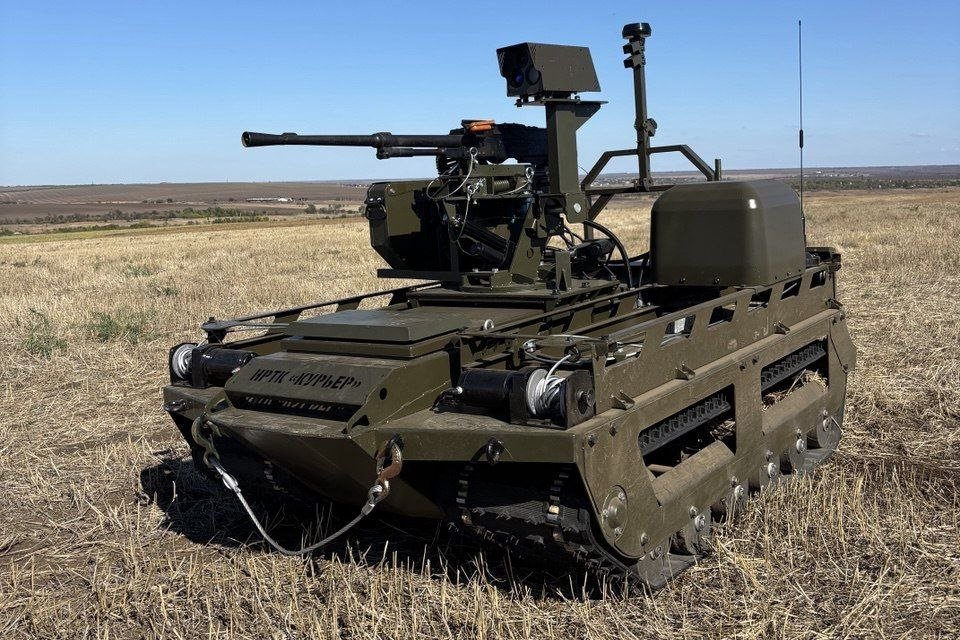
3/ "2. What's happening with the ground drones?
There's an interesting picture here: the enemy is increasing their use, while we're decreasing it. And it's not because we're physically short of them—they're sitting in warehouses by the thousands.
There's an interesting picture here: the enemy is increasing their use, while we're decreasing it. And it's not because we're physically short of them—they're sitting in warehouses by the thousands.
4/ "The first key reason is communications. While Starlink was around, they could go pretty much anywhere. Now the chance of losses, not even from enemy attacks, but simply from falling into radio shadow (which can happen in any low-lying ground), are extremely high.
5/ "We (Ushkuynik) proposed a working solution with a robot on reinforced fibre optics, but it didn't go into production for a trivial reason: reinforced fibre optics are expensive.
6/ "And here's the second reason. A robot, even with working communications, is quite expensive. It's also slow and can't outrun an attacking FPV drone.
7/ "Commanders on the ground simply don't risk taking responsibility for the risk of a possible loss: oddly enough, losing a delivery man will cause fewer problems with their superiors than losing valuable equipment.
8/ "Command either failed, or didn't even try, to teach commanders to treat the robots as consumables (as they eventually did with drones).
There are several ways to overcome this problem.
There are several ways to overcome this problem.
9/ "First, the unit cost of each robot can and should be radically reduced. This requires launching mass production (not the current cottage industry).
10/ "If AvtoVAZ, instead of trying to squeeze workers by raising recycling fees, had quickly mastered at least medium-scale production of ground robots for the front, we could have a product no more expensive than the FPV and in theoretically any quantity…
11/ …(thankfully, unlike aerial drones, we can produce 100% of everything without imported components). "Yes, but why?"
12/ "Secondly, we can and should deploy our own high-speed digital communications network over the combat zone. A ready-made solution for doing this without satellites, simply using aerostats, already exists, has been calculated, and is "on the table."
13/ "Then, the robots will be able to travel everywhere again, without any additional work.
Thirdly, we can and should develop ways to protect them from air attacks—so that the enemy spends not just one drone on each robot, but at least five or seven.
Thirdly, we can and should develop ways to protect them from air attacks—so that the enemy spends not just one drone on each robot, but at least five or seven.
14/ "With the cost of a robot and a drone comparable, the economics of war are already in our favor. We will propose our own solutions in the very near future, but we are not alone.
15/ "Fourth, the point isn't to implement ground robots per se, but to improve last-mile logistics as a whole. Therefore, in addition to ground delivery, air delivery can and should be developed.
16/ "The main limiting factor here is rather strange: not a shortage of cargo drones (they exist), but the leadership's inability to institutionalise the "friend or foe" system to minimize losses from friendly fire (currently, this accounts for up to 80% of our flying…
17/ …cargo losses). The cumulative effect of years of terrorizing our front line with the "Baba Yaga" is also taking its toll—we've finally learned to shoot down the "Yagas" more or less effectively, but as a result, they're wiping everyone out of the sky, including our own.
18/ "Fifth, we need to develop a range of payload modules for the unmanned resupply system—not just delivery vehicles, but also mobile small air defence systems, mobile small electronic warfare systems, mobile drone carriers, etc.—…
19/ …and practice scenarios for their group deployment, where some deliver, others provide cover, others insure and evacuate damaged equipment, etc.
20/ "This again requires reaching an important organisational "phase change"—moving from operator training to training entire units, companies, or even battalions of unmanned resupply systems. This is happening at training grounds, in the rear.
21/ "Sixth, we now have six months of dry ground ahead of us, until the autumn rains. This is already an opportunity not only for tracked and wheeled vehicles, but also for robotic dogs, which, you'll be surprised, we've already learned how to mass-produce.
22/ "And their main advantage is that, with solid ground beneath their feet, they don't require roads; they'll go anywhere a person can go, and even where they can't. It would be foolish not to take advantage of this.
In short, there are options."
[To be continued in part 3]
In short, there are options."
[To be continued in part 3]
• • •
Missing some Tweet in this thread? You can try to
force a refresh





