
1/ This continues Russian drone developer Alexey Chadayev's analysis of the state of Russia's drone warfare; see the links below for parts 1 and 2. In this part, he assesses the crucial role of communications systems in drone control. ⬇️ 
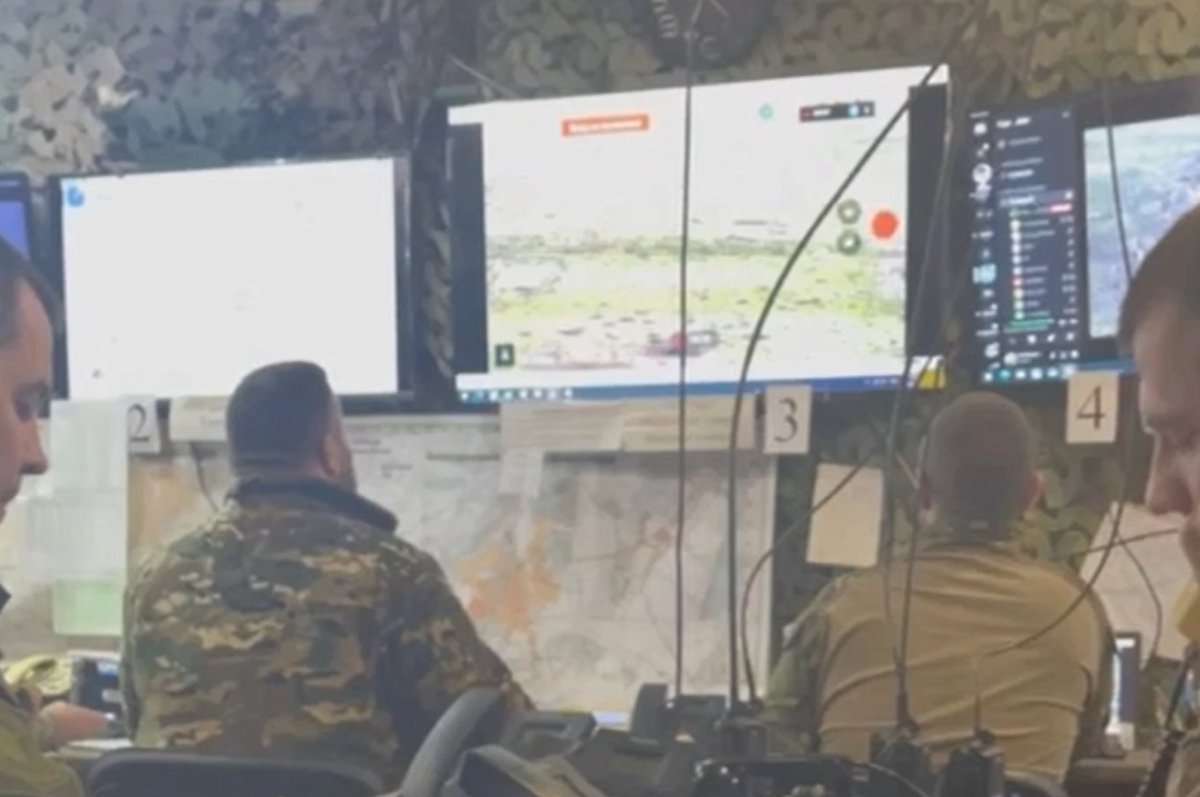
4/ "3. Communications.
The superiors, of course, are stuck in the mid-1970s, in the pre-digital era; they still primarily understand communications as the ability to verbally command a subordinate without the enemy interfering or eavesdropping.
The superiors, of course, are stuck in the mid-1970s, in the pre-digital era; they still primarily understand communications as the ability to verbally command a subordinate without the enemy interfering or eavesdropping.
5/ "But, unfortunately, we haven't come very far from them in our conceptual description of communications in digital warfare, and we've failed to articulate or convey it.
6/ "I'll try to outline an approach to how this should have been done in the past. Now, my description won't be the final word, but first, we need to at least discuss and understand the penultimate point.
7/ "Communications must be understood as a multi-layered infrastructure, where at the most basic, grassroots level lies the physical ability to transmit a unit of information from point A to point B.
8/ "And at the very top is software that provides a unified data field between the people and robots involved in the war (drones, sensors, data processors, etc.); in this sense, a conventional messenger is also part of the communications infrastructure at the very top layer.
9/ "This is related to the question of Telegram, by the way.
And yet, the Russian Armed Forces currently lack any "master" of military communications who would be integrally responsible for upgrading all its levels.
And yet, the Russian Armed Forces currently lack any "master" of military communications who would be integrally responsible for upgrading all its levels.
10/ "The Main Communications Directorate ... is only authorised to oversee the two lower levels—physical communications and the channel system. The next five are simply beyond its current role and responsibility.
11/ "The question should be addressed not just about "connectivity," but rather about "connectivity," understood as the integrated throughput of a shared data space and the toolset for this capability.
12/ "Simply put, in a war in which the entire battlefield is transformed into a sensor field, saturated to the limit with a multitude of diverse automated devices, the factor of superiority becomes,…
13/ …firstly, the ability to exchange information between all these devices as quickly as possible, and secondly, the ability to apply the information received and processed from this field to combat missions.
14/ "The key is that this very communication field, ultimately, should be built not between people, but between automated devices—it is precisely this device that constitutes the basic "unit" of the network.
15/ "The fact that some of these devices are used by people to exchange information with each other—text, audio, graphics, and video streams—is, in a sense, secondary.
16/ "The key is that there is a vast array of diverse devices exchanging large volumes of information with each other 24/7 and capable of quickly combining into virtual clusters for a task within a single communication field, whether controlled by people, one or more AI agents,…
17/ …and so on. There are devices that mine big data, there are those that process it (and in several stages), there are those that use it to build a multilayered digital twin of the battlefield, there are those that develop or adjust action algorithms depending on the…
18/ …situation and enemy actions, and so on.
What does this approach provide? The ability to solve problems layer by layer. The first layer is the physical ability to transmit a signal from point to point.
What does this approach provide? The ability to solve problems layer by layer. The first layer is the physical ability to transmit a signal from point to point.
19/ "The second is the creation of a channel or network of channels for regular signal exchange. The third layer is a set of data exchange protocols. The fourth is the infrastructure for storing/processing/cataloging both data and sources/streams.
20/ "The fifth is the software, for which all of the preceding is, in a sense, simply a communications transport and library system.
21/ "Specifically, it looks like this. An attack drone is flying. Its camera sees something. This real-time image is transmitted to a server somewhere, where it enters a stream library that already contains streams from stationary sensors—radar, acoustic, optical, even seismic.
22/ "All this data is processed to adjust the battlefield model in real time. This model is accessible at any time to all authorized users, whether humans or robots, and allows them to rely on it when modeling any subsequent actions.
23/ "Each action is quickly processed first in the digital model and then repeated in physical reality, and to human perception, this cycle is practically instantaneous.
24/ "The funniest thing is that even now, with the current level of technological development, everything is in place for this. Somebody like Yandex-Taxi, God forgive me, was already dabbling in this kind of simulation years ago.
25/ "Let say it starts raining in one of Moscow's districts—that means, firstly, they need to raise prices for that district by 20 percent, and secondly, they need to send as many available cars there as possible from other districts,…
26/ …because the number of people wanting to leave that district by taxi as quickly as possible, no matter the cost, will increase exponentially.
27/ "Moreover, the infrastructure they rely on to implement this scenario is standard 4G, smartphones for subscribers and drivers, GPS, weather averages from open sources, their own GIS, and a fare calculation algorithm based on years of observation. Nothing complicated.
28/ "Nothing prevents this entire suite of technologies and approaches from being applied in war, with the only caveat, perhaps, that communications and navigation systems must operate under conditions of active enemy countermeasures,…
29/ …attempting to suppress both by any means necessary. But even our current adversary, with its Bakhmut Telecom, demonstrates that the solution to this problem is anything but rocket science.
30/ "This is because there's infrastructure—what exists in the physical world "below" the battle space. And then there's the ultrastructure—what exists in the brains of people and AI agents "above" the battle space. And by and large, it all begins with the ultrastructure.
31/ "Yandex, for example, will tell you the truth: a system must first be conceived, then physically built, and only then can scenarios for its implementation be implemented for the main goal—in their case, freeing our wallets from so-called excess money.
32/ "In the event of war, this means the most organized, technologically advanced, and cost-effective destruction of the enemy.
33/ "But for this to happen, there must first be a sense of what lies "above" the infrastructure and "below" the ultrastructure—the actual _structure_, consisting of specifically organized and trained people.
34/ "The structure, that is, the "master" of all this, simply does not exist today, I repeat—there are only its individual, disparate elements.
35/ "Moreover, even these are inherited from the previous technological order, from the pre-digital, industrially organized war between humans and human-controlled mechanical machines.
36/ "In this form, they are simply unsuitable as a foundation for building both "ultra" upwards and "infra" downwards. Alas, an insufficient understanding of the whole picture has forced many of us to expend so much energy on a struggle that was unwinnable." /end
• • •
Missing some Tweet in this thread? You can try to
force a refresh





