Robert A. Pape Profile picture
Apr 13 11 tweets 2 min read Read on X
Within 10 days, parts of the global economy will start running short of critical goods
After 30 years studying economic sanctions and blockades, I don’t say this lightly:
--Not just higher prices
--Shortages.
Markets are not ready for this
Everyone is still talking about oil prices
That’s already outdated
--This is no longer a price shock
--It is the early stage of a system-wide supply shock
Here’s the mechanism:
price spike → physical shortage → economic contraction
We are now crossing into step 2
That’s when things break.
~20% of global oil flows through the Strait of Hormuz.
That flow is now constrained -- by Iran AND US
And it’s not just oil—it’s the base layer of modern production:
fuel, fertilizer, plastics, much more
Once inventories run down, this stops being about expensive inputs
It becomes about missing inputs
Factories don’t slow because costs rise
They stop because materials don’t arrive
We’ve seen the smaller version of this.
1973: ~7% supply disruption → shortages, rationing, industrial decline in under 90 days.
Today’s shock is larger.
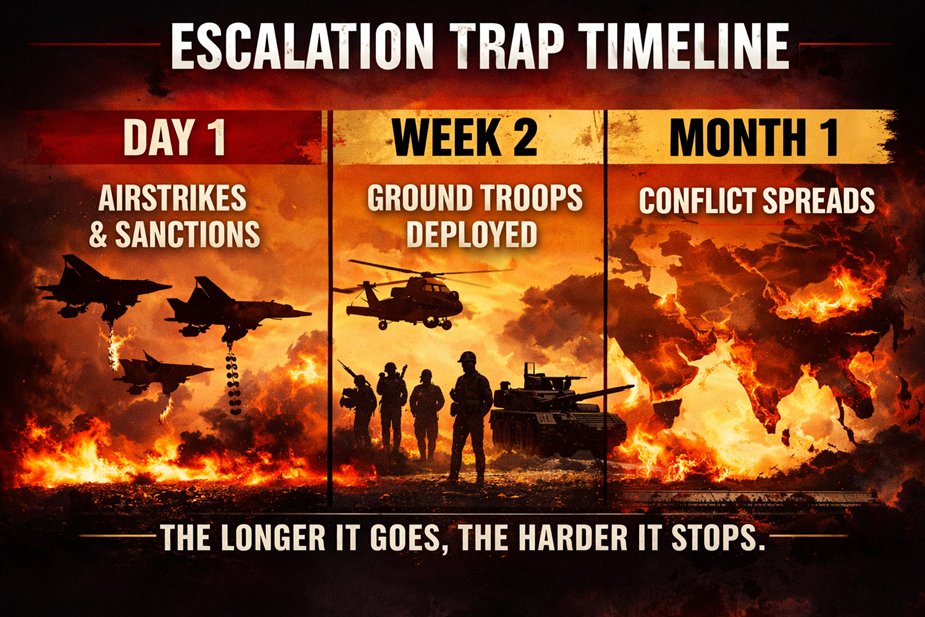
The system is tighter -- We are at Day 45
The sequence from here is predictable:
Asia first → Europe next → global compression
Not collapse
Contraction
The U.S. won’t be spared
Energy independence doesn’t protect a globally integrated economy
When supply chains seize, the shock transmits via trade reductions
This is the real shift:
Prices no longer determine outcomes
Access does
And once that flips, governments start choosing winners and losers
Watch one thing this week:
Ships through Hormuz
--Not statements
--Not markets
If flows don’t recover, the system tightens further -- necessarily
By the time shortages show up in headlines, it’s already too late
That’s how these shocks work
Full breakdown—mechanism, timeline, what happens next: new analysis: Escalation Trap substack

• • •

Missing some Tweet in this thread? You can try to force a refresh

 

Keep Current with Robert A. Pape

Robert A. Pape Profile picture

Stay in touch and get notified when new unrolls are available from this author!

Read all threads

This Thread may be Removed Anytime!

PDF

Twitter may remove this content at anytime! Save it as PDF for later use!

Try unrolling a thread yourself!

how to unroll video
  1. Follow @ThreadReaderApp to mention us!

  2. From a Twitter thread mention us with a keyword "unroll"
@threadreaderapp unroll

Practice here first or read more on our help page!

More from @ProfessorPape

Apr 8
The Iran ceasefire is being called a “pause.”

It’s not.

It’s a revelation:
The U.S. used overwhelming force—and still could not control the outcome.
That’s a structural shift in power.
Over 40 days, the U.S. escalated step by step:
more strikes, more targets, more threats.
Each time, the expectation was compliance.

Each time, the result was more instability.

This is bombing to lose, not bombing to win.
For decades, U.S. power meant guaranteeing stable energy flows.

Now?
Even with maximum force,
that stability can’t be assured.
Allies notice.
And when allies hedge—power shifts.
Read 5 tweets
Apr 7
A 2-week ceasefire in the Iran war just took effect.
No strikes. No missiles. Hormuz open—with Iranian cooperation.
This is a good day—for 92 million Iranians, the Gulf, the global economy, and Americans.

But don’t mistake pause for resolution.
Ceasefires in active escalation cycles fail more often than they hold.
--Israel hasn’t agreed.
-- Forces are still deployed.
-- Capabilities are intact.
This isn’t de-escalation.
It’s a temporary interruption.
What the last 40 days revealed is more important than the ceasefire itself:

Power in this war did not come from size.
It came from leverage over vulnerability.

That’s the shift.
Read 6 tweets
Apr 7
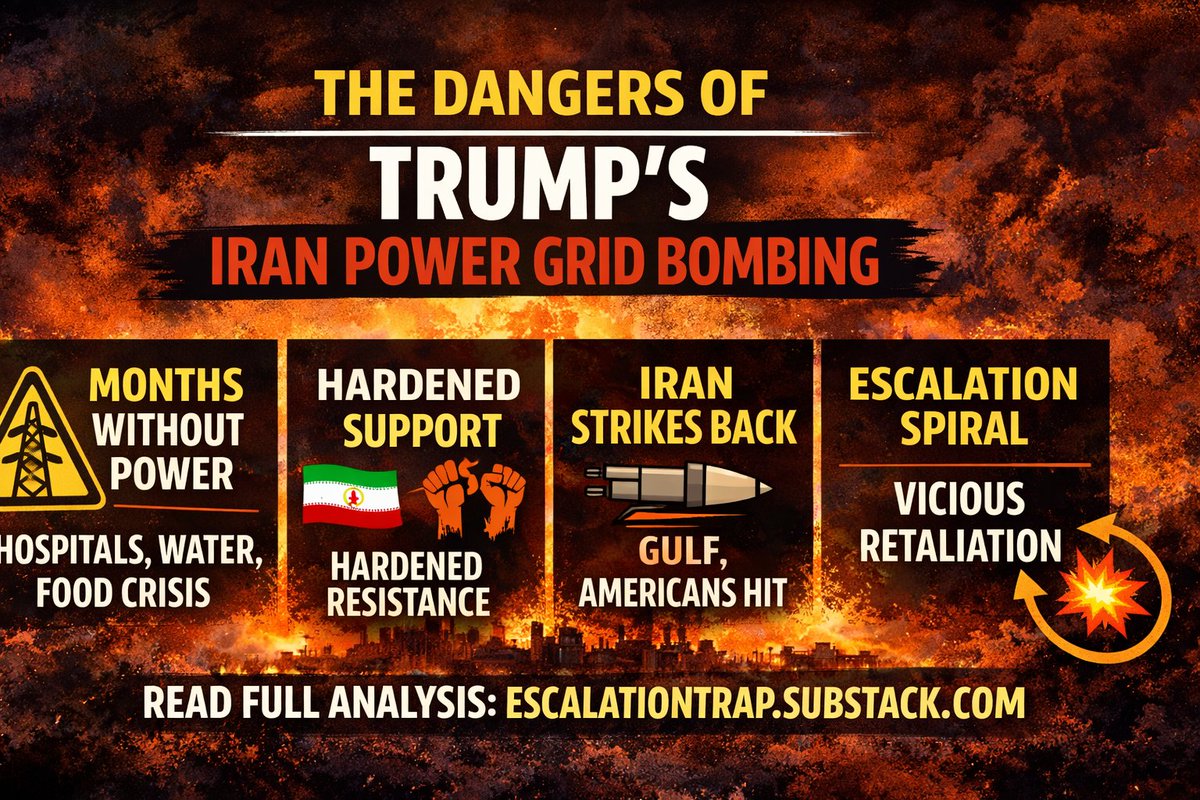
Why Trump’s Threat to Bomb Iran’s Power Grid Is So Dangerous
This isn’t coercion.
It’s escalation—with predictable failure.Image
I spent years working with the U.S. Air Force on strategic bombing theory.

We studied how to destroy electric grids.
Not just tactically—but systematically.

What follows is the part never published—
but determines whether it works or fails.
There are two ways to hit a power system:

• Transformers → outages for weeks
• Generating hulls → outages for 6+ months
Trump’s language—“never to be used again”—signals the second.

That’s not pressure -- That’s societal collapse
Read 6 tweets
Apr 6
In my new piece in The New York Times today, I argue the Iran war has reached a point Washington still refuses to say out loud:

either the U.S. escalates to a ground war—or Iran emerges as a new center of global power.

Think about—what stops this future?
nytimes.com/2026/04/06/opi…
This is not about personalities

It’s a structural problem building since 2002, when Iran’s nuclear program shifted the conflict from political to military

Once large-scale strikes begin, escalation follows a logic of its own
The administration’s strategy is not irrational:
--limited force
--signal resolve
--avoid ground war
--create leverage

The problem is the assumption underneath it:
that escalation can be controlled
History says otherwise
Read 7 tweets
Apr 2
Tonight’s speech by Donald Trump was framed as “mission nearly complete.”
But listen carefully — the substance points the other way:
This is not de-escalation. It’s controlled escalation.
1) He claims victory — while extending the war
Says “core objectives” are nearly done
Says the war could continue 2–3 more weeks
Translation:
Victory rhetoric + no clear end date = war continuation
2) He keeps escalation options open
Prior threats include strikes on critical infrastructure like power plants
Continued bombardment until strategic compliance (Hormuz, etc.)
That’s not winding down.
That’s raising the ceiling of destruction if Iran resists
Read 7 tweets
Apr 1
Many are asking what Trump might say about NATO tonight.

The real issue isn’t whether the U.S. formally leaves NATO.

It’s this:

NATO is already dead
We are now just writing its obituary
Most people misunderstand what NATO actually is

It is not just a political alliance

NATO is an integrated military command structure—where a U.S. general (SACEUR) can direct allied forces in wartime

That only works if allies trust U.S. leadership
That trust is the foundation of NATO

Not treaties. Not statements. Not summits

Trust that, in a crisis, following U.S. command will make countries more secure—not less

That foundation has now been broken
Read 9 tweets

Did Thread Reader help you today?

Support us! We are indie developers!


This site is made by just two indie developers on a laptop doing marketing, support and development! Read more about the story.

Become a Premium Member ($3/month or $30/year) and get exclusive features!

Become Premium

Don't want to be a Premium member but still want to support us?

Make a small donation by buying us coffee ($5) or help with server cost ($10)

Donate via Paypal

Or Donate anonymously using crypto!

Ethereum

0xfe58350B80634f60Fa6Dc149a72b4DFbc17D341E copy

Bitcoin

3ATGMxNzCUFzxpMCHL5sWSt4DVtS8UqXpi copy

Thank you for your support!

Follow Us!

:(