When soldiers are taught how to survive an FPV drone, they’re taught “how to try to survive.”
Rule number one: don’t stay together. One strike can wipe out a group. If you scatter, the drone has to pick one target. After that — it’s all down to chance, The Telegraph. 1/
If there’s no cover, drop low and make yourself harder to see. If there is cover — run. Stay in shadows, hug walls, use vegetation to reduce visibility and heat signature. 2/
Drone Fight Club founder Vladyslav Plaksin: You have to think ahead. What you’re doing now is already in the past. You need to know where the drone will be in 2–3 seconds. That’s why musicians make great operators. 3/
Drones now cause around 80% of battlefield losses. But people still decide outcomes. Ukraine and Russia are scaling up drone operators fast. Russia aims to train up to 1 million by 2030. 4/
Thermal cameras now work day and night. They spot people in open fields, forests, even in white clothing on snow.
In March alone, Ukrainian drones hit 151,207 targets — up 50% from February. 5/
Plaksin: Russia no longer prioritizes artillery — it hunts FPV operators. Ukraine is effectively training Russia. Russian units adapt, learn to intercept drones, and will use that knowledge beyond Ukraine. 6X
For decades, Germany blocked every attempt to build European defense without America. Merz reversed course after concluding Trump was ready to abandon Ukraine.
Germany leads a coalition planning to run NATO without the US. The project has a name: "European NATO" — WSJ. 1/
Germany, France, the UK, Poland, the Nordics, and Canada are planning to fill US command roles, run air-and-missile defenses, and secure reinforcement corridors into Poland and the Baltics.
The planning runs through side meetings and dinners inside NATO. 2/
Pistorius, German Defense Minister: "NATO must become more European in order to remain trans-Atlantic."
The plans accelerated after Trump threatened to seize Greenland from NATO ally Denmark. The Iran war standoff gave them fresh urgency. 3/
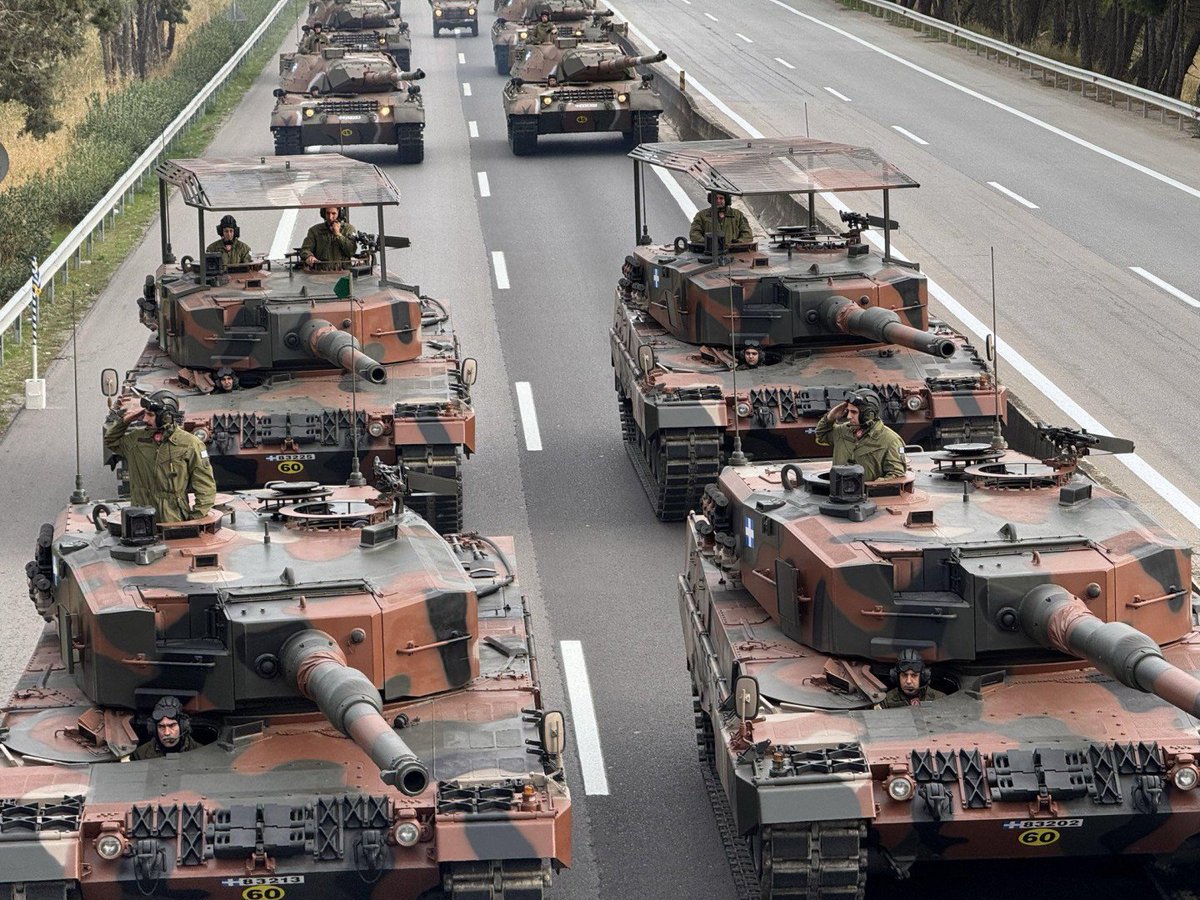
NATO’s eastern flank is getting much harder for Russia. Europe fields roughly 8,000+ tanks across NATO members.
Russia has 3,460 active plus 2,100 in storage — but most are T-55s, T-62s, and Soviet-built T-72s. NATO is pulling ahead on quality, writes United24. 1/
Turkey has the most tanks in Europe — 2,381. But Poland is becoming NATO’s most dangerous armored power. Because of what it is building. 2/
Poland today fields 180 South Korean K2 Black Panthers, 233 American Abrams, 202 Leopard 2s, and 251 older PT-91 and T-72s.
Total: 897 tanks. Not the biggest fleet. But the most modern mix on NATO’s eastern flank. 3/
Fukuyama: Hungary’s election was an extraordinarily important victory for liberal democracy.
Orban built “illiberal democracy”: no guardrails, no rule of law, no constitutional checks. JD Vance went to help him, and that seems to have hurt Orban. 1/
Fukuyama: Peter Magyar and Tisza won a supermajority and can now reverse many of the constitutional changes Orban put in place to keep himself in power.
That is a real chance to stop the slide toward authoritarian government and populism. 2X
Sup. Com. of Sweden, Claesson: Russia is not 10ft tall. It’s their favorite tool to make us believe that they are. If Russia would make a true military assessment, they know they would lose [to NATO]. That leads to a hybrid warfare to exploit vulnerabilities in our societies. 1/
Claesson: With the means available to the Ukrainians, it is very compelling to see how they bring multi-domain situation awareness together, how they do targeting and make the command & control arrangements work throughout the whole structure. 2/
Claesson: One aspect of the Ukrainian success — they work incrementally, they try, they test, they take risks. With the back against the wall they must not be risk avert. It is important to learn from them and be less risk avert to apply those lessons. 3/
Keane: You do not need 10,000 troops to seize Iran’s uranium. The US controls the airspace.
The real threat is rockets and missiles. Another option is to threaten Kharg Island: give up enrichment, or lose more than 90% of your export lifeline. 1/
Keane: Trump’s blockade already shuts down Iran’s oil exports. Zero export oil leaves Iran under this order.
Kharg Island handles more than 90% of that flow, so cutting that artery hits Tehran hard and fast and strips away Tehran’s leverage. 2/
Keane: Iran misread the ceasefire. Tehran thought the shutdown gave it leverage and would push US negotiators into concessions.
Instead, talks collapsed, Trump wanted everything, and Washington’s answer was simple: absolutely not. 3/