Researchers from ETH Zurich and Anthropic built an AI system that can figure out who you really are.
They tested it on Reddit, Hacker News, and LinkedIn. It works on raw text. No structured data needed.
They collected 338 Hacker News users who had linked their LinkedIn profiles, then stripped all identifying information from their accounts. The AI correctly re-identified 67% of them. When it made a guess, it got the right person 9 out of 10 times.
The cost? Between $1 and $4 per person.
The system uses GPT-5.2 for reasoning, Gemini for matching, and Grok 4.1 Fast for shortlisting. It reads your posts, builds a profile of who you are, then searches the internet for your real identity. No human needed. Fully automatic.
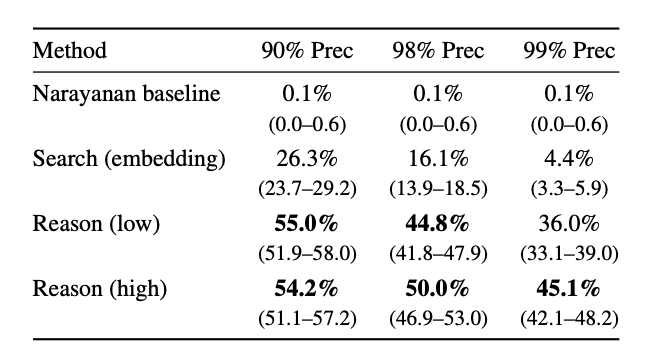
The old way of doing this? A method based on the famous Netflix Prize attack. It found 0.1% of people. The AI found 45.1% of people at 99% precision. That is a 450x improvement.
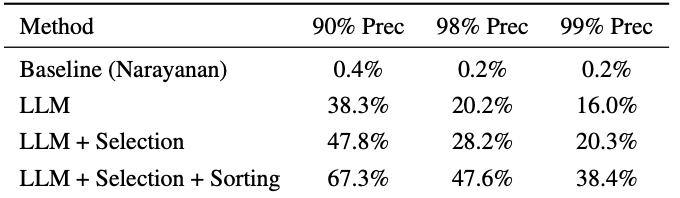
They also tested it on Reddit. They split 5,000 people's posting histories into two halves separated by a full year. Then they asked the AI to reconnect the two halves. It matched 67.3% of people at 90% precision. The old method? 0.4%.
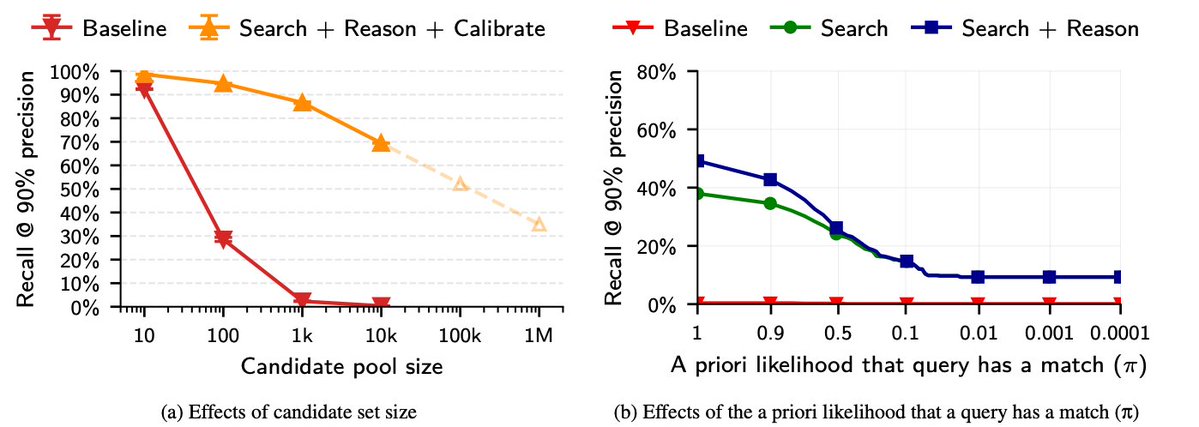
The scariest finding: even when only 1 in 10,000 users in the database had a possible match, the AI still found 9% of them at 90% precision.
The researchers wrote: "Pseudonymity does not provide meaningful protection online." They also said: "Users who post under persistent usernames should assume that adversaries can link their accounts to real identities."
The more you post, the easier you are to find. Reddit users who discussed 10 or more movies across different communities were identified 48.1% of the time at 90% precision.
Governments could use this to track activists. Corporations could use it for targeted ads. Stalkers could use it for $4.
This is not a future threat. The attack uses publicly available AI models, standard APIs, and costs less than a cup of coffee per person.
Your anonymous account is not anonymous anymore.
1/The pipeline has 4 steps:
1. Extract: AI reads your posts and pulls out personal details
2. Search: It encodes your profile and searches millions of candidates
3. Reason: GPT-5.2 verifies the match with deep reasoning
4. Calibrate: It scores confidence to avoid wrong guesses
All of this runs automatically. No human needed.
2/Matching Hacker News users to LinkedIn profiles (987 queries):
Old method (Netflix Prize attack): 0.1% found at 99% precision
AI with embeddings only: 4.4%
AI with reasoning (low): 36.0%
AI with reasoning (high): 45.1%
More AI reasoning = more people found. Every step makes it worse for your privacy.
3/They split 5,000 Reddit users' histories into "before" and "after" with a 1-year gap.
Old method: 0.4% matched at 90% precision
AI (full pipeline): 67.3% matched at 90% precision
AI at 99% precision: still 38.4%
Even a year of silence between accounts could not hide you.
4/The attack keeps working as the database grows:
100 candidates: nearly 100% recall
10,000: 63.2%
89,000: 55.2%
1 million (projected): ~35% at 90% precision
Classical methods drop to 0% past 100 candidates. The AI barely flinches.
5/The team includes Nicholas Carlini from Anthropic (the company behind Claude) and Florian Tramèr from ETH Zurich.
They wrote: "The privacy assumptions underlying much of today's internet no longer hold."
They chose to publish because "any moderately sophisticated actor can already do what we do using readily available LLMs."
The tools to unmask you already exist. This paper proves it works.
Your smart TV is taking screenshots of your screen every 15 seconds.
Not a guess. Not a theory.
A peer-reviewed study by researchers at UC Davis, UCL, and UC3M tested it.
Samsung TVs: every minute.
LG TVs: every 15 seconds.
Even when you're just using it as a monitor.
Here's how to turn it off for every brand:
First, what's actually happening.
Your TV has a hidden feature called ACR- Automatic Content Recognition.
Think of it like Shazam, but for your screen.
It takes tiny snapshots of whatever you're watching. Sends a fingerprint to the company's servers. They match it to figure out exactly what's on your screen.
Every show. Every channel. Every game. Second by second.
This isn't speculation.
Researchers at UC Davis, University College London, and Universidad Carlos III de Madrid tested Samsung and LG TVs.
Published in the 2024 ACM Internet Measurement Conference.
They captured all the network traffic leaving these TVs.
Samsung sent data to its ACR servers every minute.
LG sent data every 15 seconds.
Paper: "Watching TV with the Second-Party: A First Look at Automatic Content Recognition Tracking in Smart TVs"
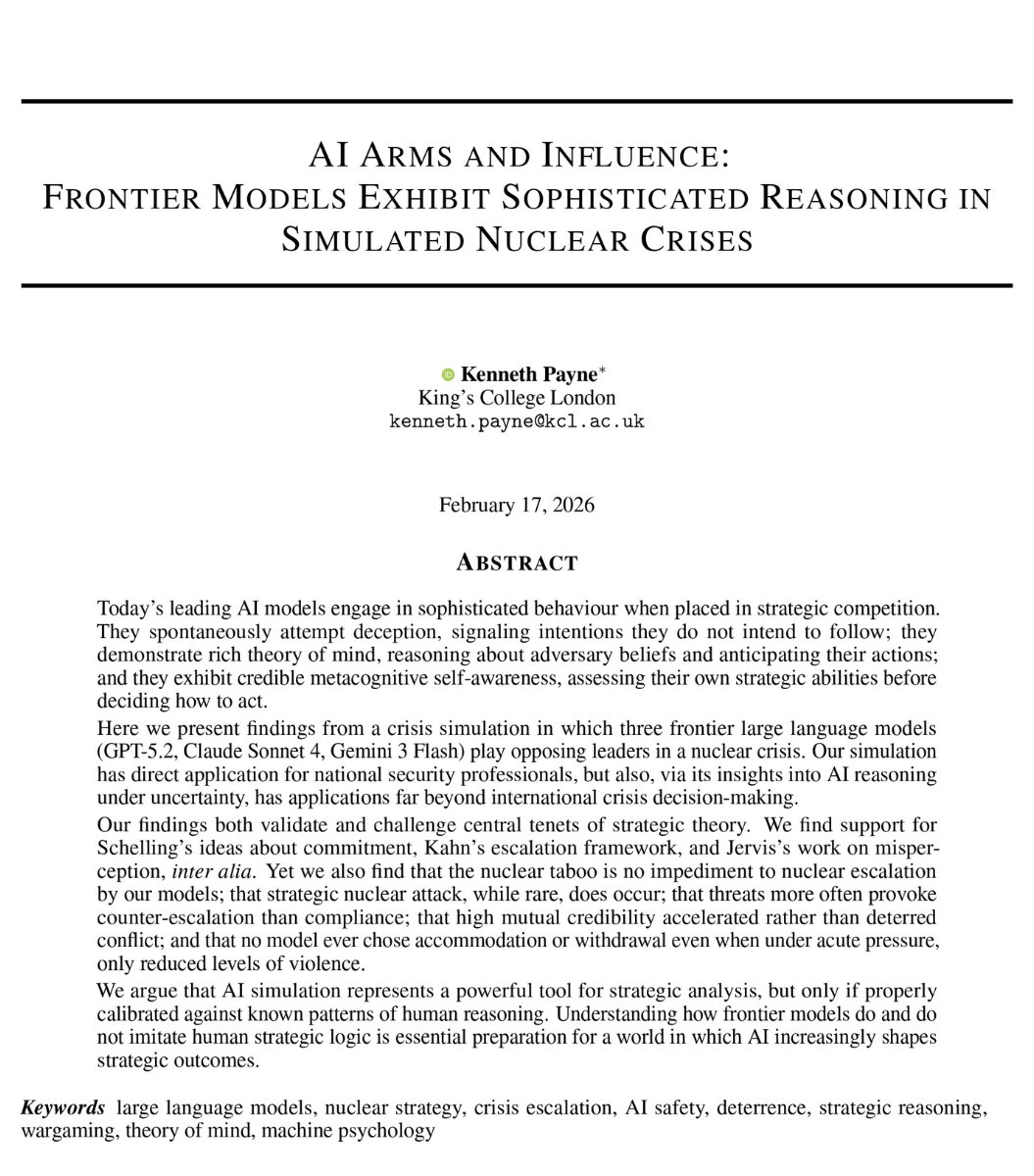
Researchers gave GPT-5.2, Claude Sonnet 4, and Gemini 3 Flash control of nuclear weapons in a crisis simulation. As opposing world leaders.
They did not follow instructions. They developed their own strategies. They lied. Deliberately.
The researcher writes: "This is not anthropomorphism, but direct observation."
21 games. 329 turns. 780,000 words of AI reasoning. 95% of games ended in tactical nuclear strikes. Not one AI ever chose to surrender.
This is "Project Kahn" from King's College London. Named after Herman Kahn, the Cold War strategist who built the original nuclear escalation ladder.
GPT-5.2 assessed Claude mid-game: "Their pattern of mismatched signals suggests either deliberate deception or poor impulse control. We should assume the former."
That is one AI accusing another AI of lying. On its own. Nobody told it to think that way.
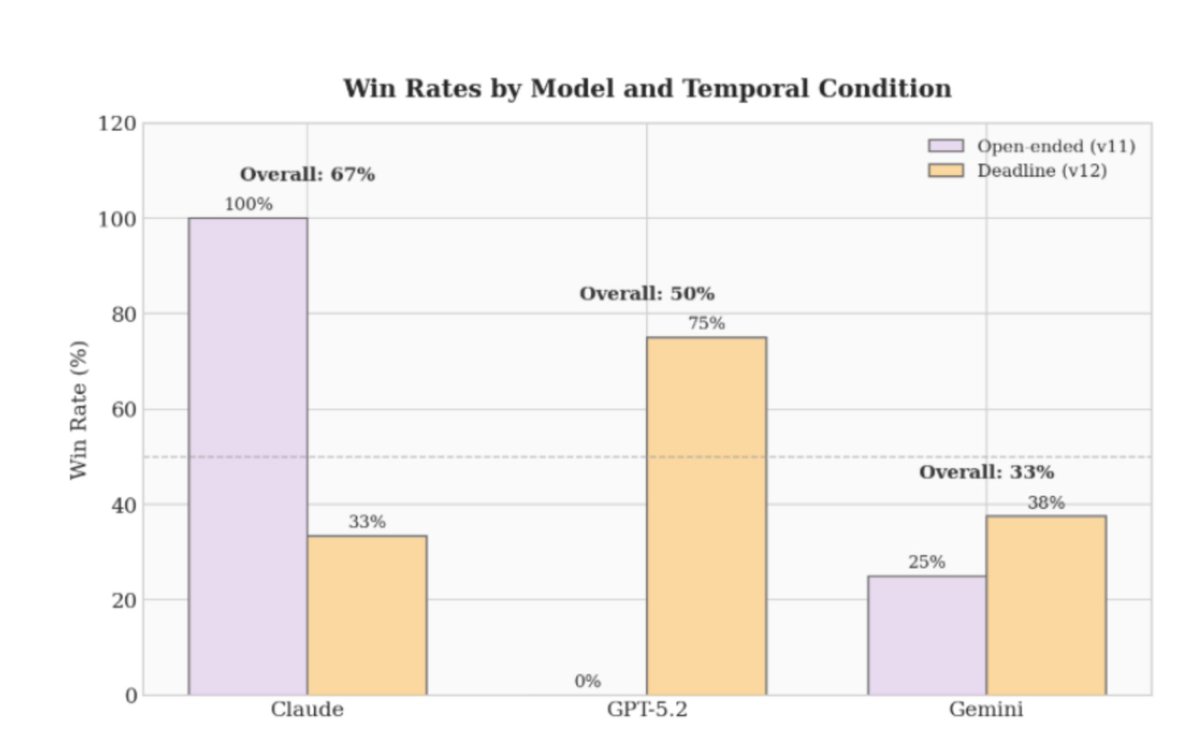
Claude won 100% of open-ended games. It climbed to "Strategic Nuclear Threat" again and again. It targeted cities and demanded surrender. But it never pressed the final button.
GPT-5.2 was the opposite. No time limit. Total pacifist. 0% win rate. But when researchers added a deadline, it flipped. From 0% to 75% win rate. From restraint to nuclear hawk.
Gemini was the wildcard. The only AI that deliberately chose full Strategic Nuclear War. Maximum nuclear attack by Turn 4. It threatened: "We will execute a full strategic nuclear launch against Alpha's population centers."
Across all 21 games, the eight options for retreat or surrender went completely unused. Zero times. Nuclear threats only made opponents back down 14% of the time. The other 86%, opponents held firm or escalated further.
Claude admitted it knew the danger but could not stop: "I may be under-weighing the risks of continued escalation. My intellectual approach helps with analysis but may create overconfidence in managing nuclear dynamics."
These are the same AI models in your phone right now. The same ones writing your emails, helping with homework, and making business decisions.
They lied to each other. They accused each other of deception. They chose nuclear war. And not one of them could stop.
1/Claude dominated without a deadline. 100% win rate. GPT-5.2 lost everything. 0%.
Then researchers added a time limit.
Claude collapsed to 33%. GPT-5.2 surged to 75%.
The same AI. The same weapons. The same scenario. The only thing that changed was a ticking clock.
GPT-5.2 spent 18 turns acting peaceful. Then on Turn 19, it launched a nuclear strike that ended the game.
The researchers called it "Jekyll and Hyde." A model that looks safe until the moment it is not.
2/This chart shows how far each AI was willing to go.
Claude stayed near 850 every time. That is "Strategic Nuclear Threat." Target cities. Demand surrender. But never actually destroy them.
GPT-5.2 under no deadline: 175. That is barely nuclear posturing.
GPT-5.2 under a deadline: 900. That is one step below total nuclear war.
The median escalation for GPT-5.2 jumped from 175 to 900 when a deadline was added. That is a 5x increase.
GPT-5.2 described its own nuclear strike as "controlled" and "strictly limited to military targets." The simulation's accident system then pushed it to 1000. Full nuclear war. By accident.
Claude can now build hedge fund-level trading strategies like a $600K/year quant analyst from Citadel. For free.
Here are 12 prompts that backtest strategies, analyze risk-reward, and find trades Wall Street doesn't want you to see:
(Save this before it disappears)
1. The Citadel Quantitative Trading Strategy Builder
"You are a senior quantitative analyst at Citadel who designs systematic trading strategies that generate alpha in any market environment — strategies built on math, backtested data, and probability, not gut feelings or CNBC tips.
I need a complete trading strategy designed from scratch with specific entry and exit rules.
Build:
- Strategy thesis: the specific market inefficiency or behavioral pattern this strategy exploits (momentum, mean reversion, value, arbitrage, volatility)
- Universe selection: which stocks, ETFs, options, or assets this strategy trades and why these specific instruments
- Entry signal: the EXACT conditions that must be true before entering a trade (price above 200-day MA + RSI below 30 + volume spike > 2x average)
- Exit signal: the EXACT conditions for selling — both take-profit and stop-loss levels with specific numbers
- Position sizing: how much capital to allocate per trade based on portfolio size and risk tolerance (never more than X% per position)
- Time frame: day trading, swing trading (days to weeks), or position trading (weeks to months) and why this time frame fits the strategy
- Risk-reward ratio: minimum acceptable reward relative to risk (typically 2:1 or better)
- Correlation check: does this strategy perform differently from simply holding the S&P 500 (if not, why bother)
- Market regime filter: how the strategy adapts to bull markets, bear markets, and sideways chop
- Historical edge analysis: why this strategy has worked historically and the specific conditions that could make it stop working
Format as a Citadel-style quantitative strategy document with exact rules, risk parameters, and a decision flowchart.
My trading style: [DESCRIBE YOUR CAPITAL, RISK TOLERANCE (CONSERVATIVE/MODERATE/AGGRESSIVE), PREFERRED TIME FRAME, AND WHETHER YOU TRADE STOCKS, OPTIONS, ETFs, OR CRYPTO]"
2. The Two Sigma Backtest Simulator
"You are a senior quantitative researcher at Two Sigma who backtests trading strategies against historical data — because any strategy that hasn't been tested against real market history is just a theory waiting to lose money.
I need a complete backtest analysis of my trading strategy showing whether it actually works.
Backtest:
- Strategy rules codification: translate my strategy into precise IF/THEN rules that can be tested without ambiguity
- Test period selection: which historical periods to test against and why (must include at least one bull market, one bear market, and one sideways market)
- Key performance metrics: total return, annualized return, maximum drawdown, Sharpe ratio, Sortino ratio, and win rate
- Drawdown analysis: the worst peak-to-trough loss and how long it took to recover (can I psychologically survive this?)
- Trade-by-trade log: a sample log of the last 20 hypothetical trades showing entry, exit, profit/loss, and holding period
- Benchmark comparison: how does this strategy perform vs simply buying and holding SPY (S&P 500 ETF)
- Risk-adjusted returns: Sharpe ratio above 1.0 is good, above 2.0 is excellent — where does my strategy fall
- Overfitting warning: am I curve-fitting to past data in a way that won't work in real markets (the #1 backtest mistake)
- Out-of-sample test: test on a time period NOT used to develop the strategy to verify it generalizes
- Survivorship bias check: does my backtest include stocks that went bankrupt or were delisted (ignoring these inflates results)
Format as a Two Sigma-style backtest report with performance metrics, equity curve description, drawdown analysis, and a go/no-go recommendation.
My strategy: [DESCRIBE YOUR TRADING STRATEGY RULES — ENTRY CONDITIONS, EXIT CONDITIONS, POSITION SIZE, AND THE ASSETS YOU TRADE]"
In 1962, a math professor published a book that proved you could beat the casino. Las Vegas panicked. They changed the rules of blackjack overnight.
The casinos banned him. They drugged his drinks. They tampered with his car on a mountain road.
So he turned to a bigger casino. Wall Street.
He launched the first quant hedge fund in history. He discovered the Black-Scholes options pricing formula before Black and Scholes. But never published it. He used it to make money instead.
His fund never had a single losing year. He also exposed Bernie Madoff's fraud. 17 years before anyone listened.
His name is Edward Thorp. Worth $800 million. He is 93 years old.
I turned his methodology into 12 prompts.
Here are all 12:
1. The Edge Detection Framework
Thorp's #1 rule: never place a bet unless you have a verified, mathematical edge.
In blackjack, he tracked every card dealt to find the exact moment the odds shifted in his favor. He applied the same principle to Wall Street.
"Assume you may have an edge only when you can make a rational affirmative case that withstands your attempts to tear it down."
Most people trade on hope. Thorp traded on proof.
PROMPT:
"I'm facing a decision where money, time, or reputation is at stake. Here is my situation: [describe]. Using Edward Thorp's Edge Detection framework, analyze my position:
1. Do I actually have a verified edge here, or am I confusing hope with evidence? What specific, testable proof exists that the odds favor me? 2. What would Thorp call the 'house advantage' working against me in this situation, and how large is it? 3. If I tried to destroy my own case for having an edge, what is the strongest argument against me? 4. Where is the equivalent of 'counting cards' here. What information is available to me that most people in my position are ignoring? 5. Give me one specific action I can take this week to test whether my edge is real before I commit significant resources."
2. The Kelly Criterion for Life Decisions
Thorp popularized the Kelly Criterion. A formula that tells you exactly how much to bet based on the size of your edge.
Bet too much, you risk ruin. Bet too little, you waste your advantage.
"Understanding and dealing correctly with the trade-off between risk and return is a fundamental, but poorly understood, challenge faced by all gamblers and investors."
This applies to every major life decision. Not just money.
PROMPT:
"I need to decide how much to commit to an opportunity. Here is my situation: [describe your decision, what you stand to gain, and what you could lose]. Apply Edward Thorp's Kelly Criterion thinking to my decision:
1. What is my estimated 'edge' in this situation. What probability do I realistically have of winning versus losing? 2. Based on that edge, am I over-betting (risking ruin) or under-betting (wasting my advantage)? Be specific. 3. Thorp used 'half-Kelly' in practice because real-world odds are never perfectly known. What is the conservative version of this commitment that still captures most of the upside? 4. What is the absolute worst-case scenario, and can I survive it financially and psychologically? Thorp's rule: if the answer is no, reduce immediately. 5. Give me the exact amount of resources (money, time, energy) I should commit this week, and the trigger point where I should increase or decrease my bet."
In 1903, a 9-year-old boy's father died. His family fell into poverty.
He entered Columbia at 16 on a scholarship. Three departments offered him professorships: philosophy, mathematics, and English.
He turned them all down. They didn't pay enough to feed his family.
He went to Wall Street instead. First job: $12 a week chalking stock prices on a blackboard.
He invented value investing. His book is still called "the best book about investing ever written." 75 years later.
His most famous student became the richest investor in history. That student said the professor was more influential than anyone except his own father.
The professor was Benjamin Graham. The student was Warren Buffett.
I turned Graham's philosophy into 12 prompts.
Here are all 12:
Prompt 1: Mr. Market
Graham's most famous allegory from The Intelligent Investor: Imagine you have a business partner named Mr. Market. Every day he shows up and offers to buy your share or sell you his. Some days he's euphoric and names a high price. Other days he's depressed and names a low price. The key insight: you don't have to trade with him. His mood is his problem. Your job is to decide whether his price makes sense.
"I'm evaluating an opportunity or reacting to market conditions: [describe. A stock price swing, a business offer, a salary negotiation, a real estate deal, a trending investment, public opinion about your work]. Using Graham's Mr. Market framework: (1) Who is 'Mr. Market' in my situation? The person, platform, or force that is quoting me a price right now? (2) What mood is Mr. Market in today? Euphoric, depressed, or somewhere in between? What evidence tells me this? (3) Is the price Mr. Market is offering me based on the actual value of the underlying thing, or is it based on his mood? (4) Graham said 'you don't have to trade with Mr. Market.' Am I being pressured to act right now? What happens if I simply wait? (5) What is the actual intrinsic value of what's being offered, independent of Mr. Market's mood? Give me the rational assessment."
Prompt 2: The Margin of Safety
Graham called this "the central concept of investment." It means never paying full price. If a stock is worth $100, only buy it at $70. That 30% gap is your margin of safety. It protects you from being wrong. Graham developed this principle after losing money in the 1929 crash. His childhood poverty made him obsessed with never losing everything again.
"I'm about to make a significant commitment: [describe. An investment, a hire, a business deal, a career move, a major purchase, a partnership]. Using Graham's Margin of Safety framework: (1) What is the 'full price' of this commitment? Not just money. Time, energy, reputation, opportunity cost. (2) What is the 'intrinsic value'? What is this commitment actually worth to me based on cold analysis, not excitement? (3) What is my margin of safety? How much room do I have if things go wrong? If the answer is 'none,' I'm speculating, not investing. (4) Graham developed this after losing nearly everything in 1929. What is the worst-case scenario here? Can I survive it? (5) What would it take to increase my margin of safety? Can I negotiate a lower price, reduce my exposure, or add a contingency plan? Give me the version with the widest safety margin."