Russian troops turned Oleshky into a sealed pocket.
2,000 civilians remain trapped in occupied city. No safe exit routes after Russian troops mined roads.
At least 47 children are still inside, with no regular food or water supplies. People die of hunger, Kyiv Independent. 1/
“If the situation doesn’t improve, people will just die there from hunger. There’s no way out, no food coming in,” a resident who escaped says.
Out of 24,000 pre-war population, only about 2,000 remain, mostly elderly, ill, or alone. 2/
Russian forces placed mortars, guns, and mines inside residential areas.
Civilians live among military positions, which also shield Russian troops from Ukrainian strikes, forcing residents to remain inside active combat zones. 3/
Locals call one route the “road of death.”
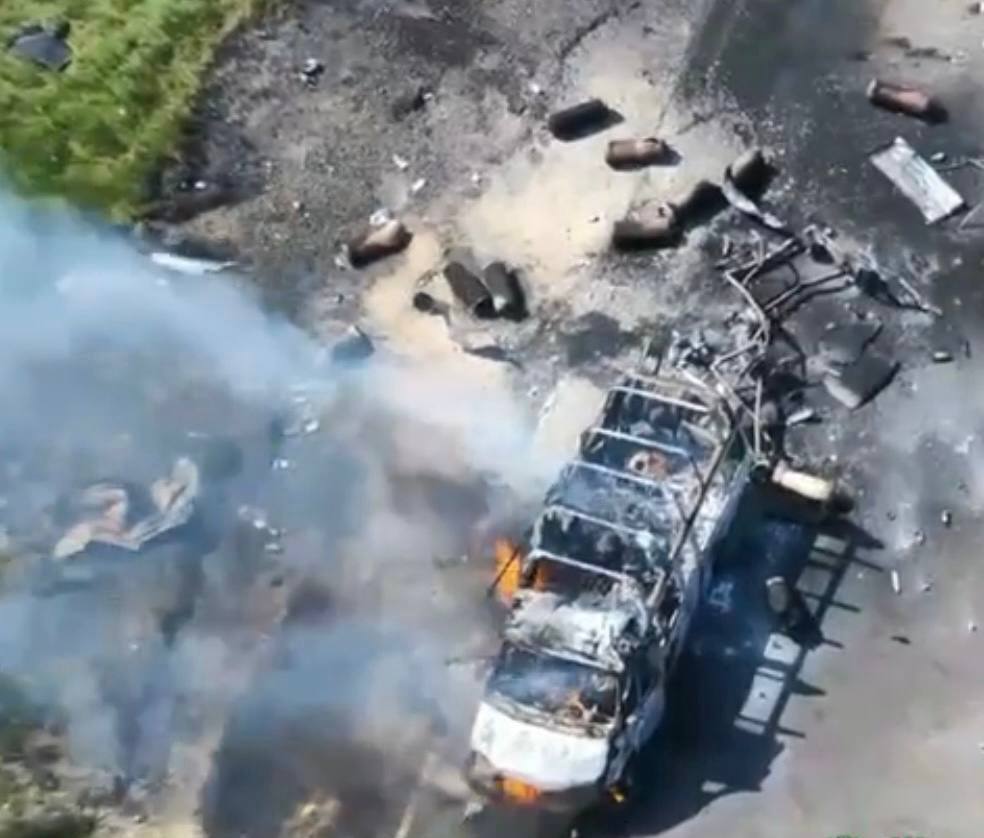
In February, 6 cars bringing food were destroyed by mines or drones. A volunteer driver and 2 evacuees were killed trying to leave. Movement in or out has nearly stopped. 4/
“Many people were completely exhausted and starving… they would arrive at hospital and drop dead,” a resident says.
No electricity, water, or gas. Stores closed. People survived winter burning firewood and eating remaining canned food. 5/
Aid depends on Russian passports.
Residents must travel to other cities to apply, wait months, and many lost documents after the 2023 flood caused by the Kakhovka dam destruction. Only 4-5 deliveries reached the city in Mar. 6/
“People are counting every sip of water to survive one more day. This is deliberate terrorism,” Ukraine’s ombudsman says.
Evacuation limited to small groups at their own risk. Some walk 23 km to escape. Hundreds still waiting. 7X
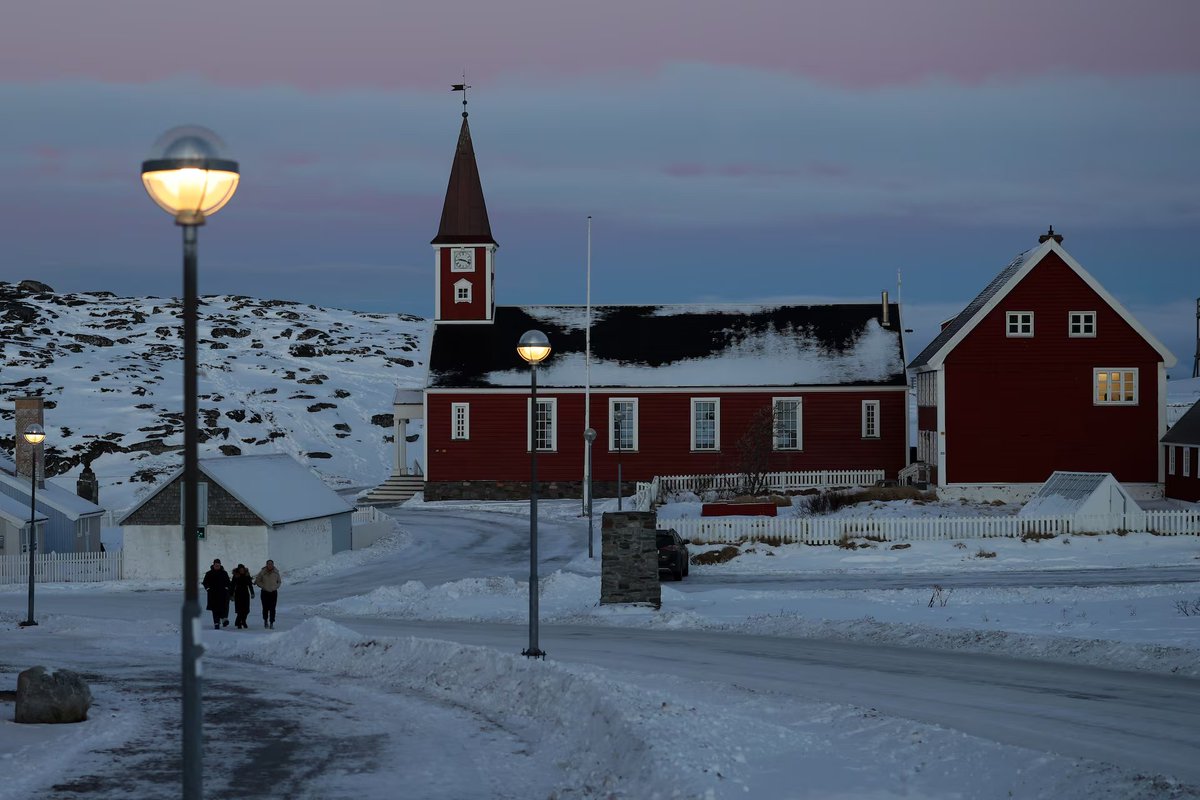
Remember Greenland crisis? Trump's allies now run a covert influence campaign in Greenland.
A network of Americans with White House ties has bribed a dogsledding association, cultivated opposition politicians, and highlighted Denmark's colonial crimes — Reuters.
1/
The main face: Jørgen Boassen. Banned from Nuuk's main hotel, its public pool, and its fight club.
In December, he confronted a senior Greenlandic parliamentarian outside a restaurant and challenged him to a fight.
2/
Tom Dans, linked to Project 2025 and reappointed by Trump to chair the US Arctic Research Commission, coordinated with National Security Council staff.
He raised $250,000 for the dogsledding championship in exchange for inviting US officials.
3/
The same FSB unit that poisoned Navalny also runs Russia’s state doping program. It shares the same staff, the same lab, and the same command.
The workers handle urine samples and nerve agents under one roof and joke: “you don’t want to mix urine and Novichok” - The Insider. 1/
At the 2014 Sochi Olympics, FSB officers ran a system that swapped dirty urine samples for clean ones.
They used a hidden hole in the lab wall, opened sealed bottles, replaced the samples, and closed them again. Russian athletes passed tests and won medals. 2/
Staff edited the Moscow anti-doping lab database before handing it to investigators.
They deleted positive test results, removed raw data files, and added fake entries designed to shift blame onto whistleblower Grigory Rodchenkov and hide the state program. 3/
Ukraine's Ambassador to the US, Stefanishyna: Putin’s so-called Easter ceasefire lasted less than 24 hours and was breached multiple times.
Very shortly after that came one of the largest attacks since winter: more than 700 drones across Ukraine. 1/
Stefanishyna: Attention is on Iran, but war does not stop because attention shifts.
We have had smaller disruptions in military deliveries, but not major ones. We hope once the war in Iran is over, order will be restored and efforts can return to ending the war in Ukraine. 2/
Stefanishyna: Talks are continuing on multiple layers. More than 100 Ukrainian POWs and abducted Ukrainian children came back.
But Russia is not interested in diplomacy. Russia speaks the language of pressure, when it is deprived of money, resources and the fuel of war. 3/
Petraeus: Ukraine is stopping the Russians cold with nearly 10,000 unmanned systems a day — in the air, on the ground, and at sea.
There are incremental gains either way, but I see no prospect of a Russian breakthrough. 1/
Petraeus: The front is now a 35-kilometer death zone in either direction.
Logistics move remotely, anything caught there for long gets taken out, and maritime drones have sunk over 35% of Russia’s Black Sea Fleet. It is the most lethal front line in history. 2/
Petraeus: Once oil prices fall, I expect sanctions on Russia to snap back, with new US sanctions added to the EU package.
Then Russia goes back to running out of money, failing to recruit enough troops, and facing nightly Ukrainian strikes on energy infrastructure. 3/
Russia spends $500m a day on the war — the cost of 5-7 large hospitals.
A ceasefire would free these resources and cut the prohibitive interest rate. But it will not fix the economy. The system was broken long before 2022 — The Moscow Times. 1/
Russia's economic deformations predate 2022. The war merely accelerated them.
The foundation: concentrated power among big business, regional elites, Kremlin bureaucrats. Systematic underinvestment in hospitals, schools, roads, utilities across most regions. 2/
Depressed regions, deprived of economic prospects, became the reservoir from which the Kremlin draws its contract soldiers. The ruling class keeps its children safe.
The fiscal reserves that made the war possible were built by technocrats who called themselves pragmatists. 3/
Zelenskyy: Russia openly says it wants to control its neighbors and decide Europe’s security order.
It has carried its war agenda as far as Syria and Africa. This is a global threat — and more countries now see it that way.
1/
Zelenskyy: Putin knows exactly what he’s doing and who he resembles.
He is rightly compared to the Nazis: the same expansionism, the same urge to decide which nations may exist.
2/
Zelenskyy: The freedom Ukraine still lacks is freedom from ruins and from those who bring them.
Freedom is never abstract — it must be fought for, protected, and built on security, law, culture, education, and one clear principle: evil must be punished.