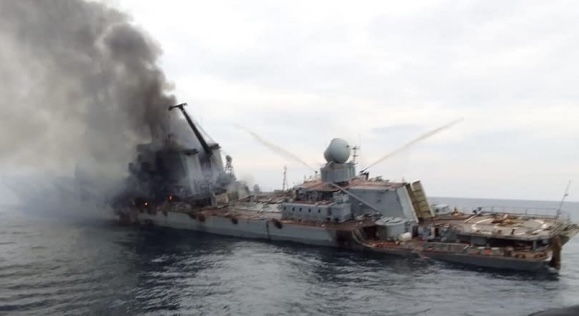
Russian troops turned Oleshky into a sealed pocket.
2,000 civilians remain trapped in occupied city. No safe exit routes after Russian troops mined roads.
At least 47 children are still inside, with no regular food or water supplies. People die of hunger, Kyiv Independent. 1/
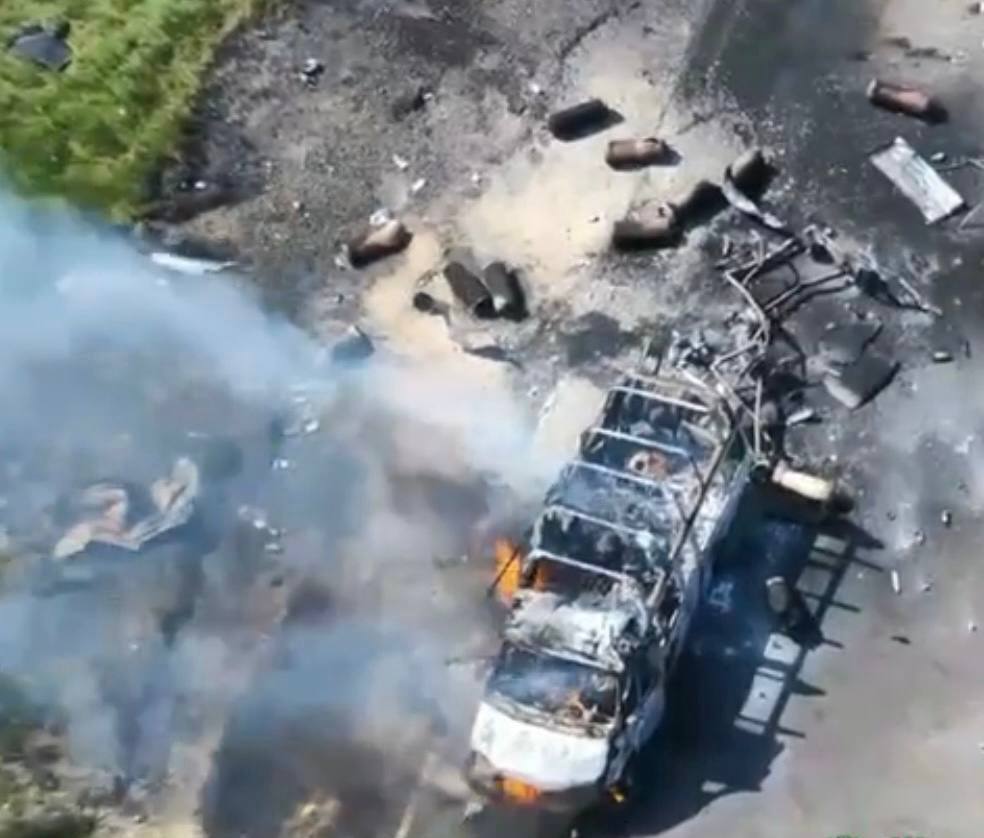
“If the situation doesn’t improve, people will just die there from hunger. There’s no way out, no food coming in,” a resident who escaped says.
Out of 24,000 pre-war population, only about 2,000 remain, mostly elderly, ill, or alone. 2/
Russian forces placed mortars, guns, and mines inside residential areas.
Civilians live among military positions, which also shield Russian troops from Ukrainian strikes, forcing residents to remain inside active combat zones. 3/
Locals call one route the “road of death.”
In February, 6 cars bringing food were destroyed by mines or drones. A volunteer driver and 2 evacuees were killed trying to leave. Movement in or out has nearly stopped. 4/
“Many people were completely exhausted and starving… they would arrive at hospital and drop dead,” a resident says.
No electricity, water, or gas. Stores closed. People survived winter burning firewood and eating remaining canned food. 5/
Aid depends on Russian passports.
Residents must travel to other cities to apply, wait months, and many lost documents after the 2023 flood caused by the Kakhovka dam destruction. Only 4-5 deliveries reached the city in Mar. 6/
“People are counting every sip of water to survive one more day. This is deliberate terrorism,” Ukraine’s ombudsman says.
Evacuation limited to small groups at their own risk. Some walk 23 km to escape. Hundreds still waiting. 7X
Russian parliament approved a bill that gives Putin the right to deploy troops abroad to free russians arrested under ICC warrants.
Russia can use that to start operations against NATO members to test Article 5 — The Times. 1/
Estonia is the most cited target. Moscow could launch a campaign there under the pretext of protecting the Baltic country's large russian-speaking population.
Estonia halted detention of russian shadow fleet tankers this month, because of "risk of military escalation."
2/
In May, russia sent a fighter jet into NATO airspace over the Baltic Sea to escort a sanctioned oil tanker into russian waters.
Last week, a russian warship escorted two tankers through the English Channel. The UK announced it would detain such vessels — but has not acted.
3/
CENTCOM com. Brad Cooper: We launched own one way drones into Iran, originally Iranian designed. We took the guts out, put a "made American" stamp on them and fired them back. Very effective.
We are employing AI to sift through information to help us make decisions faster. 1/
Cooper: We have collected dozens, if not hundreds, of lessons learned. The joint force is taking them and very tactically applying them right now.
Great teams are always adjusting, and that's what we're doing right now. 2X
Zelenskyy: Russia does not want only Ukraine. It has openly said it wants to control all its neighbors and decide what security in Europe should look like.
Russia has carried these war ideas as far as Syria and Africa. This is a truly global threat. 1/
Zelenskyy: At the core of Russia’s war is the false claim that Ukraine does not exist and is merely part of Russia.
Putin knows exactly what he is doing and who he resembles. He is rightly compared to the Nazis. He has the same expansionist ambitions. 2/
Zelenskyy: Air defense remains crucial. Pressure on Russia must continue through sanctions and restrictions, but Russian war criminals must also face justice.
The tribunal for Russia’s aggression must move forward. Do not let Russia go unpunished. 3/
Petraeus: Iran could come out of this much weaker militarily and economically, yet strategically stronger if it keeps control of Hormuz.
A battered Iran that still dictates the strait would leave the US and Gulf partners with an unacceptable result. 1/
Petraeus: Confrontation may well be coming. A US Navy ship apparently already shot down a recon drone, mines are reportedly in the channel, and even one attack every day or two can shut traffic down.
This is not about insurance. It is about the lives of ship crews. 2/
Petraeus: Clearing Hormuz and escorting ships through the normal channel is a very difficult mission.
Demining is laborious and hazardous. Maritime experts say it could require two carrier groups, 8 to 10 frigates and destroyers, and a sustained coalition effort. 3/
Two Russians tried to assault Ukrainian positions. Only one of them had a gun. He threw the riffle to his comrade who tried to shoot down an FPV. After the explosion, both became unarmed and started looking for a hiding spot.
This is happening in Hulaipole — Kyiv Independent. 1/
“Tokha”, Bradley crew commander: We must always drive in and get out quickly.
Enemy’s shape-charged warhead drones are dangerous, but can’t always be in air. We must get out before it gets off and throws a warhead.
2/
“Desnau”, infantryman: When Russians started their assaults on Hulaipole, it was complete chaos.
You could go out to smoke for a second, and two of them are already there, in your yard.
It was happening very fast. You saw the target — killed it. That’s all.
On April 13, 2022 a Neptune operator picked up a target on radar 120 km away. He had minutes to decide: fire or not. Nobody could confirm the target. Bayraktars refused to fly. He pressed launch. UP tells the story of how Ukraine sank the cruiser Moskva four years ago. 1/
That day heavy rain clouds hung just a few kilometers above the Black Sea. Aircraft, Bayraktars, and optical satellites were all useless. 2/
The Neptune's standard radar could see targets only up to 18 km. The Moskva knew this and closed to within 120 km of the Ukrainian coast, certain it was untouchable. 3/