Russia has entered a critical stage of the Kostiantynivka campaign, concentrating forces from several army groupings in what appears to be one of its priority operational sectors. The immediate objective is to seize Kostiantynivka and Druzhkivka, which would open the southern and southeastern approaches to the larger Sloviansk-Kramatorsk defensive agglomeration. To support this effort, Russian command has reinforced the sector with units from multiple formations — including elements drawn from AG Centre and AG Dniepr to supplement AG South own 8th Army and 3rd AC — indicating both the importance of the objective and the difficulty of achieving it with local forces alone.
The current offensive is developing along several converging axes. From the south, Russian troops advancing from Berestok pushed through an overgrown ravine to reach the southwestern outskirts of Ivanivka, while simultaneously massing infantry in Berestok itself in preparation for a larger infiltration into western Kostiantynivka via the T-0504 road corridor.
On the southwestern axis, Russian assault groups have been fighting for over two weeks along the Yablonivka–Stepanivka line, attempting to push through toward Dovha Balka, though so far only a tenuous foothold in the southern part of Stepanivka has been established. Further south, assaults continue near Pleshchiivka and Ivanopillia, likely intended to push Ukrainian defenders northward and secure the flanks of the main attack.
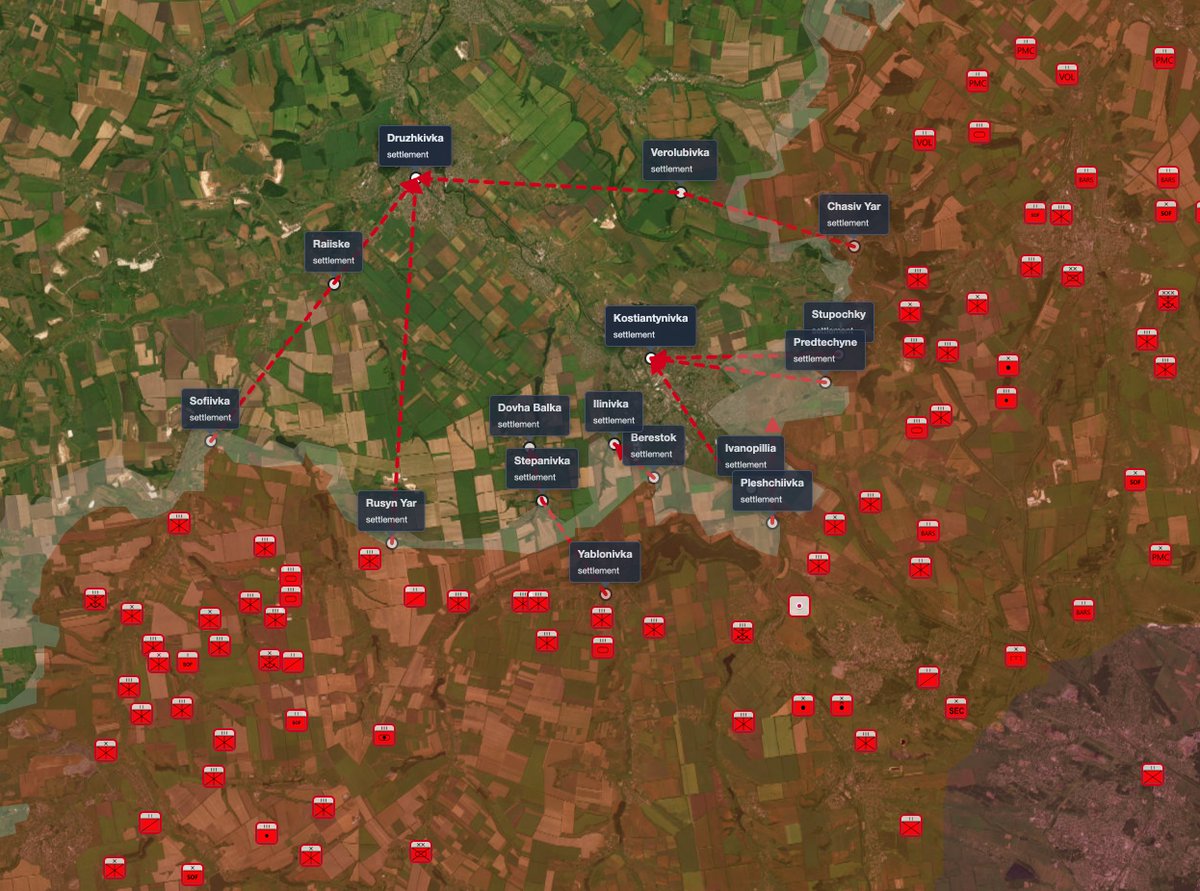
From the southeast and east, forces advancing from Stupochky, Predtechyne, and the Dacha area have achieved limited penetration into the outskirts of the city, where heavy fighting is reported near the railway station and residential streets including Kyivska and Odeska.
Separately, elements of the 150th and 20th MRDivs are pressing toward Druzhkivka directly along the Sofiivka–Raiiske and Rusyn Yar axes on the western flank. These movements suggest an attempt to compress Ukrainian defenses from multiple directions rather than rely on a single frontal breakthrough.
Despite these efforts, Russian progress remains tactical rather than operational. They have gained footholds on the outskirts and in contested gray zones, but there is still no confirmed breakthrough into the central urban area. Ukrainian defenders continue to hold important blocking positions south and east of the city, while maintaining a broader defensive line that prevents rapid encirclement. The Russian advance appears slow, methodical, and costly, relying on repeated infantry assaults supported by artillery and localized armored thrusts.
A major factor shaping the battle is the continued Ukrainian presence around Chasiv Yar. Russian 70th MRDiv attempts to break out along the railway toward Verolubivka and the Stinka–Nikolaivka–Krasne–Podolske line have so far failed, leaving the Ukrainian pocket intact. As long as Ukrainian forces retain positions there, Russian units of the 3rd AC pushing toward Kostiantynivka from the southeast remain exposed to possible flank counterattacks. This forces Russian command to divert part of its forces northward from Stupochky to secure its own lines instead of committing everything directly against Kostiantynivka. In effect, fighting around Chasiv Yar continues to influence the Kostiantynivka battle even without a dramatic frontline shift.
Operationally, time is becoming an important variable. Russia likely intended faster progress during the winter-spring period in preparation for a broader 2026 summer campaign toward Sloviansk and Kramatorsk. The slower-than-expected pace means every additional week spent storming Kostiantynivka reduces the chances of transitioning quickly into a larger offensive. Attrition of assault infantry, armored vehicles, artillery ammunition, and experienced junior leadership could become more damaging than the limited territorial gains justify.
Looking forward, several scenarios are possible. If Ukraine sustains its current defense, Russia may become locked in a prolonged urban battle that drains combat power and delays wider operations. If Russia captures Kostiantynivka, Druzhkivka would come under immediate pressure and southern routes toward Kramatorsk would become more vulnerable. However, even a Russian victory in the city would not automatically create a breakthrough, as further advances would require fresh reserves, logistical support, and the ability to overcome successive Ukrainian defensive belts.
Overall, the battle for Kostiantynivka is becoming more than a local engagement. It is increasingly a test of whether Russia can convert massed assaults and numerical pressure into meaningful operational momentum, or whether Ukrainian resistance can force another costly culmination before the next planned phase of the war.
Russian Vision 2036
A Clear Image of Victory in the Ideological War Based on Forecasting and Design;
Annexation of Kyiv, Odessa, Kharkov, etc. Victory in the ideological struggle, final consolidation of a sovereign worldview;
Establishment of bipolarity while maintaining opposition, in which Russia plays the main role;
Dissolution of the EC;
Negative scenario
Defeat in the North-Eastern Front and confrontation with the West;
Ukraine in NATO, A sharp increase in the threat to state security and territorial integrity;
The tendency towards the complete loss of all post-Soviet states (their wait-and-see, observer position on Russia). The emergence of new conflicts (South Ossetia, Transnistria);
Preservation of "regional" sovereignty in a truncated form
Season of the Weak Arrows: Spring 2026 Retrospective
Russia entered spring with three objectives and left it with none of them meaningfully advanced.
The primary effort was always Kramatorsk. Zaporizhzhia was the secondary push. The northern border was supposed to become a formalized buffer zone.
The Green offensive launched on schedule in May. The results, so far, are not worth the schedule.
Spring is over. Time to take stock.
In three months, Russia seized roughly 334 km² according to DeepState — a modest number under any interpretation, and May was particularly thin. What made it worse was the nature of the failure. This was not a case of one bad break or one stubborn defensive line.
Russia collected nearly every problem available to collect: recruitment pressures, logistical strain, and the slow but consequential emergence of Ukrainian tactical small-air dominance at full occupation depth.
Each problem fed the next, and the cumulative result was visible decay across multiple fronts simultaneously. That combination is harder to recover from than a single setback.
The Northern Buffer: Mission Accomplished, Then Not
March and April produced something that looked, briefly, like progress.
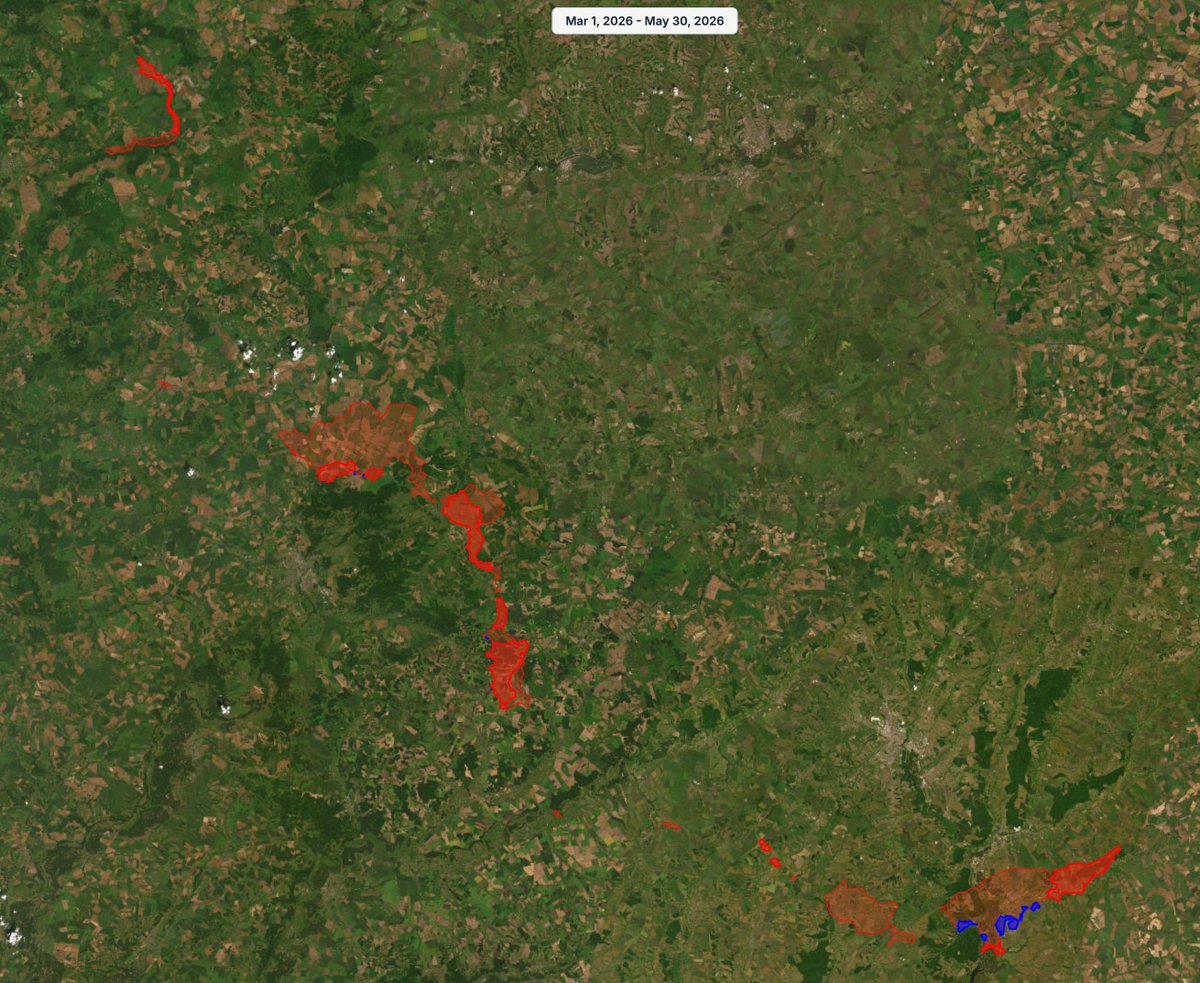
Army Group North did what it was asked to do — raided the border zone, disrupt the defense, extended the front, painted the map. The buffer materialized. Then May arrived, the momentum evaporated, and Russian forces began losing portions of the very ground they had just taken. The control was always going to be symbolic out there.
What nobody in Moscow planned for was losing even that.
Maps lie slowly. A colored zone on a operational overlay implies permanence — a held village, a secured tree line, a defended ridge. But color is a claim, not a fact, and the gap between the two widens the moment the ink dries.
Drone warfare has made that gap visible in ways that were once only felt. Every contested patch of ground is now observable in near-real time, and what observation reveals is not neat frontlines but gradients — areas where control is asserted by day and contested by night, where a position is held in the sense that no one has yet paid the price to take it, rather than in the sense that anyone is actively defending it. The map stays painted. The reality underneath it decays.
Attention follows fire. Analysts, commanders, and audiences alike orient toward the active sectors — the towns being ground down building by building, the drone corridors buzzing with FPV traffic. What happens in the quiet sections rarely makes the briefing. But the front does not pause where the cameras aren't. It is probed, listened to, slowly tested. Holding ground that isn't being attacked is not free. It requires logistics threading back along supply routes, rotation of personnel who would rather be anywhere else, and the maintenance of the fiction that any response is coming if things go wrong.
Russian forces on the Oleksandrivske direction continue attempts to restore positions lost during Ukrainian counterattacks earlier this spring. Additional units, including elements of the 120th Naval Infantry Division, were committed in support of the 36th and 29th Combined Arms Armies in an effort to push back toward the Vovcha River and secure the Hulyaipole–Velyka Novosilka road.
Fighting remains centered around small infantry assault groups on multiple sectors simultaneously. Russian troops achieved limited tactical infiltrations near Olexandrohrad, Sichneve, Stepove, Verbove and west of the Yanchur River, but most advances remain shallow and measured in hundreds of meters to a few kilometers after weeks of fighting.
The heaviest clashes are taking place between Ternove and Novohryhorivka, where Russian forces are attempting converging attacks from Berezove and Novohryhorivka to pressure Ukrainian positions near Novomykolaivka and Kalynivske. Despite some flank penetrations, Ukrainian forces continue holding these areas.
Russian activity also intensified west of the Yanchur River toward Pryvilne and Novе Zaporizhzhia, likely aiming to push Ukrainian forces farther from Uspenivka and threaten Ukrainian logistics near Dobropillia.
Overall, Russian forces have so far failed to achieve their operational objectives on the Oleksandrivske direction. The situation has devolved into persistent meeting engagements between small assault groups across several sectors. The most likely areas for renewed Russian pressure are the Novohryhorivka–Berezove sector and the area west of the Yanchur River, where additional reserves may soon be committed.
Modern battlefields are becoming transparent. Cheap drones now hover over front lines for hours, feeding live video to operators who can call in artillery, direct strike teams, or simply watch and wait. The result is something military analysts are only beginning to fully reckon with: a battlefield where being seen has become nearly as dangerous as being shot.
This is the invisible wall. Not a physical barrier, but a detection threshold — the point at which massing enough troops in one place to actually attack becomes suicidally expensive. You can move. You just can't concentrate.
The Exposure Problem
The most important thing drones do isn't destroy — it's reveal. A drone that spots a column of vehicles doesn't need to carry a warhead. It only needs to transmit a location. Artillery, missile teams, or FPV kamikaze drones can handle the rest. This separation between finding a target and killing it has fundamentally changed how forces behave near the front. Vehicles are pushed back. Command posts move constantly. Supply runs happen at night, in small groups, along unpredictable routes.
Armies have adapted by shrinking. Platoons become squads. Squads become pairs. But dispersion has a floor. A single soldier can slip through a gap undetected — but one person cannot seize a village, hold a crossing, or push through a defended line. At some point, the attack needs mass. And mass is exactly what the drones are hunting.
It Cuts Both Ways
Here's what's often missed: the wall doesn't only stop attackers. Defenders face the same sky.
Rotating exhausted troops, shifting reserves, staging a counterattack — all of these require movement and concentration. All of them are visible. A defending force can hold a position more easily than it can maneuver to exploit a gap or reinforce a threatened flank. The result isn't a one-sided advantage for the defense. It's a mutual paralysis — both sides pinned, neither able to move freely. That's the deeper mechanism behind modern stalemate.
Russia continues developing its "buffer zone" operation on the Northern Slobozhanskyi (Sumy) direction, where forces of the Northern Grouping are attempting to expand cross-border incursions east and southeast of Sumy city. Rather than a single large breakthrough, the operation currently relies on multiple small infiltration thrusts across the border zone from Myropillia to Hrabovske. The apparent concept is to create several shallow penetrations, then later link them together into a broader foothold inside Ukrainian territory.
The offensive is unfolding through three tactical groupings. The northern group is attacking from the Demidovka and Popovka areas toward Prokhody and Myropillia, seeking to pressure the northern edge of the Ukrainian border defense line. The central group is focused on Pokrovka, where meeting engagements are underway, while also probing through forested terrain toward Novodmytrivka and further south toward Taratutyne. The southern group is advancing from Hrabovske toward Riasne, attempting to outflank Ukrainian defenders from both the north and south, including movement along the Korova River and local road approaches.
At present, Russian central and southern penetrations may have linked into a single connected salient, but the northern thrust has not yet joined them. Fighting remains active along the Prokhody–Maryine line and around Myropillia, where Russian forces appear to be operating mainly with small assault detachments rather than holding firm control of settlements. This suggests limited manpower density and continued Ukrainian resistance in the northern sector.