
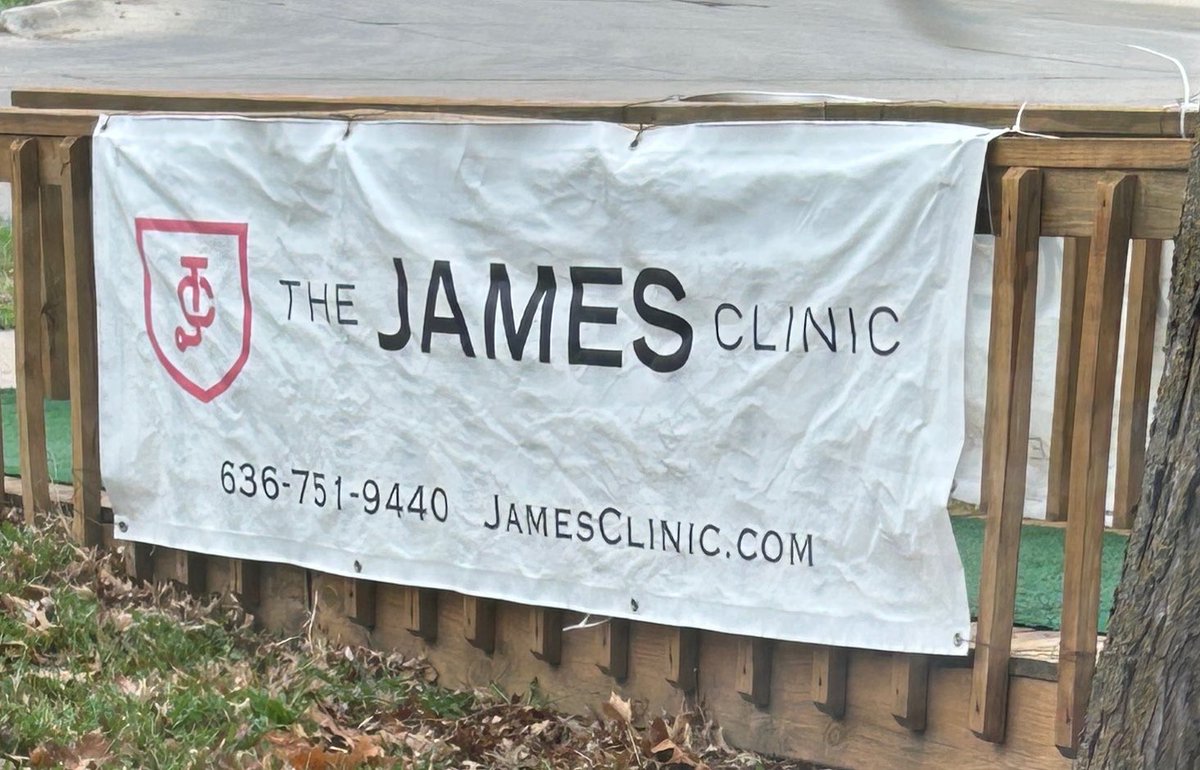
A 🧵: I went to the James Clinic @james_clinic in Chariton, Iowa. While I was there I received five MitoRegen Therapy infusions, one HBOT session, did a little test called a Brain Gauge, and received a bag of Saline via IV. The staff were all very kind and very well trained. I want to stress that many people do not see immediate results, and what improvements are seen varies from patient to patient. Also, please not the logo in this image has been updated and this sign will soon be changed. This was my experience. 👇
Day 1 4/01/2026:
I had my doctor appointment in person with Dr. Mollie James @molsjames, so I finally got to meet her in person. 🥰🫶 It was a pleasure to get to meet her in person instead of just having an appointment by telehealth as I have gotten used to. Dr. James is very intelligent, caring lady. The details of my appointment itself I will keep private. While I was having my appointment with Dr James, I was having my first MitoRegen Therapy infusion. After the therapy I noticed the vision in my right eye that has been very blurry with spots in my field of vision improved slightly. Below in the picture is what the MitoRegen insulin pump box looks like when it is hooked up. The mix of saline and insulin is in the compartment on the left. An IV bag is not required.
I had my doctor appointment in person with Dr. Mollie James @molsjames, so I finally got to meet her in person. 🥰🫶 It was a pleasure to get to meet her in person instead of just having an appointment by telehealth as I have gotten used to. Dr. James is very intelligent, caring lady. The details of my appointment itself I will keep private. While I was having my appointment with Dr James, I was having my first MitoRegen Therapy infusion. After the therapy I noticed the vision in my right eye that has been very blurry with spots in my field of vision improved slightly. Below in the picture is what the MitoRegen insulin pump box looks like when it is hooked up. The mix of saline and insulin is in the compartment on the left. An IV bag is not required.

Day 2 4/02/2026:
This is the day I did the brain gauge test and one HBOT treatment.
The Brain Gauge is a test on a tablet with a special plug in that looks kind of like a little computer mouse but with really small sensory buttons. The patient tries to sense the vibration being felt and hit the button requested as soon as they feel it.
After the test the patient gets a print out with a graph that shows the correlation between time perception, TOJ (Temporal Order Judgement), accuracy, focus, speed, and fatigue.
I scored high for Accuracy, TOJ, and plasticity.
I scored medium range for time perception, fatigue, and focus. This means improvement is needed. I scored very low on speed indicating a very slow reaction time. Overall all fields combined I scored in the middle. I definitely need to make improvement. jamesclinic.com/functional-int…
After the test is when I did a 90 minute session in the HBOT (Hyperbaric Oxygen Therapy) tent.
The pressure rating was somewhere between 2 to 2.2 ATA (Atmospheres Absolute) which is roughly 19 PSI.
At first it felt a little bit weird, but I slowly adjusted. The staff were extremely diligent about checking on me regularly to make sure I was doing okay. After getting used to it I was very relaxed and I almost fell asleep. After this HBOT session I noticed my dry eyes were moist, my TMJ in my right ear had gone away, my joint pain decreased, and that night I slept a tiny bit better.
This is the day I did the brain gauge test and one HBOT treatment.
The Brain Gauge is a test on a tablet with a special plug in that looks kind of like a little computer mouse but with really small sensory buttons. The patient tries to sense the vibration being felt and hit the button requested as soon as they feel it.
After the test the patient gets a print out with a graph that shows the correlation between time perception, TOJ (Temporal Order Judgement), accuracy, focus, speed, and fatigue.
I scored high for Accuracy, TOJ, and plasticity.
I scored medium range for time perception, fatigue, and focus. This means improvement is needed. I scored very low on speed indicating a very slow reaction time. Overall all fields combined I scored in the middle. I definitely need to make improvement. jamesclinic.com/functional-int…
After the test is when I did a 90 minute session in the HBOT (Hyperbaric Oxygen Therapy) tent.
The pressure rating was somewhere between 2 to 2.2 ATA (Atmospheres Absolute) which is roughly 19 PSI.
At first it felt a little bit weird, but I slowly adjusted. The staff were extremely diligent about checking on me regularly to make sure I was doing okay. After getting used to it I was very relaxed and I almost fell asleep. After this HBOT session I noticed my dry eyes were moist, my TMJ in my right ear had gone away, my joint pain decreased, and that night I slept a tiny bit better.
Day 3 4/03/2026
I had my second MitoRegen therapy infusion. I also decided to try it with the red light therapy lamp for 15 minutes. I have not had good luck with red light at home, and thought I would at least try the one the clinic has.
After this treatment I noticed even more improvement in my right eye. It also made me more talkative and energetic all the way up to bedtime.
That night I had some difficulty sleeping due to a an itching sensation under my skin that I literally could not scratch. What was interesting about this is it was all places where I had lost most touch sensation. In this case my chest where I had the Bilateral mastectomy for HER2 triple positive breast cancer and a few attempts to rebuild my chest with breast implants that failed. I had not been able to feel anything in that part of my body since June of 2021. I also had a tiny bit of the itching sensation on the top of my head and the bottoms of my feet. The bottoms of my feet and palms of my hands were also very flushed.
I researched this and discovered this itching is known as a neuropathic itch or insulin neuritis. It is often due to rapid improvements in blood glucose control and can happen when adjusting to insulin infusions. It can also indicate a change in nerve endings that were not working. The next morning for the first time ever I could feel my prosthetics bra touching me.
I had my second MitoRegen therapy infusion. I also decided to try it with the red light therapy lamp for 15 minutes. I have not had good luck with red light at home, and thought I would at least try the one the clinic has.
After this treatment I noticed even more improvement in my right eye. It also made me more talkative and energetic all the way up to bedtime.
That night I had some difficulty sleeping due to a an itching sensation under my skin that I literally could not scratch. What was interesting about this is it was all places where I had lost most touch sensation. In this case my chest where I had the Bilateral mastectomy for HER2 triple positive breast cancer and a few attempts to rebuild my chest with breast implants that failed. I had not been able to feel anything in that part of my body since June of 2021. I also had a tiny bit of the itching sensation on the top of my head and the bottoms of my feet. The bottoms of my feet and palms of my hands were also very flushed.
I researched this and discovered this itching is known as a neuropathic itch or insulin neuritis. It is often due to rapid improvements in blood glucose control and can happen when adjusting to insulin infusions. It can also indicate a change in nerve endings that were not working. The next morning for the first time ever I could feel my prosthetics bra touching me.
Day 4 4/06/2026
This was my third MitoRegen Therapy Infusion.
By the end of this infusion there was a noticeable different in my skin tone. For years I have been pasty white with patches of translucent skin. Now my skin looks normal with a touch of pink all over. I once again noticed a further improvement in the vision in my right eye and less pressure pushing on it.
That night I slept over 6 hours without waking up. That was a HUGE improvement for me. Since late November 2024 I had not been sleeping well. That is when the trigeminal neuropathy started. I was usually only lucky enough to get 2 1/2 hours of sleep before waking up and it would take me up to an hour to fall back asleep again. 6 HOURS! Yay!!!!!!
This was my third MitoRegen Therapy Infusion.
By the end of this infusion there was a noticeable different in my skin tone. For years I have been pasty white with patches of translucent skin. Now my skin looks normal with a touch of pink all over. I once again noticed a further improvement in the vision in my right eye and less pressure pushing on it.
That night I slept over 6 hours without waking up. That was a HUGE improvement for me. Since late November 2024 I had not been sleeping well. That is when the trigeminal neuropathy started. I was usually only lucky enough to get 2 1/2 hours of sleep before waking up and it would take me up to an hour to fall back asleep again. 6 HOURS! Yay!!!!!!
Day 5 4/07/2026
I traveled to the newer Jane’s Clinic location in Ankeny, Iowa to meet with another DO by the name of Dr. Figueroa. He specializes in Structural Medicine, Physical Medicine and Rehabilitation (PM&R), and Osteopathic Manipulative Medicine (OMM). He is also certified in the Fascial Distortion Model (FDM). This is a specialized anatomical perspective used to diagnose and treat musculoskeletal injuries and chronic pain by focusing on the body's connective tissues.
After discussing my symptoms and things going on it was decided that Dr. Figueroa would consult with Dr. James before we think of attempting to fix any of my skeletal and connective tissue issues. This is a VERY wise thing to do for certain patients. A manipulation can sometimes cause serious issues with blood related health issue involving potential clotting. Dr. Figueroa is a very smart man and he and Dr. James decided for now that I should not get any manipulations made. I am hoping when I can travel to Iowa again and we know more about what is going on, that Dr. Figueroa will be able to see me and treat me to help with my joints and connective tissues.
I traveled to the newer Jane’s Clinic location in Ankeny, Iowa to meet with another DO by the name of Dr. Figueroa. He specializes in Structural Medicine, Physical Medicine and Rehabilitation (PM&R), and Osteopathic Manipulative Medicine (OMM). He is also certified in the Fascial Distortion Model (FDM). This is a specialized anatomical perspective used to diagnose and treat musculoskeletal injuries and chronic pain by focusing on the body's connective tissues.
After discussing my symptoms and things going on it was decided that Dr. Figueroa would consult with Dr. James before we think of attempting to fix any of my skeletal and connective tissue issues. This is a VERY wise thing to do for certain patients. A manipulation can sometimes cause serious issues with blood related health issue involving potential clotting. Dr. Figueroa is a very smart man and he and Dr. James decided for now that I should not get any manipulations made. I am hoping when I can travel to Iowa again and we know more about what is going on, that Dr. Figueroa will be able to see me and treat me to help with my joints and connective tissues.
Day 6 4/08/2026
This was my fourth MitoRegen Therapy Infusion.
After this treatment I noticed the heat lamp burning my scalp sensation on the top of my head went away. I also noticed the encephalopathy in my head went away. I no longer felt like the inside of my head was inflamed and I felt a massive reduction in pressure in my head as a result. This was the night I slept the hardest. I managed to sleep 7 hours before waking up. I was then easily able to go back to sleep afterwards for 2 more hours. MORE SLEEP!!!! Yay!!!!
This was my fourth MitoRegen Therapy Infusion.
After this treatment I noticed the heat lamp burning my scalp sensation on the top of my head went away. I also noticed the encephalopathy in my head went away. I no longer felt like the inside of my head was inflamed and I felt a massive reduction in pressure in my head as a result. This was the night I slept the hardest. I managed to sleep 7 hours before waking up. I was then easily able to go back to sleep afterwards for 2 more hours. MORE SLEEP!!!! Yay!!!!
Day 7 4/09/2026
This was my fifth MitoRegen Therapy Infusion.
Afterwards I felt very good and relaxed and was able to take a nap.
That night was a rough one for me though. We were testing my tolerance to the therapy and see if we could work it up to having it 3 days in a row. This was only day two in a row.
That night my blood vessels opened widely and swelled to release body heat. My cellular processes were kicking it up in high gear to function and repair after having not worked very well at all for many years. I could not sleep well because I was extremely hot. 🥵 I also got dehydrated. 😅
By the next morning though I felt fine body temperature wise and my blood vessels went back to their normal size. I felt a bit better after guzzling down 32 oz of electrolyte mix in my water.
This was my fifth MitoRegen Therapy Infusion.
Afterwards I felt very good and relaxed and was able to take a nap.
That night was a rough one for me though. We were testing my tolerance to the therapy and see if we could work it up to having it 3 days in a row. This was only day two in a row.
That night my blood vessels opened widely and swelled to release body heat. My cellular processes were kicking it up in high gear to function and repair after having not worked very well at all for many years. I could not sleep well because I was extremely hot. 🥵 I also got dehydrated. 😅
By the next morning though I felt fine body temperature wise and my blood vessels went back to their normal size. I felt a bit better after guzzling down 32 oz of electrolyte mix in my water.
Day 8 4/10/2026
This day was supposed to be my sixth MitoRegen infusion and we decided after the previous night with the overheating that two days in a row for now is my limit. We decided to not try a third day. Instead of the regular infusion I had one bag of saline solution via IV. It helped replenish what I had lost the night before from overheating and sweating. It is important to understand that each patient is different. Some can handle working up to getting multiple infusions in a row very quickly. Some cannot. I cannot. Not for now at least.
That night I slept a whopping 9 hours!!!!
This day was supposed to be my sixth MitoRegen infusion and we decided after the previous night with the overheating that two days in a row for now is my limit. We decided to not try a third day. Instead of the regular infusion I had one bag of saline solution via IV. It helped replenish what I had lost the night before from overheating and sweating. It is important to understand that each patient is different. Some can handle working up to getting multiple infusions in a row very quickly. Some cannot. I cannot. Not for now at least.
That night I slept a whopping 9 hours!!!!
I returned to my home in the Black Hills of South Dakota this last Sunday, 04/12/2026. Since my return home I have not had the encephalopathy come back, nor the burning heat lamp sensation on the top of my head. My TMJ also has not returned. I can still feel things touching me on my chest where I had all the surgeries. It’s not a full return of sensation, but I can still feel when something is touching it.
The vision in my right eye that improved is staying stable. The blurry vision and spots in my field of vision have not returned. I am sleeping much better. I can get 5-7 hours of sleep without waking up. When I do wake, I can easily fall back asleep. It is not taking an hour to do so. My energy level is still good, but I crashed slightly for a few days when I got home by trying to stupidly unpack all my things at once and put them away after 2 days on the road. 😅 I have also noticed a few additional improvements. My stomach is no longer bloated and inflamed. I have not lost any weight, but keeping my pants up due to not having a swollen belly is nice. I might have to buy some new pants. 🤭 I have also noticed that I have way less brain fog, and my insulin resistance has improved. I’m no longer having the insulin kick into overdrive and drop my glucose very low. Before this my sugar was dropping so much I had to watch out carefully for hypoglycemia. As a result of the improve insulin resistance I do not need to eat as many complex carbohydrates with a fat like avocado oil to help hold my sugars steady. At this time I am not sure how long these improvements will stay or if they will be permanent. I am currently planning on returning to The James Clinic in Chariton, Iowa. I am hoping to be back there at the end of summer or early fall. I would really like to try to work up to a grand total of 12 MitoRegen Therapy infusions and see what else can be improved.
I have been a patient a very long time. I suffered a Gardasil HPV vaccine injury in 2007 and was given ME/CFS& FMS chronic illness labels, was in liver failure in 2015, and am a HER2+ cancer survivor. Until now I did not seek alternative or functional medicine help. In South Dakota we do not have many providers trained to help people like me, and we definitely do not have treatments like MitoRegen Therapy available here. After experiencing what I would call a worthless waste of money at Mayo Clinic in 2016, I was hesitant to try anything else that would cost out of pocket. That was until I heard about MitoRegen and looked into it. Given my own personal experience I feel this therapy can help many people. This treatment is currently only available in 15 clinics globally.
The vision in my right eye that improved is staying stable. The blurry vision and spots in my field of vision have not returned. I am sleeping much better. I can get 5-7 hours of sleep without waking up. When I do wake, I can easily fall back asleep. It is not taking an hour to do so. My energy level is still good, but I crashed slightly for a few days when I got home by trying to stupidly unpack all my things at once and put them away after 2 days on the road. 😅 I have also noticed a few additional improvements. My stomach is no longer bloated and inflamed. I have not lost any weight, but keeping my pants up due to not having a swollen belly is nice. I might have to buy some new pants. 🤭 I have also noticed that I have way less brain fog, and my insulin resistance has improved. I’m no longer having the insulin kick into overdrive and drop my glucose very low. Before this my sugar was dropping so much I had to watch out carefully for hypoglycemia. As a result of the improve insulin resistance I do not need to eat as many complex carbohydrates with a fat like avocado oil to help hold my sugars steady. At this time I am not sure how long these improvements will stay or if they will be permanent. I am currently planning on returning to The James Clinic in Chariton, Iowa. I am hoping to be back there at the end of summer or early fall. I would really like to try to work up to a grand total of 12 MitoRegen Therapy infusions and see what else can be improved.
I have been a patient a very long time. I suffered a Gardasil HPV vaccine injury in 2007 and was given ME/CFS& FMS chronic illness labels, was in liver failure in 2015, and am a HER2+ cancer survivor. Until now I did not seek alternative or functional medicine help. In South Dakota we do not have many providers trained to help people like me, and we definitely do not have treatments like MitoRegen Therapy available here. After experiencing what I would call a worthless waste of money at Mayo Clinic in 2016, I was hesitant to try anything else that would cost out of pocket. That was until I heard about MitoRegen and looked into it. Given my own personal experience I feel this therapy can help many people. This treatment is currently only available in 15 clinics globally.
MitoRegen Therapy is also known as MDI ( Metabolic Design Intervention) and it is micro-dosed insulin infusions. MitoRegen Therapy a is physician-guided metabolic restoration program designed to rehabilitate mitochondria, the cellular engines, to boost ATP energy production, reduce metabolic strain, and improve cellular resilience.
This is what it does:
1) Restores Metabolic "Language". The model posits that healthy metabolism relies on rhythmic physiologic signaling.
2) Physiologic Signaling: It aims to recreate natural signals, such as the rhythmic bursts of insulin every 4–6 minutes, which are often lost in chronic metabolic dysfunction.
3) Targets the Root Cause: Instead of just managing symptoms, the MDI model focuses on rehabilitating the mitochondria to improve how the body creates energy (ATP) and processes fuel at the cellular level. jamesclinic.com/treatments-ser…
This is what it does:
1) Restores Metabolic "Language". The model posits that healthy metabolism relies on rhythmic physiologic signaling.
2) Physiologic Signaling: It aims to recreate natural signals, such as the rhythmic bursts of insulin every 4–6 minutes, which are often lost in chronic metabolic dysfunction.
3) Targets the Root Cause: Instead of just managing symptoms, the MDI model focuses on rehabilitating the mitochondria to improve how the body creates energy (ATP) and processes fuel at the cellular level. jamesclinic.com/treatments-ser…
Here is a YouTube video explaining in more detail what MitoRegen Therapy is and more about the technology it uses.

@threadreaderapp unroll please
• • •
Missing some Tweet in this thread? You can try to
force a refresh




