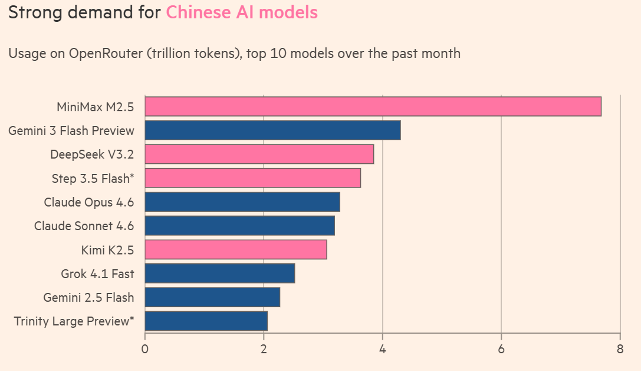
2/ Measured by token consumption, which is the most popular AI model in the world?
3/ Answer: China’s MiniMax M2.5.
4/ Bonus: of the top 4 models by token consumption, how many were Chinese? How many were American?
5/ Answer: 3 are Chinese (MiniMax, Deepseek, and Step). 1 is American (Gemini).
6/ As the Financial Times (@FT) reported this week, “cheaper energy and more efficient models” permit Chinese companies to charge about $3 per million output tokens. Anthropic charges five times more—$15 per million output tokens.
]ft.com/content/256787…
7/ The result is that developers are using cheaper Chinese models for most of their work, reserving complicated tasks for more expensive and capable American models.
8/ *As part of an effort to improve our understanding of China, I will continue to offer another “Believe It or Not” about China each week. Readers are invited to send along candidates for the list.
• • •
Missing some Tweet in this thread? You can try to
force a refresh

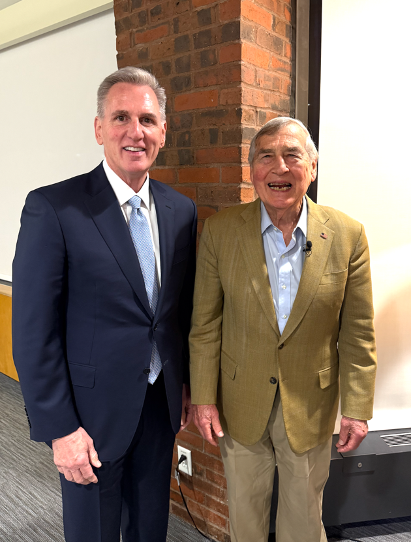
1/ Harvard Conversation With Former Republican House Speaker Kevin McCarthy:
For those seeking illumination about the political road ahead in 2026, former Republican House Speaker Kevin McCarthy provided dozens of points of light in a vigorous conversation with members of the Kennedy School and the larger Harvard community. I had the honor to be his host and moderator of the conversation.
2/ Having spent 17 years in the House of Representatives and having served in every role there, including as Speaker from January to October 2023, Kevin built a Republican majority by selecting candidates, coaching candidates, raising money for candidates, refining the case for his candidates, and most of all, persisting.
3/ For insights about President Trump (whom he knows very well, supports, and talks to regularly), the war in Iran; the likely outcome of the midterms; and the road beyond that for American politics, you can view the conversation here.
2/ The US was the first country to develop the most remarkable drones the world has ever seen. Used heavily in the wars in Iraq and Afghanistan, by 2019, the MQ-1 Predator and MQ-9 Reaper had logged more than 4 million flight hours supporting combat operations.
3/ In the search for and killing of the mastermind of the attack on the World Trade Center, Osama Bin-Laden, US efforts reportedly included drones as small as a hummingbird.
A must-read summary of a great listen: see @nytimes @DavidAFrench's conversation with former commander of US Special Forces in Afghanistan and Iraq Gen. Stanley McChrystal.
2/ To successfully meet the challenge the US currently faces in Iran, McChrystal recommends starting with “strategic empathy”: asking how the events occurring today look through the eyes of our adversary. (In the security studies canon, strategic empathy is an antidote to Americans’ natural “strategic narcissism” that understands events only through our own eyes, assumes others see the world as we do, and expects them to act only in response to our initiatives.)
3/ Specifically, McChrystal advocates beginning by asking how Iranian leaders remember the history that has led to this juncture: “I try to remind people whenever we think of what’s happening now: If we don’t understand the journey to this point, we don’t understand the attitudes that are going to drive decisions people make.” While Americans’ memory of Iran’s 1979 revolution and support for Shia militias leads US policymakers to view Iran as a “recalcitrant enemy,” for Iranians, it really starts in 1953 with US covert action to overthrow Iran’s elected leader.
2/ Who has the longest stack of escalators in the world?
3/ Answer: Chongqing, China. The “Goddess” escalator in Wushan county consists of a series of two dozen individual escalators and lifts that climb more than 750 feet over a 2,500-foot length in 21 minutes. Every day, 9,000 people pay the 50-cent fee to avoid a steep stairway.
*As part of an effort to improve our understanding of China, I will continue to offer another “Believe It or Not” about China each week. Readers are invited to send along candidates for the list.
2/ Last week a @FinancialTimes story announced: “An ambitious high-speed rail project linking Poland and the Baltic states will probably be a decade late.” The 750-mile line that had been promised by 2030 will be delayed until at least 2040. ft.com/content/0fe9d0…
3/ How late is America’s only high-speed rail project, which (if all of it gets built) will cover 750 miles from Los Angeles to San Francisco and on to Sacramento?