"Food deserts" are an example of social scientists getting causality backwards
They saw poor people eating unhealthy foods and blamed local supply
They should have blamed demand!
Using data from 13 years of supermarket entries, there's basically no effects on healthy eating🧵
They saw poor people eating unhealthy foods and blamed local supply
They should have blamed demand!
Using data from 13 years of supermarket entries, there's basically no effects on healthy eating🧵
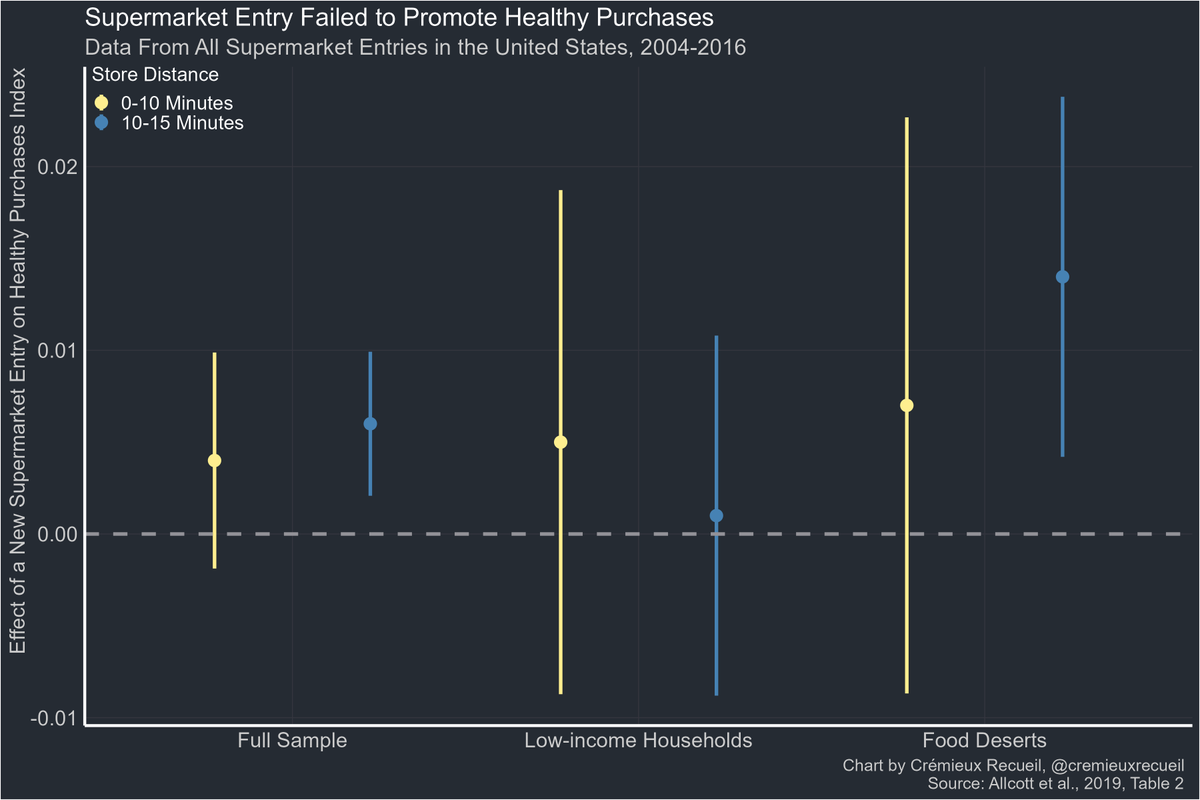
The significant effects are probably not meaningful. They're more likely under the null with this gigantic dataset (p's of 0.003 and 0.005 with a total sample size of ~2.9m)
Entry did affect sales for new stores, but not existing ones. It also affected more local places more.
Entry did affect sales for new stores, but not existing ones. It also affected more local places more.
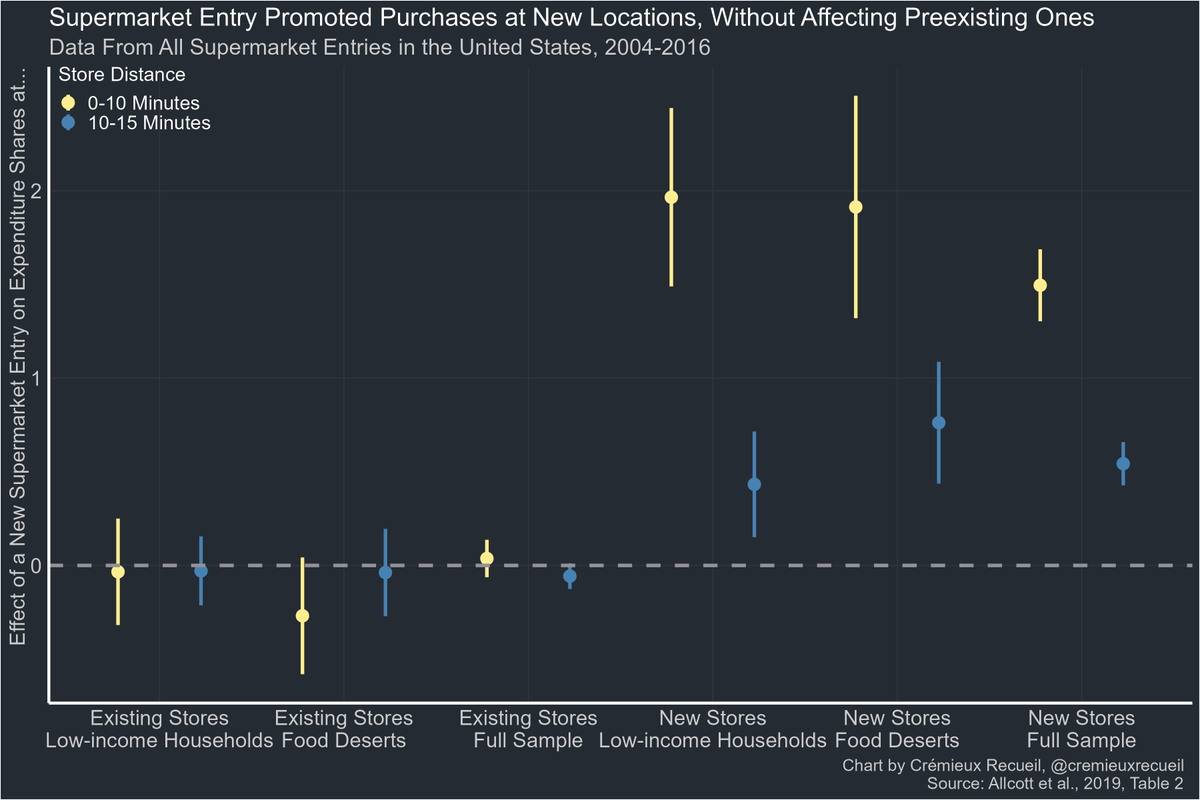
When new supermarkets open up, they do nab a share of local grocery sales, but the effect on healthy eating in total, among low-income households, and in food deserts, just isn't there.
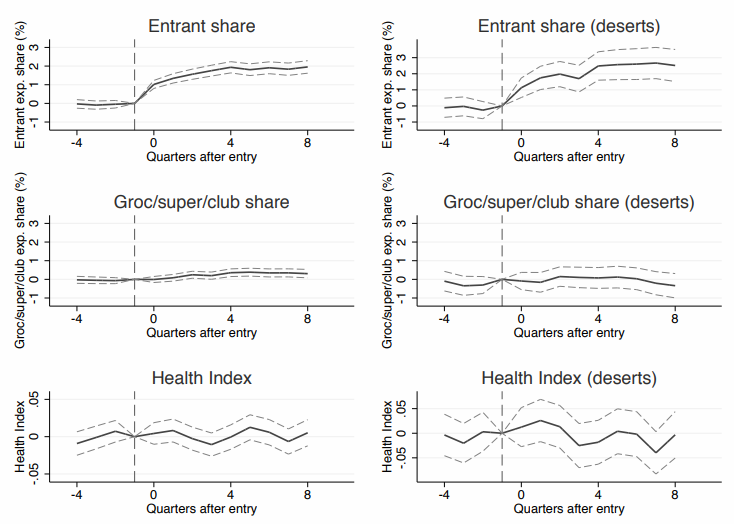
But we can go further.
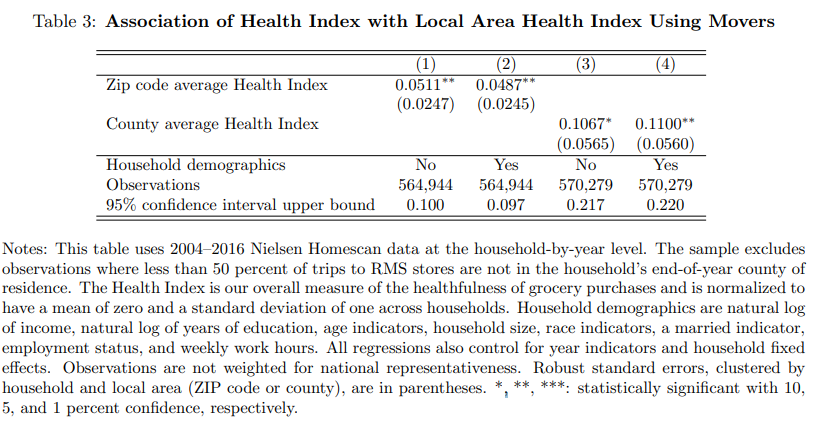
Using a sample of movers, it appears the effect of supply is small.
Through exploiting the results from both of these designs, it's also boundable.
Using a sample of movers, it appears the effect of supply is small.
Through exploiting the results from both of these designs, it's also boundable.
"Base" is the normalized health index differences across income levels. The next columns, left to right
- Set prices equal to the highest income group
- Set prices and product nutrient quality equal
- Set nutrient preferences equal
- Set product preferences equal
- Set prices equal to the highest income group
- Set prices and product nutrient quality equal
- Set nutrient preferences equal
- Set product preferences equal

Going from left to right, the income gradient in consumed food healthiness is eliminated.
If rich and poor demanded the same products, the health index gap would be reduced by 91%. In alternative specifications, this ranged from 88 to 93%.
If rich and poor demanded the same products, the health index gap would be reduced by 91%. In alternative specifications, this ranged from 88 to 93%.
The apparent harms of food deserts are almost entirely not a problem of supply, nor is the relationship between income and healthy eating driven by supply.
Both are demand problems: unhealthy households contain people who desire unhealthy food.
Both are demand problems: unhealthy households contain people who desire unhealthy food.
To learn more, go read my article on this: cremieux.xyz/p/food-deserts…
• • •
Missing some Tweet in this thread? You can try to
force a refresh