AI can now run competitive intelligence like a CIA analyst (for free).
Here are 12 Perplexity prompts that build the kind of threat assessments governments pay millions for.
(Save for later)
Here are 12 Perplexity prompts that build the kind of threat assessments governments pay millions for.
(Save for later)

1/ The Signals Collection Brief
CIA analysts don't start with conclusions.
They start by collecting every available signal from every available source before forming a single opinion.
Most business intelligence fails here. People collect the signals that confirm what they already believe and call it research.
"Run a full signals collection brief on [competitor / market / geopolitical situation]. Pull from every available public source simultaneously: news from the last 90 days, regulatory filings, job postings, executive statements, patent applications, partnership announcements, customer reviews, social media activity, and any academic or industry research mentioning them. Do not analyze yet. Present everything organized by source type. Flag anything that appeared in only one source single-source intelligence is always treated with higher skepticism in CIA methodology."
The quality of your analysis is entirely determined by the quality of your collection.
This prompt collects everything before touching a single conclusion.
CIA analysts don't start with conclusions.
They start by collecting every available signal from every available source before forming a single opinion.
Most business intelligence fails here. People collect the signals that confirm what they already believe and call it research.
"Run a full signals collection brief on [competitor / market / geopolitical situation]. Pull from every available public source simultaneously: news from the last 90 days, regulatory filings, job postings, executive statements, patent applications, partnership announcements, customer reviews, social media activity, and any academic or industry research mentioning them. Do not analyze yet. Present everything organized by source type. Flag anything that appeared in only one source single-source intelligence is always treated with higher skepticism in CIA methodology."
The quality of your analysis is entirely determined by the quality of your collection.
This prompt collects everything before touching a single conclusion.

2/ The OSINT Deep Dive
OSINT Open Source Intelligence is the CIA's most underrated discipline.
80% of what intelligence agencies know about foreign governments comes from public sources that anyone could access.
The advantage isn't access. It's knowing what to look for and where.
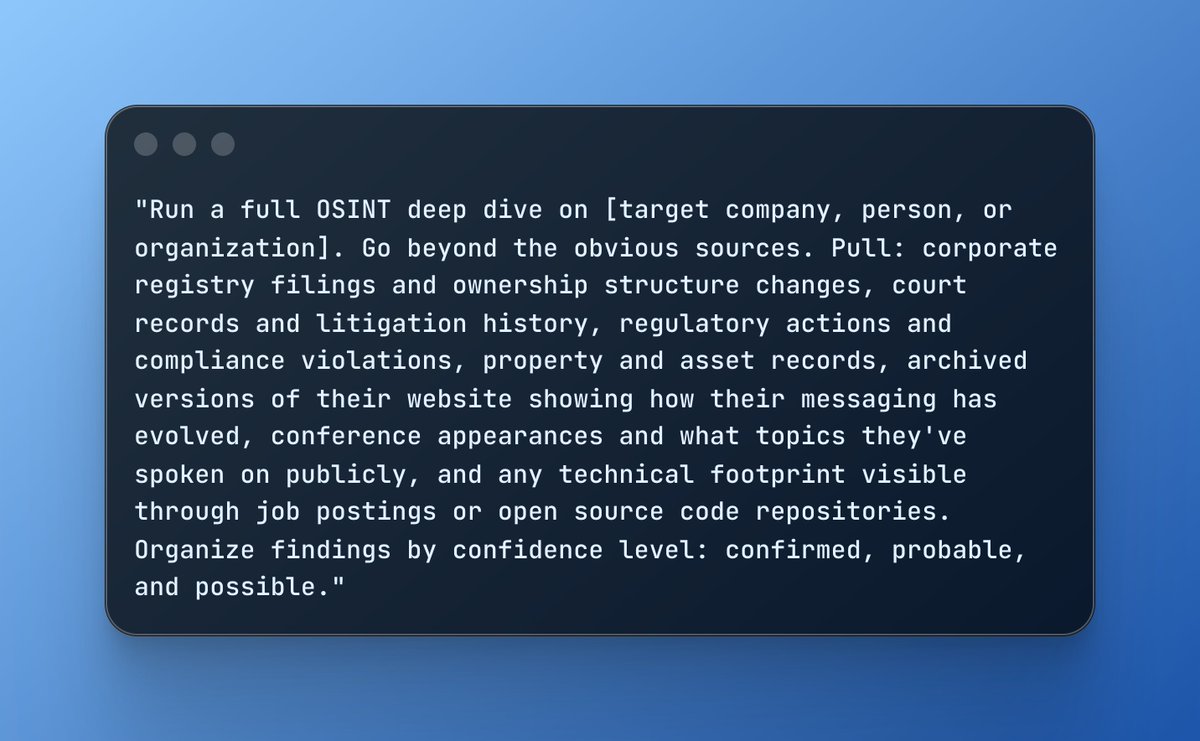
"Run a full OSINT deep dive on [target company, person, or organization]. Go beyond the obvious sources. Pull: corporate registry filings and ownership structure changes, court records and litigation history, regulatory actions and compliance violations, property and asset records, archived versions of their website showing how their messaging has evolved, conference appearances and what topics they've spoken on publicly, and any technical footprint visible through job postings or open source code repositories. Organize findings by confidence level: confirmed, probable, and possible."
The CIA calls unverified intelligence 'raw.' This prompt turns raw into confirmed.
OSINT Open Source Intelligence is the CIA's most underrated discipline.
80% of what intelligence agencies know about foreign governments comes from public sources that anyone could access.
The advantage isn't access. It's knowing what to look for and where.
"Run a full OSINT deep dive on [target company, person, or organization]. Go beyond the obvious sources. Pull: corporate registry filings and ownership structure changes, court records and litigation history, regulatory actions and compliance violations, property and asset records, archived versions of their website showing how their messaging has evolved, conference appearances and what topics they've spoken on publicly, and any technical footprint visible through job postings or open source code repositories. Organize findings by confidence level: confirmed, probable, and possible."
The CIA calls unverified intelligence 'raw.' This prompt turns raw into confirmed.
3/ The Threat Assessment Matrix
Every CIA country brief starts with a formal threat assessment.
Not a list of risks. A structured matrix that evaluates each threat on two dimensions simultaneously: probability of occurrence and severity of impact if it does occur.
Most business risk analysis is a list. Lists treat all risks as equal.
The matrix forces prioritization.
"Build a formal threat assessment matrix for [your company / market position / specific initiative]. Identify every credible threat across these categories: competitive threats from existing players, competitive threats from new entrants, technology disruption threats, regulatory threats, macroeconomic threats, and supply chain or partner dependency threats. For each threat: rate probability from 1 to 5 and impact from 1 to 5. Plot the matrix. Identify the quadrant with high probability and high impact these are your priority intelligence requirements. What signals would tell you each high-priority threat is accelerating?"
The threat you don't prioritize correctly is the one that catches you unprepared.
Every CIA country brief starts with a formal threat assessment.
Not a list of risks. A structured matrix that evaluates each threat on two dimensions simultaneously: probability of occurrence and severity of impact if it does occur.
Most business risk analysis is a list. Lists treat all risks as equal.
The matrix forces prioritization.
"Build a formal threat assessment matrix for [your company / market position / specific initiative]. Identify every credible threat across these categories: competitive threats from existing players, competitive threats from new entrants, technology disruption threats, regulatory threats, macroeconomic threats, and supply chain or partner dependency threats. For each threat: rate probability from 1 to 5 and impact from 1 to 5. Plot the matrix. Identify the quadrant with high probability and high impact these are your priority intelligence requirements. What signals would tell you each high-priority threat is accelerating?"
The threat you don't prioritize correctly is the one that catches you unprepared.

4/ The Competitor HUMINT Simulator
HUMINT Human Intelligence is what the CIA collects from actual people.
In business, your HUMINT sources are hiding in plain sight.
Former employees. Customer reviews. Conference talks. Podcast interviews. LinkedIn posts from their team.
Every one of these is a human source broadcasting intelligence about your competitor's internal reality.
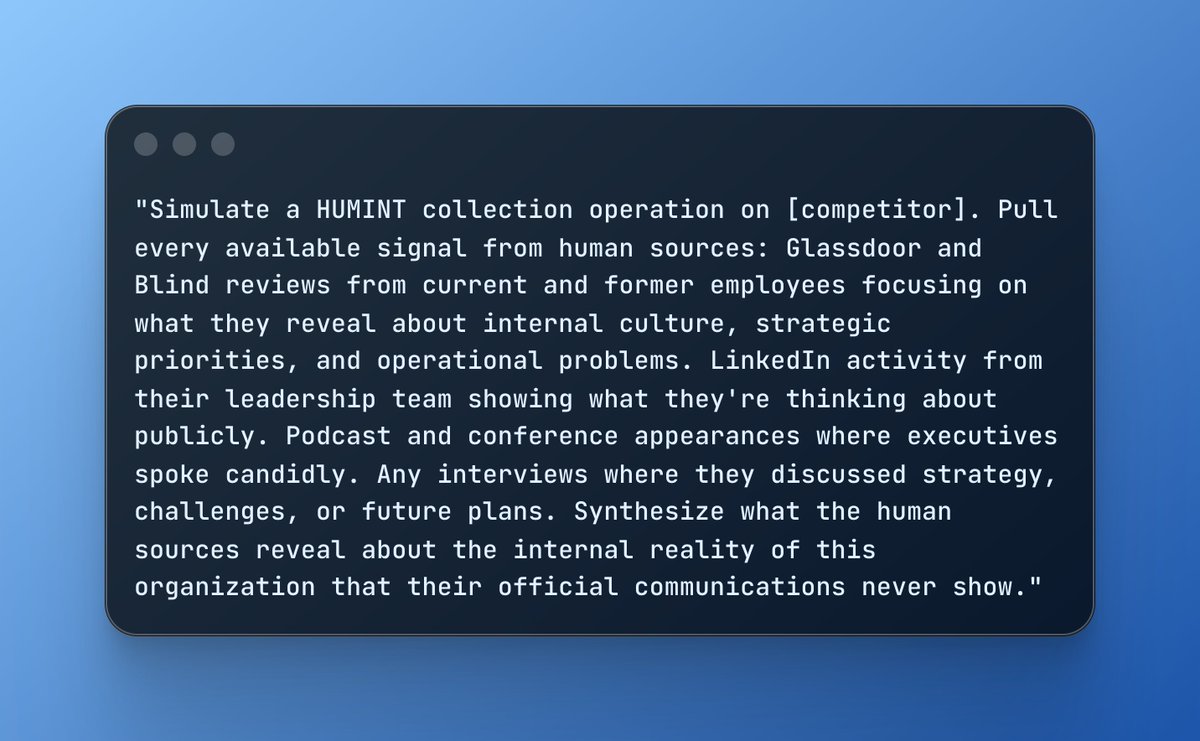
"Simulate a HUMINT collection operation on [competitor]. Pull every available signal from human sources: Glassdoor and Blind reviews from current and former employees focusing on what they reveal about internal culture, strategic priorities, and operational problems. LinkedIn activity from their leadership team showing what they're thinking about publicly. Podcast and conference appearances where executives spoke candidly. Any interviews where they discussed strategy, challenges, or future plans. Synthesize what the human sources reveal about the internal reality of this organization that their official communications never show."
Official communications tell you the story they want told.
Human sources tell you what's actually happening inside.
HUMINT Human Intelligence is what the CIA collects from actual people.
In business, your HUMINT sources are hiding in plain sight.
Former employees. Customer reviews. Conference talks. Podcast interviews. LinkedIn posts from their team.
Every one of these is a human source broadcasting intelligence about your competitor's internal reality.
"Simulate a HUMINT collection operation on [competitor]. Pull every available signal from human sources: Glassdoor and Blind reviews from current and former employees focusing on what they reveal about internal culture, strategic priorities, and operational problems. LinkedIn activity from their leadership team showing what they're thinking about publicly. Podcast and conference appearances where executives spoke candidly. Any interviews where they discussed strategy, challenges, or future plans. Synthesize what the human sources reveal about the internal reality of this organization that their official communications never show."
Official communications tell you the story they want told.
Human sources tell you what's actually happening inside.
5/ The Pattern of Life Analysis
CIA analysts build what they call a Pattern of Life a map of how a target behaves consistently over time.
Because behavior patterns reveal intentions more reliably than statements do.
A country that consistently moves troops to a border is planning something regardless of what their foreign minister says.
A competitor that consistently hires in a specific function is building something regardless of what their press releases announce.
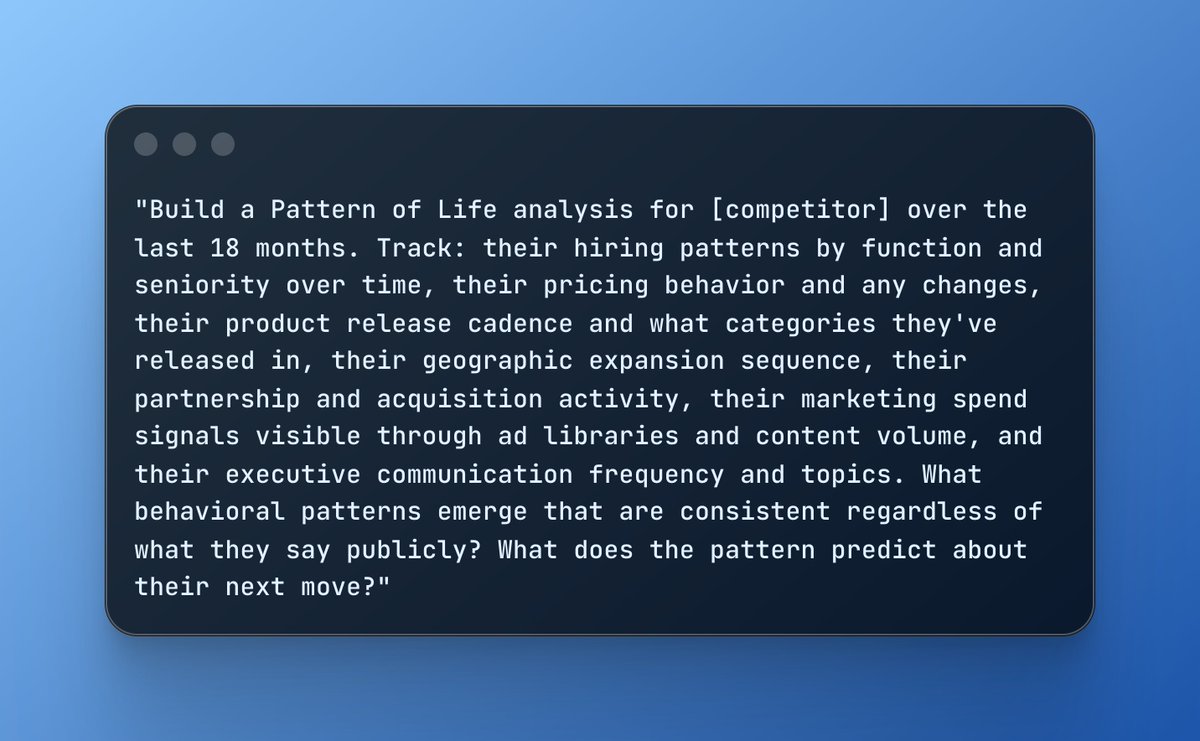
"Build a Pattern of Life analysis for [competitor] over the last 18 months. Track: their hiring patterns by function and seniority over time, their pricing behavior and any changes, their product release cadence and what categories they've released in, their geographic expansion sequence, their partnership and acquisition activity, their marketing spend signals visible through ad libraries and content volume, and their executive communication frequency and topics. What behavioral patterns emerge that are consistent regardless of what they say publicly? What does the pattern predict about their next move?"
Patterns don't lie. Press releases do.
CIA analysts build what they call a Pattern of Life a map of how a target behaves consistently over time.
Because behavior patterns reveal intentions more reliably than statements do.
A country that consistently moves troops to a border is planning something regardless of what their foreign minister says.
A competitor that consistently hires in a specific function is building something regardless of what their press releases announce.
"Build a Pattern of Life analysis for [competitor] over the last 18 months. Track: their hiring patterns by function and seniority over time, their pricing behavior and any changes, their product release cadence and what categories they've released in, their geographic expansion sequence, their partnership and acquisition activity, their marketing spend signals visible through ad libraries and content volume, and their executive communication frequency and topics. What behavioral patterns emerge that are consistent regardless of what they say publicly? What does the pattern predict about their next move?"
Patterns don't lie. Press releases do.
6/ The Red Cell Analysis
The CIA's Red Cell is a small unit of analysts whose entire job is to think like the adversary.
Not to understand the adversary. To actually become them to reason from their objectives, their constraints, and their worldview and produce the analysis they would produce.
The output is always uncomfortable. That's the point.
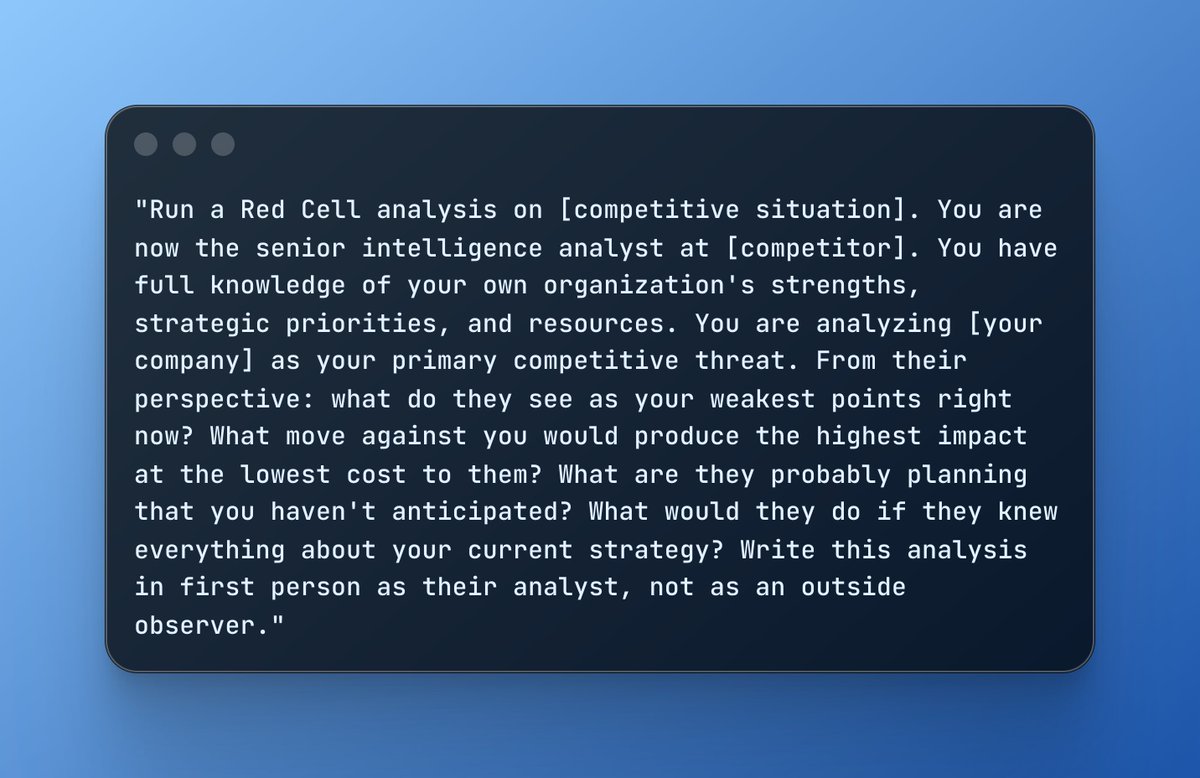
"Run a Red Cell analysis on [competitive situation]. You are now the senior intelligence analyst at [competitor]. You have full knowledge of your own organization's strengths, strategic priorities, and resources. You are analyzing [your company] as your primary competitive threat. From their perspective: what do they see as your weakest points right now? What move against you would produce the highest impact at the lowest cost to them? What are they probably planning that you haven't anticipated? What would they do if they knew everything about your current strategy? Write this analysis in first person as their analyst, not as an outside observer."
The most valuable intelligence is always the analysis your opponent would write about you.
This prompt forces you to read it.
The CIA's Red Cell is a small unit of analysts whose entire job is to think like the adversary.
Not to understand the adversary. To actually become them to reason from their objectives, their constraints, and their worldview and produce the analysis they would produce.
The output is always uncomfortable. That's the point.
"Run a Red Cell analysis on [competitive situation]. You are now the senior intelligence analyst at [competitor]. You have full knowledge of your own organization's strengths, strategic priorities, and resources. You are analyzing [your company] as your primary competitive threat. From their perspective: what do they see as your weakest points right now? What move against you would produce the highest impact at the lowest cost to them? What are they probably planning that you haven't anticipated? What would they do if they knew everything about your current strategy? Write this analysis in first person as their analyst, not as an outside observer."
The most valuable intelligence is always the analysis your opponent would write about you.
This prompt forces you to read it.
7/ The Indications and Warning System
The CIA's Indications and Warning system is designed for one purpose.
To identify the earliest possible signals that a significant event is developing before it becomes visible to everyone.
By the time an event is obvious, it's too late to prepare for it optimally.
The competitive advantage lives in the warning period.
"Build an Indications and Warning system for [your industry / competitive situation]. First: identify the 5 most significant events that could materially change your competitive position in the next 12 months a competitor launching in your core market, a regulatory change, a technology shift, a major customer defection, a new entrant with significant backing. For each scenario: what are the earliest possible indicators that this is developing the signals that would appear 3 to 6 months before the event becomes public knowledge? Build a monitoring protocol that tells me exactly what to watch weekly to get maximum warning time before each scenario materializes."
The CIA's job is to prevent surprise.
This prompt builds the system that prevents yours.
The CIA's Indications and Warning system is designed for one purpose.
To identify the earliest possible signals that a significant event is developing before it becomes visible to everyone.
By the time an event is obvious, it's too late to prepare for it optimally.
The competitive advantage lives in the warning period.
"Build an Indications and Warning system for [your industry / competitive situation]. First: identify the 5 most significant events that could materially change your competitive position in the next 12 months a competitor launching in your core market, a regulatory change, a technology shift, a major customer defection, a new entrant with significant backing. For each scenario: what are the earliest possible indicators that this is developing the signals that would appear 3 to 6 months before the event becomes public knowledge? Build a monitoring protocol that tells me exactly what to watch weekly to get maximum warning time before each scenario materializes."
The CIA's job is to prevent surprise.
This prompt builds the system that prevents yours.

8/ The All Source Fusion Report
The CIA's most senior product is the all-source fusion report.
It takes raw intelligence from every collection discipline OSINT, HUMINT, signals intelligence, imagery and fuses it into a single coherent picture.
The fusion is where individual signals that mean nothing alone combine into conclusions that are actionable.
"Run a full all-source fusion on [competitor / market / situation]. Take everything collected across signals collection, OSINT, pattern of life, and human source analysis and fuse it into one coherent intelligence picture. Where do multiple independent sources confirm the same conclusion these are your high-confidence findings. Where do sources contradict each other these are your intelligence gaps requiring more collection. Where does one strong signal stand alone without corroboratio these require cautious treatment. Produce a fused assessment with every conclusion rated by confidence level: high, medium, or low based on the quality and quantity of sourcing behind it."
One source that says something is interesting.
Five independent sources that say the same thing is intelligence.
The CIA's most senior product is the all-source fusion report.
It takes raw intelligence from every collection discipline OSINT, HUMINT, signals intelligence, imagery and fuses it into a single coherent picture.
The fusion is where individual signals that mean nothing alone combine into conclusions that are actionable.
"Run a full all-source fusion on [competitor / market / situation]. Take everything collected across signals collection, OSINT, pattern of life, and human source analysis and fuse it into one coherent intelligence picture. Where do multiple independent sources confirm the same conclusion these are your high-confidence findings. Where do sources contradict each other these are your intelligence gaps requiring more collection. Where does one strong signal stand alone without corroboratio these require cautious treatment. Produce a fused assessment with every conclusion rated by confidence level: high, medium, or low based on the quality and quantity of sourcing behind it."
One source that says something is interesting.
Five independent sources that say the same thing is intelligence.

9/ The Competitive Counterintelligence Audit
The CIA doesn't just collect intelligence on others.
They run counterintelligence operations to identify what others are collecting on them.
Most companies never ask this question.
What does our competition already know about us and how are they finding it?
"Run a counterintelligence audit on [your company]. From the perspective of a sophisticated competitor running the same intelligence collection methods against us: what would they already know from our public signals? What does our job posting history reveal about our strategic priorities and capability gaps? What do our employees reveal on LinkedIn, Glassdoor, and social media about our internal operations? What does our pricing behavior, product release cadence, and partnership activity telegraph about our next moves? What intelligence gaps do we have that a sophisticated competitor could exploit? What are we broadcasting that we should stop broadcasting?"
The best defense against competitive intelligence is knowing what you're already revealing.
The CIA doesn't just collect intelligence on others.
They run counterintelligence operations to identify what others are collecting on them.
Most companies never ask this question.
What does our competition already know about us and how are they finding it?
"Run a counterintelligence audit on [your company]. From the perspective of a sophisticated competitor running the same intelligence collection methods against us: what would they already know from our public signals? What does our job posting history reveal about our strategic priorities and capability gaps? What do our employees reveal on LinkedIn, Glassdoor, and social media about our internal operations? What does our pricing behavior, product release cadence, and partnership activity telegraph about our next moves? What intelligence gaps do we have that a sophisticated competitor could exploit? What are we broadcasting that we should stop broadcasting?"
The best defense against competitive intelligence is knowing what you're already revealing.

10/ The Strategic Warning Assessment
CIA strategic warning is the highest-stakes intelligence product.
It answers one question: is a fundamental shift coming that will change the entire operating environment?
Not a tactical threat. A strategic one.
The kind of shift that makes your current strategy obsolete before you realize it's happened.
"Produce a strategic warning assessment for [your industry]. Look beyond the next 6 months. What are the 3 scenarios that would fundamentally restructure this industry in the next 3 to 5 years the changes that would make the current competitive map irrelevant? For each scenario: what is the current probability, what are the early warning indicators already visible, how much warning time would we realistically have before the shift becomes irreversible, and what strategic position would be most advantaged versus most vulnerable if this scenario materializes? Which scenario is most underpriced by the market right now?"
Most strategy is optimized for the world as it is.
Strategic warning tells you when to start optimizing for the world as it's about to be.
CIA strategic warning is the highest-stakes intelligence product.
It answers one question: is a fundamental shift coming that will change the entire operating environment?
Not a tactical threat. A strategic one.
The kind of shift that makes your current strategy obsolete before you realize it's happened.
"Produce a strategic warning assessment for [your industry]. Look beyond the next 6 months. What are the 3 scenarios that would fundamentally restructure this industry in the next 3 to 5 years the changes that would make the current competitive map irrelevant? For each scenario: what is the current probability, what are the early warning indicators already visible, how much warning time would we realistically have before the shift becomes irreversible, and what strategic position would be most advantaged versus most vulnerable if this scenario materializes? Which scenario is most underpriced by the market right now?"
Most strategy is optimized for the world as it is.
Strategic warning tells you when to start optimizing for the world as it's about to be.

11/ The Intelligence Gap Analysis
CIA analysts are trained to be as rigorous about what they don't know as what they do.
Every finished intelligence product includes a formal gaps assessment the questions that collection hasn't answered, the uncertainties that remain, the places where confidence should be lower than the analysis might suggest.
Most business intelligence skips this entirely.
Which is how companies end up acting on incomplete pictures with full confidence.
"Run a formal intelligence gaps analysis on everything collected about [competitor / market / situation]. For every major conclusion in the analysis: what would we need to know to be genuinely confident in this finding versus cautiously confident? What questions remain unanswered that could materially change the assessment if answered differently? What are we assuming in the absence of direct evidence and how sensitive is the overall conclusion to those assumptions being wrong? Produce a ranked list of priority intelligence requirements: the specific questions that if answered would most improve the accuracy and confidence of the overall assessment."
Knowing what you don't know is half of knowing what you do.
CIA analysts are trained to be as rigorous about what they don't know as what they do.
Every finished intelligence product includes a formal gaps assessment the questions that collection hasn't answered, the uncertainties that remain, the places where confidence should be lower than the analysis might suggest.
Most business intelligence skips this entirely.
Which is how companies end up acting on incomplete pictures with full confidence.
"Run a formal intelligence gaps analysis on everything collected about [competitor / market / situation]. For every major conclusion in the analysis: what would we need to know to be genuinely confident in this finding versus cautiously confident? What questions remain unanswered that could materially change the assessment if answered differently? What are we assuming in the absence of direct evidence and how sensitive is the overall conclusion to those assumptions being wrong? Produce a ranked list of priority intelligence requirements: the specific questions that if answered would most improve the accuracy and confidence of the overall assessment."
Knowing what you don't know is half of knowing what you do.

12/ The Daily Intelligence Brief
The President's Daily Brief is the most tightly edited document in the world.
One page. Maximum. Written for a reader with no time and every decision pending.
Every word earns its place or it doesn't appear.
It doesn't summarize everything collected. It tells the decision-maker the one thing they need to know today and what it means for the decisions they're making this week.
Run this every Monday morning on your competitive situation:
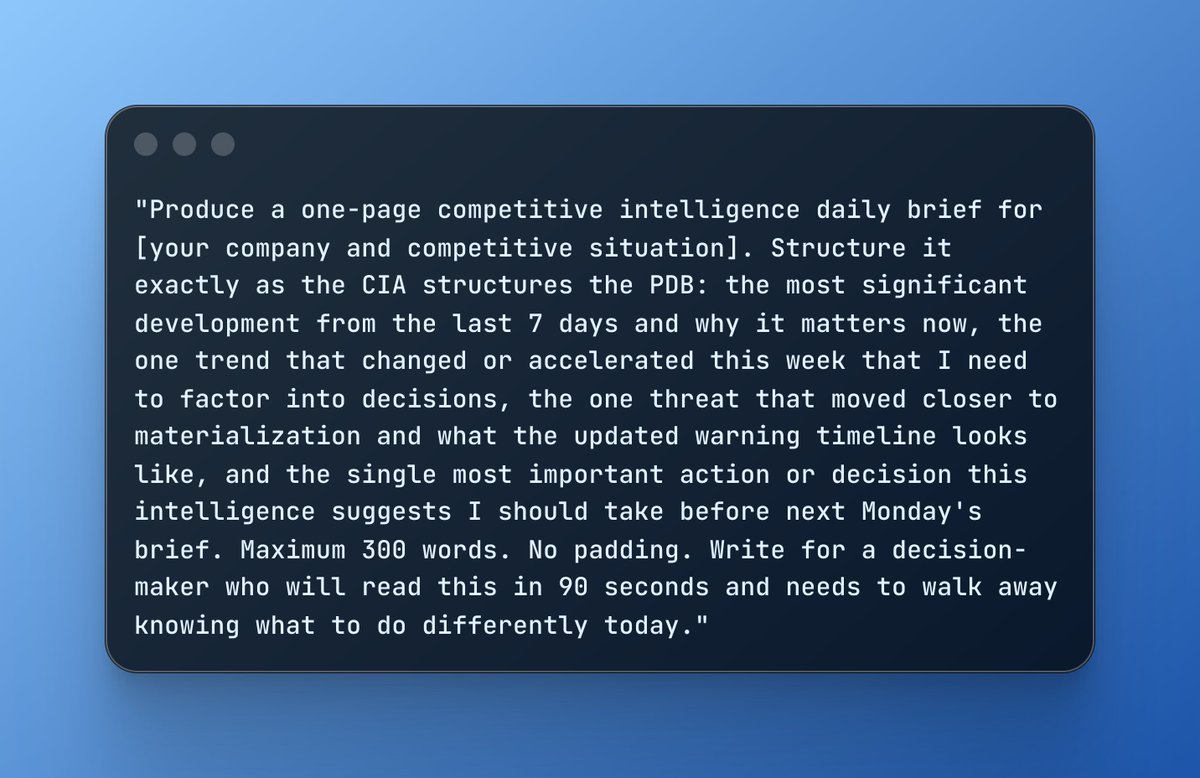
"Produce a one-page competitive intelligence daily brief for [your company and competitive situation]. Structure it exactly as the CIA structures the PDB: the most significant development from the last 7 days and why it matters now, the one trend that changed or accelerated this week that I need to factor into decisions, the one threat that moved closer to materialization and what the updated warning timeline looks like, and the single most important action or decision this intelligence suggests I should take before next Monday's brief. Maximum 300 words. No padding. Write for a decision-maker who will read this in 90 seconds and needs to walk away knowing what to do differently today."
The CIA brief doesn't inform.
It drives decisions.
That's the only standard worth building to.
The President's Daily Brief is the most tightly edited document in the world.
One page. Maximum. Written for a reader with no time and every decision pending.
Every word earns its place or it doesn't appear.
It doesn't summarize everything collected. It tells the decision-maker the one thing they need to know today and what it means for the decisions they're making this week.
Run this every Monday morning on your competitive situation:
"Produce a one-page competitive intelligence daily brief for [your company and competitive situation]. Structure it exactly as the CIA structures the PDB: the most significant development from the last 7 days and why it matters now, the one trend that changed or accelerated this week that I need to factor into decisions, the one threat that moved closer to materialization and what the updated warning timeline looks like, and the single most important action or decision this intelligence suggests I should take before next Monday's brief. Maximum 300 words. No padding. Write for a decision-maker who will read this in 90 seconds and needs to walk away knowing what to do differently today."
The CIA brief doesn't inform.
It drives decisions.
That's the only standard worth building to.
The CIA's advantage was never classified information.
It was a disciplined process for turning public signals into actionable intelligence that decision-makers could act on with confidence.
Every method in these 12 prompts is built on that process.
Collection before analysis.
Multiple sources before conclusions.
Confidence ratings before recommendations.
Warning systems before events.
Most companies react to competitive threats after they've already materialized.
The ones that see them coming are running some version of this process.
Now you are too.
12 prompts. One Perplexity session.
The same competitive intelligence capability governments pay millions to maintain.
Save this thread.
Run prompt 1 on your most dangerous competitor this week.
By prompt 12 you'll know more about their next move than they think you do.
It was a disciplined process for turning public signals into actionable intelligence that decision-makers could act on with confidence.
Every method in these 12 prompts is built on that process.
Collection before analysis.
Multiple sources before conclusions.
Confidence ratings before recommendations.
Warning systems before events.
Most companies react to competitive threats after they've already materialized.
The ones that see them coming are running some version of this process.
Now you are too.
12 prompts. One Perplexity session.
The same competitive intelligence capability governments pay millions to maintain.
Save this thread.
Run prompt 1 on your most dangerous competitor this week.
By prompt 12 you'll know more about their next move than they think you do.
• • •
Missing some Tweet in this thread? You can try to
force a refresh