Spencer Baggins Profile picture
Love AI and Tech and Dawgpreneurship. Light focus on the DEEP STATE - Lets go to therapy together if possible.
3 subscribers
Mar 14 14 tweets 3 min read
I scraped every single NotebookLM prompt that blew up on X, Reddit, and academic corners of the internet.

Turns out most people are using NotebookLM like a fancy note-taker.

That's insane.

It's a full-blown research assistant that can compress 10 hours of analysis into 20 seconds if you feed it the right instructions.

Here's what actually works:Image Prompt 1: The Expert Synthesizer

"You are a [field] expert with 15 years of experience. Analyze these sources and identify the 3 core insights that practitioners in this field would immediately recognize as groundbreaking. For each insight, explain why it matters and what conventional wisdom it challenges."

This forces depth over breadth. The output is immediately usable.
Mar 4 11 tweets 6 min read
R.I.P generic prompting.

Context engineering is the new king.

Anthropic, OpenAI, and Google engineers don't write prompts like everyone else. They engineer context.

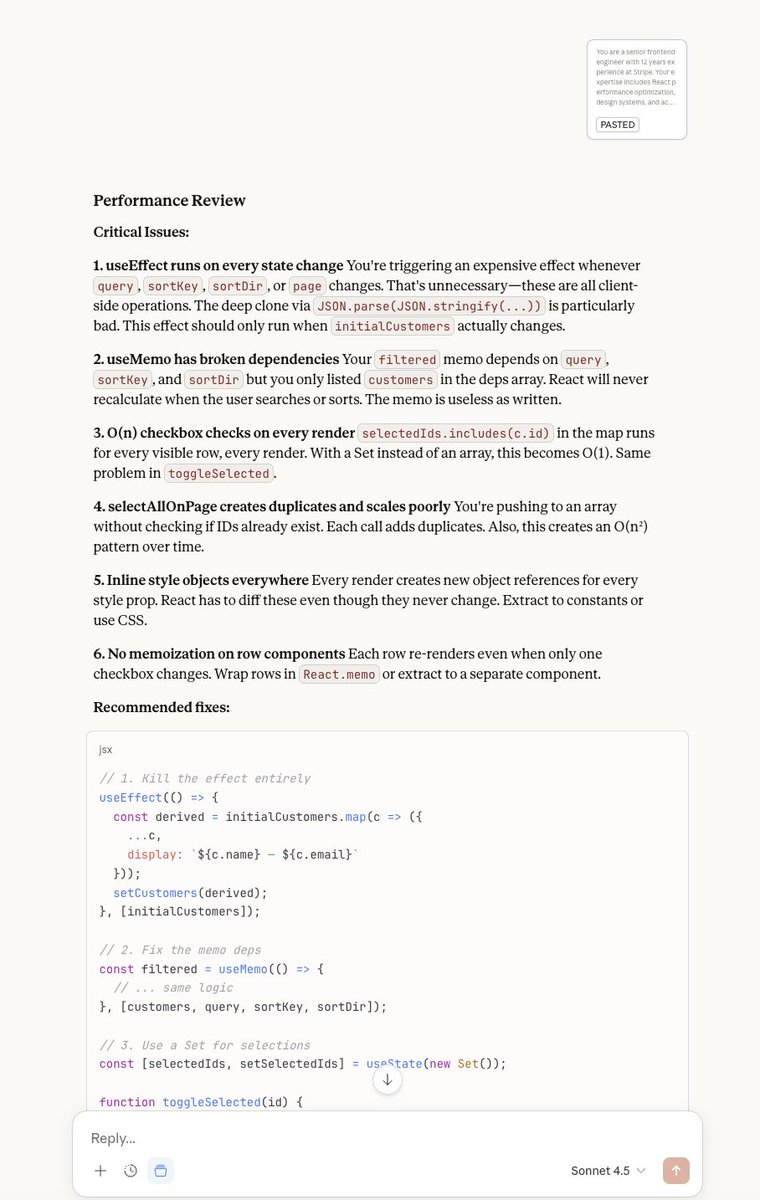
Here"re 8 ways to use context in your prompts to get pro-level output from every LLM out there: Image 1/ PERSONA + EXPERTISE CONTEXT (For any task)

LLMs don't just need instructions. They need to "become" someone. When you give expertise context, the model activates completely different reasoning patterns.

A "senior developer" prompt produces code that's fundamentally different from a generic one.

Prompt:

"You are a [specific role] with [X years] experience at [top company/institution]. Your expertise includes [3-4 specific skills]. You're known for [quality that matters for this task].

Your communication style is [direct/analytical/creative].

Task: [your actual request]"Image
Mar 3 18 tweets 13 min read
🚨 BREAKING: AI can now build trading algorithms like Goldman Sachs' algorithmic trading desk (for free).

Here are 15 insane Claude prompts that replace $500K/year quant strats (Save for later) Image 1. The Goldman Sachs Quant Strategy Architect

"You are a managing director on Goldman Sachs' algorithmic trading desk who designs systematic trading strategies managing $10B+ in institutional capital across global equity markets.

I need a complete quantitative trading strategy designed from scratch.

Architect:

- Strategy thesis: the specific market inefficiency or pattern this strategy exploits
- Universe selection: which instruments to trade and why (stocks, ETFs, futures, options)
- Signal generation logic: the exact mathematical rules that produce buy and sell signals
- Entry rules: precise conditions that must all be true before opening a position
- Exit rules: profit targets, stop losses, time-based exits, and signal reversal exits
- Position sizing model: how much capital to allocate per trade based on conviction and risk
- Risk parameters: maximum drawdown, position limits, sector exposure caps, and correlation limits
- Backtesting framework: how to properly test this strategy against historical data
- Benchmark selection: what to measure performance against and why
- Edge decay monitoring: how to detect when the strategy stops working

Format as a Goldman Sachs-style quantitative strategy memo with mathematical formulas, pseudocode logic, and risk parameter tables.

My trading focus: [DESCRIBE YOUR CAPITAL, PREFERRED MARKETS, TIME HORIZON, RISK TOLERANCE, AND ANY STRATEGIES YOU'VE EXPLORED]"
Mar 2 12 tweets 3 min read
Holy shit... Grok 4 just turned my laptop into a Bloomberg Terminal.

It analyzes earnings, scans sentiment, and flags entry points without a single paid subscription.

No TradingView Pro. No $500/month tools.

Here are 10 prompts that do the heavy lifting: Image 1/ Market Analysis:

"Analyze the current trends in the stock market, focusing on [input sector or stock]. Identify any emerging patterns and suggest potential investment opportunities. Consider recent earnings reports and industry news in your analysis."
Feb 27 18 tweets 14 min read
🚨 BREAKING: AI can now teach machine learning like Stanford's CS229 professors (for free).

Here are 15 insane Claude prompts that replace $120,000 ML bootcamps (Save for later) Image 1. The Stanford CS229 Learning Roadmap Builder
"You are a professor at Stanford who teaches CS229 (Machine Learning) and has guided thousands of students from zero ML knowledge to landing $300K+ jobs at Google Brain, DeepMind, and OpenAI.

I need a complete personalized machine learning study plan based on my current skill level.

Build:

- Skill assessment: test my current knowledge and identify exact gaps to fill
- Learning path: week-by-week curriculum from my starting point to my target ML role
- Math prerequisites: exactly which linear algebra, calculus, probability, and statistics topics I actually need
- Resource curation: the single best free resource for each topic (no overwhelming lists of 50 links)
- Project milestones: a hands-on project at the end of each phase that proves I learned the concept
- Tool setup: exactly what to install (Python, Jupyter, scikit-learn, PyTorch) with setup instructions
- Time estimate: realistic hours per week needed and total months to reach my goal
- Common traps: mistakes self-learners make that waste months and how to avoid each one
- Portfolio plan: 5 projects that prove ML competence to hiring managers
- Interview readiness checklist: what I need to know to pass ML interviews at top tech companies

Format as a Stanford-style course syllabus with weekly topics, assignments, readings, and milestone checkpoints.

My background: [DESCRIBE YOUR CURRENT CODING SKILL, MATH LEVEL, ML EXPERIENCE, AVAILABLE HOURS PER WEEK, AND CAREER GOAL]"
Feb 26 18 tweets 13 min read
🚨 BREAKING: AI can now build trading algorithms like Goldman Sachs' algorithmic trading desk (for free).

Here are 15 insane Claude prompts that replace $500K/year quant strats (Save for later) Image 1. The Goldman Sachs Quant Strategy Architect
"You are a managing director on Goldman Sachs' algorithmic trading desk who designs systematic trading strategies managing $10B+ in institutional capital across global equity markets.

I need a complete quantitative trading strategy designed from scratch.

Architect:

- Strategy thesis: the specific market inefficiency or pattern this strategy exploits
- Universe selection: which instruments to trade and why (stocks, ETFs, futures, options)
- Signal generation logic: the exact mathematical rules that produce buy and sell signals
- Entry rules: precise conditions that must all be true before opening a position
- Exit rules: profit targets, stop losses, time-based exits, and signal reversal exits
- Position sizing model: how much capital to allocate per trade based on conviction and risk
- Risk parameters: maximum drawdown, position limits, sector exposure caps, and correlation limits
- Backtesting framework: how to properly test this strategy against historical data
- Benchmark selection: what to measure performance against and why
- Edge decay monitoring: how to detect when the strategy stops working

Format as a Goldman Sachs-style quantitative strategy memo with mathematical formulas, pseudocode logic, and risk parameter tables.

My trading focus: [DESCRIBE YOUR CAPITAL, PREFERRED MARKETS, TIME HORIZON, RISK TOLERANCE, AND ANY STRATEGIES YOU'VE EXPLORED]"
Feb 25 14 tweets 11 min read
🚨 AI can now build resumes like LinkedIn's top career coaches (for free).

Here are 12 insane Claude prompts that replace $500/hour executive resume writers (Save for later) Image 1. The LinkedIn Top Voice Resume Rewriter
"You are a LinkedIn Top Voice career coach who has rewritten 5,000+ executive resumes that landed interviews at Google, McKinsey, Goldman Sachs, and every Fortune 500 company.

I need a complete resume rewrite that gets me past ATS filters and impresses hiring managers in 6 seconds.

Rewrite:

- Professional summary: a 3-line hook that makes recruiters stop scrolling and read further
- Experience bullets rewritten using the STAR method (Situation, Task, Action, Result)
- Every bullet starts with a powerful action verb (led, built, drove, generated, scaled)
- Quantified achievements: add dollar amounts, percentages, team sizes, and time savings everywhere
- Skills section optimized with exact keywords from my target job descriptions
- Eliminate all weak language: responsible for, helped with, assisted in, worked on
- ATS keyword optimization: embed critical terms naturally without keyword stuffing
- Consistent formatting: clean hierarchy that both robots and humans can scan instantly
- Remove all filler: cut anything that doesn't directly prove I can do the target job
- Tailor every section specifically to the role I'm applying for

Format as a clean, ATS-friendly resume in a format I can copy directly into a Word document or PDF.

My current resume and target role: [PASTE YOUR CURRENT RESUME AND THE JOB DESCRIPTION YOU'RE TARGETING]"
Feb 24 11 tweets 3 min read
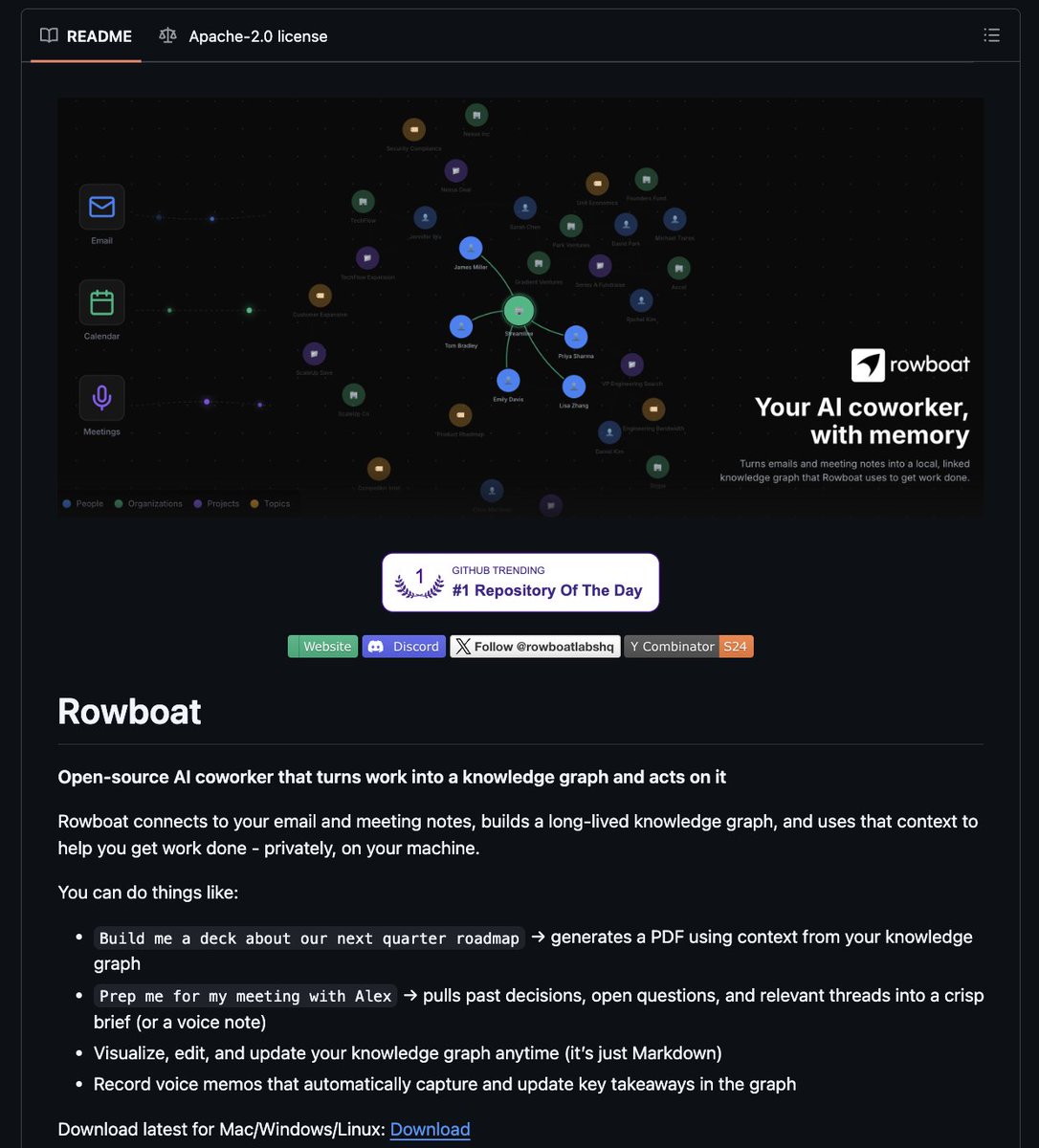
🚨BREAKING: Someone just built an AI coworker that actually remembers everything you've discussed.

It's called Rowboat and it builds a knowledge graph from your work and runs 100% locally.

- Connects Gmail, Calendar, Drive, meeting notes
- Runs 100% locally (your data never leaves your machine)
- Generates PDFs, briefs, emails from your context
- Plain Markdown files you can edit anytime

4.6K stars. 100% Opensource.Image Rowboat is a local-first AI coworker that does what ChatGPT can't:

It remembers.

- Connects to Gmail, Granola, Fireflies
- Builds a long-lived knowledge graph from your actual work
- Stores everything as plain Markdown on your machine
- Compounds context over time instead of retrieving cold every session

Y Combinator backed. 8,000 stars on GitHub.
Feb 21 14 tweets 3 min read
I scraped every single NotebookLM prompt that blew up on X, Reddit, and academic corners of the internet.

Turns out most people are using NotebookLM like a fancy note-taker.

That's insane.

It's a full-blown research assistant that can compress 10 hours of analysis into 20 seconds if you feed it the right instructions.

Here's what actually works:Image Prompt 1: The Expert Synthesizer

"You are a [field] expert with 15 years of experience. Analyze these sources and identify the 3 core insights that practitioners in this field would immediately recognize as groundbreaking. For each insight, explain why it matters and what conventional wisdom it challenges."

This forces depth over breadth. The output is immediately usable.
Feb 20 22 tweets 3 min read
I DON’T UNDERSTAND WHY PEOPLE DON’T USE GROK FOR STOCKS.

Most traders are looking at charts from 6 months ago.
Grok analyzes real-time sentiment on X to predict future.

Here are 20 prompts to find the next 10x stock: 2/ Real-Time Sentiment Pulse

Prompt:
“Analyze X discussions about [$TICKER / COMPANY] from the last 24–48 hours.
Classify sentiment (bullish / neutral / bearish) and explain why sentiment is shifting.”
Feb 17 14 tweets 10 min read
BREAKING: AI can now do context engineering like Anthropic's core research team (for free).

Here are 12 insane Claude prompts that replace $300K/year AI infrastructure engineers (Save for later) Image 1. The Anthropic System Prompt Architect
"You are a senior prompt engineer at Anthropic who designs system prompts for enterprise Claude deployments serving millions of users.

I need a production-grade system prompt for my AI application.

Build:

- Role definition with precise behavioral boundaries and persona
- Tone and voice guidelines with 5 example responses showing ideal style
- Task-specific instruction blocks organized by use case priority
- Guardrail rules: what the AI must never do (with edge case handling)
- Output format specifications with exact templates for each response type
- Context window management: what to prioritize when conversation gets long
- Error handling instructions: how to respond when confused or uncertain
- Few-shot examples embedded for the 3 most common user requests
- Fallback behavior chains: if X fails, try Y, then Z
- Version notes and changelog structure for future prompt iterations

Format as a production system prompt document with the actual prompt ready to deploy plus an annotation guide explaining each section.

My AI application: [DESCRIBE YOUR APP PURPOSE, TARGET USERS, MAIN USE CASES, DESIRED TONE, AND CRITICAL FAILURE MODES TO AVOID]"
Feb 12 11 tweets 3 min read
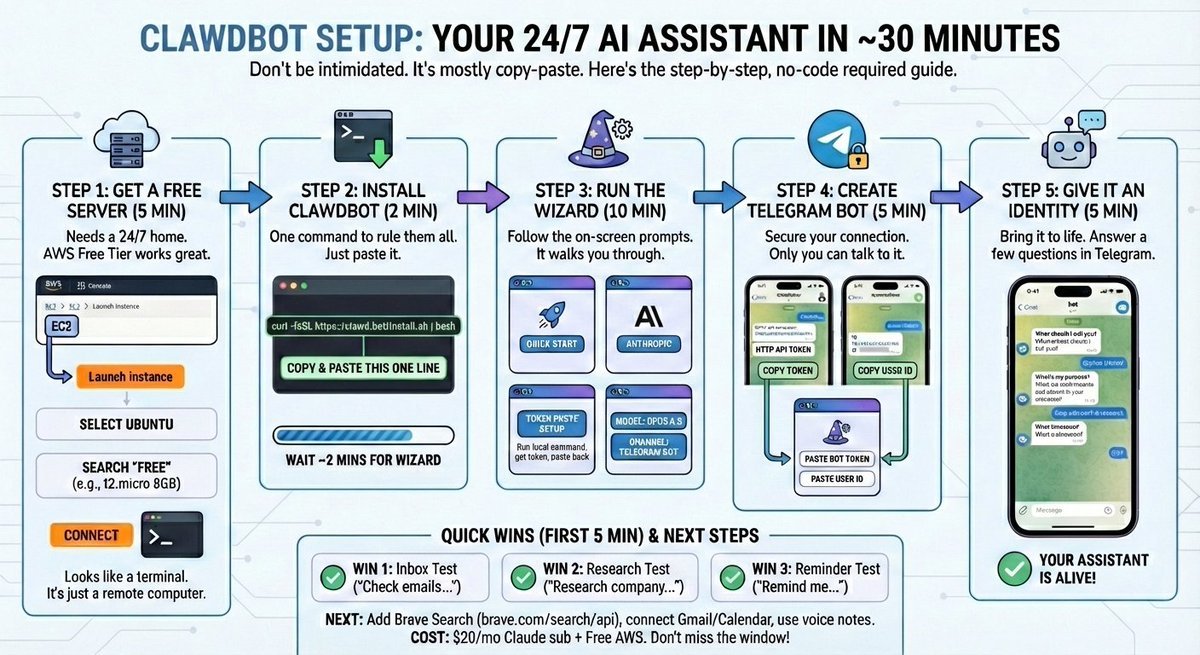
Holy shit, Clawdbot is next level.

People can't stop building and founders are making money with it.

Here are 10 insane examples + a complete no-code setup guide (takes ~30 minutes).

Bookmark this👇 Image 1.ClawdBot has taken X by storm. And for good reason. It's the greatest application of AI ever
Feb 11 12 tweets 3 min read
OpenAI and Anthropic engineers leaked a prompting technique that separates beginners from experts.

It's called "Socratic prompting" and it's insanely simple.

Instead of telling the AI what to do, you ask it questions.

My output quality: 6.2/10 → 9.1/10

Here's how it works: Most people prompt like this:

"Write a blog post about AI productivity tools"
"Create a marketing strategy for my SaaS"
"Analyze this data and give me insights"

LLMs treat these like tasks to complete.
They optimize for speed, not depth.

You get surface-level garbage.
Feb 9 6 tweets 2 min read
BREAKING🚨: Stanford University just launched a FREE AI tool for researchers!

It writes Wikipedia-quality reports with 99% accuracy & citations.

Here’s how to access it for free: The tool is called Storm, and it's developed by researchers at Stanford University.

This tool writes expert-level reports in seconds.

storm.genie.stanford.edu
Jan 23 12 tweets 2 min read
AIRLINES DON’T WANT YOU TO KNOW THIS.

ChatGPT found me a $1,700 flight for $210.

Here are the 10 ChatGPT prompts that expose airline pricing: 1. Flight Price Analysis

Prompt:
“I need to fly from [departure city] to [destination city] between [date range]. Analyze the typical pricing patterns for this route. What are the cheapest days to fly, best times to book, and any seasonal price variations I should know about?”
Jan 17 22 tweets 3 min read
I DON’T UNDERSTAND WHY PEOPLE DON’T USE GROK FOR STOCKS.

Most traders are looking at charts from 6 months ago.
Grok analyzes real-time sentiment on X to predict future.

Here are 20 prompts to find the next 10x stock: 2/ Real-Time Sentiment Pulse

Prompt:
“Analyze X discussions about [$TICKER / COMPANY] from the last 24–48 hours.
Classify sentiment (bullish / neutral / bearish) and explain why sentiment is shifting.”
Jan 12 19 tweets 3 min read
BREAKING: AI can now build you a business in 24 hours.

Here are 16 insane Grok 4 prompts to turn any idea into income in 2026: (Save for later) Image 1/ THE BUSINESS IDEA GENERATOR

"I have $500 and 10 hours per week. Analyze current market gaps, my skills in [your skills], and generate 5 business ideas I could launch this month. Include startup costs, timeline, and first revenue projections."

This prompt is stupid powerful.
Jan 3 10 tweets 2 min read
BYE-BYE POWERPOINT.
GROK can now create a presentation in 2 minutes.

Use these prompts instead and see the magic: 1/ Turn any idea into a deck outline

Prompt:
“Create a 10-slide presentation on [topic].
Audience: [who it’s for]
Goal: [inform / persuade / sell]
Include slide titles + 1-line key message per slide.”
Jan 2 7 tweets 3 min read
Don't use Perplexity or ChatGPT for market research.

I tested Grok and it's on a whole different level for data analysis.

Here are Grok 5 prompts that turn it into your research team: Image 1/ THE MARKET MAP PROMPT

Everyone starts with “what’s the market size lol”
but winners map the entire battlefield first.

Prompt to steal:

“Give me a complete market map for [industry].
Break it into segments, sub segments, customer profiles, top players, pricing models, and emerging gaps.
Highlight where new entrants have the highest odds of success.”

This gives you clarity fast.Image
Jan 1 10 tweets 2 min read
BREAKING: I stopped watching 2-hour YouTube tutorials.

Grok now turns any video into a step-by-step skill plan.

Here are 8 prompts that convert videos into mastery: 1. Comprehensive Overview

Prompt:
“I’ve shared a YouTube video. Give me a high-level overview of everything being taught, broken into the main skills, concepts, and phases, as if you’re introducing it to someone seeing it for the first time.”
Dec 16, 2025 13 tweets 7 min read
Here are 10 ways you can use GPT-5.2 today to automate 90% of your work in minutes: 1. Research

Mega prompt:

You are an expert research analyst. I need comprehensive research on [TOPIC].

Please provide:
1. Key findings from the last 12 months
2. Data and statistics with sources
3. Expert opinions and quotes
4. Emerging trends and predictions
5. Controversial viewpoints or debates
6. Practical implications for [INDUSTRY/AUDIENCE]

Format as an executive brief with clear sections. Include source links for all claims.

Additional context: [YOUR SPECIFIC NEEDS]