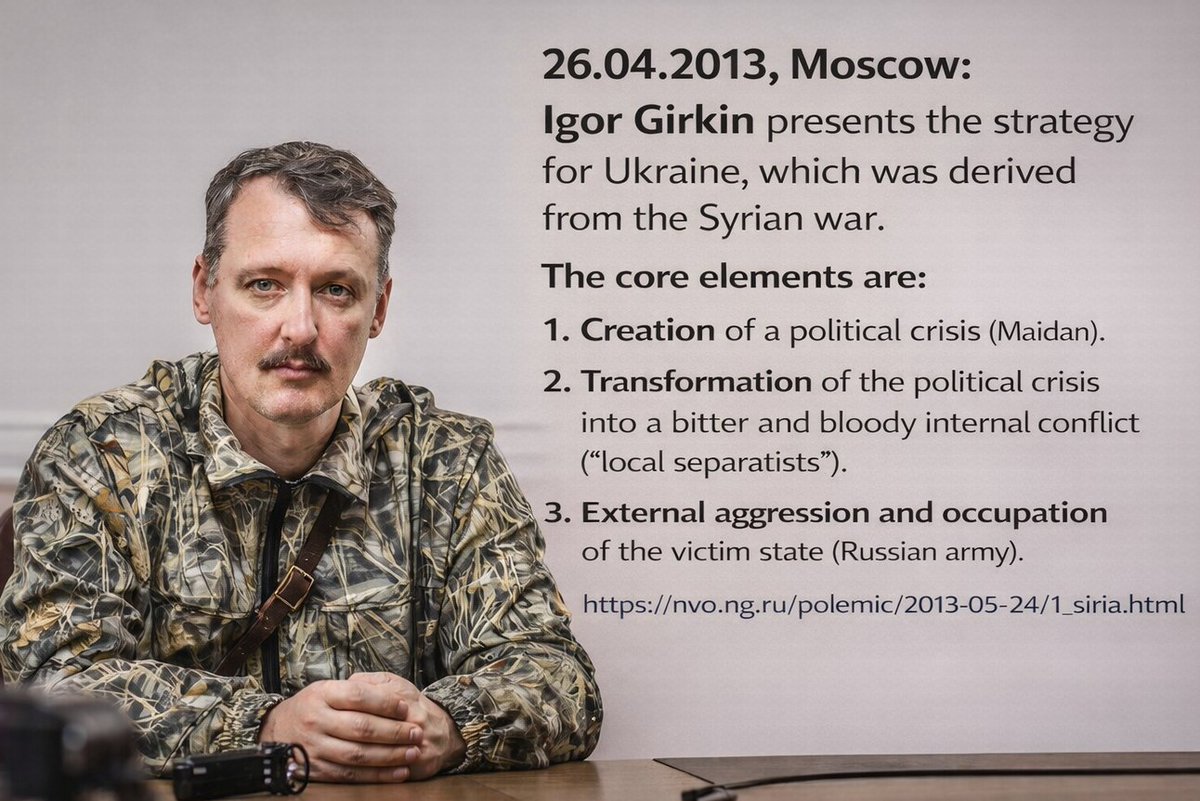
26.04.2013: Igor Girkin outlines a three-phase strategy derived from the Syrian War for the violent conquest of countries. Events in Ukraine will unfold exactly as he describes. In August 2013, Putin warned that Ukraine’s pro-EU course would spell its downfall.
The timeline clearly illustrates the three phases that Igor Girkin devised in Moscow in April 2013.
Putin had threatened Yanukovych, saying that if he signed the agreement with the EU, he would take over large parts of the country.
In the spring of 2014, the Russian army was stationed along the border with Ukraine and was subsequently tasked with protecting the so-called local separatists under the guise of peacekeepers.
The so-called separatists in eastern Ukraine received massive support from the Russian army, or were, to a significant extent, the Russian army itself.
Anyone who still claims that Russia did not plan the war against Ukraine well in advance, given that Girkin had already outlined the strategy back in 2013:
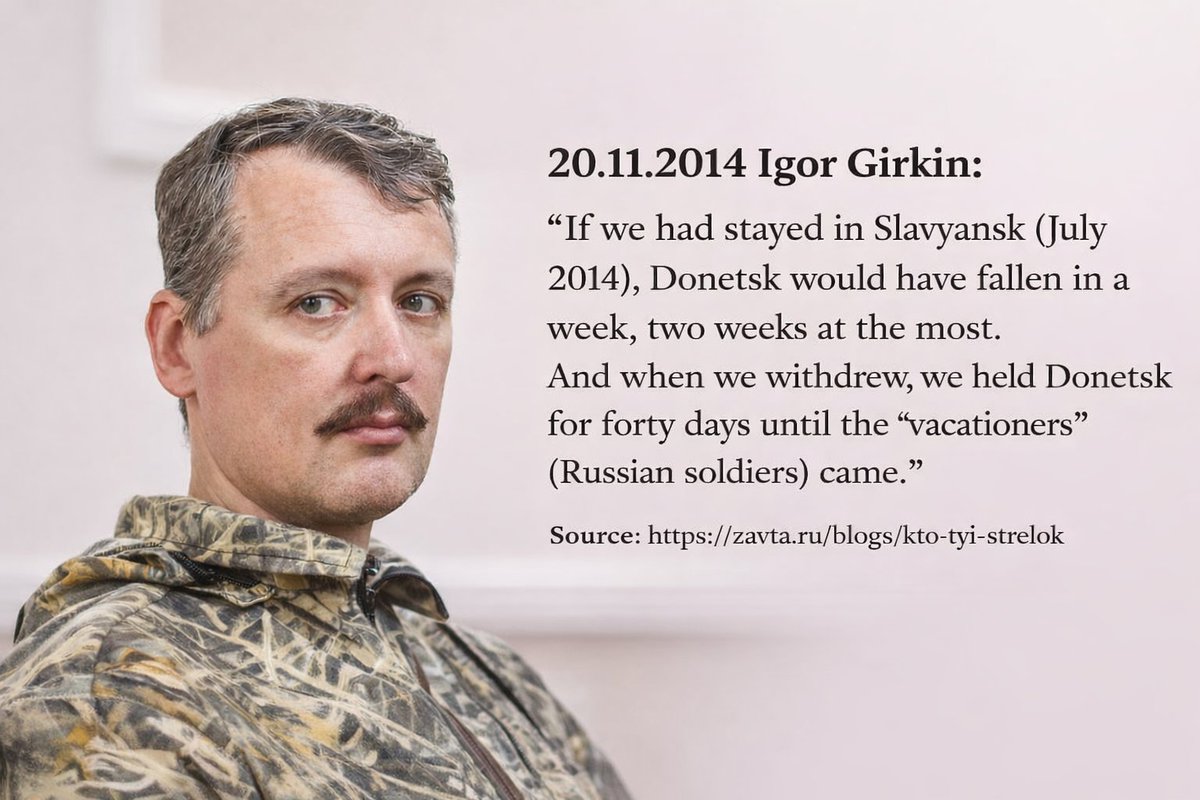
12.04.2014: Igor Girkin arrives in Sloviansk. In 2020, he describes how Russian special forces were tasked with holding out until the referendum, at which point the Russian army—which was already stationed at the border under the guise of peacekeepers—would intervene.
Unlike in Crimea, the Russian soldiers in eastern Ukraine were simply on "vacation". As if it were normal in the Russian army for soldiers to take their tanks, artillery, or modern air defense systems with them on leave.
The former self-proclaimed “people’s governor of Donbas,” Pavel Gubarev, has acknowledged that the 2014 “uprising” in eastern Ukraine was fully financed and orchestrated by Moscow, with direct involvement of Russian military forces.
February 2015: Russian soldiers from Samara arrive in Belgorod. They are bored, and one soldier starts filming. They say they are being transferred to Ukraine "to shoot." In February 2015, a fierce battle for Debaltseve (Ukraine) takes place.
In February 2015, a fierce battle will take place in Debaltseve, in which numerous Russian soldiers will also die.
04.03.1994: Today, 32 years ago, U.S. President Bill Clinton praised Ukraine for giving up its nuclear weapons. In return, the United States pledged support for Ukraine’s independence and territorial integrity, saying it was unlikely Russia would try to take Crimea back.
In February 2014, Russia annexed Crimea. In an interview in May 2020, Igor Girkin explains how the annexation of Crimea was prepared in advance.
After occupying Crimea in February 2014, Moscow sent its FSB/GRU agents to eastern Ukraine in April 2014. There, they were supposed to play the role of the famous "local separatists."
2025: A Russian train driver from Rostov recounts how he carried out military transports from Matveyev Kurgan to Ukraine in 2014. He laughs as he recounts how the Russian army fought near Debaltseve (Ukraine) in February 2015, and not the famous "local separatists".
2014: At first, the Russian army mainly transported older tank models to Ukraine in an attempt to conceal its presence.
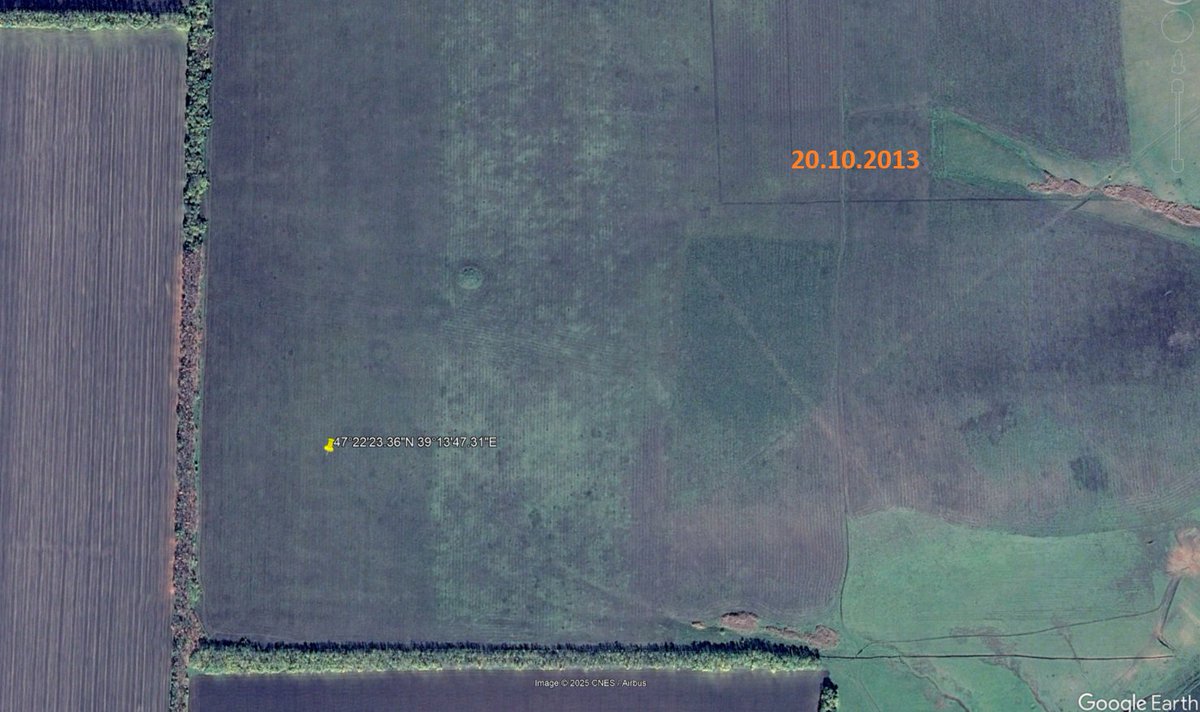
Matveyev Kurgan was an important railway junction in 2014 and 2015 for the Russian army to transport its military goods to Ukraine. Numerous bases and camps were set up in the region during this period.
21.02.2014: Igor Girkin (Russian colonel in the FSB reserve) arrives in Crimea. In an interview in 2020, he explains that he was already in Crimea in mid-January 2014 and met with members of the military and politicians to prepare for the annexation of Crimea by Russia.
21.02.2014: Igor Girkin arrives in Simferopol, Crimea. His task is to use armed force to compel people to vote. According to his statements, the Berkut police unit has defected. It becomes known that Russian paratroopers had disguised themselves as Berkut police officers.
Here, for example, Russian paratrooper Alexei Ivanov from the 31st Separate Airborne Unit can be seen standing in the Crimean parliament wearing a Ukrainian Berkut police uniform during Russia's takeover of Crimea.
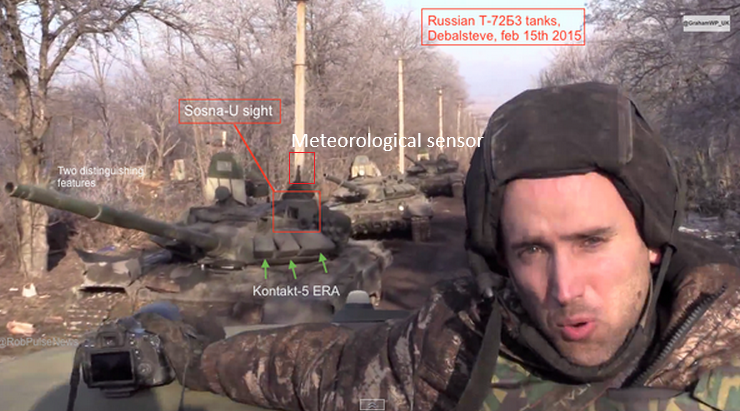
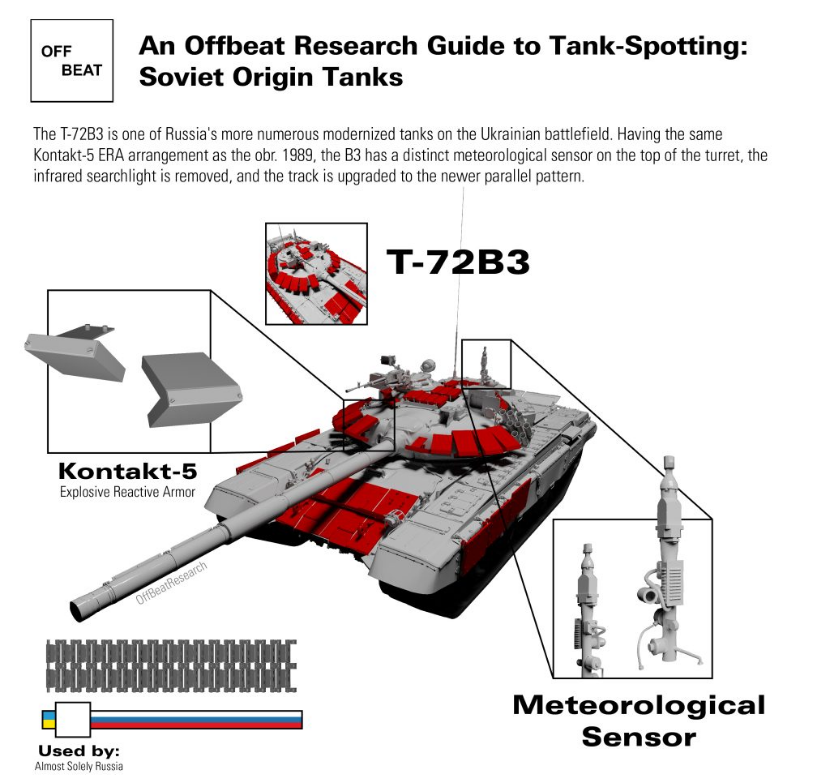
15.02.2015: RT correspondent Graham Phillips is filming near Debaltseve (Ukraine). He passes a column of "local separatists" who happen to be the Russian 5th Separate Guards Tank Brigade. At this point in time, the T-72B3 was used exclusively by the Russian armed forces.
The T-72B3 is relatively easy to identify. After the major offensive in 2022, Ukraine also captured several T-72B3 tanks.
From summer 2014 onwards, Russia regularly deployed its army in Ukraine. Nevertheless, the legend of local separatists is still needed for the Western public.