
1/ Ukrainian citizens are reportedly selling 'whitelisted' Starlink terminals to Russia, to enable the Russian army to get around the blocking of unauthorised Starlink terminals. The trade highlights how corruption in Ukraine is directly aiding Russia's war effort. ⬇️ 

2/ Russian forces in Ukraine used Starlink on a large scale for both battlefield communications and, increasingly, drone guidance. Since early February 2026, however, only whitelisted terminals – which can only be acquired with Ukrainian government permission – can be used.
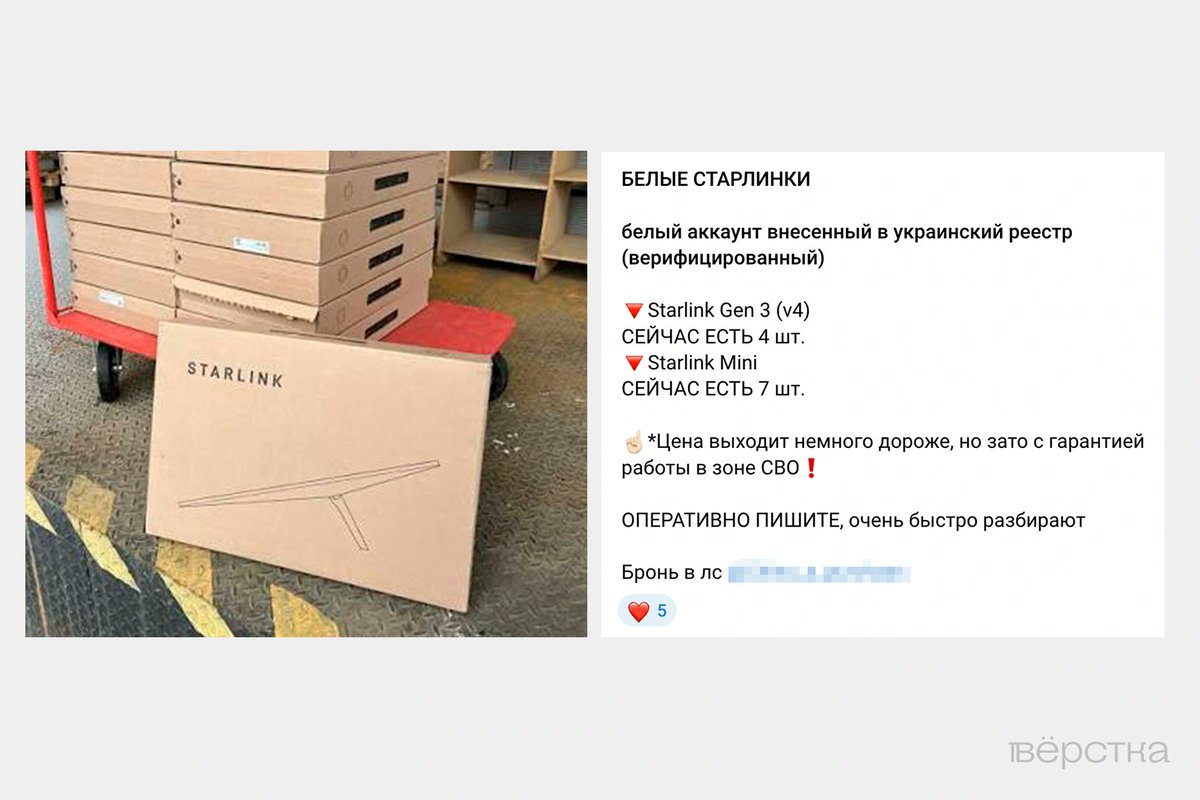
3/ However, some in Ukraine appear to be helping Russia to circumvent these restrictions. So-called 'White Starlink' offers are proliferating on Telegram channels, offering whitelisted "Starlink for military and civilians in the new territories of the Russian Federation".
4/ A journalist for the independent Russian news outlet Verstka responded to several such ads and was offered a terminal and subscription registered to a Ukrainian citizen. Prices start at 74,000-121,000 rubles ($988-$1,600) for a Starlink mini with a 3- to 12-month subscription.
5/ The terminals are registered by Ukrainian citizens or legal entities under their own names, and the usernames and passwords are handed over, before they are shipped to Russia via third countries. They have to be turned off during their transit through Russia.
6/ According to the seller, the terminals won't be shut down because so many are online and "no one is looking for a specific terminal". He says that over 400 have been sent to the Russian front line since the beginning of March 2026.
7/ Ukrainians selling Starlink terminals to the Russians face severe punishment, including potential life sentences. In late February, two people from Izmail in the Odesa region were arrested after agreeing to illegally register Starlink satellite terminals for Russian forces.
8/ The pair were said to have been recruited by Russian operatives through Telegram channels offering "easy money." They also tried to recruit drug addicts to use their IDs. Russian operatives offered them $30 for each Starlink terminal they registered for use by Russian forces.
9/ In other cases, the families of Ukrainian POWs being held in Russia have reportedly been threatened with harm to their imprisoned relatives unless they register Starlink terminals for the Russians.
10/ According to Ukrainian defence expert Serhii "Flash" Beskrestnov, "For the enemy, Starlink is so important that they have deployed a whole network to search for traitors who are ready to register Starlink for themselves in the Central Administrative Service."
11/ He says that Russian troops are offering up to $230 to register a single terminal – equivalent to a third of the average salary in Ukraine.
12/ In mid-February, Ukraine's 256th Cyber Assault Division ran a sting operation on Telegram to promote the 'reactivation' of disabled Russian Starlink terminals. It exposed the positions of 2,420 terminals, but also exposed 31 Ukrainians who offered to help register them.
13/ Another Russian seller says that Ukrainian soldiers are registering terminals for the Russian side. Several terminals can reportedly be verified simultaneously – up to 10 per Ukrainian Armed Forces contract soldier, for a fee of $3,200.
14/ The terminals can still be shut down if military uses are detected – so no drone control. However, Russians and Ukrainians use the same apps – Telegram, YouTube, WhatsApp, etc. – and VPNs can disguise connections to Russian government websites and the MAX messenger app.
15/ Starlink is still attractive to Russian soldiers because the only Russian alternatives, such as Gazprom's Yamal-601, are much more expensive and offer slower connections. A single Yamal-601 terminal now costs at least 280,000 rubles ($3,700).
16/ Internet connections provided by the Russian MOD are "completely crap", according to Russian soldiers at the front. The MOD is said to be laying fibre-optic cables to local settlements, then using signal boosters and Wi-Fi bridges to reach the front lines.
17/ Soldiers still widely use Telegram when they can, using VPNs, but the lack of stable Internet connections makes it difficult. A soldier told Verstka that since Starlink was blocked, "the network's a disaster: I use it when I can find a signal, but Telegram’s barely working."
18/ "Otherwise, we’ve got no signal here—I was out on the front line without any connection; I’ve only just come back to catch my breath. There’s a new messaging app, MAX; I think the government’s promoting it, but I haven’t used it — it won’t work here, there’s no mobile signal.
19/ "And, to be honest, it’s not exactly something I’m keen on, but there’s nothing else."
A dedicated military messenger app is being rolled out, but it seems to have attracted little use so far due to the authorisations and dedicated smartphones required.
A dedicated military messenger app is being rolled out, but it seems to have attracted little use so far due to the authorisations and dedicated smartphones required.
20/ The nearly simultaneous blocking of Starlink and Telegram has had a heavy impact on morale at the front lines. Many Russian soldiers are now cut off from communicating with their loved ones, and can no longer access online services for relaxation.
21/ This is causing widespread discontent on military forums. One soldier writes:
"Once again, we've hit a dead end because in our country they refuse to allocate money for anything or do something useful for the front lines — or even for ordinary citizens' lives in general.
"Once again, we've hit a dead end because in our country they refuse to allocate money for anything or do something useful for the front lines — or even for ordinary citizens' lives in general.
22/ "Starlink was invented by one guy, so why, in all this time, couldn't we have made something similar but in a Russian style? Team up with the Chinese, and they would have already churned out a ton of these Russified Starlinks?
23/ "Instead, they're also shutting down our only practical means of communication — Telegram. Great solution, nothing to say about that. The enemies cut off communications, and our own side shoot at our heels by cutting off contact with family and more." /end
Sources:
🔹 verstka.media/chto-proishodi…
🔹 kyivpost.com/post/70681
🔹 businessinsider.com/ukraine-worrie…
🔹 businessinsider.com/ukraine-starli…
🔹 verstka.media/chto-proishodi…
🔹 kyivpost.com/post/70681
🔹 businessinsider.com/ukraine-worrie…
🔹 businessinsider.com/ukraine-starli…
• • •
Missing some Tweet in this thread? You can try to
force a refresh






