Markets by Zerodha Profile picture
Apr 28 21 tweets 4 min read Read on X
The IEA just released its Gas Market Report. It's a picture of chaos. Before the West Asian war, the world expected a massive LNG wave. That story is now effectively dead. So what happened, and how long until it recovers? 🧵👇
To understand how wrong things have gone, you need to see how right they were going in. Three years after Russia's invasion of Ukraine sent prices sky-rocketing, the world's gas markets were finally recovering. Supply was catching up. Prices were settling.
New LNG plants were coming online one after another. The US opened a terminal at Plaquemines, Louisiana. LNG Canada began production. America's Corpus Christi facility expanded massively. Nearly half of all new global LNG between October and February came from Plaquemines alone.
This expansion was pulling prices down. By early 2026, European gas traded roughly a quarter cheaper than the year before. Asian prices fell even more. The IEA projected global gas demand would grow 2% across 2026. A wave was coming. Source: https://iea.blob.core.windows.net/assets/98825800-2689-4a2b-b067-69e918fef898/GasMarketReport%2CQ2-2026.pdf
Qatar alone was set to add 70 billion cubic metres of new capacity. India was one of the buyers waiting. Indian industry had been switching away from gas to naphtha, fuel oil, even diesel, because gas had become too expensive. The drought was nearly over. Then the wave broke.
The Strait of Hormuz effectively closed on March 2. Those 33 kilometres were also the main route for gas exports from Qatar and the UAE, together responsible for roughly a fifth of all LNG sold on the planet. When the strait closed, the floor fell out.
By March, European gas was trading at $18 per million BTU, the highest monthly average since the worst of the Ukraine war. In Asia, spot prices climbed to nearly $21, nearly twice the $11 industrial users were paying under long-term contracts.
Asian buyers scrambled for alternatives. They sourced roughly three times as much LNG from North America in March as a year ago. From West Africa, six times as much. LNG carrier rates roughly tripled in early March, the steepest day-on-day jump on record.
Countries were differently positioned. China's LNG imports fell by one-third. India's by a sixth. Pakistan, which relied on Qatar for nearly all its LNG, saw imports collapse by around 70%. Power plants, fertiliser factories, and industrial estates were suddenly shuttered.
The ceasefire has done little. The strait is still not open. Iran is charging tolls of more than a million dollars per ship. The US has imposed a counter-blockade on Iranian ports. The hot war may have cooled, but the chokehold on global energy has not.
Then came the strike on Ras Laffan, the world's largest LNG terminal. On March 18, Iranian missiles damaged two of its fourteen liquefaction trains. Qatar supplies a sixth of the world's LNG. Almost a fifth of that capacity was destroyed. Repairs will take three to five years. Source: https://jang.com.pk/en/61986-iran-strikes-qatars-ras-laffan-worlds-largest-lng-hub-under-attack-news
You can't rush this. The equipment that goes into an LNG plant is enormously specialised. You can't order a replacement gas turbine off the shelf.
Before the war, Qatar had been preparing its largest LNG expansion in history, the North Field East project with 44 billion cubic metres of new capacity a year. Construction is now suspended, the timeline slipped by more than a year. North Field South has no public timeline.
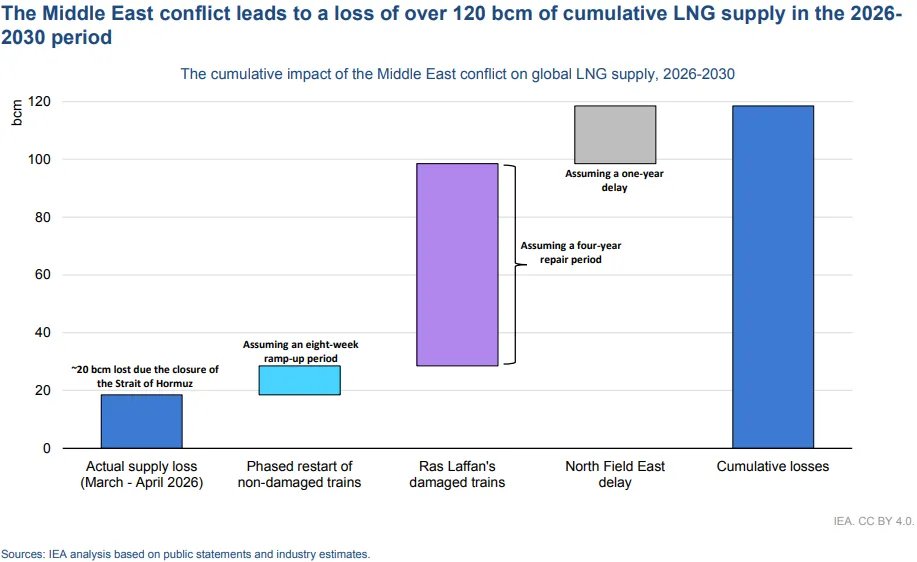
The IEA estimates the war has destroyed around 120 billion cubic metres of LNG supply between 2026 and 2030, roughly 15% of the new LNG the world had been anticipating. Any medium-term energy outlook has simply broken down. Source: https://iea.blob.core.windows.net/assets/98825800-2689-4a2b-b067-69e918fef898/GasMarketReport%2CQ2-2026.pdf
The crisis didn't affect the whole world equally. India sourced nearly 30% of its gas and 60% of its total LNG imports through the Strait. Pakistan imported all its LNG from Qatar alone. Bangladesh imported about 60% via the strait. Europe got less than 3% from there. Source: https://iea.blob.core.windows.net/assets/98825800-2689-4a2b-b067-69e918fef898/GasMarketReport%2CQ2-2026.pdf
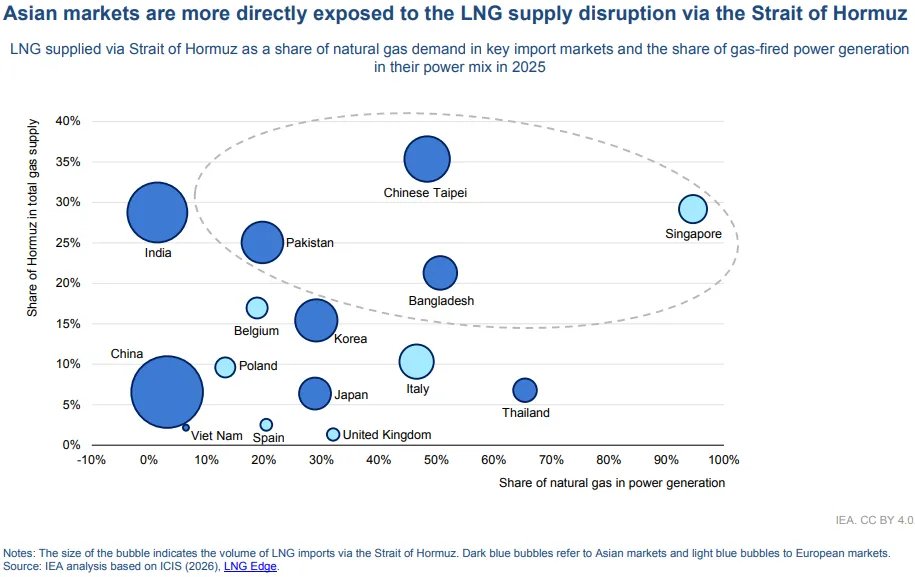
India's largest LNG buyers, Petronet and GAIL, get most of their gas through long-term contracts with Qatar. Once that supply was frustrated, the only option was the spot market, where prices were three to four times higher. We couldn't buy our way out.
In early March, the government invoked the Essential Commodities Act of 1955, a law most commonly applied for food shortages, to ration gas. Industrial users saw supply fall by 10 to 30%. Two decades of gas market liberalisation, undone in days.
Others responded differently. Pakistan introduced a four-day work week. Bangladesh cut supplies to fertiliser plants. Japan and Korea lifted restrictions on coal power. Across Asia, gas use in the power sector could drop by 60 to 65 billion cubic metres.
Three years ago, when Russia cut off Europe's gas, rich countries took the hit. They bid up prices and absorbed the shock. This time, the worst has fallen on a different part of the world, where countries can't outbid their way through.
The honest answer to when gas markets return to normal is years. Even if the war ends today, repairs alone will take years. Expansion projects that were coming will be pushed out. Where Europe paid, we have to ration.
We cover this and one more interesting story in today’s edition of The Daily Brief. Read on Substack, watch on YouTube, or listen on Spotify, Apple Podcasts, or wherever you get your podcasts; just search for “The Daily Brief by Zerodha.”

• • •

Missing some Tweet in this thread? You can try to force a refresh

 

Keep Current with Markets by Zerodha

Markets by Zerodha Profile picture

Stay in touch and get notified when new unrolls are available from this author!

Read all threads

This Thread may be Removed Anytime!

PDF

Twitter may remove this content at anytime! Save it as PDF for later use!

Try unrolling a thread yourself!

how to unroll video
  1. Follow @ThreadReaderApp to mention us!

  2. From a Twitter thread mention us with a keyword "unroll"
@threadreaderapp unroll

Practice here first or read more on our help page!

More from @zerodhamarkets

Apr 27
Every April, the IMF releases its World Economic Outlook, basically a report card on the global economy. This year's edition is different. Most of the report is about war, whose incidence has risen sharply over four decades. The IMF is not known for dramatic language. This is as dramatic as it gets. 🧵👇
Two of the three chapters are entirely about the military turn in global politics. Chapter 2 studies what rearming costs an economy. Chapter 3 studies what actual war costs. Together they form an escalating argument, spending, fighting, recovering, with each stage more damaging and harder to reverse than the one before.
Start with where most countries currently are: spending more on defence without yet fighting a war. Over the past five years, roughly half of all countries worldwide have raised their military budgets. As of 2024, nearly 40% of countries were spending more than 2% of GDP on defence, up from 27% in 2018.
Read 21 tweets
Apr 23
Iran's entire defence budget is $10 billion, or ₹84,000 crore. The United States' defence budget is $850 billion, or ₹71 lakh crore. Yet in the war currently being fought in the Gulf, Iran has the better economics.🧵👇
A ₹29 lakh drone with a moped engine is draining the world's most expensive air defence system faster than any factory can replenish it. Cheap drones have broken the economics of modern warfare, and this has something important to say about India's ₹2 lakh crore defence procurement.
Since late February, Iran has been firing the Shahed-136 at US military bases, Saudi oil infrastructure, and Israeli cities. It's not impressive by any conventional measure. A small piston engine, the kind you'd find on a moped. Body moulded from cheap composite material.
Read 25 tweets
Apr 23
For over six decades, India's passenger trains ran on the same basic idea. A powerful locomotive up front, pulling a long string of passive coaches behind it. As of March 2018, 49,033 conventional coaches were still in service. Then, in January 2018, the ICF flagged off its last one.🧵👇Image
Since 1955, the Integral Coach Factory in Chennai and its sister factories have built over 75,000 coaches of all types. For most of that history, the dominant design was the conventional ICF coach. What replaced them, and why, is a story that goes beyond a simple paint upgrade.
The original ICF coach was designed in the 1950s with technology from a Swiss company. It was made of mild steel, which made it heavy and prone to rusting quicker. These coaches had a maximum permissible speed of 110 kmph, and like all conventional trains they were locomotive-hauled.Image
Read 25 tweets
Apr 20
The Indian Railways runs thousands of passenger, freight, and express trains on a shared, tightly coordinated network. For most of this network's history, what kept those trains apart was signals along the track and the locomotive pilot's instinct. Manual judgement left room for errors. Let's find out how India is changing this. 🧵👇
The single biggest safety risk on this network has been something called SPAD: Signal Passed At Danger. That's when a driver misses or misjudges a red signal, and the train enters a section it shouldn't be in. Training helps, but it can't eliminate the problem.
As speeds on key corridors have risen toward 130-160 km/h and more trains have been packed onto same routes, there's less room for driver to recover from mistake. By the 2010s, Europe, Japan, and China had all moved to automated train protection systems.
Read 23 tweets
Apr 20
In India, the unemployment rate for illiterates is 3%. For graduates aged 15 to 24, it's 40%. The more educated you are in this country, the more likely you are to be jobless. Not because education is worthless, but because it creates aspirations the economy struggles to absorb. 🧵👇
An illiterate worker takes whatever survival work is available. A graduate holds out for something better. And that something better, for millions, may never arrive.
This isn't a new problem. The State of Working India 2026 report by @rosaabraham6 traces four decades of labour data and finds that graduate unemployment for the youngest cohort has been stuck between 35-40% since 1983.
Through liberalisation, the IT boom, Make in India, and a startup revolution, nothing moved it.
Read 23 tweets
Apr 17
India's defence exports hit a record ₹38,424 crore in FY26, up 62.66% from the previous year. Ten years ago, defence was not a private-market story in the way it is now. The domestic industrial ecosystem was narrow, state-heavy, and deeply dependent on imports. How did we get here?
Let's find out. 🧵👇
To be clear, the dependence hasn't fully vanished. MP-IDSA noted last year, drawing on SIPRI data, that India was still the world's largest arms importer in 2019-2023, with around 9.8% of global imports. But something important has changed. Defence production has risen from ₹46,429 crore in 2014-15 to ₹1.50 lakh crore in 2024-25. In FY25 alone, the Ministry of Defence signed 193 contracts worth ₹2.09 lakh crore, of which ₹1.69 lakh crore went to domestic industry.Source: https://x.com/rajnathsingh/status/2039552441482695102?s=20
Ammunition is not like a tank or a radar. It's a consumable. In an intense conflict, shells, rockets, and propellants are burned through fast. That's why militaries maintain reserve benchmarks in the first place. If you're below both the floor and the cushion, you end up empty-handed as enemies come knocking.
Read 22 tweets

Did Thread Reader help you today?

Support us! We are indie developers!


This site is made by just two indie developers on a laptop doing marketing, support and development! Read more about the story.

Become a Premium Member ($3/month or $30/year) and get exclusive features!

Become Premium

Don't want to be a Premium member but still want to support us?

Make a small donation by buying us coffee ($5) or help with server cost ($10)

Donate via Paypal

Or Donate anonymously using crypto!

Ethereum

0xfe58350B80634f60Fa6Dc149a72b4DFbc17D341E copy

Bitcoin

3ATGMxNzCUFzxpMCHL5sWSt4DVtS8UqXpi copy

Thank you for your support!

Follow Us!

:(



