Ed Zitron Profile picture
Apr 28 13 tweets 9 min read Read on X
Free newsletter: The economics of AI don't make sense. Monthly subscriptions to AI services are scams that represent a product that is impossible for OpenAI and Anthropic to provide long term, and AI data centers are an economic disaster at scale.
wheresyoured.at/ais-economics-…
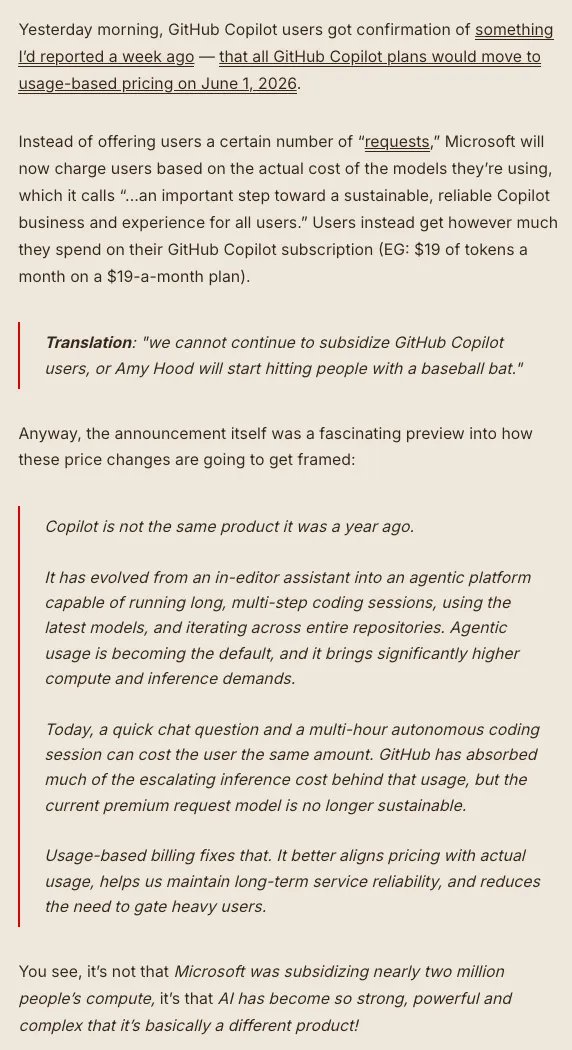
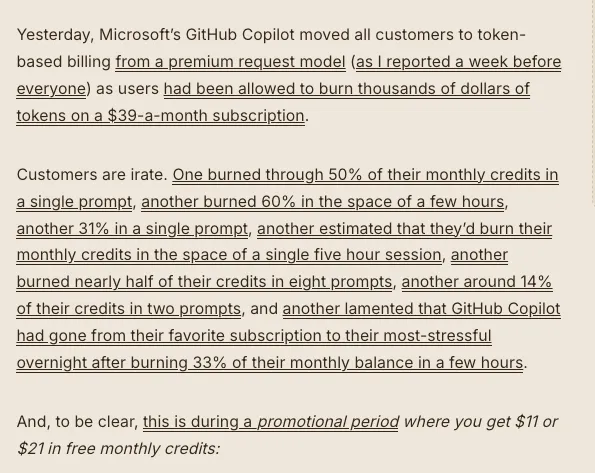
Github Copilot, as I reported last week, is moving towards token-based billing, charging the actual cost of token burn — a move that alienated many of its users who built entire workflows around a request-based product that no longer exists.
wheresyoured.at/ais-economics-…Yesterday morning, GitHub Copilot users got confirmation of something I’d reported a week ago — that all GitHub Copilot plans would move to usage-based pricing on June 1, 2026.   Instead of offering users a certain number of “requests,” Microsoft will now charge users based on the actual cost of the models they’re using, which it calls “...an important step toward a sustainable, reliable Copilot business and experience for all users.” Users instead get however much they spend on their GitHub Copilot subscription (EG: $19 of tokens a month on a $19-a-month plan).  Translation: "we canno...
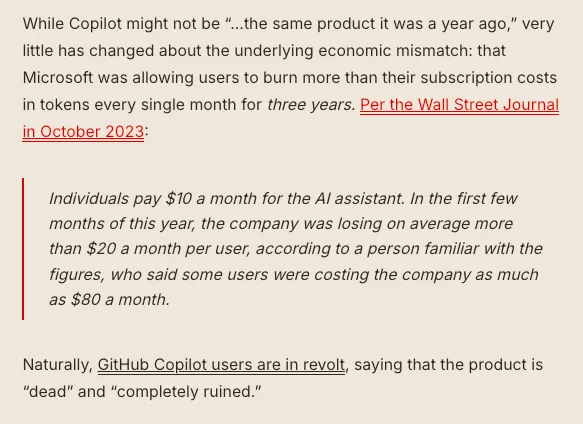
 While Copilot might not be “...the same product it was a year ago,” very little has changed about the underlying economic mismatch: that Microsoft was allowing users to burn more than their subscription costs in tokens every single month for three years. Per the Wall Street Journal in October 2023:  Individuals pay $10 a month for the AI assistant. In the first few months of this year, the company was losing on average more than $20 a month per user, according to a person familiar with the figures, who said some users were costing the company as much as $80 a month. Naturally, GitHub Copil...
This is the subprime AI crisis — and a crisis of deception. AI products tricked users by offering unsustainable monthly subscriptions built to separate the process of using AI from its real cost. Eventually everybody will go token-based.
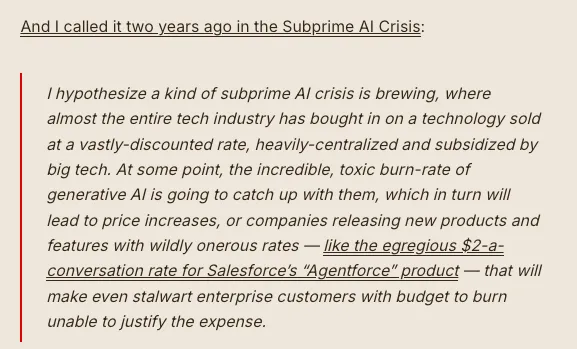
wheresyoured.at/ais-economics-… And I called it two years ago in the Subprime AI Crisis:  I hypothesize a kind of subprime AI crisis is brewing, where almost the entire tech industry has bought in on a technology sold at a vastly-discounted rate, heavily-centralized and subsidized by big tech. At some point, the incredible, toxic burn-rate of generative AI is going to catch up with them, which in turn will lead to price increases, or companies releasing new products and features with wildly onerous rates — like the egregious $2-a-conversation rate for Salesforce’s “Agentforce” product — that will make even stalwart enter...
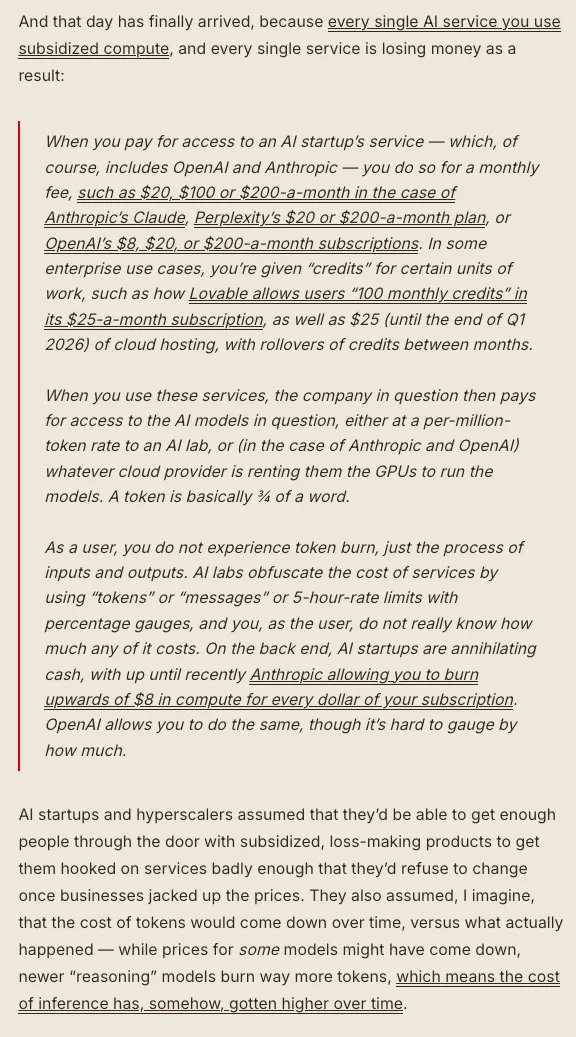
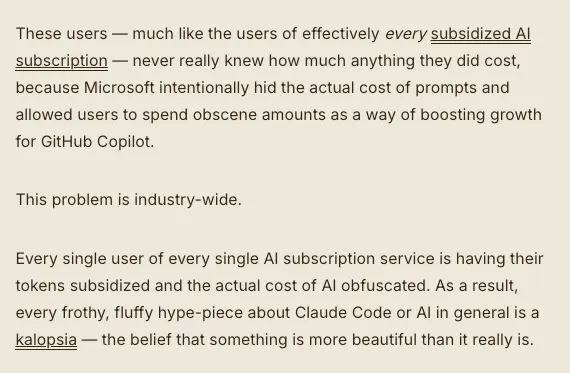
And that day has finally arrived, because every single AI service you use subsidized compute, and every single service is losing money as a result:  When you pay for access to an AI startup’s service — which, of course, includes OpenAI and Anthropic — you do so for a monthly fee, such as $20, $100 or $200-a-month in the case of Anthropic’s Claude, Perplexity’s $20 or $200-a-month plan, or OpenAI’s $8, $20, or $200-a-month subscriptions. In some enterprise use cases, you’re given “credits” for certain units of work, such as how Lovable allows users “100 monthly credits” in its $25-a-month su...
AI subscriptions are an intentional scam. When you're not paying the actual cost of using AI, you're willing to forgive AI's hallucinations and mistakes. The majority of LLM users have built workflows around all-you-can-eat cost structures.

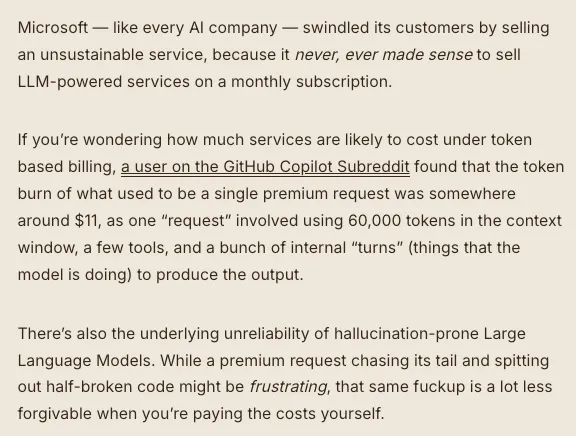
wheresyoured.at/ais-economics-…Microsoft — like every AI company — swindled its customers by selling an unsustainable service, because it never, ever made sense to sell LLM-powered services on a monthly subscription.  If you’re wondering how much services are likely to cost under token based billing, a user on the GitHub Copilot Subreddit found that the token burn of what used to be a single premium request was somewhere around $11, as one “request” involved using 60,000 tokens in the context window, a few tools, and a bunch of internal “turns” (things that the model is doing) to produce the output.   There’s also the un...
The AI industry tried to use a classic startup growth trick — subsidize, scale, and when you reach a critical mass, crank up the prices. Except the services are too expensive, and the costs too far removed from the cost of subscription.

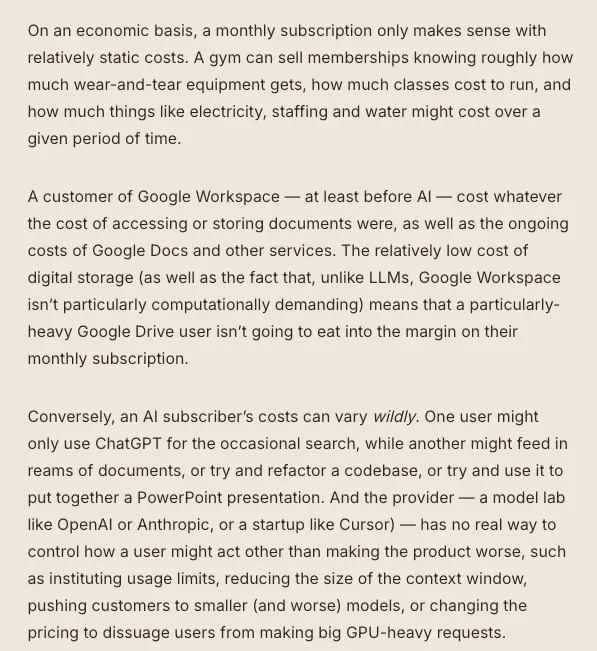
wheresyoured.at/ais-economics-… On an economic basis, a monthly subscription only makes sense with relatively static costs. A gym can sell memberships knowing roughly how much wear-and-tear equipment gets, how much classes cost to run, and how much things like electricity, staffing and water might cost over a given period of time.   A customer of Google Workspace — at least before AI — cost whatever the cost of accessing or storing documents were, as well as the ongoing costs of Google Docs and other services. The relatively low cost of digital storage (as well as the fact that, unlike LLMs, Google Workspace isn’t partic...
Subscription-based AI subsidies were essential to the generative AI growth story. It’s easy to write puff pieces about Claude Code when you’re paying $20 a month rather than, at minimum, $13 or $30 a day (based on Anthropic's own estimates).

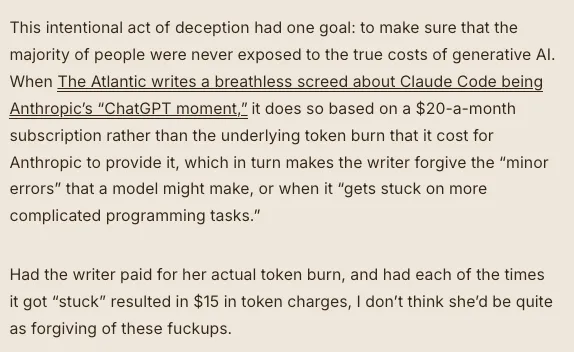
wheresyoured.at/ais-economics-… This intentional act of deception had one goal: to make sure that the majority of people were never exposed to the true costs of generative AI. When The Atlantic writes a breathless screed about Claude Code being Anthropic’s “ChatGPT moment,” it does so based on a $20-a-month subscription rather than the underlying token burn that it cost for Anthropic to provide it, which in turn makes the writer forgive the “minor errors” that a model might make, or when it “gets stuck on more complicated programming tasks.”  Had the writer paid for her actual token burn, and had each of the times it got...
You cannot guarantee whether an LLM will do a particular action, or whether it will present you with an outcome based on reality. You cannot for certain say how much a particular task — even one you’ve done many times using an LLM in the past — might cost, nor can you be sure when a model might go berserk and delete something, or simply not do something yet claim that it did.   These are far more forgivable if you’ve not paying on a per-token basis, because in the mind of a subscriber, that’s just another turn or two with a chatbot rather than something that’s incurring a real cost. One doe...
We'll find out exactly how "useful" AI is once companies and users are forced to pay for their actual token burn. When AI costs 10% of your headcount, and may reach 100%, flimsy claims of boosted productivity spouted by boosters and CTOs go quiet.

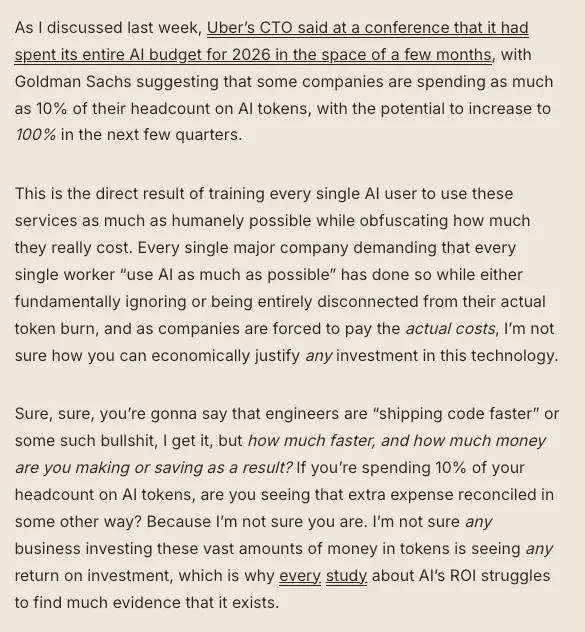
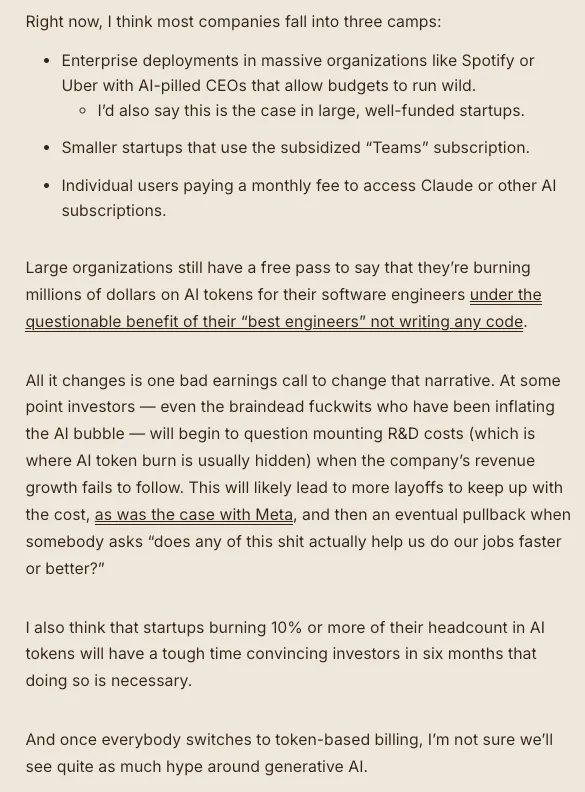
wheresyoured.at/ais-economics-… As I discussed last week, Uber’s CTO said at a conference that it had spent its entire AI budget for 2026 in the space of a few months, with Goldman Sachs suggesting that some companies are spending as much as 10% of their headcount on AI tokens, with the potential to increase to 100% in the next few quarters.   This is the direct result of training every single AI user to use these services as much as humanely possible while obfuscating how much they really cost. Every single major company demanding that every single worker “use AI as much as possible” has done so while either fundamental...
Right now, I think most companies fall into three camps:  Enterprise deployments in massive organizations like Spotify or Uber with AI-pilled CEOs that allow budgets to run wild. I’d also say this is the case in large, well-funded startups. Smaller startups that use the subsidized “Teams” subscription. Individual users paying a monthly fee to access Claude or other AI subscriptions.  Large organizations still have a free pass to say that they’re burning millions of dollars on AI tokens for their software engineers under the questionable benefit of their “best engineers” not writing any code...
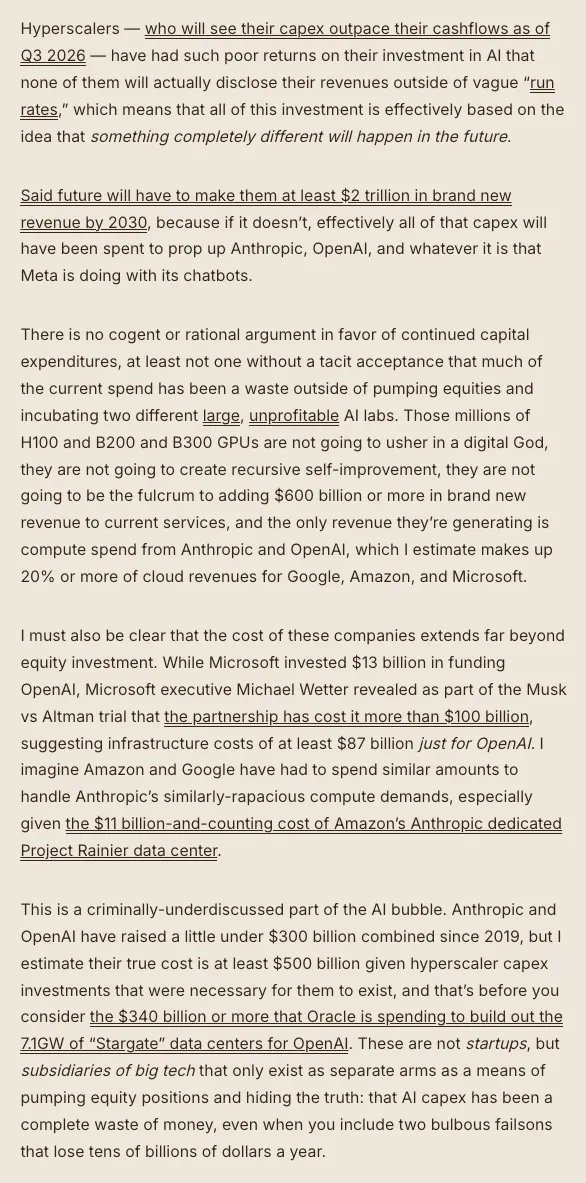
The economics of AI data centers also don't make sense.

A 100MW data center costs over $4.5bn with $3bn+ in GPUs, with costs eating up 85% of your revenue, and the rest destroyed by debt. Oh, and the chips are obsolete in a few years.

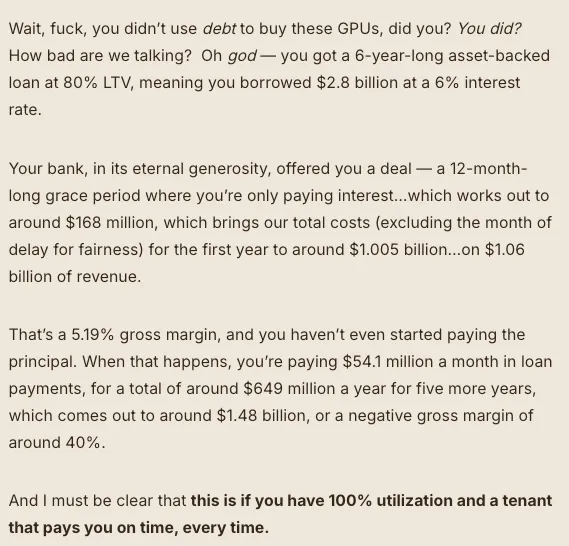
wheresyoured.at/ais-economics-…To explain the economic mismatch, I’m going to use a theoretical example of a data center leased to a theoretical AI compute company.   The GPUs in that data center are likely NVIDIA’s Blackwell chips. More than likely, said data center is using pods of 8 B200 GPUs, retailing around $450,000 a piece, or $56,250 a GPU. Based on there being 85MW of Critical IT load, the all-in capex per megawatt is around $36.78, or total IT capex of around $3.126 billion, or around $2.67 billion in GPUs.  Let’s assume this data center is in Ellendale, North Dakota, which means you’ve got an industrial electr...
 Wait, fuck, you didn’t use debt to buy these GPUs, did you? You did? How bad are we talking?  Oh god — you got a 6-year-long asset-backed loan at 80% LTV, meaning you borrowed $2.8 billion at a 6% interest rate.   Your bank, in its eternal generosity, offered you a deal — a 12-month-long grace period where you’re only paying interest…which works out to around $168 million, which brings our total costs (excluding the month of delay for fairness) for the first year to around $1.005 billion…on $1.06 billion of revenue.  That’s a 5.19% gross margin, and you haven’t even started paying the prin...
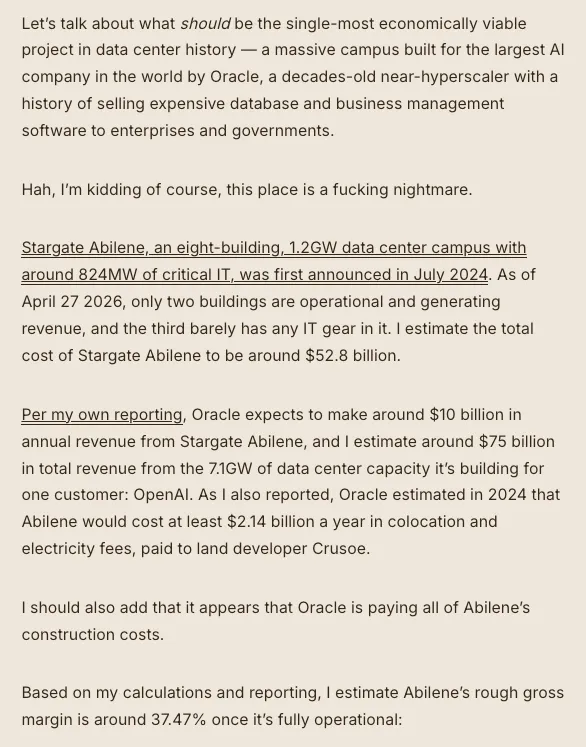
Things get worse with large data centers like Oracle's Stargate Abilene - a $52.8bn, 8-building campus that's years behind schedule, has billions a year in costs, and relies on a single tenant - OpenAI - who just missed its revenue targets.

wheresyoured.at/ais-economics-…Let’s talk about what should be the single-most economically viable project in data center history — a massive campus built for the largest AI company in the world by Oracle, a decades-old near-hyperscaler with a history of selling expensive database and business management software to enterprises and governments.  Hah, I’m kidding of course, this place is a fucking nightmare.  Stargate Abilene, an eight-building, 1.2GW data center campus with around 824MW of critical IT, was first announced in July 2024. As of April 27 2026, only two buildings are operational and generating revenue, and th...
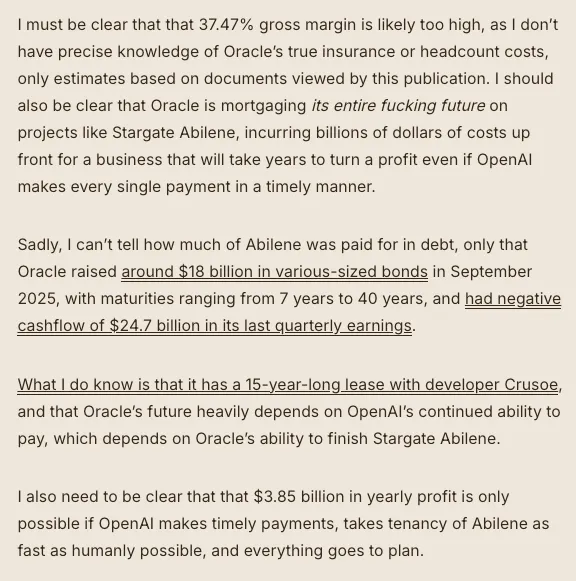
 I must be clear that that 37.47% gross margin is likely too high, as I don’t have precise knowledge of Oracle’s true insurance or headcount costs, only estimates based on documents viewed by this publication. I should also be clear that Oracle is mortgaging its entire fucking future on projects like Stargate Abilene, incurring billions of dollars of costs up front for a business that will take years to turn a profit even if OpenAI makes every single payment in a timely manner.  Sadly, I can’t tell how much of Abilene was paid for in debt, only that Oracle raised around $18 billion in vario...
If OpenAI doesn't make $852 billion by the end of 2030, the Stargate Data Center project will destroy Oracle, as it needs to make $75 billion in annual revenue for its 7.1GW in data centers to keep up with the debt and its negative cash flow.
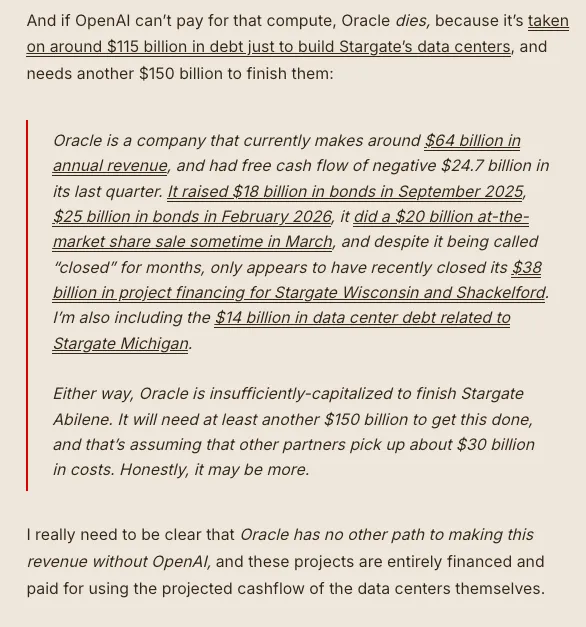
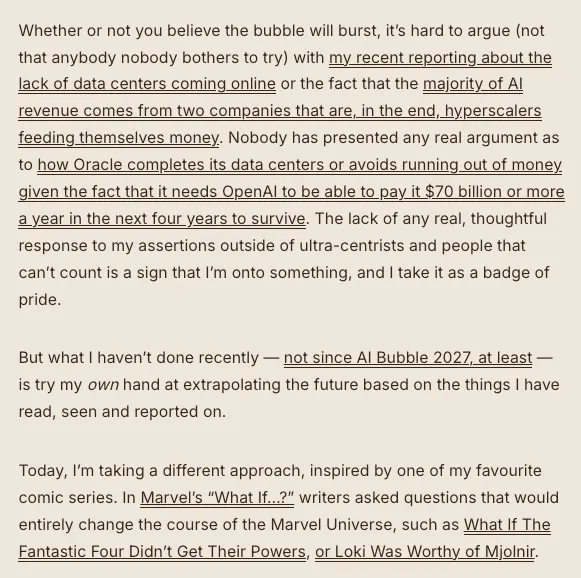
wheresyoured.at/ais-economics-…Yet there’s a larger, more-existential problem with the overall Stargate data center project — that the only way any of it makes sense is if OpenAI meets its ridiculous, cartoonish projections.  As I discussed on Friday:   I’ll repeat the numbers: the 7.1GW of Stargate data centers in progress will make around $75 billion in annual revenue on completion, and cost more than $340 billion in total. Oracle’s free cash flow was negative $24.7 billion, and its other business lines are plateauing, making its negative-to-low margin cloud business its only growth engine.  For OpenAI to actually be a...
Image
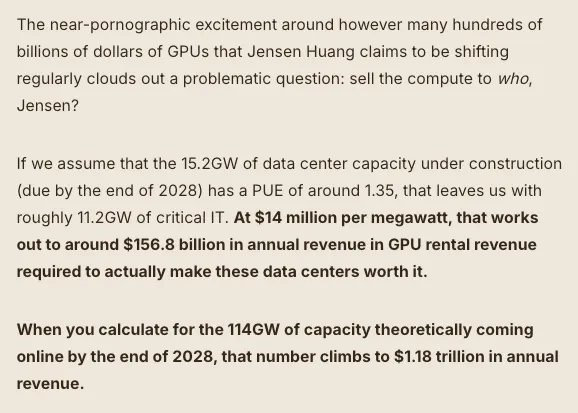
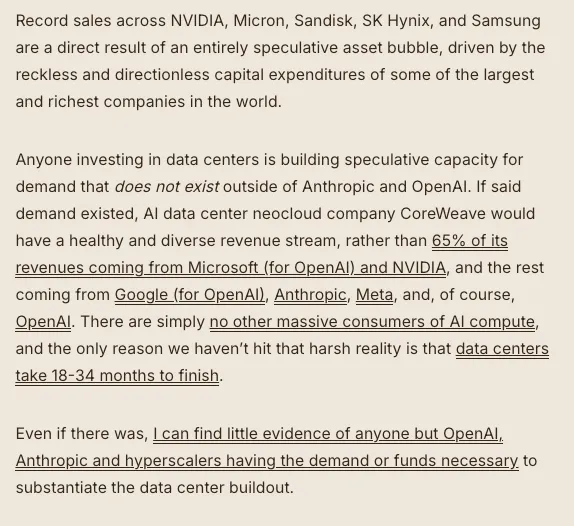
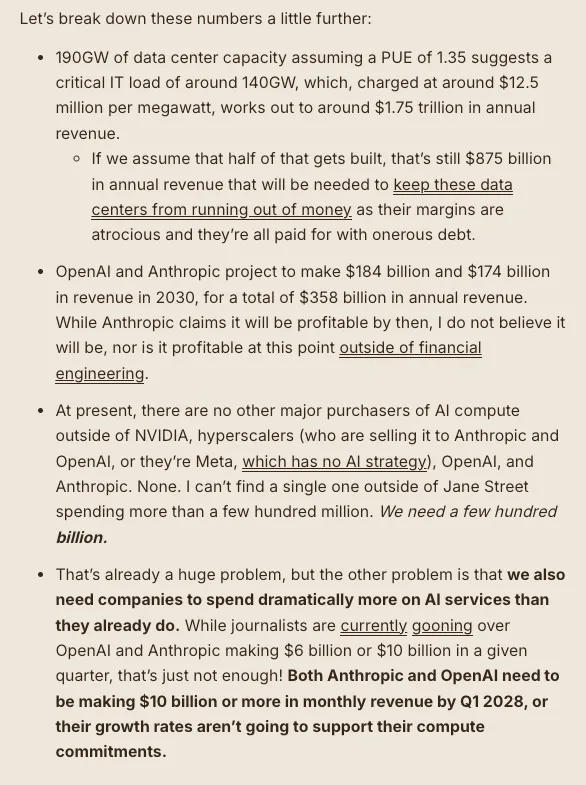
Based on my analysis, for the 15.2GW of in-construction data centers due by the end of 2028 to make sense, they must generate over $156 billion in annual revenue. Right now, I'm struggling to find $2 billion a year outside of OpenAI and Anthropic.

wheresyoured.at/ais-economics-…The near-pornographic excitement around however many hundreds of billions of dollars of GPUs that Jensen Huang claims to be shifting regularly clouds out a problematic question: sell the compute to who, Jensen?   If we assume that the 15.2GW of data center capacity under construction (due by the end of 2028) has a PUE of around 1.35, that leaves us with roughly 11.2GW of critical IT. At $14 million per megawatt, that works out to around $156.8 billion in annual revenue in GPU rental revenue required to actually make these data centers worth it.  When you calculate for the 114GW of capacity ...
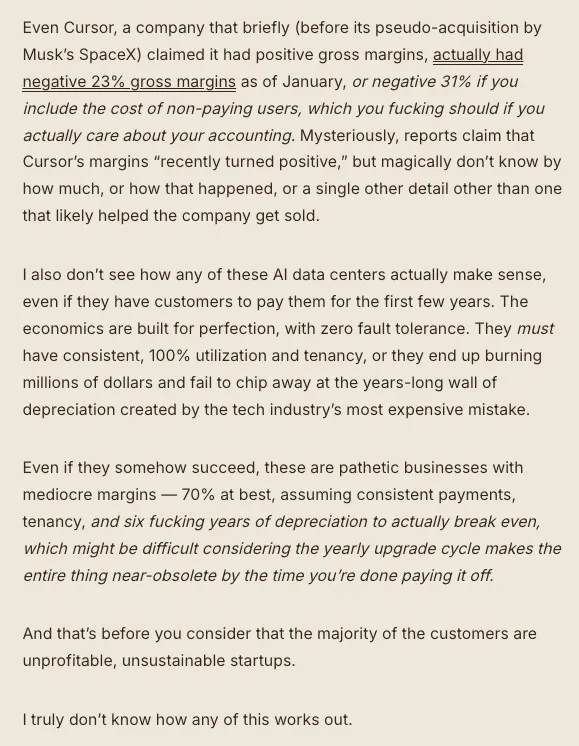
Even Cursor, a company that briefly (before its pseudo-acquisition by Musk’s SpaceX) claimed it had positive gross margins, actually had negative 23% gross margins as of January, or negative 31% if you include the cost of non-paying users, which you fucking should if you actually care about your accounting. Mysteriously, reports claim that Cursor’s margins “recently turned positive,” but magically don’t know by how much, or how that happened, or a single other detail other than one that likely helped the company get sold.  I also don’t see how any of these AI data centers actually make sens...
AI is a con, one rushed to market using unsustainable subscription products to convince people of its benefits while actively obfuscating the real costs that customers would eventually pay. That and rushing to make it seem "inevitable."
wheresyoured.at/ais-economics-…AI is a con, and this is how the con works. AI was rushed and pushed in our faces as quickly as humanly possible in the least-efficient yet most-accessible form it could be presented, even if said form was never going to result in anything resembling a sustainable business. The media was rushed to immediately say that this was the thing so that everybody would agree that this was the thing now and use it as much as physically possible, and, crucially, use it in a subscription-based form that would make people experience it without ever asking how much it costs to provide.  The narrative cam...
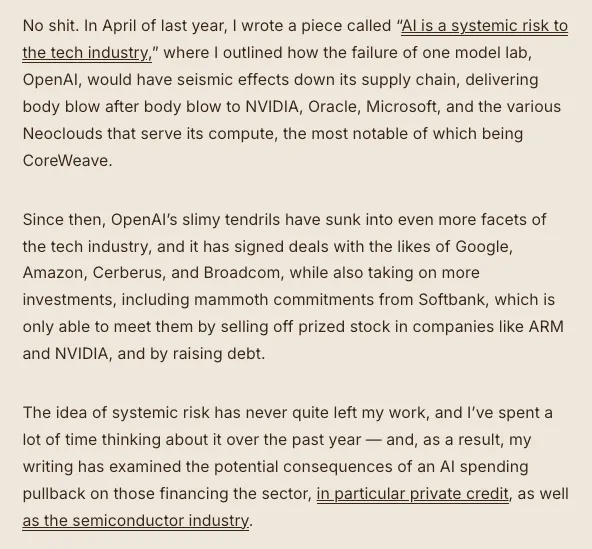
OpenAI must make 10x its current revenue and raise at least $200 billion by 2030 or it will be unable to pay its bills, which will kill Oracle, which will in turn destroy Larry Ellison's wealth.

The warning signs have been there for years.
wheresyoured.at/ais-economics-…The problem is that these men have now signed far too many deals to get away scot-free.   OpenAI’s CFO has now said multiple times that she doesn’t believe OpenAI is ready for IPO, and has material concerns about its growth and continued ability to meet its obligations. To repeat a quote from before:    Chief Financial Officer Sarah Friar has told other company leaders that she is worried the company might not be able to pay for future computing contracts if revenue doesn’t grow fast enough, according to people familiar with the matter.  This is a blinking red fucking light, and in a sane m...
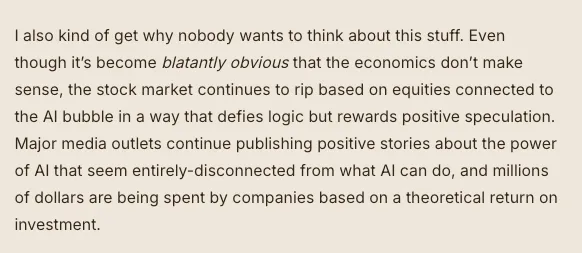
People have debased themselves to defend the AI industry, because that’s what the industry demands of its supplicants. To be an “AI expert” requires you to actively ignore the worst economics of any industry in history, to constantly explain away obvious, glaring issues with products, and to actively convince others to do the same. OpenAI and Anthropic do not provide clear explanations of how they’ll become profitable because they know that their supporters will never ask for them — because the only way to fully “believe in AI” is to actively wear blinders.  And I get it. If you accept that...

• • •

Missing some Tweet in this thread? You can try to force a refresh

 

Keep Current with Ed Zitron

Ed Zitron Profile picture

Stay in touch and get notified when new unrolls are available from this author!

Read all threads

This Thread may be Removed Anytime!

PDF

Twitter may remove this content at anytime! Save it as PDF for later use!

Try unrolling a thread yourself!

how to unroll video
  1. Follow @ThreadReaderApp to mention us!

  2. From a Twitter thread mention us with a keyword "unroll"
@threadreaderapp unroll

Practice here first or read more on our help page!

More from @edzitron

Jun 8
Free newsletter: The ROI debate has come at worst time for Anthropic and OpenAI - two companies that can’t afford to slow down thanks to their $1.1 trillion in compute commitments and a data center buildout that needs a trillion in annual revenue by 2030.
wheresyoured.at/ai-is-slowing-…
My appearance on Bloomberg last week ruffled some feathers because I don't have "skin in the game" (IE: money in the market). This is because AI boosters can't imagine somebody with a moral position on an industry run by grifters and sold with lies.
wheresyoured.at/ai-is-slowing-…Image
The AI industry is anxious because it knows it made too many egregious promises. There are 190GW+ in planned AI data centers, and to justify their existence, they'll need $2 trillion+ in AI compute revenue by 2030.

There's currently less than $100bn.

wheresyoured.at/ai-is-slowing-…Image
Image
Read 12 tweets
Jun 2
Free newsletter: The dawn of token-based billing has shown that generative AI doesn’t have a return on investment. It's too unpredictable, too unreliable, you can't easily measure the cost of tasks, and organizations are already pulling back.
wheresyoured.at/ai-doesnt-have…
Ever since the AI industry started its transition away from subscriptions to token-based billing, users have been hit with sticker shock. Once companies start paying the real cost of AI, they realize there's no measurable ROI to be found.

wheresyoured.at/ai-doesnt-have…Image
GitHub Copilot moved users to token-based billing on June 1 from a request-based system that allowed them to burn thousands of dollars for $39 a month.

Users are currently burning their entire monthly balance in a couple of prompts.

wheresyoured.at/ai-doesnt-have…Image
Image
Read 14 tweets
May 15
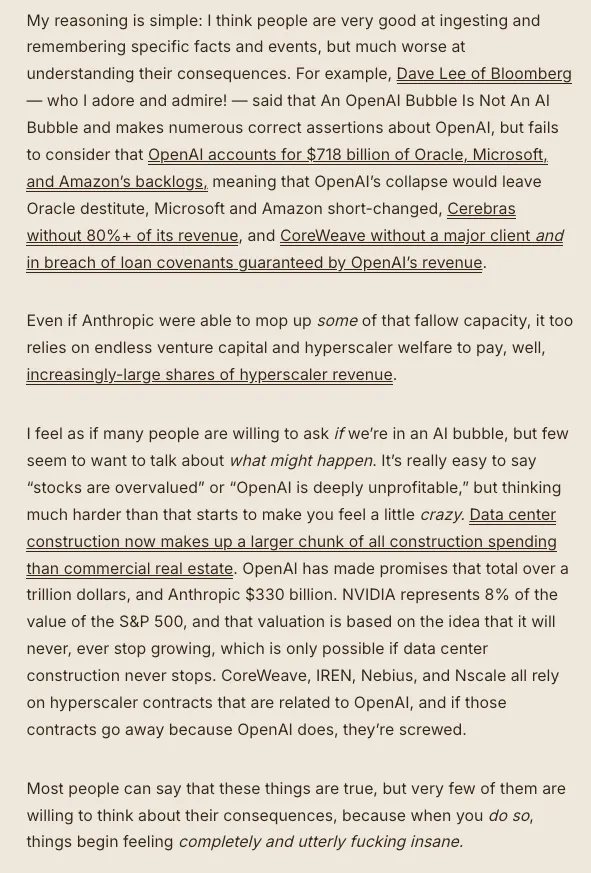
Today’s premium newsletter is part 1 of my What If...We're In An AI Bubble? series, covering scenarios that could burst the bubble starting with token-based billing's destruction of most AI products, and the slow collapse of data center construction.
wheresyoured.at/premium-what-i…
I’ve spent hundreds of thousands of words in the last year talking about the very and scary signs that we are an AI bubble, and the exuberance fueling it. Today is the first time in a long time where I’ve discussed the potential consequences in depth.

wheresyoured.at/premium-what-i…Image
I feel like people are very cavalier when discussing the AI bubble, saying stuff like "we're in an OpenAI bubble," not realizing that the collapse of OpenAI would destroy AI investment, AI startups, and kill debt issuance for AI data centers.
wheresyoured.at/premium-what-i…Image
Image
Read 15 tweets
Apr 24
Premium Newsletter: OpenAI needs to raise or make $852 billion through 2030 to pay for its compute costs, and must pay $75bn a year for Oracle's 7.1GW of Stargate data centers, or Oracle will collapse, destroying its share price and Ellison's empire.
wheresyoured.at/how-openai-kil…
It’s been little over a year since Sam Altman, Masayoshi Son, and Larry Ellison stood shoulder-to-shoulder with Donald Trump to announce the "$500 billion" Stargate data center project. In truth, no entity was ever formed, and no money was invested.
wheresyoured.at/how-openai-kil…It was January 21, 2025. Per The Information, Larry Ellison, CEO of Oracle, had just flown to Washington DC from Florida, and had to borrow a coat “...so he wouldn’t freeze during an interview he did on the White House lawn, according to two people who were involved in the event.” He was there to announce a very big — some might even say huge — new project standing next to SoftBank CEO Masayoshi Son and OpenAI CEO Sam Altman.  “Together, these world-leading technology giants are announcing the formation of Stargate, so put that name down in your books, because I think you’re gonna hear a lo...
After he was done, Ellison stepped to the podium. “The data centers are actually under construction, the first of them are under construction in Texas. Each building’s a half a million square feet, there are ten buildings currently being built, but that will expand to 20.”  Following Ellison, SoftBank’s Masayoshi Son added that Stargate would “...immediately start deploying $100 billion dollars, with the goal of making $500 billion dollars within [the] next four years, within your town!” turning to Donald Trump with his hands extended. It was unclear what town he was referring to.  Altman a...
The "$500 Billion" Stargate data center project is really a $340 billion, 7.1GW Oracle-and-debt-funded construction nightmare. Outside of Abilene - which existed before the announcement - these data centers are mostly scaffolding and steel beams.
wheresyoured.at/how-openai-kil… It’s been 15 months, and Stargate LLC has never been formed. SoftBank and OpenAI have contributed no capital to the project, other than SoftBank’s own acquisition of a former electric vehicle manufacturing plant in Lordstown, Ohio that it intends to turn into a data center parts manufacturing plant with Foxconn, which is best known for effectively abandoning a $10 billion factory in Wisconsin back in 2021. Oh, and Project Freebird, a SoftBank-built project that exists to funnel money to its subsidiary SB Energy, though I can’t imagine how SoftBank actually funds it.  No government money wa...
Read 15 tweets
Mar 9
$5 billion TO DATE? This heavily suggests that Anthropic? Over $10 billion in inference and training costs? This heavily suggests that almost every story about Anthropic’s revenue and costs they’ve leaked is wrong and that it’s been misleading the media.
Remember: reports said Anthropic made $4.5bn for all of 2025, and all of this guff about “$19bn in annualized revenue” no longer make sense, especially as that “exceeds $5 billion” line is from a lawsuit filed in *march*. This is a scandal! Image
The only thing that makes sense here is that Anthropic’s 2025 revenues were much lower than $4.5 billion. $5bn ALL TIME? Through march? Remember this is filed with a court. Suggests Anthropic is a much much smaller business than we believed
Read 5 tweets
Jan 23
Premium: The AI Bubble is a time bomb, burdening hyperscalers with billions of new depreciation a quarter that will soon eat away profits, VCs with dead equity in fallen AI startups, and Oracle with hundreds of billions of unpayable leases.
wheresyoured.at/premium-timebo…
A year ago, I wrote that Coreweave was a timebomb — a rickety tower of debt and bad deals that was primed to blow.
I could have made that argument about hyperscalers, NVIDIA and OpenAI. Everybody is waiting for somebody else to make AI a success.

wheresyoured.at/premium-timebo…Image
Image
The AI bubble is slowly turning cash-rich, margin-heavy hyperscalers into something far worse. Now these asset-light, high-margin software companies are becoming bloated, filled with tens of billions of dollars in GPUs and data centers.
wheresyoured.at/premium-timebo…Image
Read 15 tweets

Did Thread Reader help you today?

Support us! We are indie developers!


This site is made by just two indie developers on a laptop doing marketing, support and development! Read more about the story.

Become a Premium Member ($3/month or $30/year) and get exclusive features!

Become Premium

Don't want to be a Premium member but still want to support us?

Make a small donation by buying us coffee ($5) or help with server cost ($10)

Donate via Paypal

Or Donate anonymously using crypto!

Ethereum

0xfe58350B80634f60Fa6Dc149a72b4DFbc17D341E copy

Bitcoin

3ATGMxNzCUFzxpMCHL5sWSt4DVtS8UqXpi copy

Thank you for your support!

Follow Us!

:(