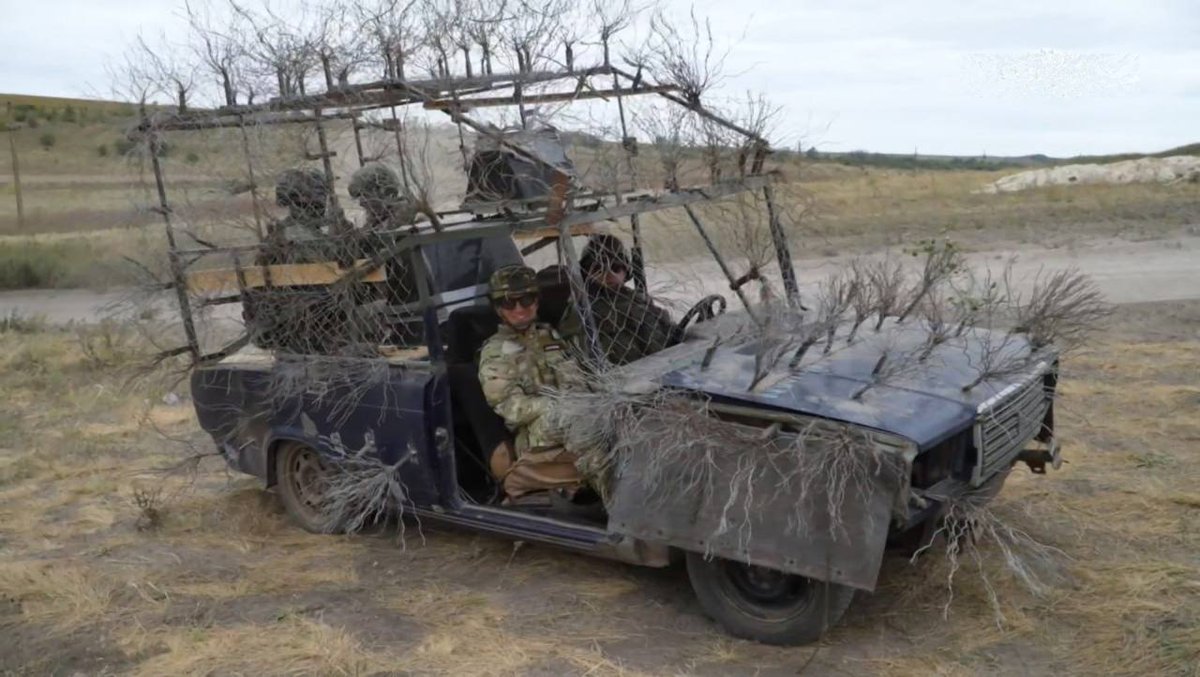
1/ Tuapse is on fire again, and once again Russians are asking why their air defences are so inadequate. Prominent Russian drone developer Alexey Chadayev blames the lack of any clearly defined responsibility for air defence.
https://x.com/maria_avdv/status/2049221307548500292
2/ Chadayev is the head of the Ushkuynik Research and Production Centre, a leading Russian drone development group. In a commentary on his Telegram channel, he highlights how disorganisation and unclear responsibilities are undermining Russian air defences.
3/ This is in marked contrast to Ukraine, where the Ukrainian Air Force is responsible for a highly organised, multi-layered, hybrid system which incorporates sophisticated detection systems with dispersed and mobile countermeasures. Russia has never been able to replicate this.
4/ Chadayev writes:
"Basically, our "Ushkuynik" was created from the very beginning with a focus on counter-drone solutions, not on attack and reconnaissance frontline drones."
"Basically, our "Ushkuynik" was created from the very beginning with a focus on counter-drone solutions, not on attack and reconnaissance frontline drones."
5/ "However, while we've achieved some success in the latter area over the past two years, we haven't demonstrated any significant results in the former, which is even reflected in the name of our research and development centre.
6/ "The reason for this is simple: frontline drones have a clearly defined customer—the Russian Ministry of Defence. Counter-drone solutions, over all these years, have never found such a customer.
7/ "We thought the facility owners would be the ones to make those requests, but no, they're still sitting there waiting for someone to come and defend them.
8/ "In a sense, they can be understood: it's not just a question of equipment and training, but also a question of the authority that no one has given them for such self-defence.
9/ "Moreover, the specialised security structure responsible for covering rear facilities has still not been determined. Consequently, the solutions we have are simply unavailable to us, and we have no one to work with to bring them to a mass-produced level.
10/ "Currently, at Ushkuynik, we are studying the experience of mobile fire teams, both ours and the enemy's.
11/ "The enemy is a separate topic, but as for our country, there is currently no competence centre that would summarize this experience and develop methods for zone and facility defence.
12/ "There are no training grounds where simulated attacks can be regularly organised and various countermeasures can be tested. There is no inexpensive, mass-produced flying target on which to hone marksmen's skills, nor is there a contract for its development or production.
13/ "There is no analytical group that would collect information on past attacks and analyze their progress. There are many other “no’s,” but the main thing is that there is no responsible structure that would turn all these “no’s” into “yes.”
14/ "The "defend yourself" solution is bad, but honestly, it would be better. Why is it bad? Because we see what's happening where these mobile fire teams are actually created.
15/ "First, they simply don't know how to shoot; no one systematically trains them to fire at moving flying targets. Second, they huddle close to the objects they're defending (instead of moving to the defensive lines as planned),…
16/ …and suddenly discover that even after hitting an aircraft, it continues to fly a couple of kilometers back to where it was headed by inertia—and, yes, debris falls on the target.
17/ "Third, service members (both military and others) are terrified of the responsibility of a downed drone falling on something, someone else's, and they'll be the ones held responsible—and there are cases (I even have video proof) where they fire like crazy ("we tried"),…
18/ …just to make sure they don't miss their target.
I could go on, but I repeat, I see no point in fueling the treason. What I consider the most difficult thing for our system is, firstly, recognizing the problem (oddly enough).
I could go on, but I repeat, I see no point in fueling the treason. What I consider the most difficult thing for our system is, firstly, recognizing the problem (oddly enough).
19/ "Secondly, recognizing that it currently lacks an "owner" (military air defence in its current form simply cannot function as such organisationally) and appointing that "owner" by directive.
20/ "Thirdly, resolving the issue of authority and responsibility—this is a legal matter, not even a management one.
21/ "Fourthly, adopting at least some kind of plan for how all this will work—if it proves poor or insufficient, it can always be adjusted, but it's important that it exists.
22/ "The problem isn't that we're suffering losses, nor even that they're completely unnecessary. The problem is that we're losing organisational momentum, chronically lagging behind the enemy's response speed.
23/ "What's flying at us now isn't some kind of miracle weapon; it can and should be shot down. This isn't a question of a lack of technology, it's a question of management decisions." /end
Source:
t.me/chadayevru/4736
Source:
t.me/chadayevru/4736
• • •
Missing some Tweet in this thread? You can try to
force a refresh