
1/ The world faces a catastrophic cliff-edge shortage of oil due to the Strait of Hormuz blockade in the next four weeks, analysts warn. This will cause a deep recession, fuel rationing, the shutdown of entire industries, and oil prices potentially as high as $370 per barrel. ⬇️ 
2/ A month ago, JP Morgan published a report highlighting that the last oil shipments from the Persian Gulf countries would be delivered by 20th April. That date has come and gone, and oil shipments via the Strait of Hormuz have not resumed.
https://x.com/ChrisO_wiki/status/2038187681935401098
3/ Limited amounts of Gulf oil have continued to be pumped via pipelines to ports on the Red Sea and Arabian Sea. However, instead of producing enough oil supply to meet global demand, the world has been relying on emergency stockpiles.

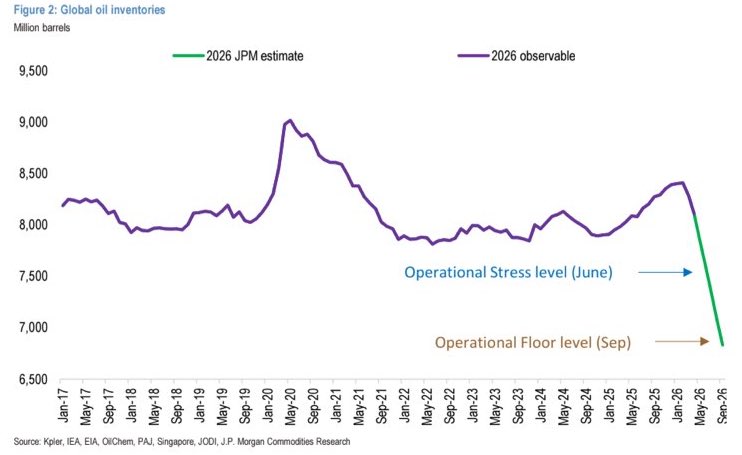
4/ According to Goldman Sachs, global oil inventories are draining at a record pace of 11 million to 12 million barrels per day. A new report from JP Morgan highlights how long is left before this becomes unsustainable.

5/ At the start of 2026, around 8.4 billion barrels of oil and oil products were in stock, comprising 6.6 billion barrels on land and 1.8 billion barrels afloat in ships. This consisted of approximately 5.2 billion barrels of crude oil and 3.2 billion barrels of refined products.
6/ However, only about 800 million barrels of this stockpile is usable without putting the system under operational stress. 280 million barrels had already been used by 23 April – a drawdown of 35%.
7/ JP Morgan assesses that only about 580 million barrels of onshore stocks are actually readily available. The rest is tied up in pipelines, minimum levels in tanks, technical stocks and other operational necessities.
8/ Drawing more than this has major risks of causing harm to infrastructure. For instance, pipelines lose flexibility, terminals become unable to operate, and refineries lose the feedstock they need to function, putting the basic infrastructure in jeopardy.
9/ Oil on water is the most easily accessible and is already being drawn down at 2.7 million barrels per day. Another 2.2 million barrels per day are coming from commercial on-shore storage. Finally, national strategic reserves account for 2.5 million barrels per day.
10/ These stockpiles are being depleted rapidly, which traders warn is leading to a 'tipping point' by the end of May. From the start of June, JP Morgan says, oil stockpiles will be under "operational stress" and will reach an "operational floor" by the end of June.
11/ Traders are warning of oil prices of $200 to $250 per barrel, but say "you can pick a number... We will just not have any buffers." Some estimates, based on a worst case scenario (such as the Arabian pipelines being disabled by new Iranian attacks) go as high as $372.
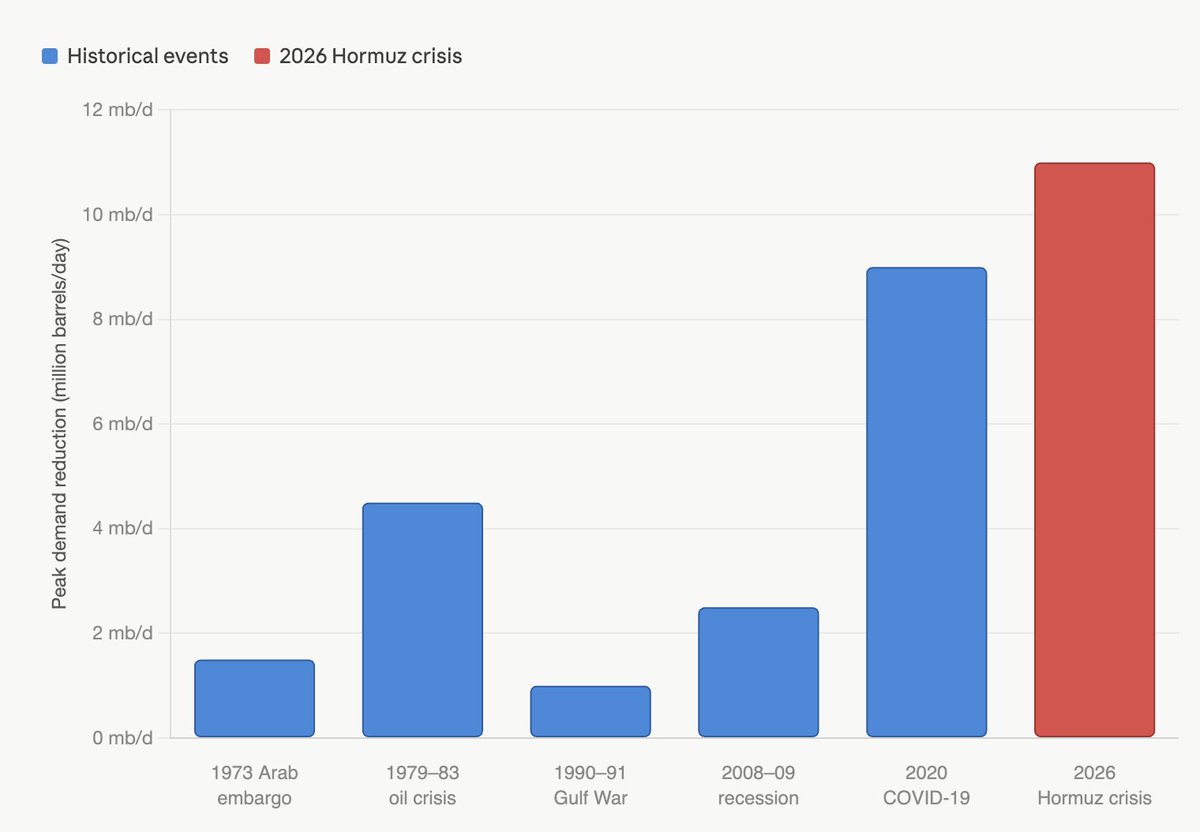
12/ This will result in demand destruction on a huge scale – the physical cessation of fuel use, caused by rationing or excessively high fuel prices. Global oil usage will have to be reduced by an unprecedented 11 million barrels per day to match the remaining supply.
13/ This far exceeds the previous drop of 9 million barrels per day caused by the COVID-19 pandemic. In each of the three previous worldwide recessions or oil crises (1973-74, 1979-83, 2008-09), oil demand was reduced by no more than 5 million barrels per day.
14/ Unlike most of the previous crises, the current one has been accompanied by major damage to physical infrastructure. This will make recovery even longer, prolonging the economic pain by months if not years.
https://x.com/NOELreports/status/2028380454097711472
15/ An analyst at oil trader Gunvor warns of "huge pain" and says: "We do not have months... It goes beyond gasoline at the pumps to industry shutting down and you enter recession. The tipping point is clearly June. This is the point at which something has to give."
16/ The world has never previously successfully absorbed 11 mb/d of demand destruction through price and market mechanisms alone. Every time anything close to that scale occurred, it was either imposed by government edict (COVID lockdowns) or took years to unfold gradually.
17/ The current crisis is demanding that the market achieve something historically unprecedented, on a timeline of weeks to months. Oil prices of $200 per barrel or higher are a realistic possibility once "price increases become exponential rather than linear.”
18/ A Macquarie Group analyst comments that "prices would need to move high enough to destroy an historically large amount of global oil demand, with some countries, particularly in Asia, already facing physical shortages."
19/ "And with the global economy much less oil intensive than 50 years ago, we would not be surprised if that would require historically high real prices – over $200 per barrel – for a time, which would equate to [an average] U.S. gasoline price of around $7 per gallon."
20/ Exactly two months into the Iran War, the world is in phase 3 of the five identified in this mid-March analysis. Physical shortages and rationing are already appearing in Asia, which ran out of Gulf oil about two weeks before Europe and the US. Brent Crude is around $115.

21/ Asian markets account for 80% of crude oil and LNG transiting through Hormuz, with China, India, Japan, and South Korea accounting for the bulk of demand. Pakistan relies on Gulf supplies for 99% of its LNG, with 80% of Vietnam's crude oil coming from Kuwait.
22/ Asian countries have seen factories shutting down, fuel rationing and other conservation measures imposed by governments, shortages of cooking gas, over 150,000 flight cancellations, and severe strain on power networks which are now suffering from a lack of fuel.
23/ These effects have not yet been seen on a large scale in the West – but with the blockade of the Strait of Hormuz persisting, it's clearly only a matter of time.
24/ With President Trump saying he will continue the blockade for "months", it's now a question of which will break first – the Iranian economy, or the world's. /end
https://x.com/atrupar/status/2049557842881867887?s=20
Sources:
🔹 "The Illusion of Plenty". JP Morgan Oil Flash Note (30 April 2026, subscribers only)
🔹 ft.com/content/b26ba4…
🔹 oilprice.com/Energy/Energy-…
🔹 finance.yahoo.com/sectors/energy…
🔹 fortune.com/2026/04/24/oil…
🔹 "The Illusion of Plenty". JP Morgan Oil Flash Note (30 April 2026, subscribers only)
🔹 ft.com/content/b26ba4…
🔹 oilprice.com/Energy/Energy-…
🔹 finance.yahoo.com/sectors/energy…
🔹 fortune.com/2026/04/24/oil…
• • •
Missing some Tweet in this thread? You can try to
force a refresh






