The El Dorado Report 2026: how much revenue independent hospitality operators are already generating but losing, every day, because they cannot see where the leak is.
Spoiler: it's a lot. 2-8% of annual revenue, depending on market.
Spoiler: it's a lot. 2-8% of annual revenue, depending on market.
The headline: across Europe's five biggest tourism markets, independent operators are sitting on a recoverable revenue wedge of €6.5B to €26.1B.
Not new demand. Demand that already arrived but converted at lower rates than it should have.
Not new demand. Demand that already arrived but converted at lower rates than it should have.
For Spain alone, on the base case (5%): €6.3B.
That's not the whole tourism market. That's the share of independent operator revenue plausibly improved through better response time, language coverage, and unread-data analysis.
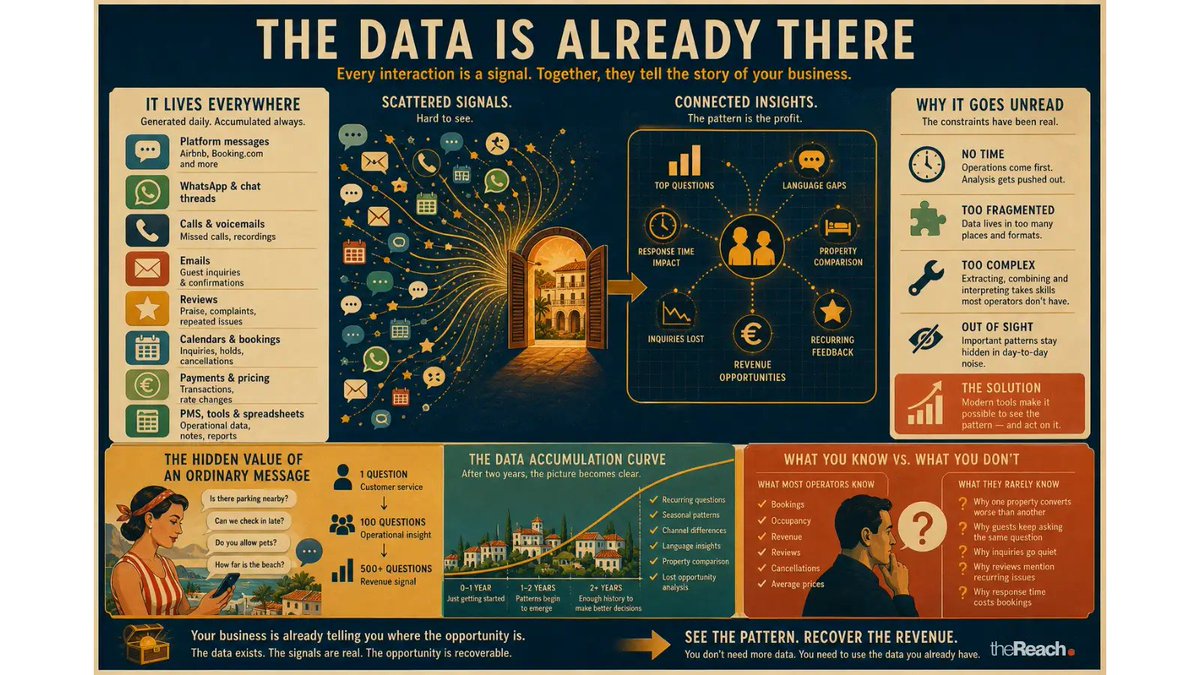
The data already arrived. Most of it never gets read
That's not the whole tourism market. That's the share of independent operator revenue plausibly improved through better response time, language coverage, and unread-data analysis.
The data already arrived. Most of it never gets read
The reason this report could not have been written two years ago:
The infrastructure barrier between independent operators and chain hotels collapsed in late 2024.
Specifically: Anthropic's MCP launched November 25, 2024. By Q1 2026: 9,400 servers, cross-vendor adoption.
The infrastructure barrier between independent operators and chain hotels collapsed in late 2024.
Specifically: Anthropic's MCP launched November 25, 2024. By Q1 2026: 9,400 servers, cross-vendor adoption.
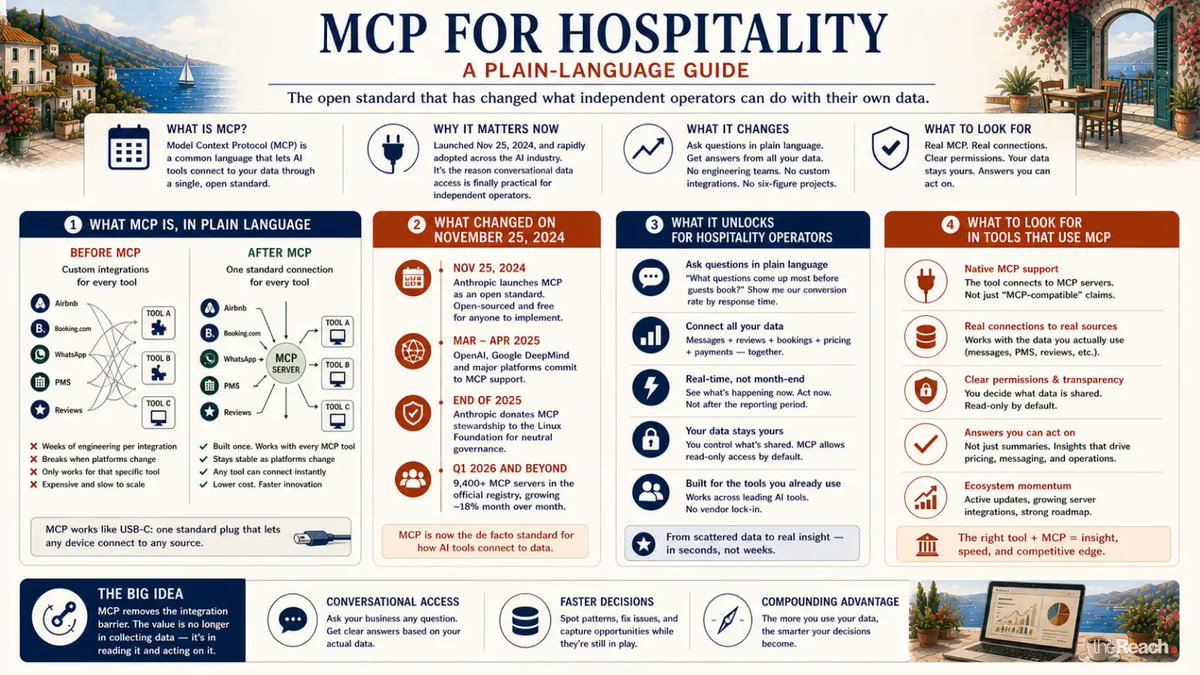
What that means in practice:
Before MCP — every AI tool needed custom integrations to read your data. Weeks of engineering per source. Cost-prohibitive for independents.
After MCP — one open standard. Independent operators can ask conversational questions of their own data.
Before MCP — every AI tool needed custom integrations to read your data. Weeks of engineering per source. Cost-prohibitive for independents.
After MCP — one open standard. Independent operators can ask conversational questions of their own data.

The five operational levers we identified, ranked by yield-per-effort:
→ Faster response on first-message inquiries
→ Coverage of guests' actual booking languages
→ Sharper pricing visibility
→ Recovery of inquiries that go quiet
→ Repeat-guest follow-up
→ Faster response on first-message inquiries
→ Coverage of guests' actual booking languages
→ Sharper pricing visibility
→ Recovery of inquiries that go quiet
→ Repeat-guest follow-up
The most overlooked of these is multilingual reach.
28% of travellers say language barriers hold them back from booking (, n=20,500).
Most independent operators serve a language-constrained subset of their own market without realising it. Booking.com
28% of travellers say language barriers hold them back from booking (, n=20,500).
Most independent operators serve a language-constrained subset of their own market without realising it. Booking.com

Country-by-country, the gap is sharp.
Spain operators: German is the highest-value non-covered language. 11.9M German visitors in 2024, above-average spend.
Italy operators: German first (19% of arrivals), then English (17.5% combined US+UK).
Spain operators: German is the highest-value non-covered language. 11.9M German visitors in 2024, above-average spend.
Italy operators: German first (19% of arrivals), then English (17.5% combined US+UK).
We built a calculator. It produces an El Dorado Score (0-100) measuring how much of this opportunity sits inside any specific operator's operation.
Two components: Automation Reach (movable in weeks) + Analytical Reach (compounds over time).
Two components: Automation Reach (movable in weeks) + Analytical Reach (compounds over time).

Five score bands:
80+: Extraction-ready. Strong data signals, clear opportunities.
60-79: High-yield.
40-59: Untapped.
20-39: Surface-level.
<20: Unmined (typical of early-stage operations).
Most operators score in the 40-60 range. Most don't realise it.
80+: Extraction-ready. Strong data signals, clear opportunities.
60-79: High-yield.
40-59: Untapped.
20-39: Surface-level.
<20: Unmined (typical of early-stage operations).
Most operators score in the 40-60 range. Most don't realise it.
The 30-day playbook for any operator who scores Untapped or below:
Week 1: Diagnose (read 90 days of guest messages, find recurring questions).
Week 2: Easy wins (close one recurring question, fix one response-time gap).
Week 1: Diagnose (read 90 days of guest messages, find recurring questions).
Week 2: Easy wins (close one recurring question, fix one response-time gap).
Week 3: Reduce friction (multilingual coverage, durable response process).
Week 4: Build the habit.
Week 4: Build the habit.
The window matters.
In 2026: this is a meaningful operator advantage.
By 2028: it will be normal practice.
By 2030: it will be expected baseline.
In 2026: this is a meaningful operator advantage.
By 2028: it will be normal practice.
By 2030: it will be expected baseline.
The compounding accrues to operators who begin now. Not because the capability disappears later.
Because the advantage of having the capability does.
Because the advantage of having the capability does.
The full report:
→ 12,000 words across 10 sections
→ 5 methodology spokes
→ 17 information panels
→ Methodology open, all sources cited
→ 12,000 words across 10 sections
→ 5 methodology spokes
→ 17 information panels
→ Methodology open, all sources cited
The pillar: thereach.ai/el-dorado
The calculator: thereach.ai/el-dorado/calc…
The 2-page exec summary: thereach.ai/el-dorado/el-d…
The calculator: thereach.ai/el-dorado/calc…
The 2-page exec summary: thereach.ai/el-dorado/el-d…
You don't need more data.
You need to use the data you already have.
That's the entire thesis. Everything else is execution.
Read it. Push back. The methodology is open.
— @thereachai
You need to use the data you already have.
That's the entire thesis. Everything else is execution.
Read it. Push back. The methodology is open.
— @thereachai
@threadreaderapp unroll
• • •
Missing some Tweet in this thread? You can try to
force a refresh