As one who is often asked about RU domestic politics, I remained sceptical about the recent "intel report". There are several factual anomalies / obvious facts masqueraded as secrets that stand out. A short thread: 1/16 istories.media/en/stories/202…
Putin "fears the use of drones for a possible assassination attempt". This is a well-know fact. FSO operatives have been carrying portable drone interceptors for a while. 2/16
"Visitors to the Presidential Administration undergo two levels of screening, including a full body search by FSO officers." AFAIK, the PA has several layers of access. And two levels of screening (body search + scanners, I assume) are completely normal even in peacetime. 3/16
"The FSO has significantly reduced the list of locations regularly visited by the president." An aggressor state does not want to disclose the location of its commander in chief? Big if true. 4/16
"Putin has often taken refuge in renovated bunkers, particularly in the Krasnodar region, where he may work for weeks." These are also natural developments. The chief commander sits close to military decision-makers in a protected facility 5/16
"FSO officers conduct large-scale checks using canine units and are also deployed along the Moscow River." So the FSO is conducting a routine check up procedures around the Kremlin when state leadership is in the city? 6/16
"Sergei Shoigu, [], who retains significant influence within the military command, is associated with the risk of a coup attempt." Military command or the MOD? Meanwhile, he and his daughter are running high-profile REM projects on Putin's behalf: 7/16 ecfr.eu/article/ore-an…
"The arrest of his former first deputy, Ruslan Tsalikov, on March 5, 2026, is seen as a violation of informal guarantees of safety for elites" In 2012, the whole ex-minister was interrogated as a witness in a purge after his removal. No coup. 8/16 kommersant.ru/doc/2259823
Also, is this the same Tsalikov who was using an iPhone at work in 2023? So the military will do a coup for Tsalikov's iPhone and his corrupt dachas, rather than for a relatively popular wartime figure like General Popov? 9/16 dossier.center/iphone-spy/
"The Chief of the General Staff also complained about a lack of personnel for the physical protection of officers in rear areas." Unrealistic, RUAF has GRU, military police, and dedicated security units for such purposes. 10/16
The FSB head "defended himself by stressing the impossibility of systematically preventing such attacks." Do the authors claim that the head of the chief internal security agency told Putin to his face that his service could not prevent sabotage? This is unrealistic 11/16
"Emphasizing that these attacks cause fear and disorganization within the ranks of the Russian Armed Forces." RU has sustained a huge war with a lot of KIAs, and are its officers are disorganised by the fear of death? The opposite is in their job description 12/16
"Vladimir Putin’s decision, made at the request of the General Staff, demonstrates the political weight of Valery Gerasimov, who succeeded in this "arbitration." This is as empty as it is actually contradictory.. -> 13/16
(1) Allegedly expanding enhanced protection has nothing to do with "political weight". It is an op. decision and has no influence on country's politics. (2) So Putin fears a military coup & simultaneously sides with the chief mil commander? 14/16
"The large-scale internet shutdowns in Moscow are carried out by the FSO rather than the FSB, as reported by some media outlets, had been told to Important Stories a month earlier by a former FSB officer." Or maybe it's the same FSB officer spreading the same rumour? 15/16
Therefore, I remain sceptical about this report. Even if such a coup threat were real and European agencies were aware of it, would they really leak this information? They could have sent a letter to the Kremlin to warn everyone there too then. 16/16
FWIW, don't get me wrong. I believe that there're probably some growing cracks in RU this year, as the war's going nowhere, the economy's getting worse, huge losses, UA strikes look bad and society is tired and wants the war to end. But the presented scenario looks unrealistic...
• • •
Missing some Tweet in this thread? You can try to
force a refresh

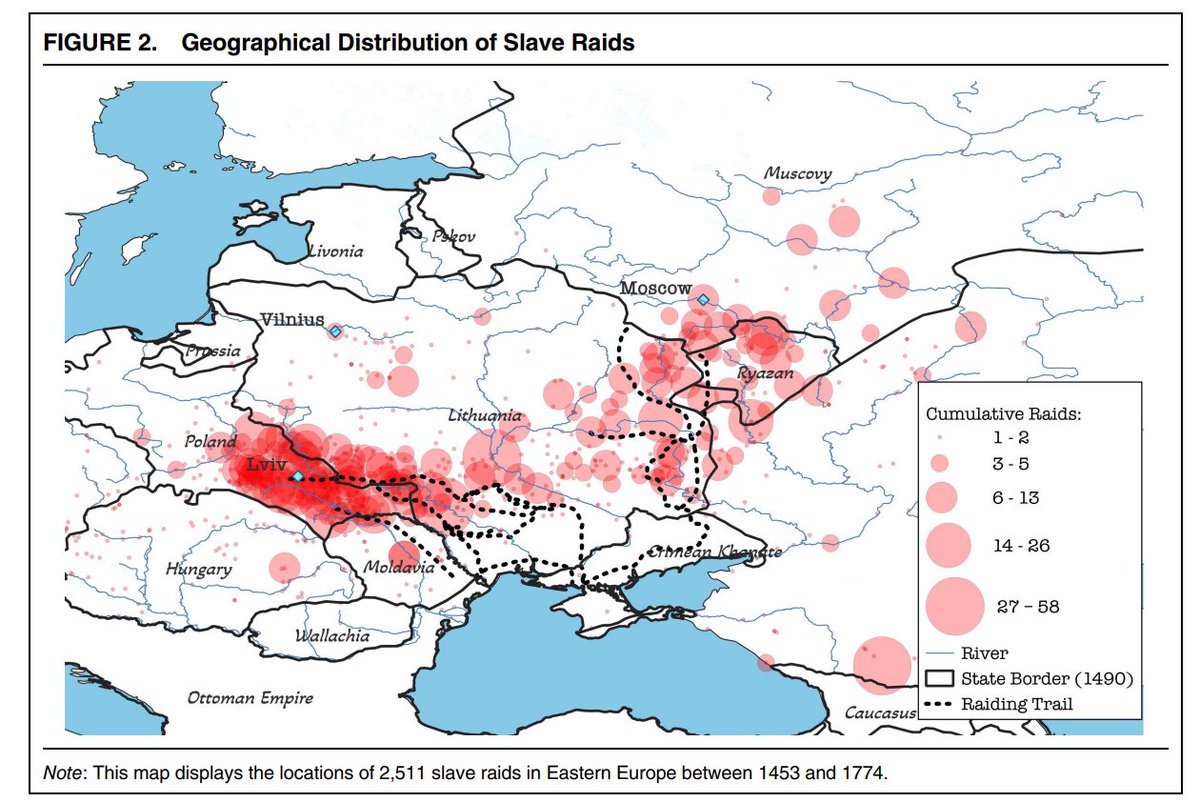
Fascinating research about slave trade in Eastern Europe. Do you know that at least 5 million people from Lviv to Moscow were captured and sold from Crimea overseas in 15-18 centuries? After West Africa, the region was the largest source of slaves in the early modern world. 1/6
Most captives were marched to Crimea and shipped to Ottoman markets in Constantinople, Cairo, Damascus via a merchant network. Survivors not ransomed were sold locally. The Crimean Khanate built its entire economy around the raids. 2/6
What research shows is that Eastern Europe's experience diverges sharply from West Africa's. There, European demand pushed rulers to adopt extractive institutions optimized for slave production — fueling violence, low trust and instability that stunted growth for generations. 3/6
Good discussion on RU elites with @amenka and Ekaterina Schulmann, 2 leading analysts of Russia. The provocative Q "why RU elites do not overthrow Putin" sounds simplistic, but the complexity hides behind risk calculus, rents, fear, and coordination. 1/10
Prokopenko’s point: there is no single “Russian elite.” There are patronal pyramids tied to Putin, each fighting for rents and access. Regime stability depends less on loyalty than on whether the system can still distribute enough resources to keep them aligned 2/10
War, sanctions, and economic degradation matter because they shrink the pie for competition. However, it does not produce revolt automatically but raises stress inside the pyramids, while fear and coordination failures still make the status quo look safer than change 3/10
Gen (R) Baluevsky (RU CGS 2004-08) and Ruslan Pukhov (head of @CentreAST) published an interesting article on the future of war saturated with digital technologies. A thread. 1/20
Miniaturization and cheaper components plus true networking are producing mass participation of drones of many types, forms, sizes, and roles. The bulk of drones are ever smaller and cheaper yet longer-range and more autonomous 2/20
Drones combine reconnaissance and strike roles in one frame. The tactical battlefield and rear areas tens of kilometers from the line of contact become, in effect, universal kill zones. Counter-drone measures become the first priority 3/20
Returning to my notes. The trip was illuminating, as it helped me to reconnect with people there and test some of my assumptions about the country, its society, the war, and the potential for negotiations. A thread with general and not scientific observations. 1/10
I have three immediate observations. 1: UA was barely mentioned in conversations about the war and West-RU relations. It felt like UA was seen either a tool or an obstacle to achieving RU FP goals. RU has a broader view of the conflict than how Europeans discuss it. 2/10
2: the mood was pessimistic yet confident. My interlocutors saw that the war offered no immediate benefits. However, nobody wants defeat, and people are confident that RU can endure whatever it takes ("burn our future for a few khutors" as one framed) to achieve victory. 3/10
Sad news about Viacheslav Morozov. A lot has been said about it, but I've noticed two worrying patterns of reaction that I think need to be highlighted 1/10
When the arrest happened a lot of academics were in disbelief. They claimed he had anti-Putin beliefs, was nice and smart. Allegedly that is why he could not be an agent. In my chats, even now some people say “but he was vocally anti-Putin!” 2/10
I don't know what people expect of a RU agent. Wear a Soviet flag? Shout "Crimea is ours" as a greeting? RU independent media has done a lot to portray the RU secret services as stupid and ineffective. It’s a classic “survivorship bias”. The smart ones are not (yet) caught. 3/10
Yesterday Lithuania commemorated the January events in Vilnius when 14 people were killed by the Soviet army and the KGB in an attempt to thwart Lithuanian independence. This story is relevant today and offers some lessons about Moscow's playbook and how to stop it. A thread 1/12
In response to LT declaration of independence on March 11, 1990, Gorbachev demanded its revocation. The USSR's reaction was to tighten its grip on the country, deploying troops, seizing archives, and targeting young Lithuanians avoiding conscription. 2/12
The declaration of independence was a moment that many Lithuanians waited for long. About 20% of Lithuanians were pro-Soviet: the capital's workers, whose factories had shut down, and many public servants who did not want to lose their seats. 3/12