The Decline of the Royal Navy – 1998 to May 2026
Views my own, corrections and comments welcome
Draft in haste - I’m at New Statesman event, listening to the great and the good talk “defence”
For those attending - I was the guy in the corner typing away 🕵️♂️
1/25
The Royal Navy enters 2026 as a shadow of its former self. Once a global force with dozens of escorts, it now struggles with historic lows in hull numbers and availability. The discreet withdrawal of HMS Iron Duke – a Type 23 frigate that received over £100m in refit spending – leaves just five available frigates. This is not an isolated incident but the result of decades of mismanagement. This thread tries to give some context.
Views my own, corrections and comments welcome
Draft in haste - I’m at New Statesman event, listening to the great and the good talk “defence”
For those attending - I was the guy in the corner typing away 🕵️♂️
1/25
The Royal Navy enters 2026 as a shadow of its former self. Once a global force with dozens of escorts, it now struggles with historic lows in hull numbers and availability. The discreet withdrawal of HMS Iron Duke – a Type 23 frigate that received over £100m in refit spending – leaves just five available frigates. This is not an isolated incident but the result of decades of mismanagement. This thread tries to give some context.
Historical Context: The Long Retreat
2/25
The decline accelerated with the 1998 Strategic Defence Review under Tony Blair’s government. The post-Cold War “peace dividend” saw the escort fleet shrink from around 35 vessels in the early 1990s. Subsequent SDSRs in 2010 and 2015 imposed further cuts, including premature retirement of Type 22 and Type 42 ships and capping Type 45 destroyers at six instead of twelve. No new frigates were ordered for over two decades, creating a procurement “valley of death”.
2/25
The decline accelerated with the 1998 Strategic Defence Review under Tony Blair’s government. The post-Cold War “peace dividend” saw the escort fleet shrink from around 35 vessels in the early 1990s. Subsequent SDSRs in 2010 and 2015 imposed further cuts, including premature retirement of Type 22 and Type 42 ships and capping Type 45 destroyers at six instead of twelve. No new frigates were ordered for over two decades, creating a procurement “valley of death”.
3/25
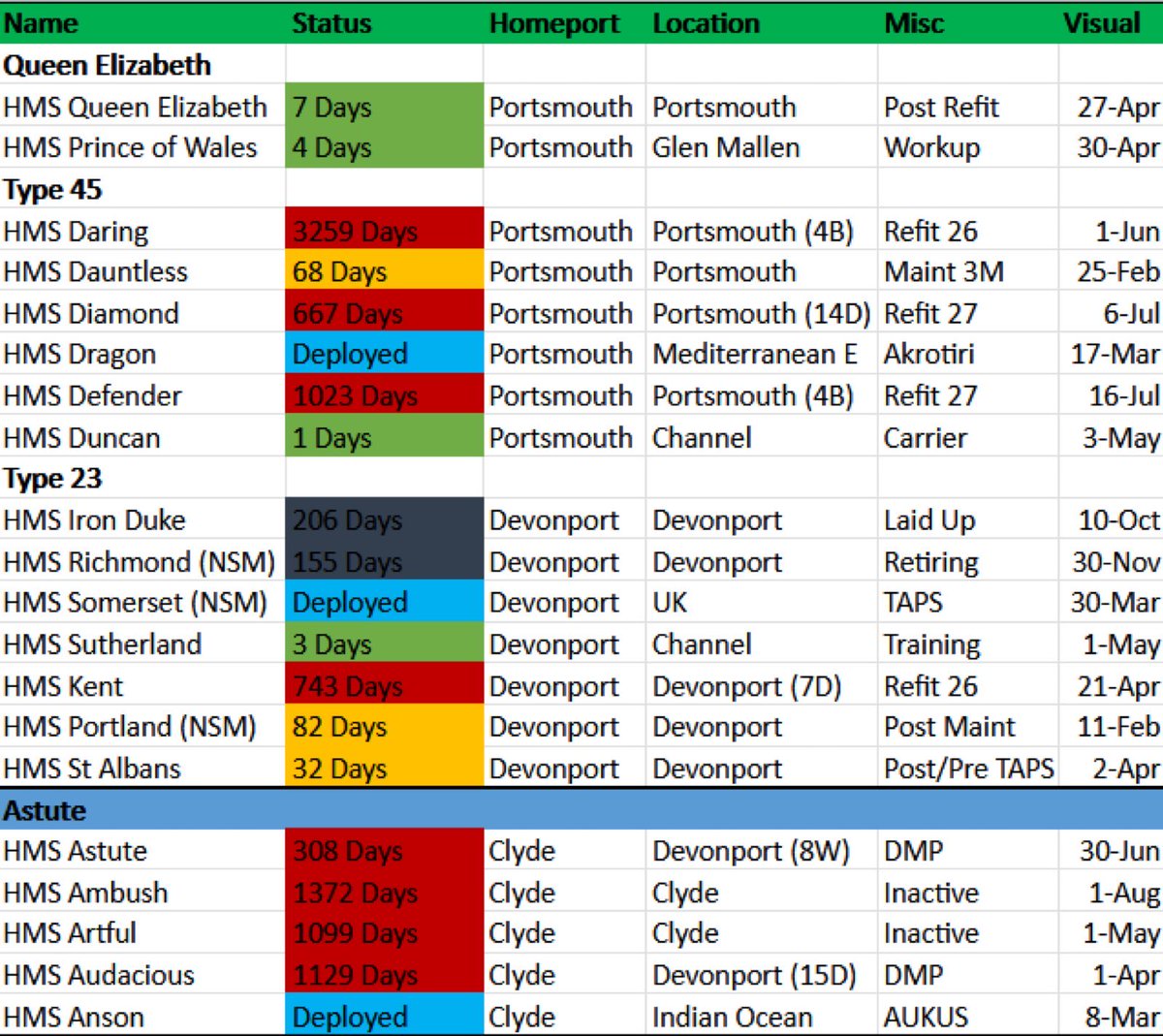
By 2026 the surface combatant force exists on paper as 13 vessels (6 Type 45s and 7 Type 23s), but real availability is far lower. Personnel numbers sit around 20,000 (excluding Royal Marines) while MoD civilians exceed 50,000. Chronic maintenance backlogs, optimistic strategic assumptions that major conflict was “10 years away”, and repeated programme delays have hollowed out capability. The attached table created and maintained by @TBrit90 illustrates this reality starkly.
By 2026 the surface combatant force exists on paper as 13 vessels (6 Type 45s and 7 Type 23s), but real availability is far lower. Personnel numbers sit around 20,000 (excluding Royal Marines) while MoD civilians exceed 50,000. Chronic maintenance backlogs, optimistic strategic assumptions that major conflict was “10 years away”, and repeated programme delays have hollowed out capability. The attached table created and maintained by @TBrit90 illustrates this reality starkly.
The Frigate Crisis
4/25
The Type 23 frigates remain the RN’s primary anti-submarine warfare (ASW) platforms. All remaining vessels in service are (should be) equipped with the Type 2087 towed array sonar, making them critical for protecting the Continuous At-Sea Deterrent (CASD). Yet years of life-extension programmes have pushed many well beyond their original 18-year design life, at enormous cost.
4/25
The Type 23 frigates remain the RN’s primary anti-submarine warfare (ASW) platforms. All remaining vessels in service are (should be) equipped with the Type 2087 towed array sonar, making them critical for protecting the Continuous At-Sea Deterrent (CASD). Yet years of life-extension programmes have pushed many well beyond their original 18-year design life, at enormous cost.
5/25
HMS Iron Duke’s situation is particularly damning. Despite a £103 million refit intended to keep her operational into the late 2020s, she has been quietly stripped of systems and sidelined since late 2025 with no formal decommissioning announcement. This leaves the RN with effectively five available Type 23 frigates. Sustaining even routine tasking is now precarious.
HMS Iron Duke’s situation is particularly damning. Despite a £103 million refit intended to keep her operational into the late 2020s, she has been quietly stripped of systems and sidelined since late 2025 with no formal decommissioning announcement. This leaves the RN with effectively five available Type 23 frigates. Sustaining even routine tasking is now precarious.
6/25
A core role for these 2087-equipped Type 23s is Towed Array Patrol Ship (TAPS) duty in support of CASD. With only five frigates available – several already committed or in limited readiness – most of the operational force will be tied to deterrent protection. This leaves virtually no margin for carrier escort, forward presence in the Indo-Pacific, or other commitments.
A core role for these 2087-equipped Type 23s is Towed Array Patrol Ship (TAPS) duty in support of CASD. With only five frigates available – several already committed or in limited readiness – most of the operational force will be tied to deterrent protection. This leaves virtually no margin for carrier escort, forward presence in the Indo-Pacific, or other commitments.
7/25
The Type 45 destroyers fare little better. Power and propulsion issues continue to plague the class, with vessels such as HMS Daring (3,259 days), HMS Diamond (667 days), and HMS Defender (1,023 days) in extended refits or maintenance as shown in the table. Generating a credible Carrier Strike Group has become increasingly difficult. The important word here is “credible”.
The Type 45 destroyers fare little better. Power and propulsion issues continue to plague the class, with vessels such as HMS Daring (3,259 days), HMS Diamond (667 days), and HMS Defender (1,023 days) in extended refits or maintenance as shown in the table. Generating a credible Carrier Strike Group has become increasingly difficult. The important word here is “credible”.
Loss of Amphibious Capability
8/25
The complete decommissioning of the Albion-class LPDs without replacement marks the abandonment of a vital capability. HMS Albion and HMS Bulwark were withdrawn in late 2025 despite heavy prior investment. HMS Bulwark alone received £72 million in refit work between 2022 and 2024, only to be sold for a fraction (circa £20m) of that sum. If the LPD’s were obsolete in a new A2AD environment where is the replacement?
8/25
The complete decommissioning of the Albion-class LPDs without replacement marks the abandonment of a vital capability. HMS Albion and HMS Bulwark were withdrawn in late 2025 despite heavy prior investment. HMS Bulwark alone received £72 million in refit work between 2022 and 2024, only to be sold for a fraction (circa £20m) of that sum. If the LPD’s were obsolete in a new A2AD environment where is the replacement?
9/25
This decision has left the UK without dedicated amphibious assault shipping capable of brigade-level operations. Remaining Bay-class vessels in the RFA cannot substitute. Britain’s ability to project power in littoral environments – essential for NATO’s northern flank or potential Indo-Pacific contingencies – has been severely degraded. No funded replacement programme exists, just aspirations and concepts.
This decision has left the UK without dedicated amphibious assault shipping capable of brigade-level operations. Remaining Bay-class vessels in the RFA cannot substitute. Britain’s ability to project power in littoral environments – essential for NATO’s northern flank or potential Indo-Pacific contingencies – has been severely degraded. No funded replacement programme exists, just aspirations and concepts.
Submarine Service Under Strain
10/25
The Astute-class SSNs have suffered construction delays, technical defects, and maintenance shortfalls. As of early 2026, availability remains “limited”, with several boats alongside for extended periods. HMS Anson’s deployment to Australia further reduced UK-based options. @TBrit90 table highlights prolonged refit periods for HMS Astute (308 days), HMS Audacious (1,129 days), and others listed as inactive - shambles is the word people should be looking for, over £6bn of capital assets left along side so the service could meet in year targets.
10/25
The Astute-class SSNs have suffered construction delays, technical defects, and maintenance shortfalls. As of early 2026, availability remains “limited”, with several boats alongside for extended periods. HMS Anson’s deployment to Australia further reduced UK-based options. @TBrit90 table highlights prolonged refit periods for HMS Astute (308 days), HMS Audacious (1,129 days), and others listed as inactive - shambles is the word people should be looking for, over £6bn of capital assets left along side so the service could meet in year targets.
11/25
For the Vanguard-class SSBNs maintaining CASD, patrol durations have lengthened dramatically. A record 205-day patrol was completed in April 2026. Maintenance overruns have forced remaining boats to remain at sea longer, increasing crew fatigue and safety pressures. The deterrent is sustained only through the extraordinary efforts of submariners, not sustainable infrastructure. These lengthened patrols are that newsworthy now that the PM and Defence Secretary get their photo op in “personally thanking the crews”.
For the Vanguard-class SSBNs maintaining CASD, patrol durations have lengthened dramatically. A record 205-day patrol was completed in April 2026. Maintenance overruns have forced remaining boats to remain at sea longer, increasing crew fatigue and safety pressures. The deterrent is sustained only through the extraordinary efforts of submariners, not sustainable infrastructure. These lengthened patrols are that newsworthy now that the PM and Defence Secretary get their photo op in “personally thanking the crews”.
Royal Fleet Auxiliary in Crisis
12/25
The RFA, vital for sustaining RN operations at distance, faces its own severe problems. Industrial action in March and April 2026 over pay and conditions highlighted chronic under-manning (up to 70-80% on some vessels). The inability to reliably deploy a Solid Stores Support Ship alongside a Carrier Strike Group remains a critical vulnerability for long-endurance operations. This is something of the current governments own making - Al Carns should be sorting it out not taking selfies of himself in his home gym.
12/25
The RFA, vital for sustaining RN operations at distance, faces its own severe problems. Industrial action in March and April 2026 over pay and conditions highlighted chronic under-manning (up to 70-80% on some vessels). The inability to reliably deploy a Solid Stores Support Ship alongside a Carrier Strike Group remains a critical vulnerability for long-endurance operations. This is something of the current governments own making - Al Carns should be sorting it out not taking selfies of himself in his home gym.
Procurement Delays and Capability Gaps
13/25
New platforms offer “hope” (not certainty) but arrive too late. Type 26 frigates (first-of-class HMS Glasgow) now target initial operating capability in 2028, with full fleet integration in the 2030s. Type 31s are promised by the end of the decade. This leaves a dangerous multi-year gap during which frigate numbers may dip even lower. The hybrid just hides the fact, the ships will be late.
13/25
New platforms offer “hope” (not certainty) but arrive too late. Type 26 frigates (first-of-class HMS Glasgow) now target initial operating capability in 2028, with full fleet integration in the 2030s. Type 31s are promised by the end of the decade. This leaves a dangerous multi-year gap during which frigate numbers may dip even lower. The hybrid just hides the fact, the ships will be late.
14/25
Air capability faces parallel constraints. The F-35B fleet lacks full over-the-horizon offensive ground-attack integration (SPEAR 3 delays). Crowsnest airborne early warning, while deployed recently to Cyprus for counter-drone protection of RAF Akrotiri, is a small fleet with retirement planned for 2029. These gaps limit the effectiveness of Carrier Strike, if we can call it carrier strike and not just “carrier deployments”.
Air capability faces parallel constraints. The F-35B fleet lacks full over-the-horizon offensive ground-attack integration (SPEAR 3 delays). Crowsnest airborne early warning, while deployed recently to Cyprus for counter-drone protection of RAF Akrotiri, is a small fleet with retirement planned for 2029. These gaps limit the effectiveness of Carrier Strike, if we can call it carrier strike and not just “carrier deployments”.
Shared Responsibility for Decline
15/25
Governments of both parties bear responsibility through sustained underfunding and short-term decisions. The MoD’s civilian bureaucracy has expanded while uniformed strength contracted. Procurement has often prioritised industrial or political considerations over operational need. Senior naval leadership has too often presented optimistic forecasts that failed to materialise (before getting promoted or moving on).
15/25
Governments of both parties bear responsibility through sustained underfunding and short-term decisions. The MoD’s civilian bureaucracy has expanded while uniformed strength contracted. Procurement has often prioritised industrial or political considerations over operational need. Senior naval leadership has too often presented optimistic forecasts that failed to materialise (before getting promoted or moving on).
16/25 Recent decisions further erode trust. From June 2026, all new officer and rating training will centralise Initial Naval Training at HMS Raleigh, with a shortened course at Dartmouth. While presented as modernisation, this raises legitimate concerns about the future of the historic Britannia Royal Naval College site and a preference for economies over tradition.

17/25
The discreet handling of HMS Iron Duke’s withdrawal after £103m expenditure exemplifies opacity. Such actions suggest a service more focused on perception management than confronting difficult realities. Trust in leadership suffers when accountability appears absent. Isn’t this something 1SL said he was sorting out?
The discreet handling of HMS Iron Duke’s withdrawal after £103m expenditure exemplifies opacity. Such actions suggest a service more focused on perception management than confronting difficult realities. Trust in leadership suffers when accountability appears absent. Isn’t this something 1SL said he was sorting out?
PR Exercises Versus Operational Reality
18/25
The RN highlights achievements such as CSG25 deployments, Wildcat operations, and Crowsnest Merlin deployments to Cyprus. Joint Expeditionary Force collaboration and talk of “hybrid navy” concepts are valuable. Yet these activities occur against constrained escort numbers, unreliable logistics, and limited air support. Mass and sustained presence are increasingly difficult to generate.
18/25
The RN highlights achievements such as CSG25 deployments, Wildcat operations, and Crowsnest Merlin deployments to Cyprus. Joint Expeditionary Force collaboration and talk of “hybrid navy” concepts are valuable. Yet these activities occur against constrained escort numbers, unreliable logistics, and limited air support. Mass and sustained presence are increasingly difficult to generate.
19/25
I’ve posted the colour-coded table again just to re-emphasise the scale of the challenge: green for short readiness, red for extended refits, dark tones for laid-up or retiring vessels. Only a handful of ships show meaningful availability. Claims of “seven frigates in service” at the start of 2026 do not match operational reality. It’s government and RN “waffle”, a sleight of hand to hide decay and decline.
I’ve posted the colour-coded table again just to re-emphasise the scale of the challenge: green for short readiness, red for extended refits, dark tones for laid-up or retiring vessels. Only a handful of ships show meaningful availability. Claims of “seven frigates in service” at the start of 2026 do not match operational reality. It’s government and RN “waffle”, a sleight of hand to hide decay and decline.

20/25
All the remaining Type 23 frigates are 2087 sonar-equipped ASW platforms, underscoring their irreplaceable role in CASD protection. With numbers so low, the fleet is stretched to breaking point across competing demands. Stand by to see the OPV fleet be further stretched to fill the gaps then listen to hear how that in itself is a “success” of fleet management.
All the remaining Type 23 frigates are 2087 sonar-equipped ASW platforms, underscoring their irreplaceable role in CASD protection. With numbers so low, the fleet is stretched to breaking point across competing demands. Stand by to see the OPV fleet be further stretched to fill the gaps then listen to hear how that in itself is a “success” of fleet management.
21/25
The pattern is clear: heavy investment in platforms (Iron Duke, Bulwark) followed by premature withdrawal. Complete capabilities (amphibious warfare) have been decommissioned without replacement. Maintenance infrastructure deficits affect both surface ships and submarines. Makes you wonder what the strategy is, or if there is one?
The pattern is clear: heavy investment in platforms (Iron Duke, Bulwark) followed by premature withdrawal. Complete capabilities (amphibious warfare) have been decommissioned without replacement. Maintenance infrastructure deficits affect both surface ships and submarines. Makes you wonder what the strategy is, or if there is one?
22/25
RFA industrial action and crewing shortages compound the problem. Carrier operations without reliable solid stores support are inherently limited in reach and endurance. With PoW deploying north soon, what exactly is it going to deploy with?
RFA industrial action and crewing shortages compound the problem. Carrier operations without reliable solid stores support are inherently limited in reach and endurance. With PoW deploying north soon, what exactly is it going to deploy with?
23/25
New ships are coming, but timelines stretch into the late 2020s and 2030s. In the interim, the RN must manage with what it has – and what it has is insufficient for the tasks assigned. It’s not great.
New ships are coming, but timelines stretch into the late 2020s and 2030s. In the interim, the RN must manage with what it has – and what it has is insufficient for the tasks assigned. It’s not great.
24/25
This is a service managed into ineffectiveness by the very people charged with its leadership: ministers, MoD officials, and senior officers. When responsibility is discussed, fingers point elsewhere. The discreet Iron Duke episode and training changes only deepen scepticism.
This is a service managed into ineffectiveness by the very people charged with its leadership: ministers, MoD officials, and senior officers. When responsibility is discussed, fingers point elsewhere. The discreet Iron Duke episode and training changes only deepen scepticism.
Conclusion
25/25
The Royal Navy’s trajectory since the late 1990s is one of sustained decline. From frigate shortages to lost amphibious capability, from record submarine patrols to logistics crises, the evidence is unambiguous. While the service attempts to highlight what it can still do, it is no longer effective at the scale and sustained level required. Someone must take responsibility.
This author will not hold his breath.
Corbett, Fisher et al would have been shocked how an island nation built on international trade and protection of sea lanes and the high sea has fallen.
25/25
The Royal Navy’s trajectory since the late 1990s is one of sustained decline. From frigate shortages to lost amphibious capability, from record submarine patrols to logistics crises, the evidence is unambiguous. While the service attempts to highlight what it can still do, it is no longer effective at the scale and sustained level required. Someone must take responsibility.
This author will not hold his breath.
Corbett, Fisher et al would have been shocked how an island nation built on international trade and protection of sea lanes and the high sea has fallen.

• • •
Missing some Tweet in this thread? You can try to
force a refresh