Hauge to me and Pettis: "Don't hide behind the language of "imbalances." If you think China is a competitive threat and that wealthy nations should actively use industrial policy to keep it at bay, say so"
I object to the idea that arguing about imbalances is hiding ...
China's imports have grown in volume terms at an annual rate of ~ 1% over the last 5 years. China's exports have grown at a faster rare that world trade. that is a real imbalance, not a fake one ...
China's savings rate is exceptionally high (comparable to Norway which saves its oil and gas proceeds as a matter of policy and Singapore which hides its investment returns from its citizens and the budget) and China's consumption to GDP ratio is incredibly low
dismissing such concerns as just western anxiety misses the level of concerns in countries like India. It also denies the underlying exceptionalism of China's macro numbers
if folks want to ignore Martin Wolf and Paul Krugman (bigger names in the economics profession than Pettis and Setser) feel free, but I don't think any one with an open mind can look at China's macro numbers and say this is a normal country, let alone a normal large economy
yes, I do think China's policy decision to juice exports to make up for the lost demand from the property sector had negative spillovers to the rest of the world. I have tried to document that with real numbers. the radicals over at Goldman Sachs reached a similar conclusion
And yes, I do think a world where China has weaponized supply and the US under Trump has tried to weaponize demand (w/o support from Congress or the courts it seems) has profound global consequences
But I also think those who celebrate China's impressive development should not ignore the unbalanced nature of China's domestic economy, or the increasingly unbalanced way China interacts with the global economy
and I equally believe that highlighting those imbalances is a first step towards constructing a better international system, one less threatened by disruptive unilateral action from either of the world's two economic superpowers.
/end
• • •
Missing some Tweet in this thread? You can try to
force a refresh

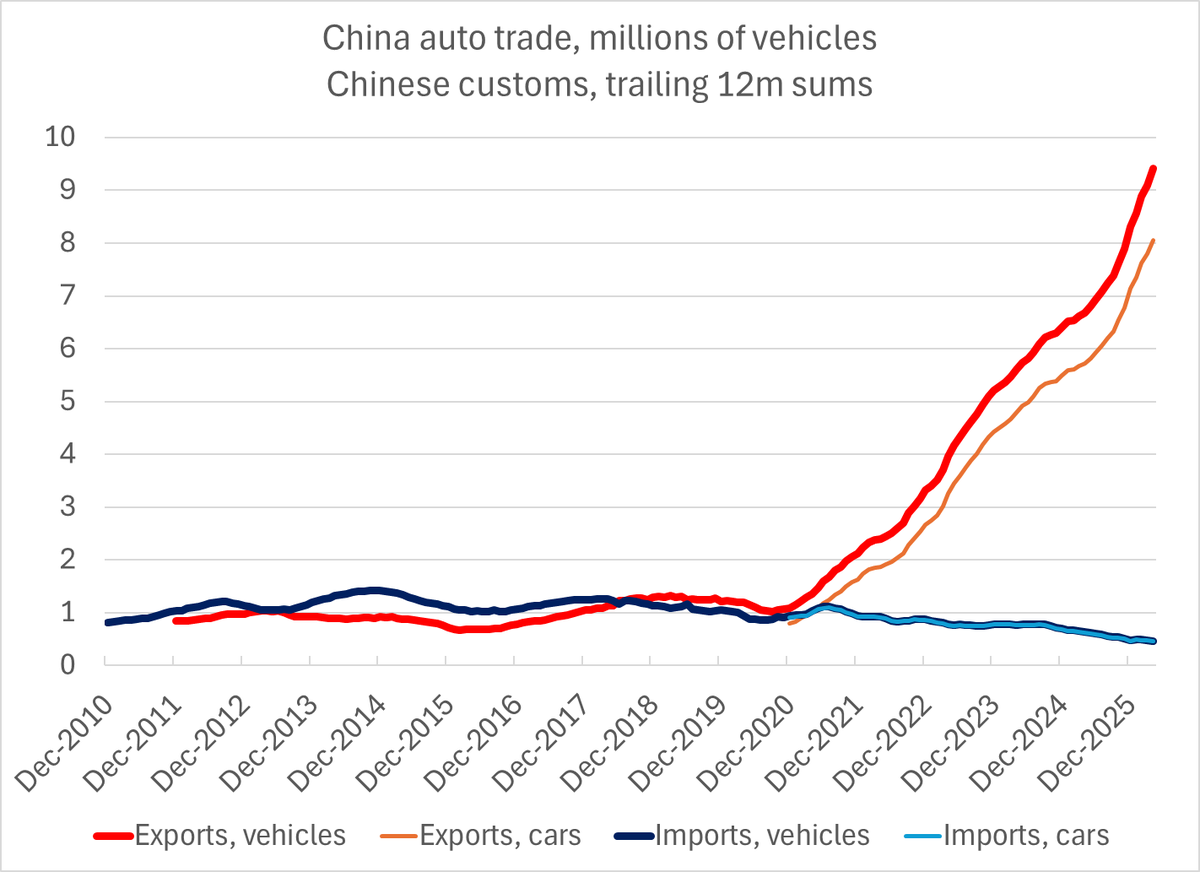
China's auto sector is a near-perfect metaphor for China's economy -- domestic demand is down, quite significantly. But exports are on a rocket ship up -- vehicle exports should come close to reaching 12m this year, car exports 10-11m
1/
Domestic demand for both ICEs and EVs is now shrinking -- and 22m cars, it falls well short of absorbing China's massive auto capacity (widely estimated to be over 50m)
2/
The annual increase in exports (change in 12m rolling sum) is now ~ 2.5m cars. & with import volumes falling, net exports are up even more ...
For scale, peak German net exports were ~ 2m cars. A year. China's growth tops peak German net exports.
Glenn's arrogance is incredible given his long history of clinging stubbornly to inaccurate arguments (no overcapacity in China's exports, China doesn't "really" have a trade surplus, SAFE produces accurate BoP that no one outside China should challenge ....)
Glenn's comment to competence ratio is high -- for various reasons he recycles old work continuously and presents it as new insight (he doesn't seem willing to spring for a real data feed). seems clear domestic margins in China came under pressure in q1. Ask BYD
my comment was riffing on press reporting like that of the FT, which consistently mentions the much fatter margins on exports than on domestic sales
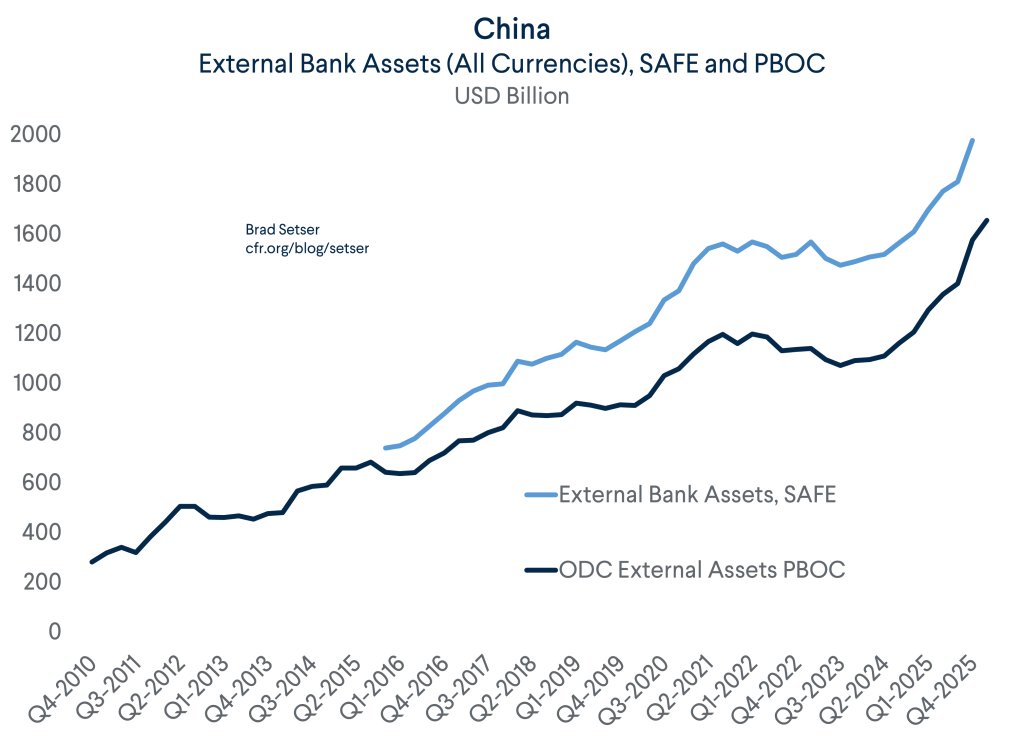
SAFE's quarterly data shows that 70% of the external fx assets of the Chinese state commercial banks are in dollars -- and that almost all of their net external fx assets (external assets funded domestically) are in dollars
2/
I don't love the SAFE quarterly data set -- it shows more external assets and way more external liabilities than the PBOC's data set. But the numbers on external assets at least line up, and the extra external liabilities are in CNY
Dollar pricing of Saudi oil predates Kissinger or Simon -- Aramco was the Arabian American oil company, and before that the California-Arabian Standard Oil Company! Standard oil of Californian (now Chevron) has the original Saudi concession
2/
Blustein confirms that the real deal was to mask Saudi purchase of Treasuries -- the Kingdom was worried about the optics of financing the US at a time when the US was supporting Israel ... 3/
The current inability of most of the GCC countries to get oil to market is a much bigger threat to the US economy than the possibility that some GCC countries (and not just sanctioned countries) might sell some oil to China for yuan ...
1/
selling China oil for yuan also doesn't immediately crete "euroyuan" -- not if the funds are only used to buy Chinese manufactures/ held on deposit in China (as Russia and Iran have sometimes been forced to do)
2/
Brendan Greely did us all a favor by reminding us that the surge in petrodollars came when the Gulf states oil revenues surged faster than their domestic spending -- creating funds that had to be parked offshore
I might quibble with a couple of Adam's points, just as he sometimes pushes back on a few of my arguments
But Adam gets the big picture right, unlike the IMF --
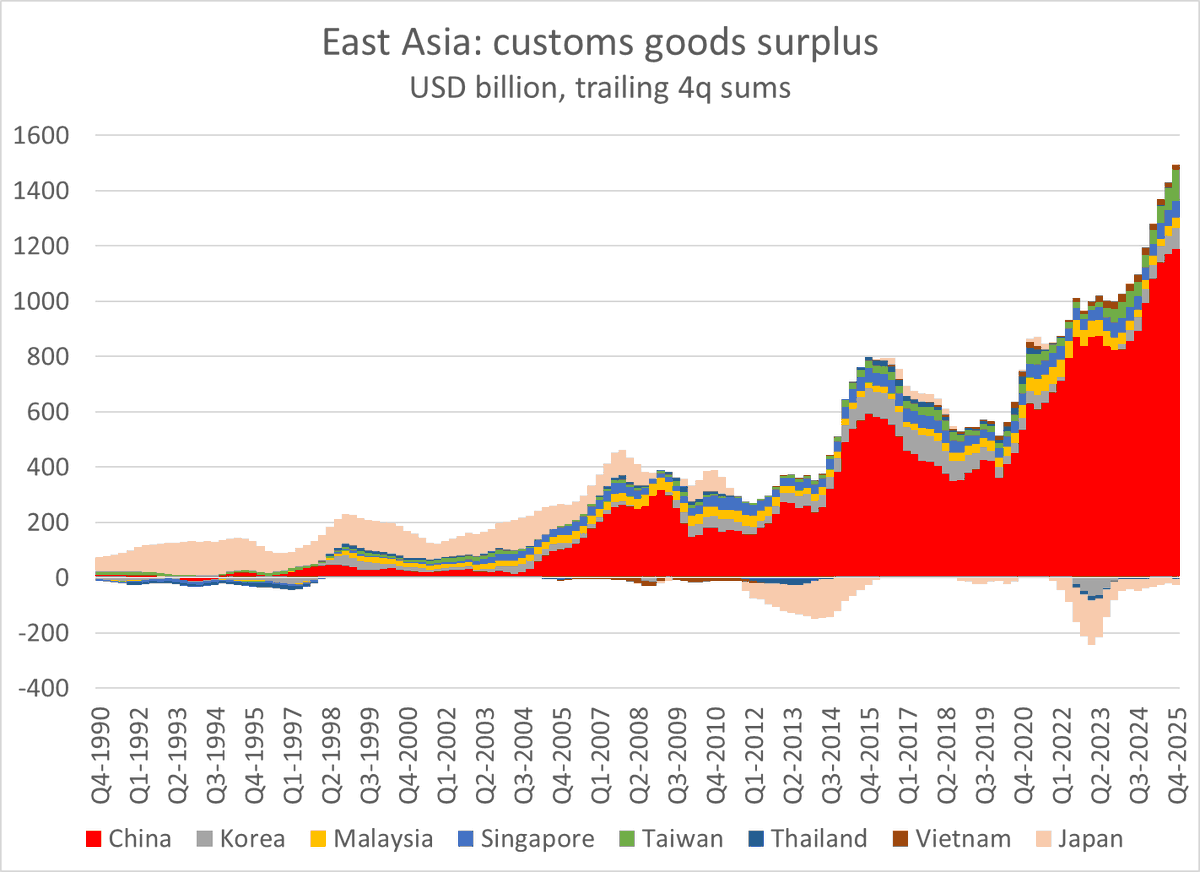
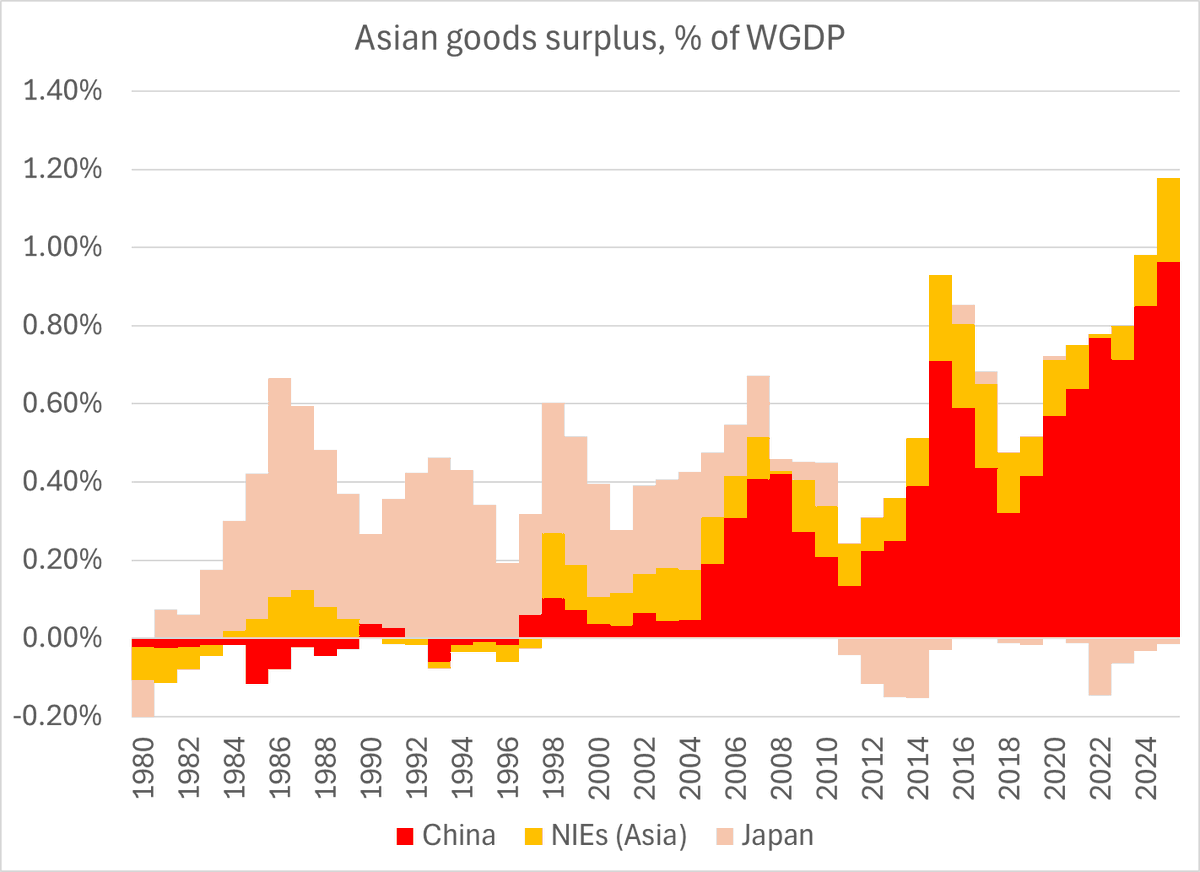
What's radically new is the scale of the surplus in manufacturirng Asia/ China
2/
That's true in dollar terms, that is also true as a share of WGDP (the Asian surplus is 2x its level in the pre-Plaza 80s, and 2x its level before the GFC -- when imbalances were more disbursed and the oil surplus was bigger)