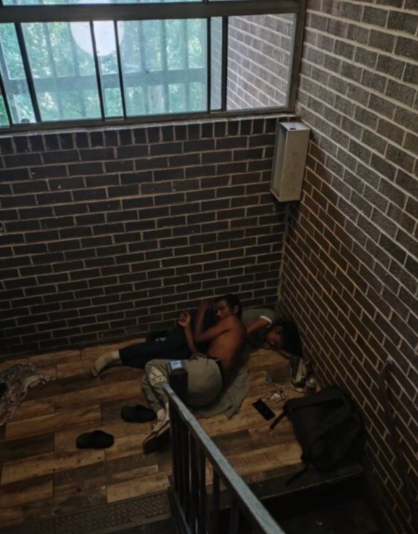
NEW: A disabled woman is suing homeless services in Portland, Oregon, after she was denied rent relief due to her low score on the city's race-based prioritization rubric, which awards more points for requesting "culturally specific services" than for having a disability.🧵
Michele Mei, a white woman with cerebrovascular disease, filed the lawsuit after she was told that she did not meet the cutoff for housing assistance, Fox 12 Oregon reported last month.
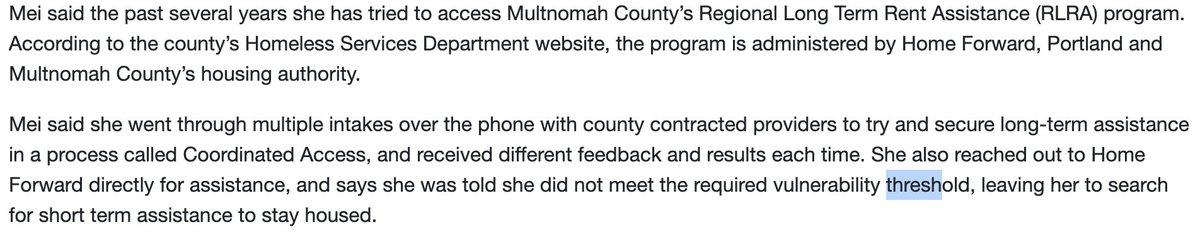
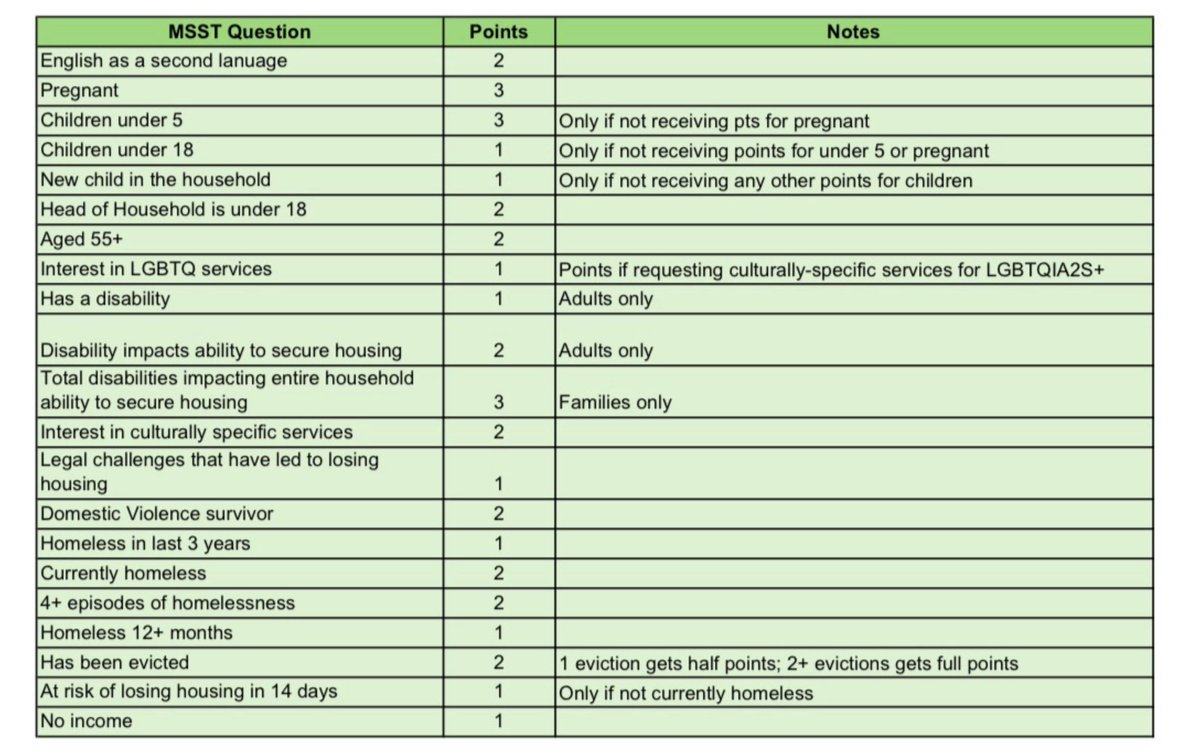
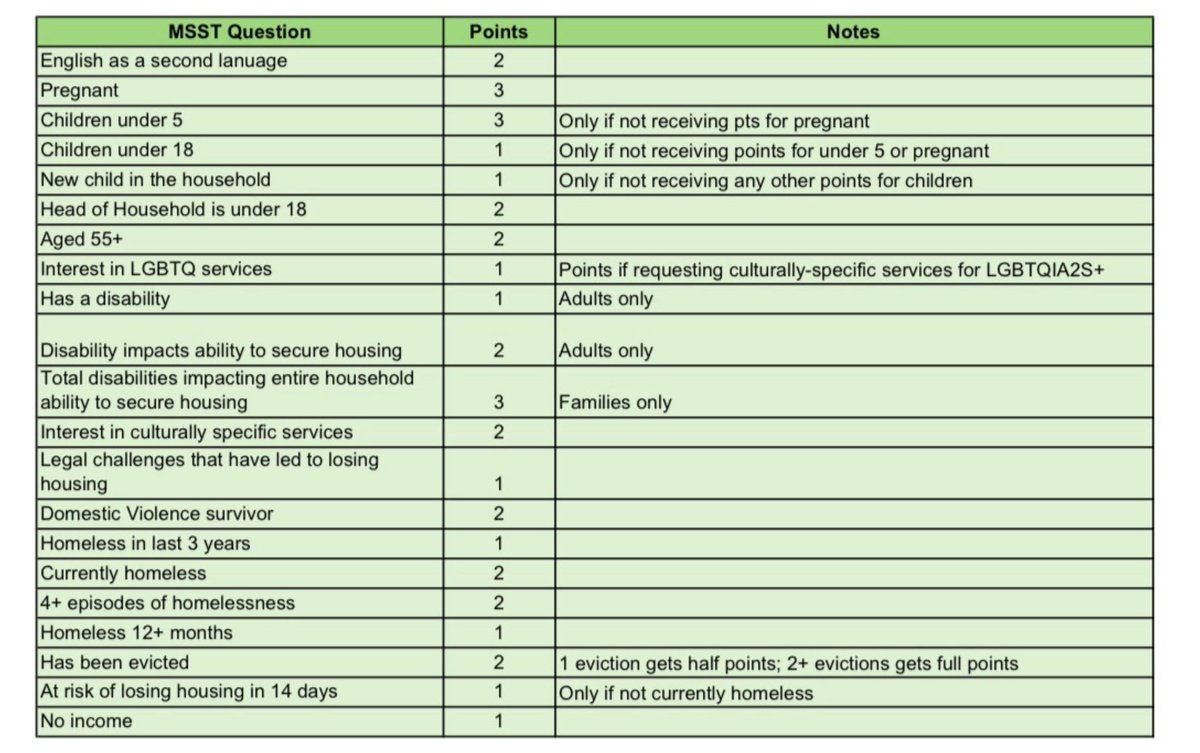
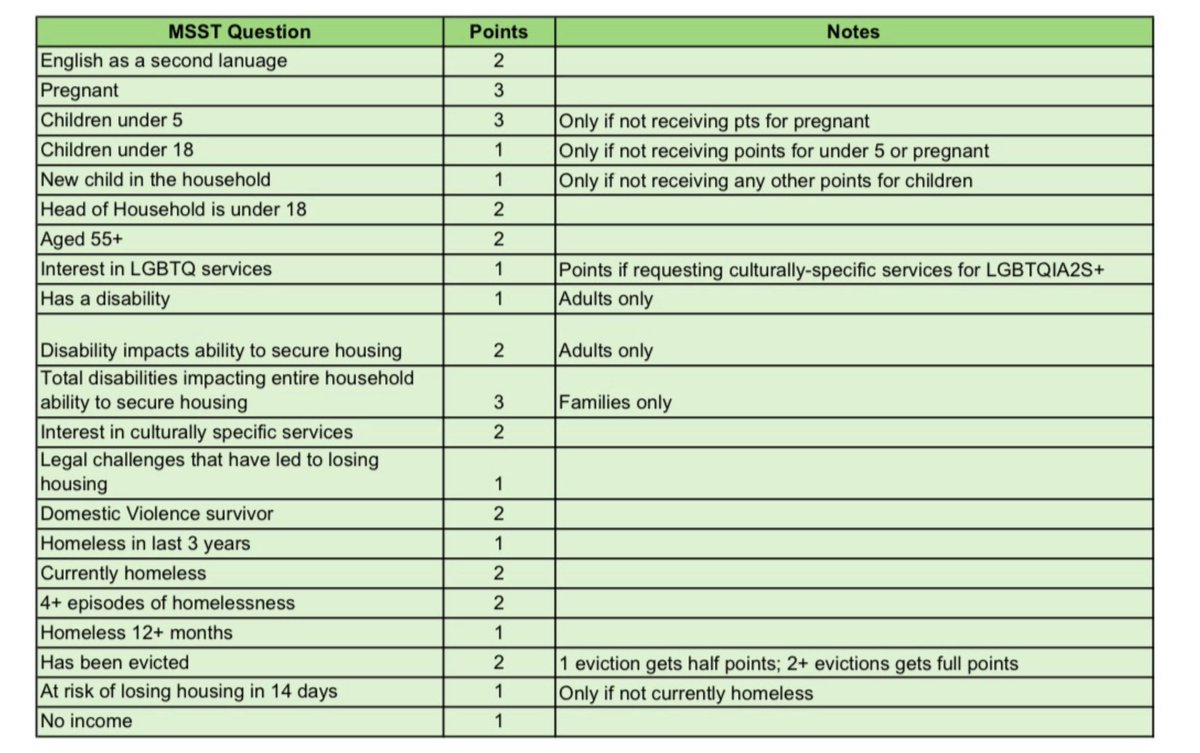
Portland (Multnomah County) uses a points-based rubric to prioritize applicants for housing assistance. Under the rubric, obtained exclusively by the Free Beacon, having a disability only counts for 1 point, whereas "interest in culturally specific services" counts for 2.
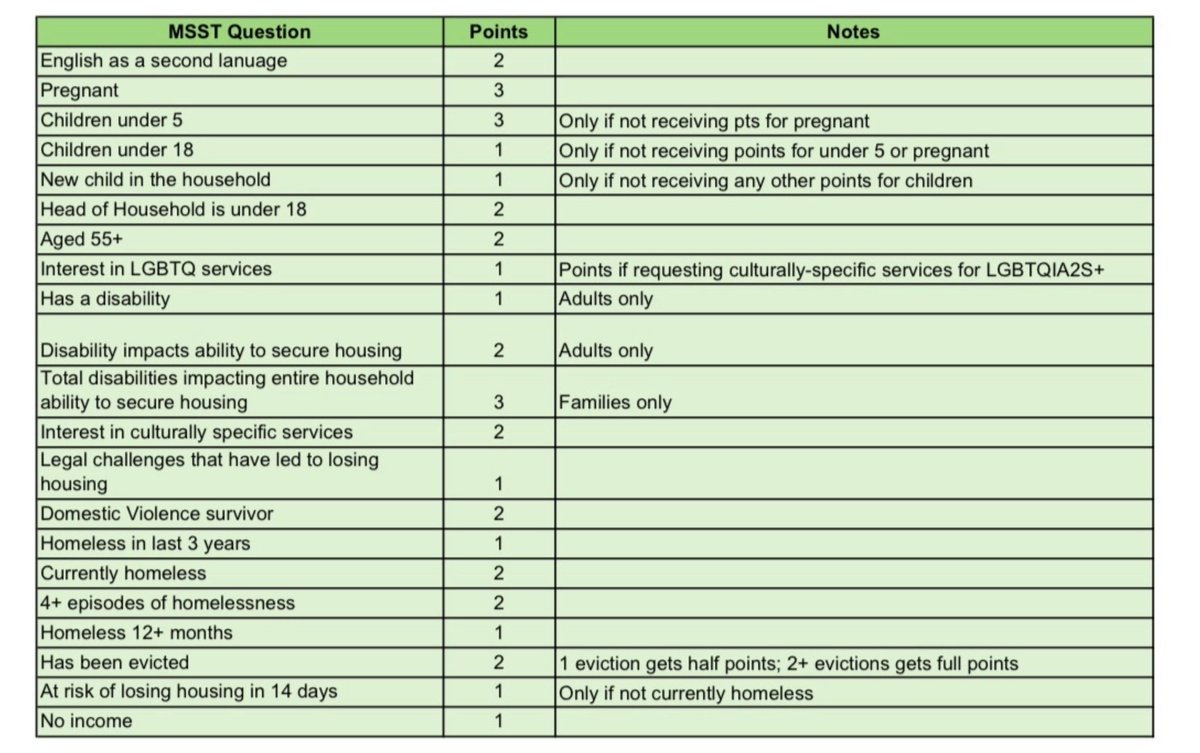
Though the rubric awards extra points when the disability impacts access to housing, it awards even more to gay, lesbian, bisexual, or transgender people who speak English as a second language, meaning that identity factors can outweigh disability status.
Mei, who is suing under the Americans with Disabilities Act, is an example of the costs of that system. Though her lawsuit does not allege racial discrimination, she would have had better odds of obtaining rent relief had she been black, LGBT, or a non-native English speaker.
The case illustrates how, in a zero-sum competition for resources, prioritizing one group necessarily comes at the expense of others, pitting protected classes against one another.
"Adding points for race may seem politically savvy, but it harms people—labeling them by immutable characteristics instead of assessing individual need," said Caitlyn Kinard, an attorney at the Pacific Legal Foundation.
"The result: people with disabilities in Multnomah County are now finding it harder to access resources."
A spokeswoman for Multnomah County, Denise Theriault, said that the county "complies with all Fair Housing Act and anti-discrimination laws."
Multnomah County, you may recall, has numerous apartments that provide "culturally specific housing" to "BIPOC" residents. Placements in those buildings are determined by Multnomah's coordinated access process, the same system Mei used.
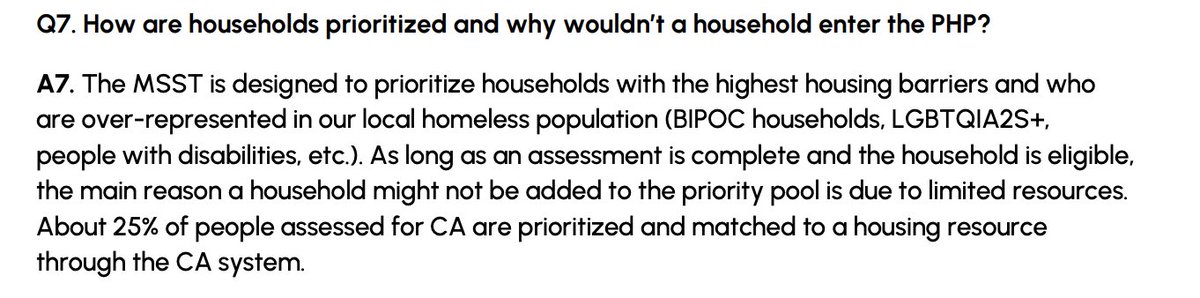
Redesigned in 2024 in order to "promote equity," the process prioritizes "BIPOC households, LGBTQIA2S+, [and] people with disabilities." But Mei says the housing department refused to meet with her for an in-person assessment, making it difficult for her to navigate the process.
Mei, who says she has been on the brink of homelessness since she fled an abusive marriage in 2018, added that rent relief would have spared her years of instability.
"I wouldn't have had to move a whole bunch of times," she said. "I wouldn't feel the threat of eviction."
Tldr: The race-based allocation of homeless services isn't just an affront to the rule of law. It also makes it harder for disabled people to receive housing, insofar as they must compete with minorities for priority.
NEW: In a mandatory anti-racism class, Penn State told 1L law students they must "acknowledge the reality of systemic racism" and "dismantle systems that racialize, subordinate, and oppress."
One student withdrew from the law school over the class. We obtained shocking audio.🧵
David Blackman, a former 911 call operator and a veteran of the Texas State Guard, was thrilled to be going to law school at Penn State.
Then he sat through the first session of "Race and the Equal Protection of the Laws," a required first year course.
Blackman listened as a transgender faculty member, Emily Spottswood, explained why the course was mandatory.
"It’s not optional," Spottswood said, because "being a lawyer is about recognizing and combating injustice."
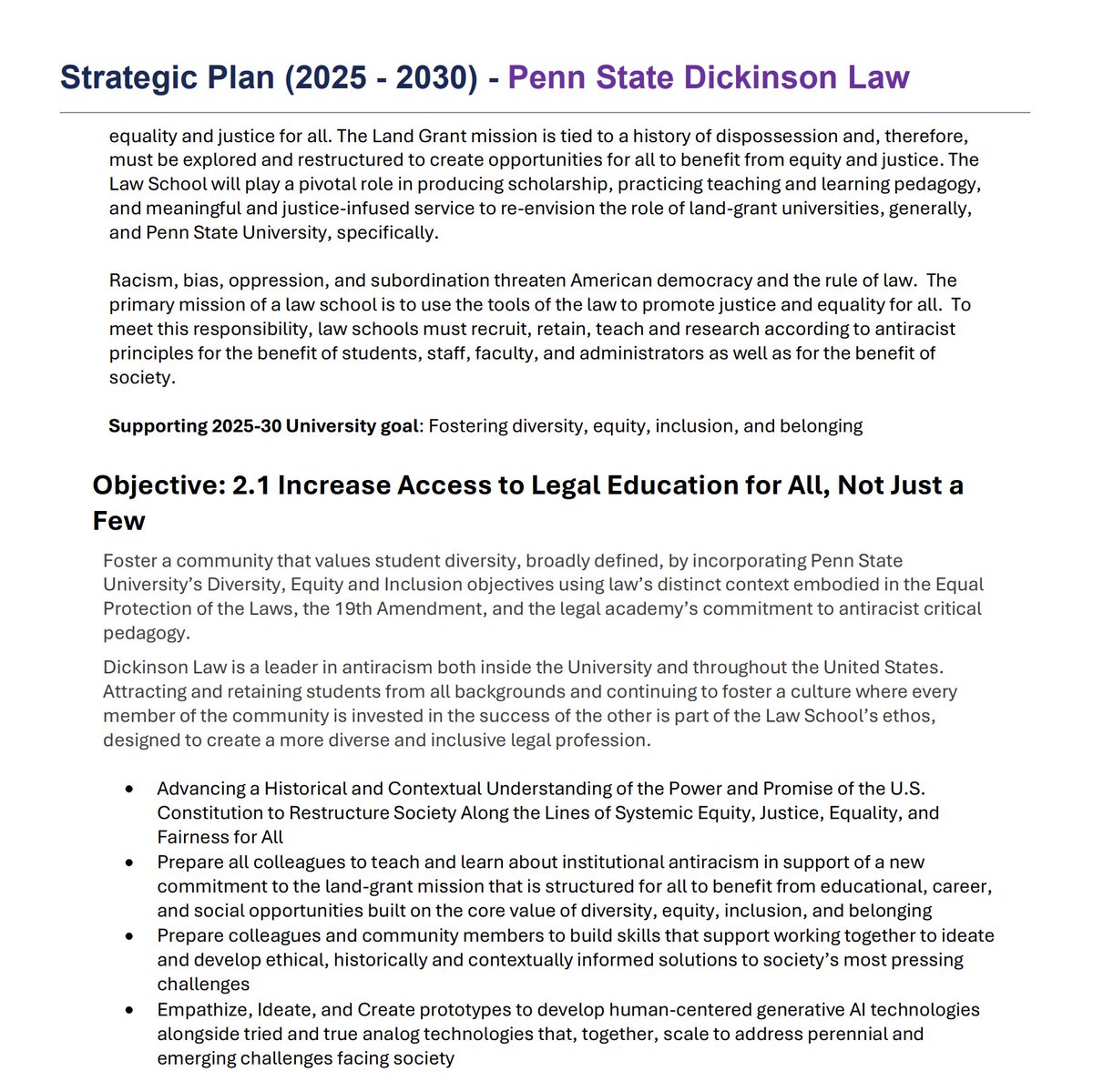
NEW: In an internal document distributed last month, Pennsylvania's flagship law school promised to devote the entire school to "antiracism," pledging to "recruit, retain, teach and research according to antiracist principles" and embrace an "antiracist critical pedagogy."🧵
The document, a "Strategic Plan Update" covering the next five years, also pledges to expand "employment opportunities for candidates who are underrepresented in the University and at the Law School." Critics say that pledge is likely to expose the school to legal action.
"Every known definition of 'antiracism' explains that race will be a factor in decision making. This is illegal and should be challenged in court," said Ed Blum, the man behind the litigation that outlawed affirmative action in college admissions.
NEW: Blue jurisdictions are rationing homeless services based on race.
In Portland, a non-white, non-native English speaker who is LGBT would get priority over a domestic violence survivor with a 6 yr old child who's been homeless for 12+ months.
The policies are shocking.🧵
Let's start with Multnomah County, OR, home of deep blue Portland, where deaths of homeless people quadrupled between 2019 and 2023. The county's screening tool for housing services is designed to "prioritize … BIPOC households, LGBTQIA2S+, [and] people with disabilities."
The rubric, obtained via a public records request, wards 1 point for "interest in LGBTQ services," 2 points for "English as a second language," and another 2 points for "interest in culturally specific services," a catch-all term for Portland's race-based housing programs.
NEW: Stanford is awarding five times as much money to a campus drag troupe as to an undergraduate veterans association. And it's awarding more money to the Muslim Student Union—$175,000—than every Christian student group combined.
We obtained the school's activities budget.🧵
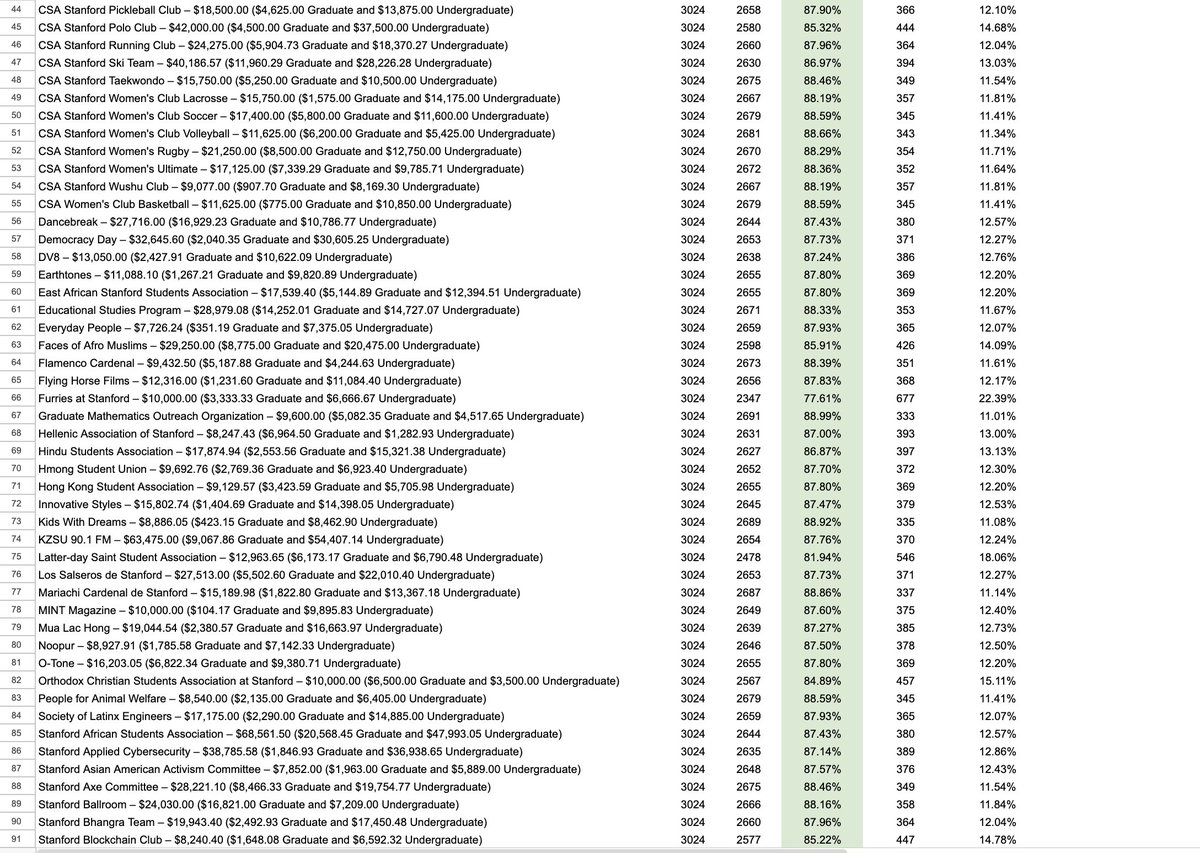
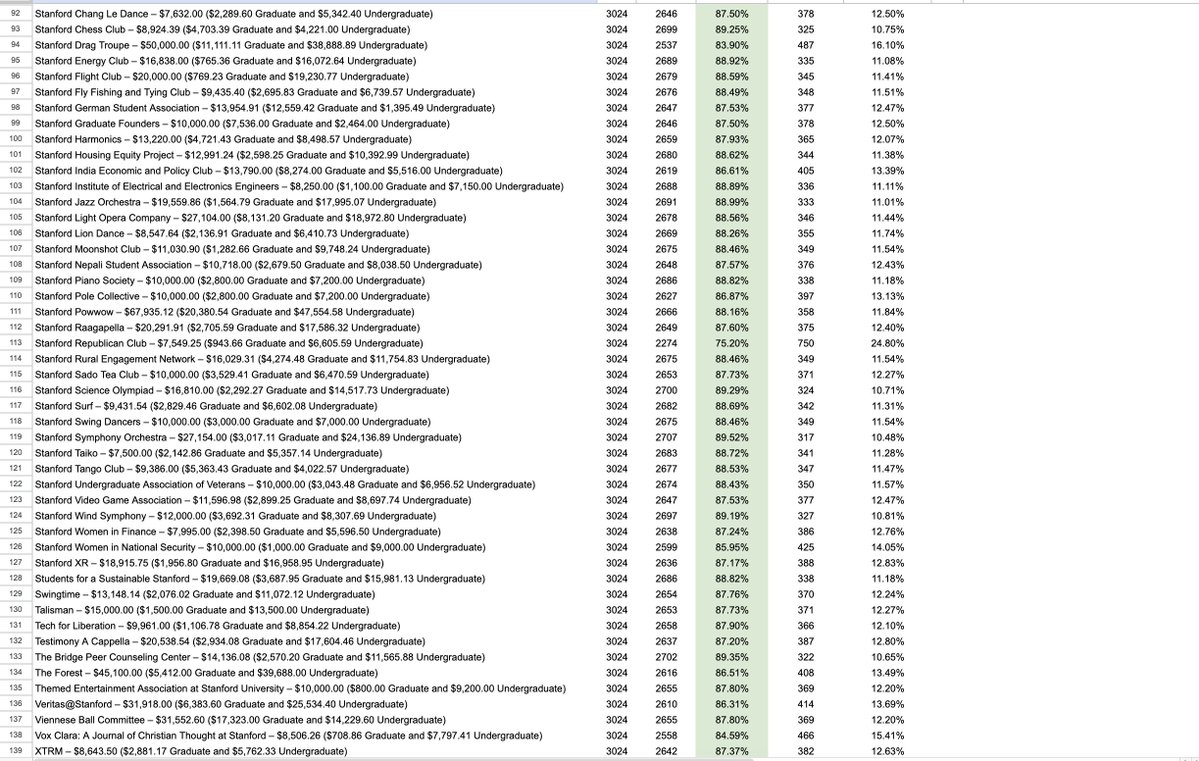
The awards include a $50,000 grant to the Stanford Drag Troupe, which last year sponsored a performance by two drag queens, "Slut the Rock Johnson" and "ZZ Chic," as part of a "sex trivia" event titled, "Are You Smarter Than A Sexpert?"
That grant dwarfs the $10,000 earmarked for the Stanford Undergraduate Association of Veterans, the $14,472 earmarked for Stanford’s sole ballet group, the $27,104 earmarked for the Stanford Light Opera Company, and the $27,154 earmarked for the Stanford Symphony Orchestra.
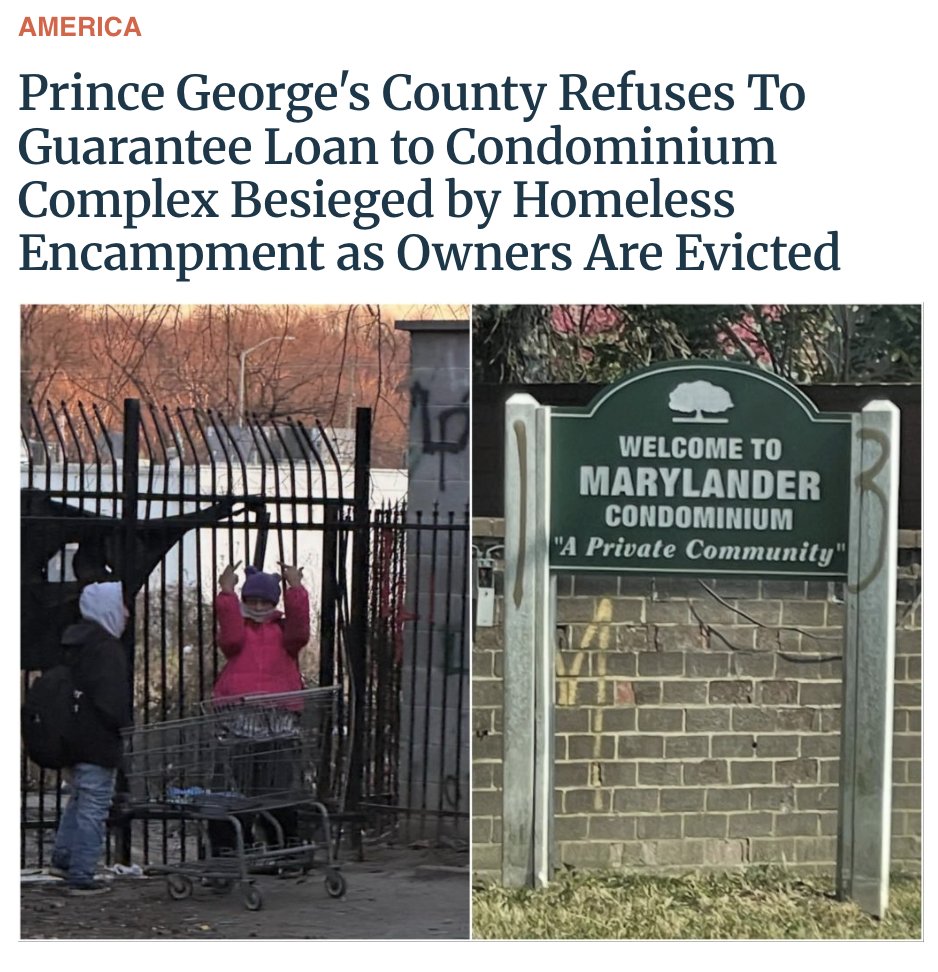
NEW: The Marylander Condominium needed millions in repairs after Prince George's County stood by as a nearby homeless encampment terrorized the condo.
One bank said it would lend if the county guaranteed the loan.
But the county refused—and now residents are being evicted.🧵
After members of the encampment allegedly vandalized the boiler room, 100 units were left without heat and in violation of local safety codes. The damage prompted building inspectors to deem those units "unfit for human habitation" in December and order their occupants to leave.
The situation made the Marylander toxic to lenders, who feared that it was all but guaranteed to default. Starved for credit and at risk of collapse, the condo found financing from a local bank that agreed to lend on one condition: The county would have to guarantee the loan.
NEW: For years, Prince George's County, MD, delivered food to a homeless encampment behind a residential condominium. Vagrants from the camp kept breaking into buildings, defecating in stairwells, and doing drugs in the hallways.
They they broke the heat.
Now the county has deemed half the complex "unfit for human habitation" and is preparing to evict residents—all because of an encampment that the county itself enabled.
The story is shocking.🧵
Residents say the Marylander Condominiums, in Hyattsville, Maryland, used to be a beautiful community.
Here's what it looks like now, after the county refused to clean up the open air drug market on its doorstep.
Half of the complex has gone without heat since Thanksgiving after vagrants allegedly vandalized the boiler room. Some units have lost electricity, too, due to the overuse of space heaters. And amid the cold, a few units have flooded after their pipes burst. Units like this one: