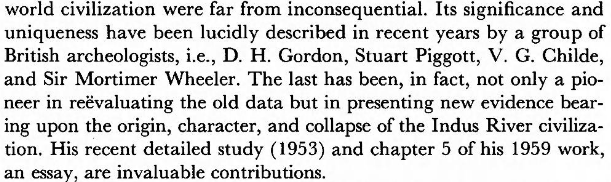
Let me quote Fairservis's paper on IVC. He is one of the leading figures in IVC archaeology from an article dating to 1961. No Bhandarkar, no Banerji, no anybody.
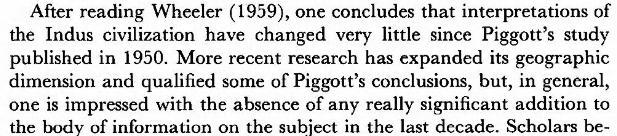
The decade of 1950s saw nothing of worth coming out of IVC.
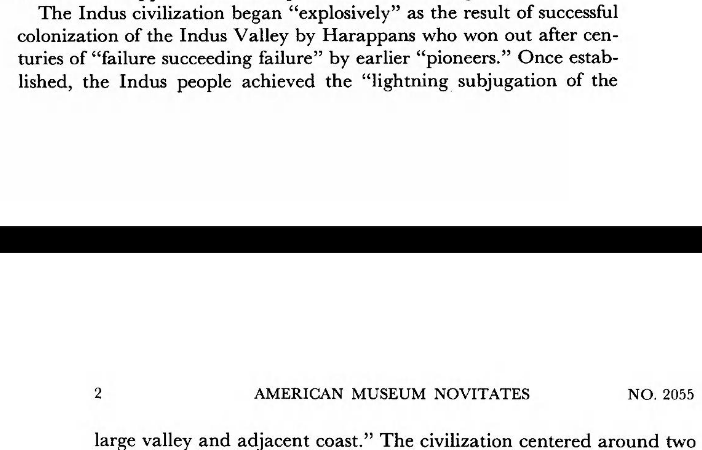
Now, how did the civilization start? Like Edison. 1000 times he failed to make a bulb and finally he made one.
Who ruled it? Some priests it seems. And the greatest achievement of IVC is it being eligible to be compared to Roman Empire 🤦♀️
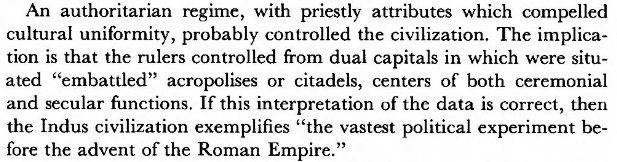
By the way, Mesopotamia taught this Indus zone barbarians the concept of civilization. How cute!!
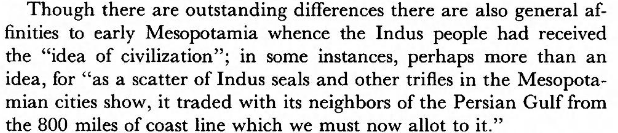
And he quotes another doyen - another hater.

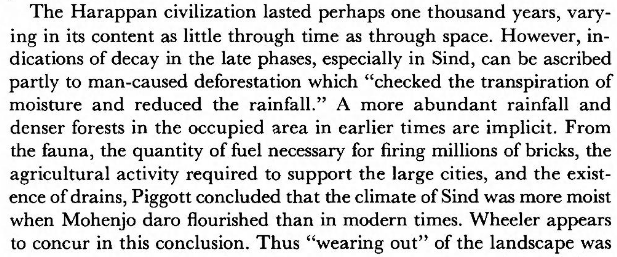
And why did it end? Because IVC made bricks. Bricks needed wood and woods means forests should be chopped. Global Warming, you see. I am confused. What has drains got to do with global warming?
And then, how can we forget the cute Aryans?

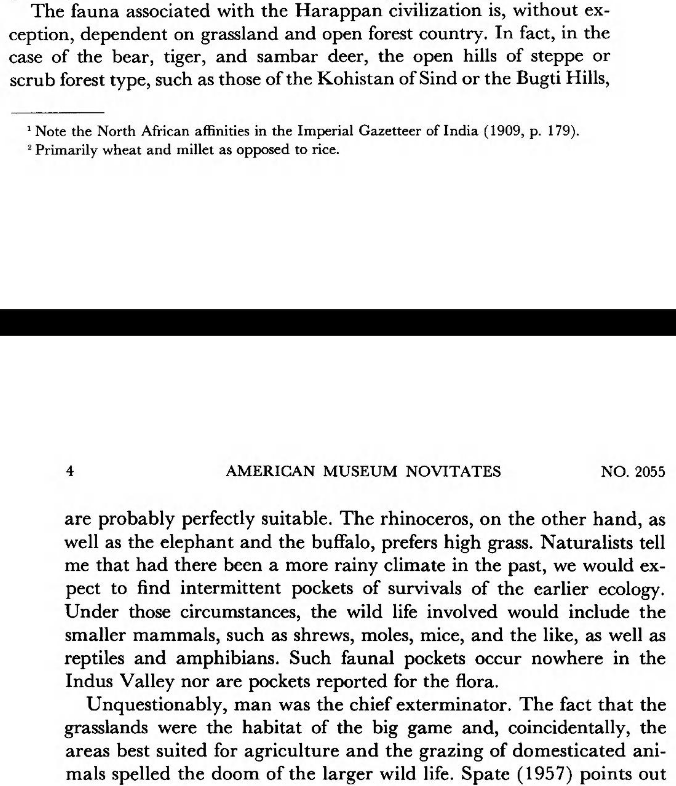
Bad Indus people. Had they been barbarians, the grasslands and forests of the zone would have stayed. A major loss, one would say.
Whatever you say. If you say there were Iranians at that time, we will accept, if there are Pakistanis in Jhumritalaiyya, we will accept, if you say igloos are built on Kilimanjaro, we will accept it.
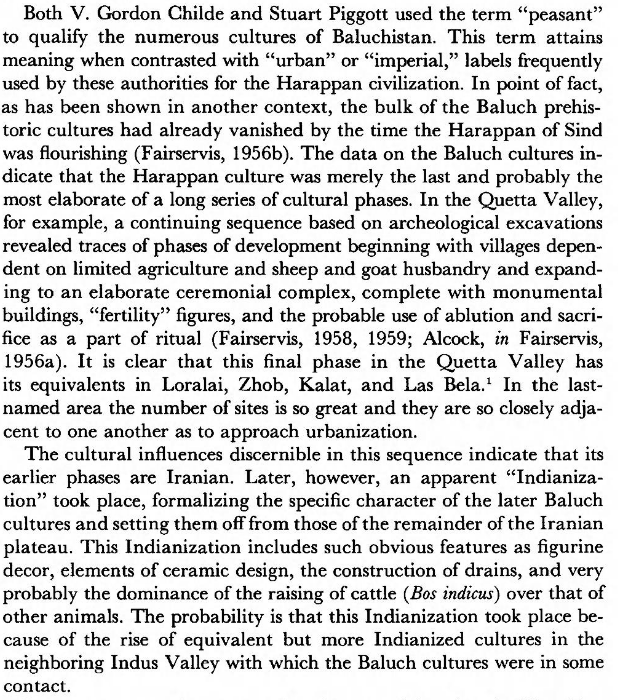
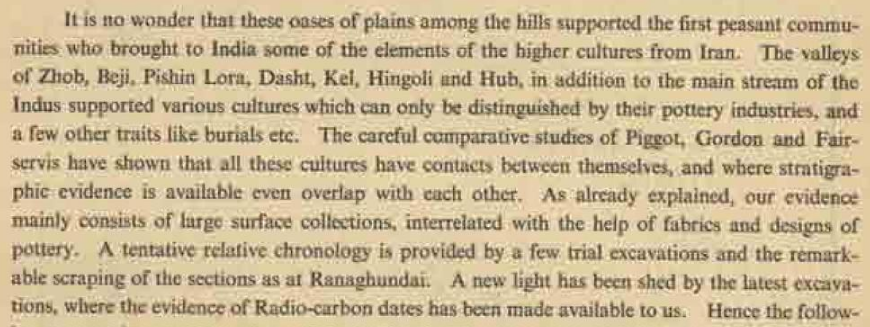
But then, because we have decided it beforehand that every civilizational move HAD TO come from Mesopotamia, this trace from Balochistan towards Sind makes sense. It's not that every hole is occupied. It's the direction which matters.
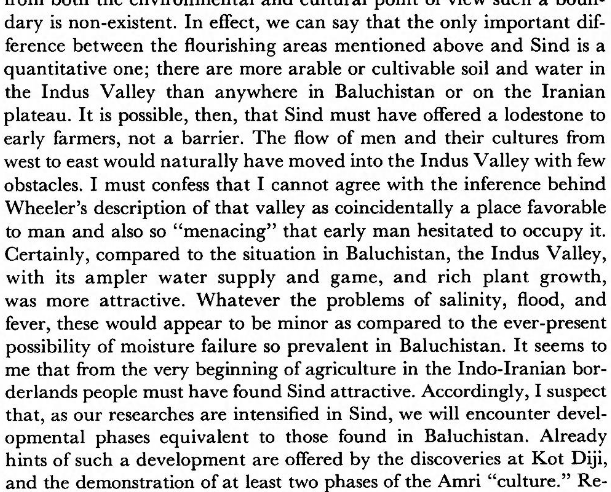
This is sad. First, he positions Amri as a competition to IVC but then tries a backflip. Did he land on his face, I don't know.
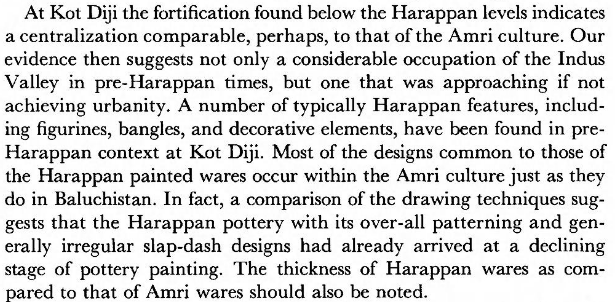
Fairservis realized what he did and is now desperately clutching to straws.
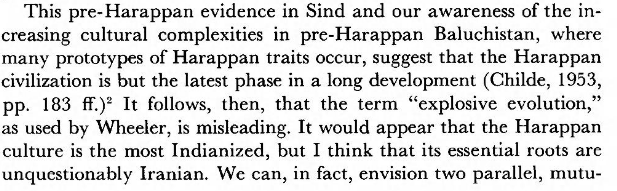
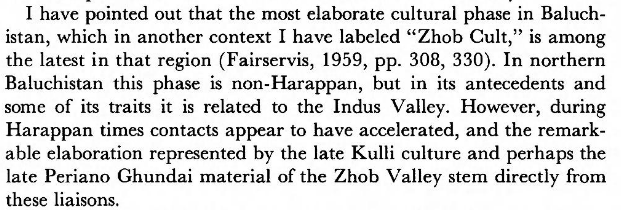
And now, Fairservis is happy that he found his brainwave. But...where is IVC? It's just a bunch of independent cultures - Amri, Harappa, Kot Diji,...

Wait. Zhob is non-Harappan but has Harappan origins and Harappan influence. What does that even mean?
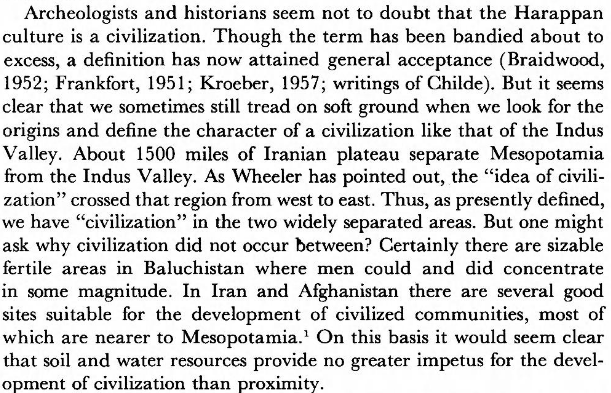
And a monologue. People say IVC is a civilization. But, I won't accept it. And people say IVC is formed because of Mesopotamia. But then, why didn't anyone form a civilization between the both? May be...may be...
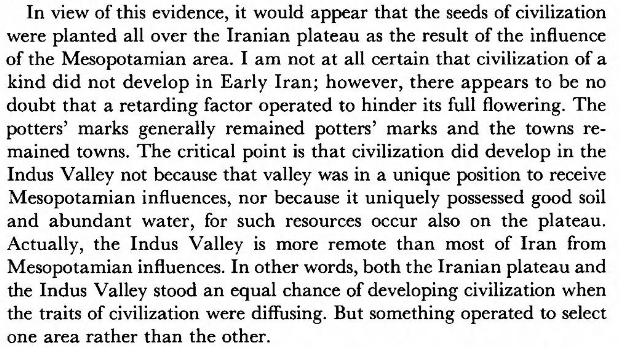
And he finds an answer. It's not as if Mesopotamia didn't teach everyone civilization, everyone except IVC turned out to be a bad student who failed his exams.
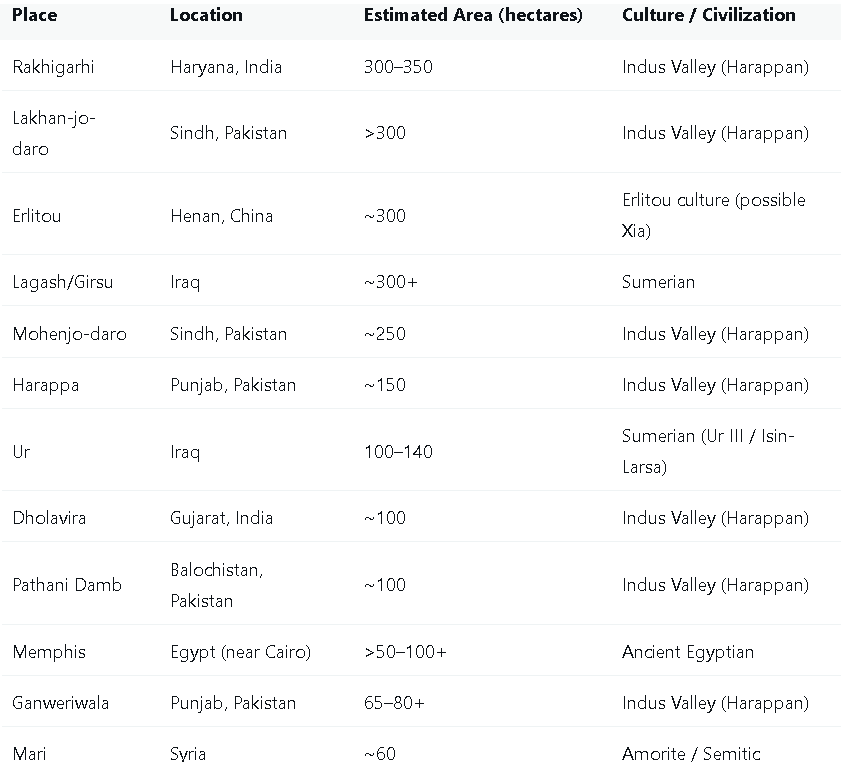
Oh!! IVC is just a bunch of villages. And what's the reality? Literally every site larger than 50 acres in 2000 BC is in IVC. Such kind of a devastating dominance IVC had.

It makes more sense if we call them aliens teaching the locals new dance moves, right? All these proofs point that they are actually aliens.
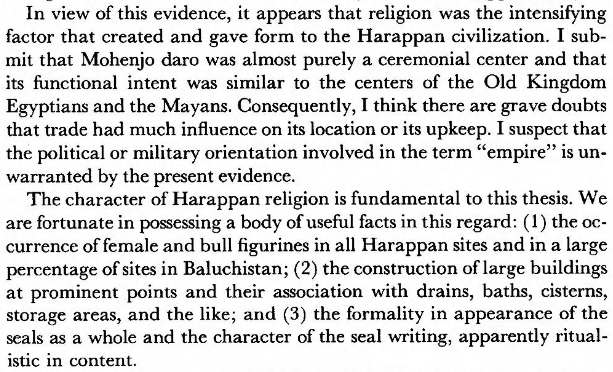
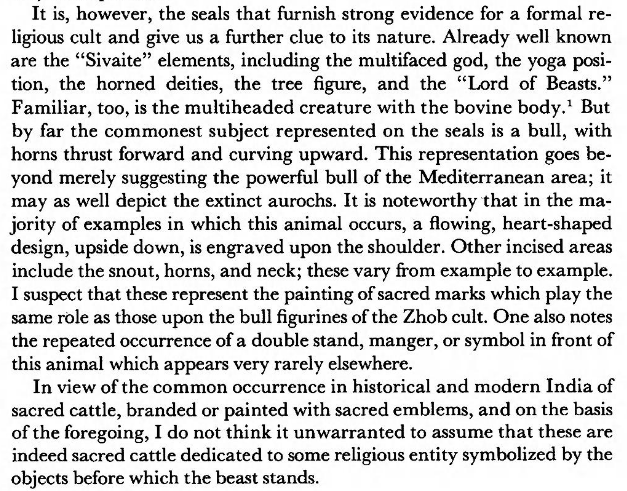
Indus seals are talismans to be worn. But I am confused. How do they wear them when there are no holes in them to pass a thread?
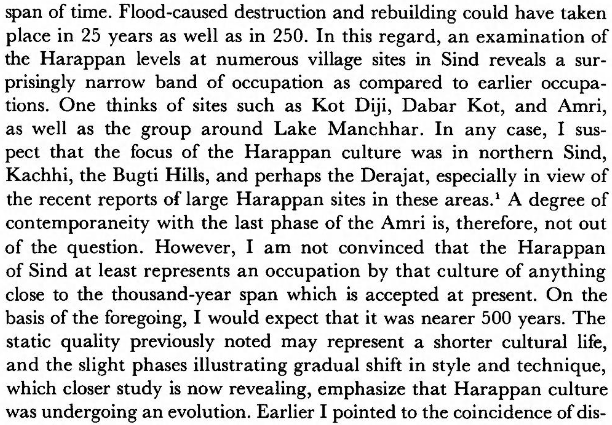
Why is IVC's lifespan 500 years? Because its a number I made up and I believe it to be true.
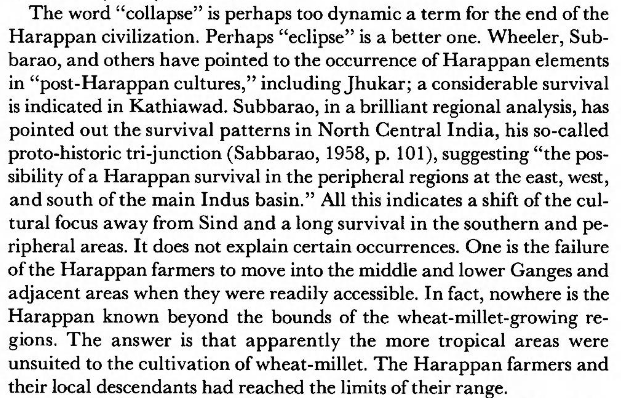
Finally an Indian. By the way, is he Subbarao or Sabbarao?
In synopsis, what does the paper say? Most of the early players in the IVC field were loath to give it an importance it deserves. One said brick burning ended the civilization, one said it is dull and uninteresting, another said it's a religious cult with talismans - none really were happy India ended up to be the founding civilizations of the world.
And what does this Sabbarao say? This Sabbarao is actually Bendapudi Subbarao, the Head of Department of Archaeology at University of Baroda. If we go by Fairservis's theories, he is indirectly saying Fairservis is a good archaeologist but has no clue what he is talking about. I believe that's a fair judgement on him? Finis.
@threadreaderapp unroll
• • •
Missing some Tweet in this thread? You can try to
force a refresh

When the Rani of Jhansi realized that the fort is about to fall, there was absolute silence for some time. The outer corridor has already fallen while the Rani was holed up in the inner fort. One fine day, the main gates opened and bust out of it, the Rani in person with an escort of 500 mercenaries and the royal treasury on a state elephant amidst.
They charged directly into the cannons, destroying them and breaking away. She didn't jump out of a window in the night. She crashed through the main gate in pomp. The British took some time to realize what happened and the hunt started.
By then, the troops split the treasury and scattered(to join back again at a rendezvous). A considerable number of them weren't able to reach the rendezvous and the most prominent amongst them was a heavily injured Moropant Tambe, the Rani's father.
One geopolitical mess which no one bothers to look into, is North Myanmar. There is a near clean demarcation between Tai, Burmese and Chin. You can ignore Chin - even till 1900, they were primitive tribes. Real deal here is the Shan and their allied Kachin.
Now, if you expand the scope out of Myanmar, you will see that there are historically two Tai nodes - one in the West, including Tai Ahom and their parent state Mongkwang, and one in the East centred around Thailand. The eastern node is not our concern.
While the border between Ahom Kingdom and Mongkwang is loosely defined and there were clashes between the both some times(Mongkwang is not actually the parent state of Tai Ahom but it was the political successor of Mong Mao, the parent state for Ahoms), the relations were
So, was reading some book over Sangam Era history. Some important points. While I am not happy with the quality of scholarship, the book, however, reveals some interesting insights. 1. The earliest kingdom Tamils know is that of Nagas. Nagas ruled from Puhar and they were conquered by Cholas. The story is exactly identical to Pallava conquest of Chutu Naga Vaijayanti. This means that Tamils had no concept of a kingdom before 200-250 AD.
2. The historic trajectory is divided into two sets of tribes - the first wave is just tribes which mainstreamed themselves like the Vedar, Kurumbar and others. They just had raw valour unlike the next wave including Malavar, Kosar and others who were sophisticated militarily. In fact, Malavar is assumed to be first ones who used horses in the Tamil country.
3. There is not much clarity on the origin of tribes: They can be local, nomadic and pastoral, or they can be remnants of armies which marched from the North. For instance, around 250-300 AD or so, we start hearing of Kongans - is that a variant of the word Ganga, indicating Ganga armies?
People think as if Vasco Da Gama did a great thing by discovering a sea route to India. It's not so. He didn't do anything actually. Bartolomeu Dias already crossed the Cape of Good Hope and confirmed that the coast turns North East from there. He would oversee building of
Vasco da Gama's ships and would accompany him at least till Cape Verde. And da Gama, after a bout of piracy and clueless what to do, came across an Indian merchant in Mombassa who took him to Calicut. These European "explorers" didn't understand the concept of longitude and
when da Gama saw the ease with which Indians crossed the ocean, he simply threw his equipment away and replaced it with that of Indian. By the way, in 1511, these people came across a Majapahit map. Cape of Good Hope was already in that!!
Let me bite the bullet then. Anyone, feel free to pick the topic.
Kurwai: Kurwai troops led by it's crown prince Izzat Khan was a part of Holkar troop. He either rebelled on field or defected - Abdali felicitated him.
He died of injuries soon after and on the other hand, Holkar invaded Kurwai and severely chastised it's ruling line.
Punjab:
Here, Marathas were completely out of picture and the subsequent decades ended up as running fights between Afghans and the kingdoms supporting them in India, and the Sikhs.
The 600s Tang campaigns which genocided Agni and imposed Chinese rule on the Tarim Basin were the decisive blow for Indic influence and culture in Tarim Basin. The implication of it was not actually lost on the locals.
Led by Khotan, a kind of pacificst Buddhism was dominant in the area(its military power broken, and with Tibet and Arabs breathing down it's neck, there is only that much they can do).
A few centuries after the Chinese advances, an Uyghur Khan was asked why doesn't he convert to Buddhism. He replied, Buddhism teaches compassion and a king can never afford to be compassionate. His successors converted to Islam.