Governor Spencer Cox and the Utah Office of Digital Privacy have launched the country’s first comprehensive State-Endorsed Digital Identity (SEDI) program this month. It’s being sold as voluntary and child-protecting with all the right patriotic key words — but it’s the blueprint for a global digital ID system. 1/
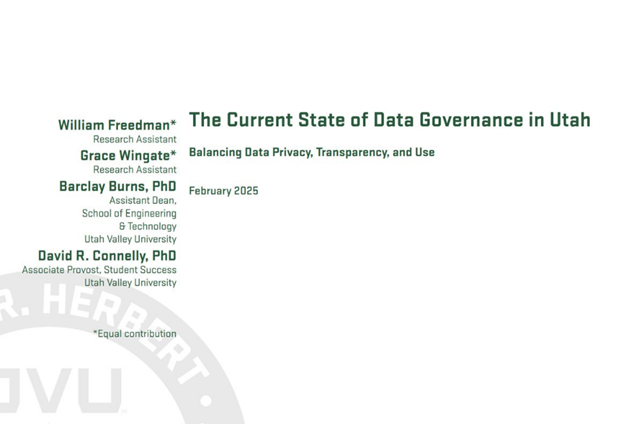
2/ Cox’s Administration partnered up with Utah Valley University’s Gary R. Herbert Institute for Public Policy. UVU produced the foundational white paper “The Current State of Data Governance in Utah” that laid the groundwork for state digital ID.
The fruit of UVU's ongoing work with Utah's Office of Digital Privacy was SB275 (formerly SB260 of 2025)— the State-Endorsed Digital Identity Program — introduced in February of this year.
🔗uvu.edu/herbertinstitu…
3/ SB275 passed UNANIMOUSLY in both chambers of the Utah Legislature and is rolling out this month.
Utah is now officially the first state in the nation with a full-blown comprehensive digital ID framework.
🔗 le.utah.gov/~2026/bills/st…
4/ In the months leading up to Charlie Kirk’s assassination on the UVU campus, UVU hosted multiple SEDI townhalls across the state — Salt Lake County, Utah Valley, Northern Utah — pitching the program to the public.
🔗 uvu.edu/herbertinstitu…
5/ Just one month after Kirk's assassination, UVU hosted the first SEDI Summit.
National policymakers, tech execs, and privacy groups were brought in to shape the future of digital identity.
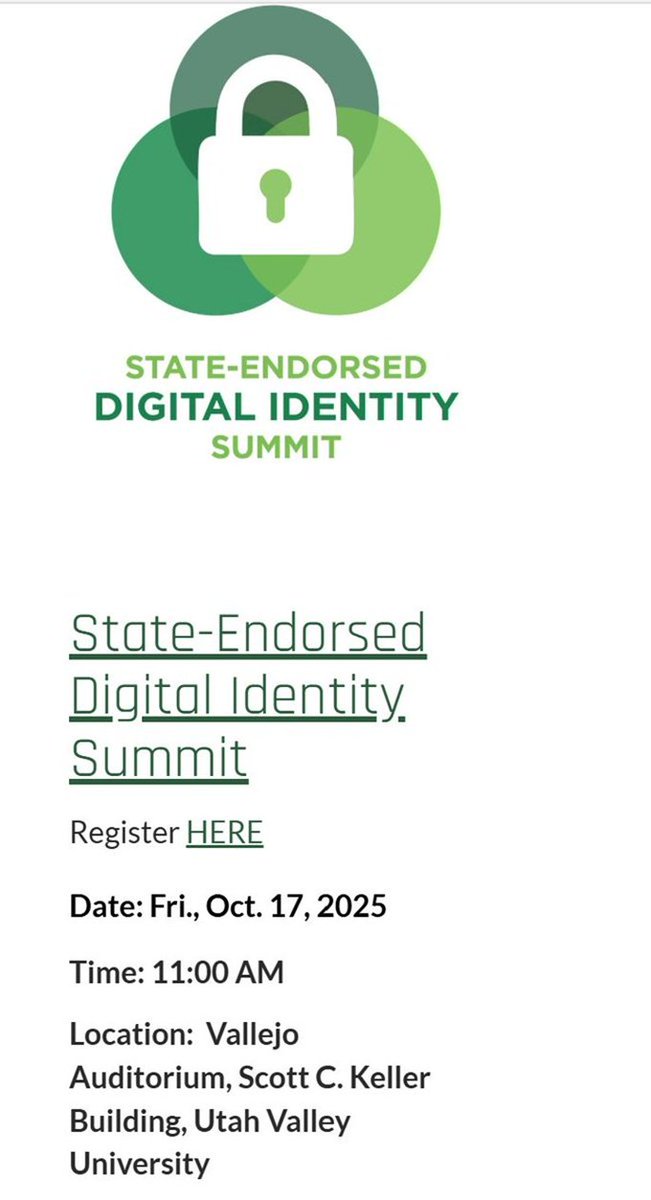
6/ In March of this year, Cox’s administration sent out invitations to state legislators across the entire country offering $1,000 stipends to attend their 2nd SEDI Summit at UVU last held last month.
(Utahans, how do you feel footing the bill for this?)
They’re actively recruiting other states to copy the model.
7/ What exactly is SEDI?
A unique global “decentralized” blockchain digital ID that you’ll eventually use to log into all your accounts, services, and government portals.
The state “endorses” it with a cryptographically signed credential, but you hold it in a digital wallet.
*Side note: Salt Lake based digital identity company, Anonyome Labs, is helping Utah roll out this digital ID program. JD Mumford, former IBM exec, is the current CEO and Todd Davis, founder of LifeLock (bought out by Symantec in 2017), and Greg Clark, former Symantec CEO, sit on the board.
No more passwords. Like the One Ring—it's One ID to rule them all.

8/ Of course, the digital ID program is starting out as “voluntary.”
But the stated long-term goal is a global digital identification system.
History speaks for itself. “Voluntary” programs have a way of becoming compulsory once the infrastructure is built and everyone is hooked.
Federal income taxes were once voluntary too.
9/ Utah's document “SEDI: Protecting Liberty in the Digital Age” is steeped in patriotic language — “digital export of freedom,” “anchoring technology in liberty and constitutional order,” “identity is inherently decentralized and innate to the individual.” It emphasizes “protecting children from digital exploitation” and preserving individual liberties.
This is classic framing: wrap surveillance infrastructure in freedom rhetoric and child-protection talk so both lawmakers and citizens embrace it and cheer it on.
"So this is how liberty dies... with thunderous applause."--Star Wars: Episode III - Revenge of the Sith
🔗privacy.utah.gov/wp-content/upl…
10/ Other states have already begun a soft launch of digital ID with voluntary mobile driver’s licenses (mDL).
Now that Utah has passed a full framework and is actively recruiting other states, expect copycat bills with identical “liberty-preserving” language to start popping up everywhere in the coming months. While no state has yet to introduce a similar comprehensive program, Idaho recently passed digital id legislation this year and cited Utah in their process.
Groups like the Council of State Governments and ACLU are, unsurprisingly, backing this effort.
🔗csgwest.org/2026/05/01/pro…
11/ This is not a Utah-only problem. It's THE national rollout model.
Stay alert to similar efforts in your state. Ask the hard questions. Share, share, share.
A global digital ID system sold as freedom is still a global digital ID system.
@CourtenayTurner this one’s all you friend. Have at it.
• • •
Missing some Tweet in this thread? You can try to
force a refresh

@TheDignityIndex , a project of UNITE and Tim Shriver looking to ease divisions and prevent violence, is, in a few words, a social change experiment.
Quoted from the 2023 Utah Pilot Project Technical Summary, University of Utah President Taylor Randall says, "The Dignity Index relies on one of the most ancient tools for social change in the history of human beings--conscience. When we see how often we use contempt and how harmful it is, we see we're a part of the problem, and that makes us part of the solution."
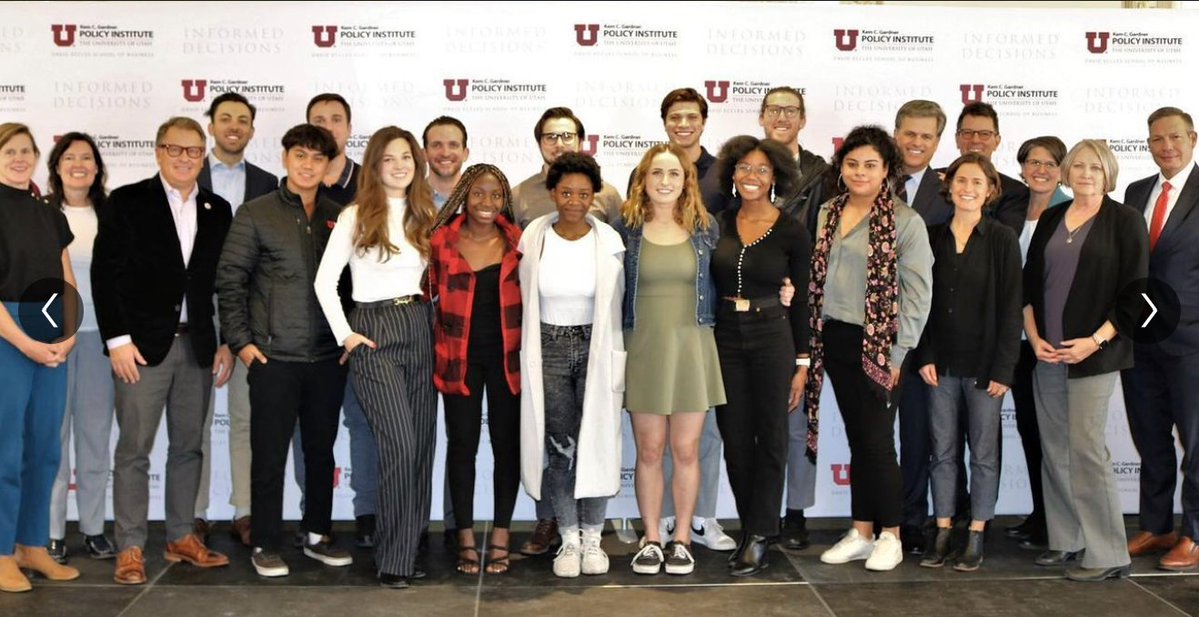
The Dignity Index partnered with University of Utah, Kem C. Gardener Policy Institute, David Eccles School of Business, and Hinckley Institute of Politics, claiming to have chosen students with politically and ideologically diverse backgrounds, to pilot a system where they would help determine a scoring mechanism for speech.
Turns out they are not so diverse after all. Rather it seems like these schools are serving as incubators to install radicalized students into various think tanks, nonprofits, and government positions across the country. 🧵
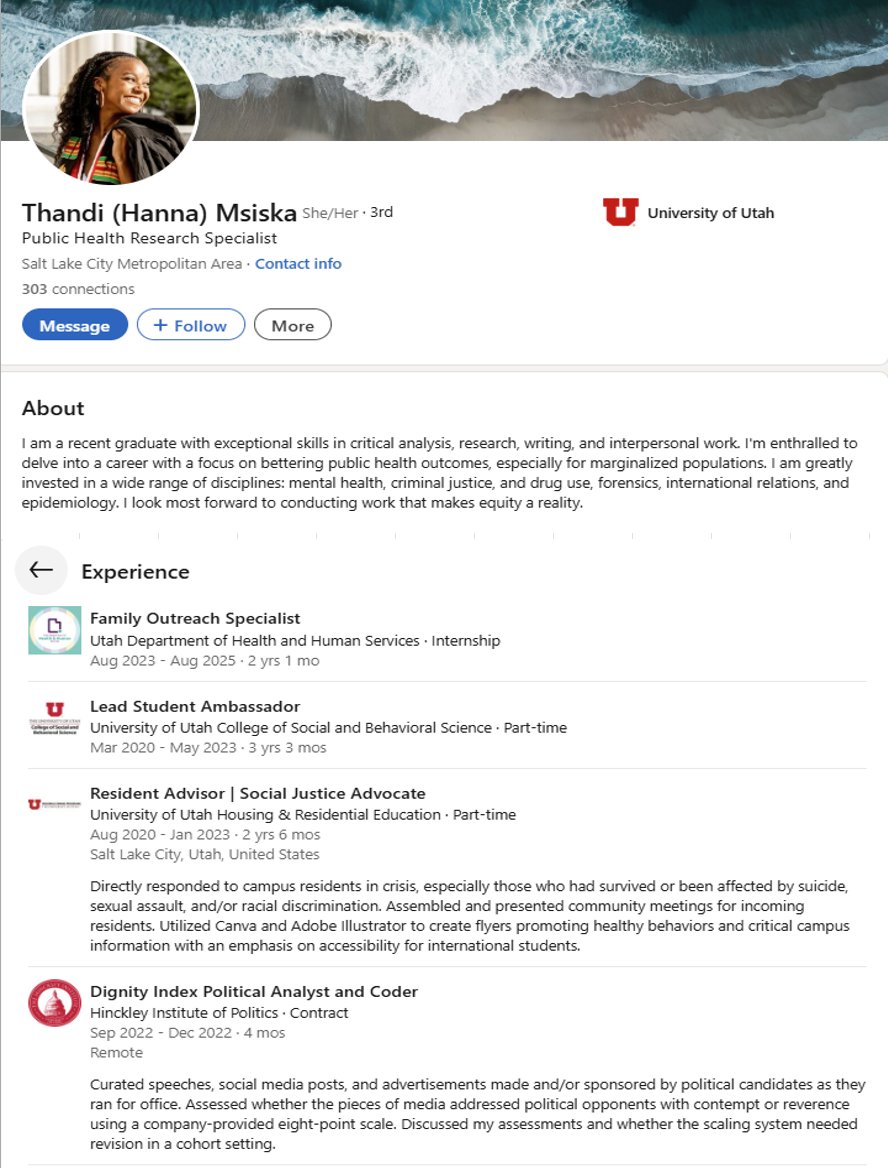
#1 Thandi (Hanna) Msiska
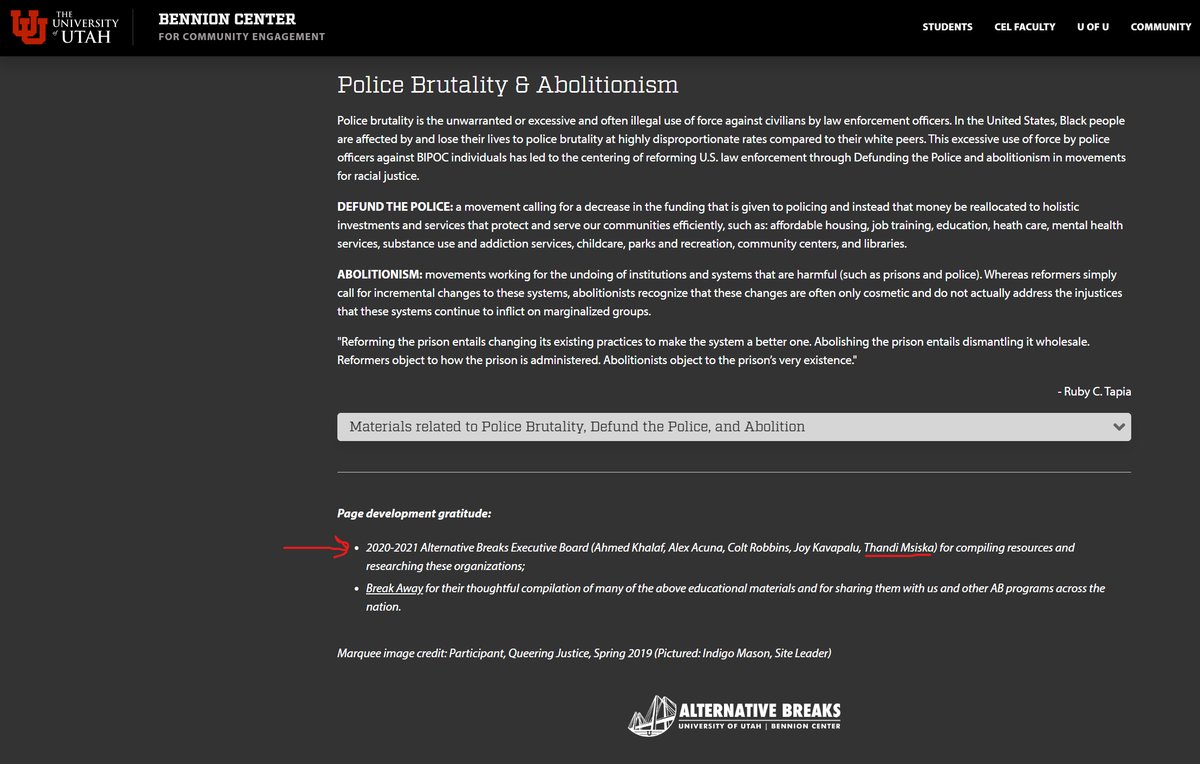
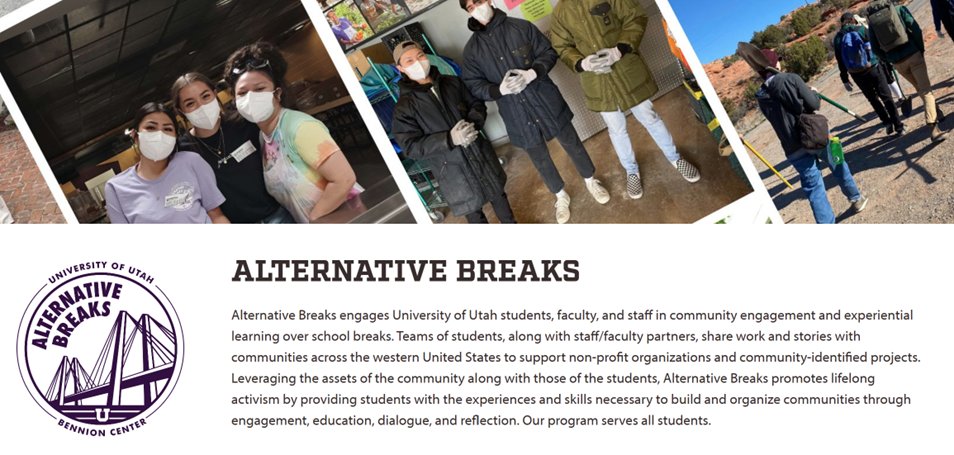
During her time at University of Utah, Thandi served on the executive board of Alternative Breaks, Bennion Center for Community Engagement.
Alternative Breaks promotes lifelong activism through its students at U of U.
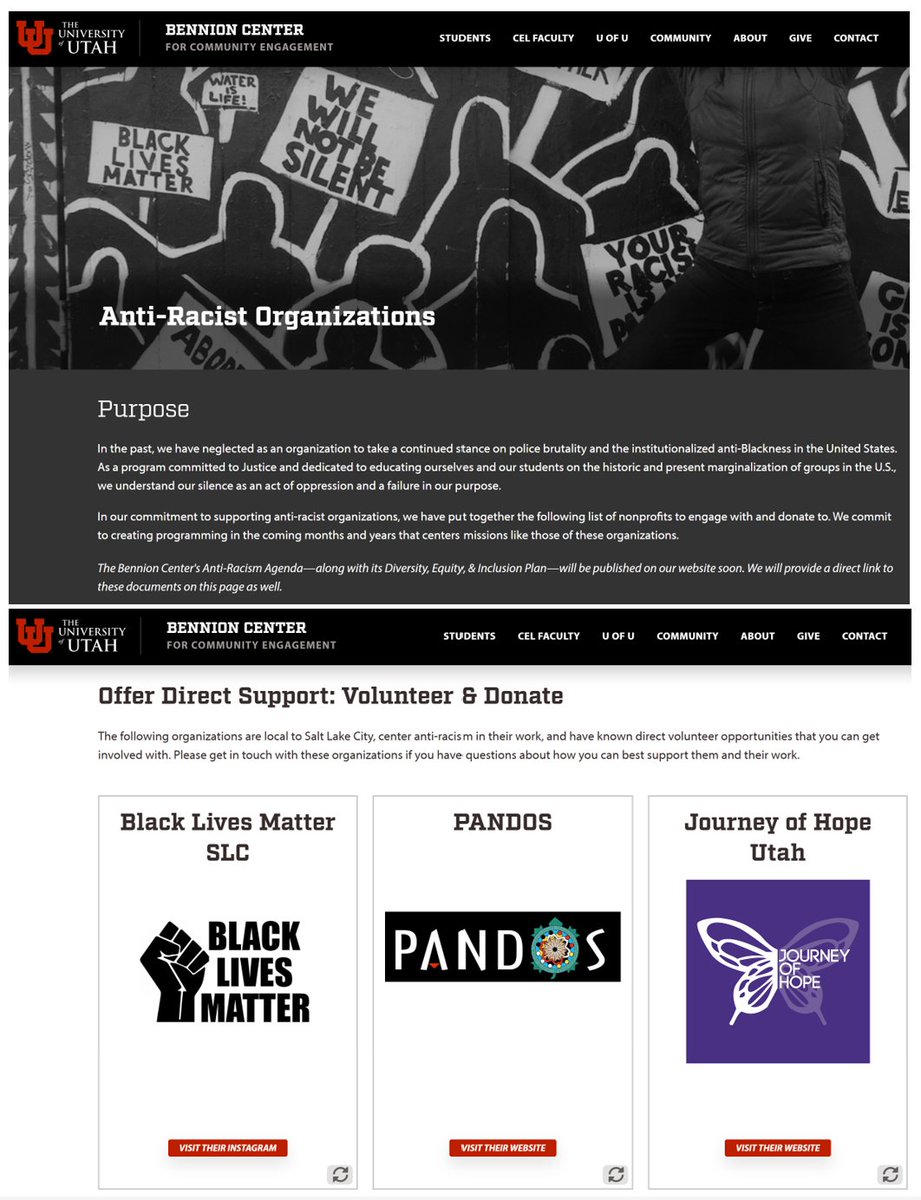
The Center's page states their negligence in taking a continued stance on police brutality and institutionalized anti-Blackness in the US, acknowledging their silence as an act of oppression and a failure in their purpose. They put together a list of nonprofits to engage with and donate to, including Black Lives Matter.
The Bennion Center at U of U has both an Anti-Racism Agenda and a Diversity, Equity, & Inclusion Plan.🧵
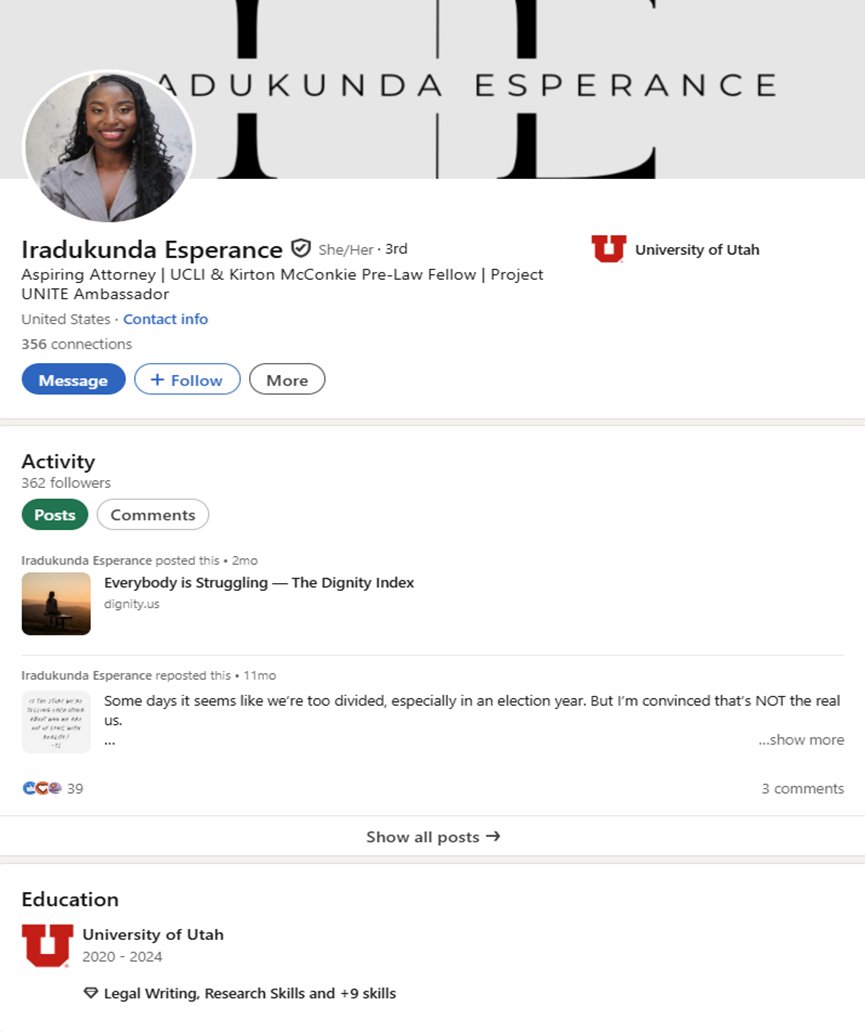
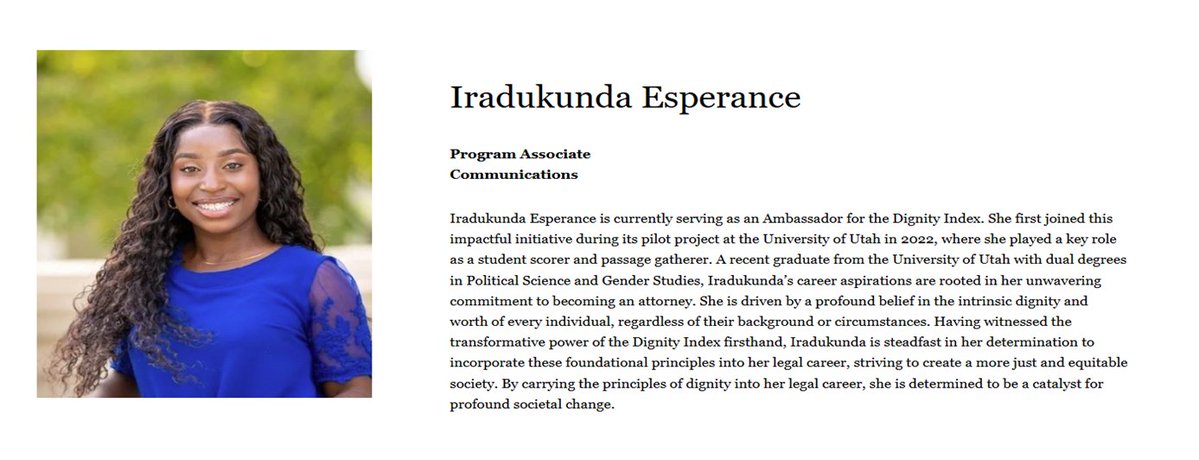
#2 Iradukunda Esperance
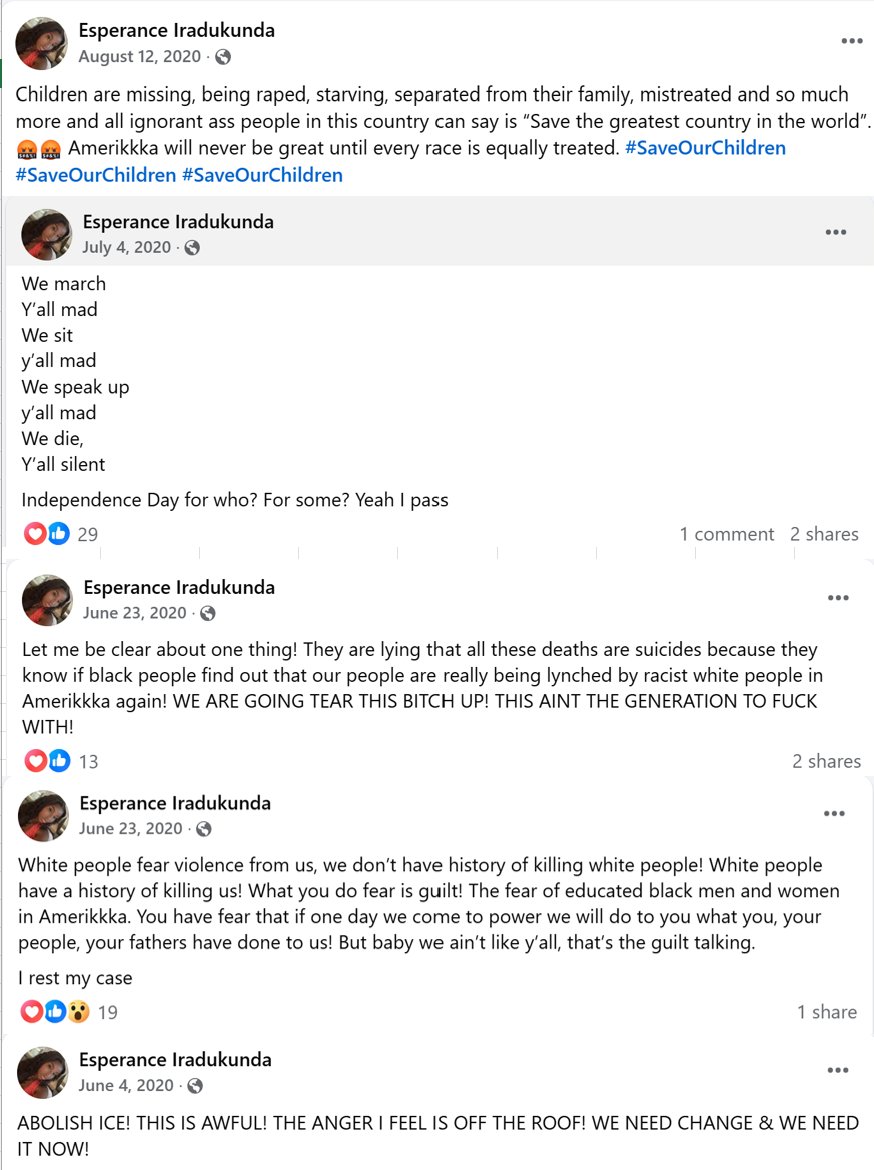
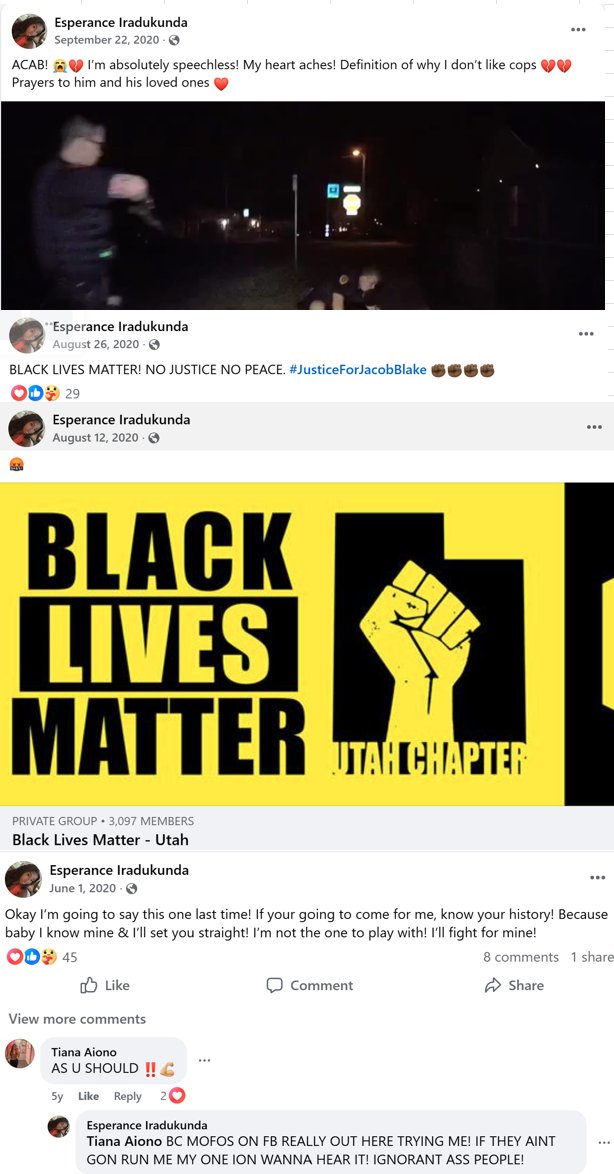
Iradukunda is a social justice activist with Black Lives Matter Utah and has quite the social media profile--from her dislike of the police and ICE to her racist and anti-America rhetoric and even, dare I say, contemptuous speech.
Did you know that, housed within the Department of Pathology at the University of Pittsburgh, is a Health Sciences Tissue Bank (HSTB)?
The HSTB collects fetal tissue, including fresh tissue samples from abortions performed at UPMC hospitals like Magee-Womens Hospital. The tissue obtained by HSTB from abortions ranges from 6 to 42 weeks (full-term) gestation. 🧵/
In 2021, in collaboration with the Center for Medical Progress, @JudicialWatch released an article detailing the nearly $3 million in federal funds spent on the University of Pittsburgh’s quest to become a “Tissue Hub." 🧵/ judicialwatch.org/hhs-documents-…
This followed a scientific study released in 2020 describing experiments conducted by the University of Pittsburgh to study human immune responses and skin infections. These experiments used full-thickness human fetal skin from aborted fetuses, grafted onto rodents to create "humanized" models. Pictures from the study show baby hair from the aborted fetuses, ranging from 18 to 20 weeks gestation, growing on the backs of rats. 🧵/ nature.com/articles/s4159…
I think I’ve heard about every excuse imaginable today as to why @Josh__Parsons lost the PA senate race. My favorites are “Republicans didn’t show up” and “Democrats beat ‘us’ at mail ballots, again.”
I’m a data gal, so let’s look at the actual data 📈
Total mail ballots returned: 12,589
Breakdown as follows:
🔴 R - 3,547
🔵 D - 8,869
⚫️ Other - 173
Amazingly, no provisionals or write-ins.
Yet, the breakdown by party registration for each of those returned ballots is as follows:
🔴 R - 4,290
🔵 D - 7,033
⚫️ Other - 1,270
What does this mean? 17% of all Republicans that returned a mail ballot had to vote for the Democrat.
When you factor in third party registrations, that number jumps to a whopping 33%.
In other words, A THIRD of all 🔴 & ⚫️ jumped ship from their party for the Democrat candidate.
Of course Shapiro would have you believe that is entirely logical. The Republican candidate is too ‘extreme’, he says. That narrative is becoming all too tired & repetitive.
The list of cancelled mail ballots tells an even more interesting tale for me.
Bottom line:
NO—Republicans did, in fact, sufficiently turn out in line with historic trends.
NO—Republicans did not lose to Democrat mail ballots. Republicans flipped. Third party voters flipped. The margin of votes by Republican voters was MORE than enough for Parsons to win handedly.
Now ask yourself why that is. Was the Democrat candidate just that appealing in a ruby red, ultra conservative district that hasn’t had a Democrat senator for well over 100 years? The same district that Trump took mere months ago by 15 points? With Rasmussen reporting a 26% approval rating for the Democrat Party nationwide?
Be careful who you listen to.
🔔 UPDATE 🔔
PA Senate District 36 “Historic Upset”, Part 2:
Another popular excuse I hear for this loss that has really taken off within party circles is that Parsons “was just not a good candidate” or he was too dull/unexciting/unliked” that people just didn’t show up for him.
For those that may not be familiar with Lancaster County or its electeds, Parsons was not some largely unknown candidate like his counterpart. Now serving in his third term as Lancaster County Commissioner, he was the county’s Clerk of Courts and also the Assistant DA prior.
So naturally, to quench my curiosity, I had to run a trend analysis comparing the 120 precincts in the 36th senate district to prior elections to see if there was any truth to this new narrative making its rounds.
Parsons was first elected in 2015. In PA, many counties have 3 county commissioners—2 from the majority party and 1 from the minority party to maintain balance in local governance. Parsons outperformed the Dem candidate by nearly 20 points in 2015, but, being a new candidate for this office, did not do as well as the returning Republican candidate Dennis Stuckey. Each election thereafter, his vote count in the district grew, as the highest vote-getter receiving more votes than both the Democrat candidate(s) as well as his Republican running mate:
🔴 2015 - 21,054
🔴 2019 - 28,763
🔴 2023 - 37,075
Does this data trend correlate with someone who is unpopular, unknown, or disliked?
And, as I pointed out in the earlier post, it is not true that the candidate was so dull that voters didn’t turn out for him. A 29% turnout is on trend with prior “off year” elections, even performing better than expected for a special election with a higher turnout rate in this district than his 2019 election, or even the 2021 Supreme Court race that saw substantially large sums of money dumped into the race to get Kevin Brobson elected.
In the same way, we reject Comrade Shapiro’s assertion that Parsons was too radical/extreme. He used this same narrative with Mastriano and later, Trump. Following Mastriano’s loss in 2022, of which Shapiro credited to his extremism, Parsons went on to secure a 2023 re-election win with more votes than any other candidate and the most votes he had received ever. Of course, Trump then easily won Lancaster in 2024. Doesn’t exactly align with the story he’s trying to sell, does it?
We can consider these claims debunked.
Now, looking at anomalous trends, I’d pay particular attention to these areas:
While relatively small, the wards of Columbia Boro, which had been making Republican gains for Parsons each election, made a hard pivot to Democrat this year.
Other precincts in need of special attention are parts of Elizabethtown Boro, parts of Rapho Twp, parts of Mount Joy Twp, Lititz Boro (particularly 1st ward 2nd precinct), Marietta Boro 2nd district, New Holland Boro 3rd district, and Conoy Twp.
Given the turnout-to-bed ratio and the batch of related cancelled mail ballots, it would be worth looking into who was conducting mail ballot assistance at the Mt Hope Nazarene Retirement Community. I have my guesses.
Finally, @LancasterCounty really needs an update to their arcane election reporting system. The 2024 elections have not yet been uploaded, data fields are cut when archived, download options are nonexistent. I feel for those who do not regularly download election data because what you are offered by the county is lacking to say the least. Keep this in mind when conversations about ‘vexatious requesters’ come up. The solution to this almost always comes back to more needed government transparency, not more restrictions to public access.
Here’s a fun little chart showing the number of mail ballots returned to the county by voters that were registered as Democrat vs. the actual number of mail ballots that voted Democrat.
How about them gains? Amazing that nearly every single precinct in the district had Republican or third party voters vote for the Democrat candidate regardless of the widely variable demographic makeup of each precinct.
It’s a Christmas miracle come early for the Democrat senate candidate!
Who is Frank McCourt? Buyer beware. You’re going to want to keep reading to find out. 🧵1
@Breeauna9 @Andreafreedom76 @iamlisalogan @CourtenayTurner @LBelle355 @luce_lexi
Frank McCourt founded McCourt Global. The organization has a philanthropic current, with social impact mindfulness at their core. Common themes throughout this thread include a “common purpose/good” and “building a better…/a new way forward” with plenty of progressive keywords like “equity,” “safety,” “resilience,” and “democracy.” 🧵2
Frank McCourt recently wrote a book called “Our Biggest Fight” addressing what McCourt sees as the need for a new, better, healthier, more equitable internet due to its threat to democracy and youth mental health.
His book site displays shining recommendations from several well-known figureheads in the leftist world, including singer Bruce Springsteen and Darren Walker, President of the Ford Foundation.🧵3
While on the subject of DOJ STOP grants, let’s talk about the PASS survey and reporting required under this grant.
PASS or Pupil Attitudes to Self and School is an assessment tool designed to track students “feelings” or social and emotional well-being. One of the primary domains of the survey is SEL (social and emotional learning). 🧵1/
@kellyske @luce_lexi @5sweetharts_ @HideYourKids0 @ALegalProcess
The Pennsylvania Office for Safe Schools under the PA Dept of Ed (PDE) administers this as the PA School Climate Survey. SEL is one of the three domains central to the survey, given not just to students, but staff, parents and community members as well as part of the broader Whole-Child, Whole-School, Whole-Community model. This reflects the shift away from ACADEMIC intelligence to EMOTIONAL intelligence. Schools are, of course, incentivized to participate through grant monies, with results shared between state and federal agencies and third-party orgs. 🧵2/
Another core focus of grant funding is Restorative Practices (RP). RP and SEL work hand-in-hand to create societal change through social consciousness and collectivism—core socialist principles. Children (and adults) are taught that systemic racial disparities exist in classrooms, where one race is disproportionally punished over another. In turn, RP works to eliminate punishment and produce equitable outcomes, instead bringing the offender and the ‘harmed’ together to repair harm through reconciliation. 🧵3/
One of the more shocking revelations I’ve had over the last few years is how inextricably linked our elections are to our education system via NGOs operating as the 4th branch of government.
We continue to peel back the layers here with a closer look at Tim Shriver’s organizations which directly link social and emotional learning and critical theory efforts in education to the push for ranked-choice voting and National Popular Vote in elections. 🧵1
Tim Shriver is the co-founder of three organizations responsible for major policy decisions in education, health, and elections. CASEL (Fetzer Institute) is arguably one of the largest organizations to help usher in social and emotional learning & CRT into both K-12 and higher Ed school systems. COVID Collaborative directed many Covid protocols implemented in the US. UNITE’s focus is to transform democracy.
Watch this video from fellow parent advocate @iamlisalogan for a foundational understanding of linkages. 🧵2 youtu.be/aDO4iSAibpk?si…
CASEL’s board not only includes Shriver, but several prominent members, some of which have been deeply involved in ushering in “evidence-based” mental health into schools since the 1980’s. While an entire thread could be done on their team members alone, the focus here is CASEL’s creation of their Collaborative States Initiative (Agreement).
The goal of CSI was to get SEL into all 50 states. 🧵3